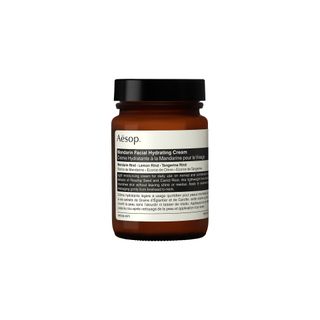
Aesop Mandarin Hydrating Cream
Works for
1 of 1 advertised claim delivered
Moisturizing12 ingredients credited for this claimGood support
“Mandarin Hydrating Cream”
This product can help improve hydration of the skin with the two types of ingredients.
The first type is called “humectants”:
these ingredients help attract water.
When humectants are on the surface of the skin, they “pull in” the moisture from the outside environment, or from
within deeper layers of the skin. The following ingredients in this product do the job:
glycerin, saccharide isomerate.
This product also contains ingredients called “occlusives”. They help reduce the speed with which our skin loses moisture to the outside environment. These ingredients also help soften the upper layer of the skin, so it feels less tight and nicer to the touch. The following ingredients in this product do the job: helianthus annuus seed oil, glycine soja oil.
Can it cause trouble?
Irritancy9 strong irritants: Citrus limon peel oil, Hamamelis virginiana water + 7 more — patch-test recommendedHigh risk
Comedogenic3 ingredients rated 2 or more on the 0–5 pore-clogging scale3 flagged
User reviews
Be the first — your take helps the next person decide.
Ingredients
Filter by role to see what each ingredient is doing.
Water~45–55%
Coco-caprylate/caprate~4.5–5.5%
- Irritation risk
- Low
Helps to soften the upper layer of the skin without creating a greasy texture
More about Coco-caprylate/caprateGlycerin~4–4.8%
- Irritation risk
- Low
One of the best moisturizing ingredients. Naturally present in skin. It attracts water to the upper layer of the skin working as a humectant
More about GlycerinCetearyl alcohol~2.6–3.2%
- Irritation risk
- Low
- Comedogenicity
- 2/5
A non-drying alcohol. Works as an emollient. Helps water and oil mix together and creates a nice product texture
More about Cetearyl alcoholBehenyl alcohol~2.5–3.1%
- Irritation risk
- Low
Non-drying alcohol that helps water and oil mix together. Also serves as an emollient
More about Behenyl alcoholPolyglyceryl-3 stearate~2–2.4%
- Irritation risk
- Low
Helps oil and water mix together
More about Polyglyceryl-3 stearateCorylus avellana seed oil~1.7–2%
- Irritation risk
- Low
Rosa canina seed extract~1.5–1.8%
- Irritation risk
- Low
Citrus limon peel oil~1.2–1.4%
Glyceryl stearate citrate~1–1.2%
- Irritation risk
- Low
Helps oil and water mix together while softening the upper layer of the skin
More about Glyceryl stearate citrateEuphorbia cerifera wax~0.9–1.15%
- Irritation risk
- Low
Saccharide isomerate~0.55–0.85%
- Irritation risk
- Low
Helps attract water to the upper layer of the skin
More about Saccharide isomerateHydroxyacetophenone~0.5–0.75%
Sesamum indicum seed oil~0.45–0.7%
- Irritation risk
- Low
A good moisturizing plant oil. Due to the high linoleic acid content, it helps soften the upper layer of the skin, reduce water loss and support skin barrier function
More about Sesamum indicum seed oilHamamelis virginiana water~0.35–0.6%
- Irritation risk
- High
A plant extract that can help calm down inflammation in skin. Can, however, itself be irritating
More about Hamamelis virginiana waterHelianthus annuus seed wax~0.45–0.65%
- Irritation risk
- Low
Helps soften the upper layer of the skin and support skin's barrier function while creating a thicker product consistency
More about Helianthus annuus seed waxTocopherol~0.35–0.65%
- Irritation risk
- Low
Pure form of vitamin E. Can help moisturise and protect the skin from free radicals. Often used to help stabilise other ingredients or the formula itself
More about TocopherolCitrus tangerina peel oil~0.3–0.55%
- Irritation risk
- High
Essential oil that can be irritating. Can lead to photosensitivity
More about Citrus tangerina peel oilSilica~0.45–0.65%
Microcrystalline cellulose~0.3–0.55%
Glycine soja oil~0.25–0.45%
- Irritation risk
- Medium
- Comedogenicity
- 2/5
A good emollient that helps soften the skin and helps repair its barrier function. It can clog pores if used in high concentrations.
More about Glycine soja oilXanthan gum~0.25–0.45%
- Irritation risk
- Low
Used to create a thicker product consistency
More about Xanthan gumGlyceryl caprate~0.25–0.45%
- Irritation risk
- Low
Benzyl alcohol~0.2–0.35%
- Irritation risk
- High
A preservative. Can be used to mask unpleasant smell. Can be irritating
More about Benzyl alcoholSodium dehydroacetate~0.2–0.4%
Triticum vulgare germ oil~0.25–0.45%
- Irritation risk
- Low
- Comedogenicity
- 3/5
A good emoillient. Contains vitamin E which can help neutralise free radicals, however the oil is unstable. Avoid if you have gluten or wheat sensitivity (including food allergies).
More about Triticum vulgare germ oilCitrus nobilis peel oil~0.2–0.35%
- Irritation risk
- High
A plant oil with high content of volatile compounds that, especially when exposed to air, can cause allergic reactions and irritate the skin
More about Citrus nobilis peel oilSodium gluconate~0.2–0.35%
Sodium citrate~0.2–0.35%
- Irritation risk
- Medium
Helps to control the skin's pH level. Maintains the skin's natural film of amino-lactic acids and oils. Helps to preserve products
More about Sodium citrateCitric acid~0.15–0.3%
- Irritation risk
- Medium
Can work as an exfoliant but is typically used to adjust the product pH
More about Citric acidCellulose gum~0.2–0.35%
- Irritation risk
- Low
Used to create thicker product consistency and stabilize emulsions
More about Cellulose gumAscorbyl palmitate~0.15–0.3%
- Irritation risk
- Medium
Being a lipid soluble form of vitamin C, it is more stable and can penetrate the skin better than L-Ascorbic acid. It is effective in protecting the skin from free radicals, as well as evening the skin tone, but is less effective in stimulating collagen production compared to L-Ascorbic acid.
More about Ascorbyl palmitateHelianthus annuus seed oil~0.2–0.4%
- Irritation risk
- Low
A great emollient due to its high linoleic acid content. One of the most effective plant oils in helping skin hydration and repairing skin barrier function
More about Helianthus annuus seed oilBenzoic acid~0.2–0.35%
Beta-carotene~0.2–0.35%
Daucus carota sativa root extract~0.2–0.35%
- Irritation risk
- Low
Carrot extract. Might have anti-oxidant properties and be used to add orange color
More about Daucus carota sativa root extractLimonene~0.15–0.25%
- Irritation risk
- High
A common frangrance that can easily irritate skin, especially if exposed to air, light or heat
More about LimoneneCitral~0.15–0.25%
Linalool~0.15–0.25%
Geraniol~0.1–0.25%
Citronellol~0.1–0.15%
Ingredient list view
Water, Coco-caprylate/caprate, Glycerin, Cetearyl alcohol, Behenyl alcohol, Polyglyceryl-3 stearate, Corylus avellana seed oil, Rosa canina seed extract, Citrus limon peel oil, Glyceryl stearate citrate, Euphorbia cerifera wax, Saccharide isomerate, Hydroxyacetophenone, Sesamum indicum seed oil, Hamamelis virginiana water, Helianthus annuus seed wax, Tocopherol, Citrus tangerina peel oil, Silica, Microcrystalline cellulose, Glycine soja oil, Xanthan gum, Glyceryl caprate, Benzyl alcohol, Sodium dehydroacetate, Triticum vulgare germ oil, Citrus nobilis peel oil, Sodium gluconate, Sodium citrate, Citric acid, Cellulose gum, Ascorbyl palmitate, Helianthus annuus seed oil, Benzoic acid, Beta-carotene, Daucus carota sativa root extract, Limonene, Citral, Linalool, Geraniol, Citronellol
Compare prices
Retailers ranked by price — lowest first.

Sources cited in this review
Every concentration estimate and effectiveness label is anchored to one of these 17 studies and safety reviews.
- 1Safety Assessment of Alkyl Esters as Used in Cosmeticscir-safety.org
- 2
- 3
- 4Triglyceride composition of Sesamum indicum seed oilonlinelibrary.wiley.com
- 5
- 6

Affiliate links · As an Amazon Associate, WIMJ earns from qualifying purchases.