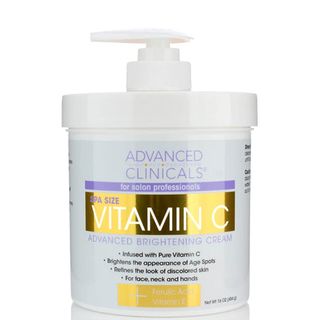
ADVANCED CLINICALS Vitamin C Cream

ADVANCED CLINICALS Vitamin C Cream

Efficacy83/100IrritancyMedium
Edit

Works for

3 of 3 advertised claims delivered

Moisturizing
Paraffinum liquidum, Caprylic/capric triglyceride + 10 more
Strong evidence
What the product description says
“This spa size brightening cream is formulated with the powerful ingredients, Vitamin E and Green Tea to soothe and nourish skin.”
Source: Advanced Clinicals

This product can help improve hydration of the skin with the two types of ingredients.

The first type is called “humectants”:
these ingredients help attract water. When humectants are on the surface of the skin, they “pull in” the moisture from the outside environment, or from within deeper layers of the skin. The following ingredients in this product do the job: glycerin, aloe barbadensis leaf juice.

This product also contains ingredients called “occlusives”. They help reduce the speed with which our skin loses moisture to the outside environment. These ingredients also help soften the upper layer of the skin, so it feels less tight and nicer to the touch. The following ingredients in this product do the job: caprylic/capric triglyceride, cocos nucifera oil.

The following ingredients in this product are especially good for supporting the skin barrier and helping with the hydration level: paraffinum liquidum

Paraffinum liquidumHero· Emollient, OcclusiveEffect: HighMineral oil. One of the most effective and well studied occlusive and emollient moisturizing ingredients. Helps reduce moisture loss in skin and repair skin barrier function~3.7–5.5%
Caprylic/capric triglycerideKey active· Emollient, OcclusiveEffect: HighA good mix of fatty acids that forms a protective layer on the skin. Improves the shelf life of products. Derived from coconut and glycerin~0.5–1.2%
Cocos nucifera oilKey active· Emollient, OcclusiveEffect: HighAn emollient. Found to be as effective as a moisturizer for dry skin as mineral oil. Could be comedogenic~1.7–2.6%
GlycerinKey active· HumectantEffect: HighOne of the best moisturizing ingredients. Naturally present in skin. It attracts water to the upper layer of the skin working as a humectant~1.3–2%
Isopropyl myristateKey active· EmollientEffect: HighAn emollient that helps soften the skin. Could be comedogenic~1.5–2.2%
Cetearyl alcoholKey active· EmollientEffect: MediumA non-drying alcohol. Works as an emollient. Helps water and oil mix together and creates a nice product texture~4.9–7.3%
Glyceryl stearate seKey activeEffect: MediumUsed to stabilize the product formulations and works as an emollient~2.4–3.6%
Butylene glycol· HumectantEffect: LowUsed to create a nice product texture and help delivery of other ingredients. Might be somewhat helpful in attracting water to the upper layer of the skin~1–1.5%
Aloe barbadensis leaf juice· HumectantEffect: LowTraditionally used to treat sunburns, dermatitis and inflammation, but evidence for its effectiveness is lacking. The extract can contain humectants that help attract water into the skin~2–3%
Ethylhexyl stearate· EmollientEffect: LowHelps soften the upper layer of the skin~0.15–0.5%
Caprylyl glycol· Humectant, EmollientEffect: LowHelps preserve products and creates a nice product texture~0.1–0.4%
Camellia sinensis leaf extractEffect: LowCan contain potent anti-oxidant compounds (abbreviated ECG, GCG, EGC, and EGCG) that might help protect the skin from free radicals. Can help calm down inflammation and has some anti-bacterial properties. Unfortunately, these antioxidants are unstable and lose their effectiveness very quickly in products. The concentration of the antioxidant compounds in the extract also tends to be low to be effective in topical formulation~0.15–0.6%
Anti-aging
Ferulic acid, Camellia sinensis leaf extract + 4 more
Moderate evidence
What the product description says
“Vitamin C is also great for scars, stretch marks, and sagging areas.”
Source: Advanced Clinicals

This product contains ferulic acid. This ingredient might be able to help reduce and prevent fine lines and wrinkles, improve skin elasticity and firmness, but there is not enough evidence that it actually works.

Ferulic acidKey activeEffect: MediumA potent anti-oxidant that has been shown to be effective in neutralizing free radicals in skin. There seem to have a synergetic effect of ferulic acid, vitamin E and C, meaning that when the ingredients are used together, they enhance each other's ability protect the skin against free radicals. Ferulic acid also helps to stabilize other ingredients - including vitamins C and E. It can help to even out the skin tone. Ferulic acid is approved for use as a sunscreen ingredient in Japan in concentrations up to 10%~0.15–0.5%
Camellia sinensis leaf extractEffect: LowCan contain potent anti-oxidant compounds (abbreviated ECG, GCG, EGC, and EGCG) that might help protect the skin from free radicals. Can help calm down inflammation and has some anti-bacterial properties. Unfortunately, these antioxidants are unstable and lose their effectiveness very quickly in products. The concentration of the antioxidant compounds in the extract also tends to be low to be effective in topical formulation~0.15–0.6%
Aloe barbadensis leaf juiceEffect: LowTraditionally used to treat sunburns, dermatitis and inflammation, but evidence for its effectiveness is lacking. The extract can contain humectants that help attract water into the skin~2–3%
Tetrahexyldecyl ascorbateUnder-dosedEffect: HighBeing a lipid soluble form of vitamin C, it is more stable than ascorbic acid, but still degrades quickly and needs to be stabilized in a formulation with another ingredient. It is claimed to penetrate skin better than pure vitamin C and have the the similar benefits, but solid studies of its effectiveness are lacking. Is likely to require a higher concentration in a product than pure vitamin C to be effective. It might be able to help reduce pore clogging.~0.15–0.7%
Ascorbic acidUnder-dosedEffect: HighThe most well-researched antioxidant that works in skin. Helps neutralize free radicals supporting collagen production, helping to even out the skin tone and preventing early signs of aging~0.15–0.5%
Aminopropyl ascorbyl phosphateUnder-dosedEffect: MediumA more stable but less potent derivative of vitamin C. It can help neautralize free radicals and even out the skin tone if used in high enough concentration (required levels are likely to be much higher than for pure vitamin C, and solid studies are lacking at the moment)~0.35–0.75%
Evens skin tone
Ferulic acid, Camellia sinensis leaf extract + 3 more
Moderate evidence
What the product description says
“This Vitamin C Body Cream, infused with Ferulic Acid, Vitamin E, and Coconut Oil, visibly brightens and improves the look of uneven skin tone, reducing the appearance of dark spots and dull, uneven-looking skin.”
Source: Advanced Clinicals

The following ingredient (ingredients) in this product might be helpful, but there is no evidence to confirm that it actually works: ferulic acid.

Ferulic acidKey activeEffect: MediumA potent anti-oxidant that has been shown to be effective in neutralizing free radicals in skin. There seem to have a synergetic effect of ferulic acid, vitamin E and C, meaning that when the ingredients are used together, they enhance each other's ability protect the skin against free radicals. Ferulic acid also helps to stabilize other ingredients - including vitamins C and E. It can help to even out the skin tone. Ferulic acid is approved for use as a sunscreen ingredient in Japan in concentrations up to 10%~0.15–0.5%
Camellia sinensis leaf extractEffect: LowCan contain potent anti-oxidant compounds (abbreviated ECG, GCG, EGC, and EGCG) that might help protect the skin from free radicals. Can help calm down inflammation and has some anti-bacterial properties. Unfortunately, these antioxidants are unstable and lose their effectiveness very quickly in products. The concentration of the antioxidant compounds in the extract also tends to be low to be effective in topical formulation~0.15–0.6%
Ascorbic acidUnder-dosedEffect: HighThe most well-researched antioxidant that works in skin. Helps neutralize free radicals supporting collagen production, helping to even out the skin tone and preventing early signs of aging~0.15–0.5%
Tetrahexyldecyl ascorbateUnder-dosedEffect: HighBeing a lipid soluble form of vitamin C, it is more stable than ascorbic acid, but still degrades quickly and needs to be stabilized in a formulation with another ingredient. It is claimed to penetrate skin better than pure vitamin C and have the the similar benefits, but solid studies of its effectiveness are lacking. Is likely to require a higher concentration in a product than pure vitamin C to be effective. It might be able to help reduce pore clogging.~0.15–0.7%
Aminopropyl ascorbyl phosphateUnder-dosedEffect: MediumA more stable but less potent derivative of vitamin C. It can help neautralize free radicals and even out the skin tone if used in high enough concentration (required levels are likely to be much higher than for pure vitamin C, and solid studies are lacking at the moment)~0.35–0.75%
Anti-oxidation
Not advertised by the brand · Ferulic acid, Camellia sinensis leaf extract + 4 more
Strong evidence

This product contains antioxidants (ferulic acid) that can help neutralize free radicals in skin. By doing so, they can lessen the damage the skin gets from the UV light (sun).

The following ingredients - camellia sinensis leaf extract also can have an antioxidant effect, but there is less evidence to confirm their effectiveness in skin.

Ferulic acidKey activeEffect: HighA potent anti-oxidant that has been shown to be effective in neutralizing free radicals in skin. There seem to have a synergetic effect of ferulic acid, vitamin E and C, meaning that when the ingredients are used together, they enhance each other's ability protect the skin against free radicals. Ferulic acid also helps to stabilize other ingredients - including vitamins C and E. It can help to even out the skin tone. Ferulic acid is approved for use as a sunscreen ingredient in Japan in concentrations up to 10%~0.15–0.5%
Camellia sinensis leaf extractKey activeEffect: MediumCan contain potent anti-oxidant compounds (abbreviated ECG, GCG, EGC, and EGCG) that might help protect the skin from free radicals. Can help calm down inflammation and has some anti-bacterial properties. Unfortunately, these antioxidants are unstable and lose their effectiveness very quickly in products. The concentration of the antioxidant compounds in the extract also tends to be low to be effective in topical formulation~0.15–0.6%
Ascorbic acidUnder-dosedEffect: HighThe most well-researched antioxidant that works in skin. Helps neutralize free radicals supporting collagen production, helping to even out the skin tone and preventing early signs of aging~0.15–0.5%
Tetrahexyldecyl ascorbateUnder-dosedEffect: HighBeing a lipid soluble form of vitamin C, it is more stable than ascorbic acid, but still degrades quickly and needs to be stabilized in a formulation with another ingredient. It is claimed to penetrate skin better than pure vitamin C and have the the similar benefits, but solid studies of its effectiveness are lacking. Is likely to require a higher concentration in a product than pure vitamin C to be effective. It might be able to help reduce pore clogging.~0.15–0.7%
Aminopropyl ascorbyl phosphateUnder-dosedEffect: MediumA more stable but less potent derivative of vitamin C. It can help neautralize free radicals and even out the skin tone if used in high enough concentration (required levels are likely to be much higher than for pure vitamin C, and solid studies are lacking at the moment)~0.35–0.75%
Tocopheryl acetateEffect: Low, below effective doseA more stable but less bio-available form of vitamin E compared to Tocopherol. Might help moisturize and protect the skin from free radicals, but mostly used in low concentrations to stabilize other ingredients.~0.15–0.6%

Can it cause trouble?

Irritancy
1 strong irritant: Parfum
Medium risk
We flagged 13 ingredients with irritancy potential. Severity depends on your sensitivity threshold; the table lists the worst offenders first.
IngredientFunctionIrritationEst. amount
Ascorbic acidThe most well-researched antioxidant that works in skin. Helps neutralize free radicals supporting collagen production, helping to even out the skin tone and preventing early signs of agingHigh~0.15–0.5%est.
ParfumAn aromatic blend of unspecified and possibly irritating ingredientsHigh~0.1–0.35%est.
Aloe barbadensis leaf juiceTraditionally used to treat sunburns, dermatitis and inflammation, but evidence for its effectiveness is lacking. The extract can contain humectants that help attract water into the skinMedium~2–3%est.
Ceteareth-20Helps oil and water mix together. Has some emollient propertiesMedium~0.85–1.25%est.
Caprylic/capric triglycerideA good mix of fatty acids that forms a protective layer on the skin. Improves the shelf life of products. Derived from coconut and glycerinMedium~0.5–1.2%est.
Aminopropyl ascorbyl phosphateA more stable but less potent derivative of vitamin C. It can help neautralize free radicals and even out the skin tone if used in high enough concentration (required levels are likely to be much higher than for pure vitamin C, and solid studies are lacking at the moment)Medium~0.35–0.75%est.
Tetrahexyldecyl ascorbateBeing a lipid soluble form of vitamin C, it is more stable than ascorbic acid, but still degrades quickly and needs to be stabilized in a formulation with another ingredient. It is claimed to penetrate skin better than pure vitamin C and have the the similar benefits, but solid studies of its effectiveness are lacking. Is likely to require a higher concentration in a product than pure vitamin C to be effective. It might be able to help reduce pore clogging.Medium~0.15–0.7%est.
Tocopheryl acetateA more stable but less bio-available form of vitamin E compared to Tocopherol. Might help moisturize and protect the skin from free radicals, but mostly used in low concentrations to stabilize other ingredients.Medium~0.15–0.6%est.
Disodium edtaStabilizes the product formulationMedium~0.1–0.5%est.
Acrylates/c10-30 alkyl acrylate crosspolymerMaintains the texture of skincare products. Allows the product to spread evenly. Helps oil and water mix togetherMedium~0.1–0.45%est.
Caprylyl glycolHelps preserve products and creates a nice product textureMedium~0.1–0.4%est.
EthylhexylglycerinA preservativeMedium~0.05–0.25%est.
Hexylene glycolHelps create a more spreadable product textureMedium~0.05–0.2%est.
Comedogenic
5 ingredients rated 2 or more on the 0–5 pore-clogging scale
5 flagged
These ingredients have a comedogenic rating of 2 or more on a 0–5 scale; the table shows each one's rating. In leave-on products they can clog pores in acne-prone skin.
IngredientFunctionRatingEst. amount
Cocos nucifera oilAn emollient. Found to be as effective as a moisturizer for dry skin as mineral oil. Could be comedogenic3/5~1.7–2.6%est.
Isopropyl myristateAn emollient that helps soften the skin. Could be comedogenic3/5~1.5–2.2%est.
Cetearyl alcoholA non-drying alcohol. Works as an emollient. Helps water and oil mix together and creates a nice product texture2/5~4.9–7.3%est.
Glyceryl stearate seUsed to stabilize the product formulations and works as an emollient2/5~2.4–3.6%est.
Ceteareth-20Helps oil and water mix together. Has some emollient properties2/5~0.85–1.25%est.
Edit

User reviews

Would you recommend?
No community reviews yet.

Be the first — your take helps the next person decide.

Write a review · ~30s

Ingredients

Filter by role to see what each ingredient is doing.

Water~40–60%
Formula
Irritation risk
Low

Plain old water

More about Water
Cetearyl alcohol~4.9–7.3%
Key activeComedogenic 2/5
Irritation risk
Low
Comedogenicity
2/5
Works for
CleansingMoisturizing

A non-drying alcohol. Works as an emollient. Helps water and oil mix together and creates a nice product texture

More about Cetearyl alcohol
Paraffinum liquidum~3.7–5.5%
Hero · Moisturizing
Irritation risk
Low
Works for
Moisturizing

Mineral oil. One of the most effective and well studied occlusive and emollient moisturizing ingredients. Helps reduce moisture loss in skin and repair skin barrier function

More about Paraffinum liquidum
Glyceryl stearate se~2.4–3.6%
Key activeComedogenic 2/5
Irritation risk
Low
Comedogenicity
2/5
Works for
CleansingMoisturizing

Used to stabilize the product formulations and works as an emollient

More about Glyceryl stearate se
Aloe barbadensis leaf juice~2–3%
Irritant · medium
Irritation risk
Medium
Works for
MoisturizingAnti-inflammatoryReduces irritationReduces rednessAntibacterialAnti-agingAnti-blemish

Traditionally used to treat sunburns, dermatitis and inflammation, but evidence for its effectiveness is lacking. The extract can contain humectants that help attract water into the skin

More about Aloe barbadensis leaf juice
Cocos nucifera oil~1.7–2.6%
Key activeComedogenic 3/5
Irritation risk
Low
Comedogenicity
3/5
Works for
Moisturizing

An emollient. Found to be as effective as a moisturizer for dry skin as mineral oil. Could be comedogenic

More about Cocos nucifera oil
Isopropyl myristate~1.5–2.2%
Key activeComedogenic 3/5
Irritation risk
Low
Comedogenicity
3/5
Works for
Moisturizing

An emollient that helps soften the skin. Could be comedogenic

More about Isopropyl myristate
Glycerin~1.3–2%
Key active
Irritation risk
Low
Works for
Moisturizing

One of the best moisturizing ingredients. Naturally present in skin. It attracts water to the upper layer of the skin working as a humectant

More about Glycerin
Butylene glycol~1–1.5%
Formula
Irritation risk
Low
Works for
Moisturizing

Used to create a nice product texture and help delivery of other ingredients. Might be somewhat helpful in attracting water to the upper layer of the skin

More about Butylene glycol
Ceteareth-20~0.85–1.25%
Comedogenic 2/5Irritant · medium
Irritation risk
Medium
Comedogenicity
2/5
Works for
Cleansing

Helps oil and water mix together. Has some emollient properties

More about Ceteareth-20
Caprylic/capric triglyceride~0.5–1.2%
Key activeIrritant · medium
Irritation risk
Medium
Works for
Moisturizing

A good mix of fatty acids that forms a protective layer on the skin. Improves the shelf life of products. Derived from coconut and glycerin

More about Caprylic/capric triglyceride
Aminopropyl ascorbyl phosphate~0.35–0.75%
Under-dosedIrritant · medium
Irritation risk
Medium
Works for
Anti-agingEvens skin toneAnti-oxidation

A more stable but less potent derivative of vitamin C. It can help neautralize free radicals and even out the skin tone if used in high enough concentration (required levels are likely to be much higher than for pure vitamin C, and solid studies are lacking at the moment)

More about Aminopropyl ascorbyl phosphate
Tetrahexyldecyl ascorbate~0.15–0.7%
Under-dosedIrritant · medium
Irritation risk
Medium
Works for
Anti-oxidationAnti-agingEvens skin tone

Being a lipid soluble form of vitamin C, it is more stable than ascorbic acid, but still degrades quickly and needs to be stabilized in a formulation with another ingredient. It is claimed to penetrate skin better than pure vitamin C and have the the similar benefits, but solid studies of its effectiveness are lacking. Is likely to require a higher concentration in a product than pure vitamin C to be effective. It might be able to help reduce pore clogging.

More about Tetrahexyldecyl ascorbate
Tocopheryl acetate~0.15–0.6%
Irritant · medium
Irritation risk
Medium
Works for
Anti-oxidation

A more stable but less bio-available form of vitamin E compared to Tocopherol. Might help moisturize and protect the skin from free radicals, but mostly used in low concentrations to stabilize other ingredients.

More about Tocopheryl acetate
Camellia sinensis leaf extract~0.15–0.6%
Key active
Irritation risk
Low
Works for
Anti-oxidationAntibacterialAnti-agingAnti-blemishEvens skin toneMoisturizing

Can contain potent anti-oxidant compounds (abbreviated ECG, GCG, EGC, and EGCG) that might help protect the skin from free radicals. Can help calm down inflammation and has some anti-bacterial properties. Unfortunately, these antioxidants are unstable and lose their effectiveness very quickly in products. The concentration of the antioxidant compounds in the extract also tends to be low to be effective in topical formulation

More about Camellia sinensis leaf extract
Disodium edta~0.1–0.5%
Irritant · medium
Irritation risk
Medium

Stabilizes the product formulation

More about Disodium edta
Ascorbic acid~0.15–0.5%
Under-dosedIrritant · high
Irritation risk
High
Works for
Anti-agingEvens skin toneAnti-oxidation

The most well-researched antioxidant that works in skin. Helps neutralize free radicals supporting collagen production, helping to even out the skin tone and preventing early signs of aging

More about Ascorbic acid
Ferulic acid~0.15–0.5%
Key active
Irritation risk
Low
Works for
Anti-oxidationEvens skin toneAnti-inflammatoryAnti-aging

A potent anti-oxidant that has been shown to be effective in neutralizing free radicals in skin. There seem to have a synergetic effect of ferulic acid, vitamin E and C, meaning that when the ingredients are used together, they enhance each other's ability protect the skin against free radicals. Ferulic acid also helps to stabilize other ingredients - including vitamins C and E. It can help to even out the skin tone. Ferulic acid is approved for use as a sunscreen ingredient in Japan in concentrations up to 10%

More about Ferulic acid
Parfum~0.1–0.35%
Irritant · high
Irritation risk
High

An aromatic blend of unspecified and possibly irritating ingredients

More about Parfum
Acrylates/c10-30 alkyl acrylate crosspolymer~0.1–0.45%
Irritant · medium
Irritation risk
Medium

Maintains the texture of skincare products. Allows the product to spread evenly. Helps oil and water mix together

More about Acrylates/c10-30 alkyl acrylate crosspolymer
Sodium polyacrylate~0.15–0.55%
Formula
Irritation risk
Low
Works for
Mattifying

Used to create a gel-like product texture, as well as to stabilize emulsions

More about Sodium polyacrylate
Ethylhexyl stearate~0.15–0.5%
Formula
Irritation risk
Low
Works for
Moisturizing

Helps soften the upper layer of the skin

More about Ethylhexyl stearate
Trideceth-6~0.1–0.4%
Formula
Irritation risk
Low
Works for
Cleansing

Helps oil and water mix together

More about Trideceth-6
Phenoxyethanol~0.1–0.3%
Formula
Irritation risk
Low

A preservative. It helps prevent bacterial growth in cosmetic products

More about Phenoxyethanol
Caprylyl glycol~0.1–0.4%
Irritant · medium
Irritation risk
Medium
Works for
Moisturizing

Helps preserve products and creates a nice product texture

More about Caprylyl glycol
Ethylhexylglycerin~0.05–0.25%
Irritant · medium
Irritation risk
Medium

A preservative

More about Ethylhexylglycerin
Hexylene glycol~0.05–0.2%
Irritant · medium
Irritation risk
Medium
Works for
Cleansing

Helps create a more spreadable product texture

More about Hexylene glycol
Sodium hydroxide~0.05–0.15%
Formula
Irritation risk
Low

Used to adjust the product's pH

More about Sodium hydroxide
Ingredient list view

Water, Cetearyl alcohol, Paraffinum liquidum, Glyceryl stearate se, Aloe barbadensis leaf juice, Cocos nucifera oil, Isopropyl myristate, Glycerin, Butylene glycol, Ceteareth-20, Caprylic/capric triglyceride, Aminopropyl ascorbyl phosphate, Tetrahexyldecyl ascorbate, Tocopheryl acetate, Camellia sinensis leaf extract, Disodium edta, Ascorbic acid, Ferulic acid, Parfum, Acrylates/c10-30 alkyl acrylate crosspolymer, Sodium polyacrylate, Ethylhexyl stearate, Trideceth-6, Phenoxyethanol, Caprylyl glycol, Ethylhexylglycerin, Hexylene glycol, Sodium hydroxide

Compare prices

Retailers ranked by price — lowest first.

Advanced Clinicals
$4.99
Buy
Advanced Clinicals
$15.00
Buy
Amazon USPrice as of 10/22/2026 03:16 GMT
$16.99
Buy

Affiliate links · prices updated regularly · As an Amazon Associate, WIMJ earns from qualifying purchases.

Worth comparing, line by line.

Match % combines shared ingredients, the first five ingredients, shared actives and hero ingredients, irritancy (lower counts in the alternative's favour), texture and body area. Only products in the same routine step are compared.

Side-by-side comparison of this product against its closest alternatives
ADVANCED CLINICALSVitamin C CreamYOUR PRODUCTElastaliftHyaluronic Acid Face & Body Cream MoisturizerBiodermaAtoderm Nutritive
Match—53%50%
Price$4.99$15.99+$11.00$20.04+$15.05
Shared key ingredients—5 of 93 of 9
Key difference—Ceramide 2Cera Microcristallina
Irritancy Medium Medium Low
Drying alcohol———
View product Shop Shop
Cheaper alternatives? See how this stacks up against similar formulas.
We compare ingredient profiles across our catalog — pick the closest match for your budget.
Open dupe finder

Product summary

"ADVANCED CLINICALS - Vitamin C Cream" has a good moisturizing formula. To work well, any moisturizer needs to include a combination of water-binding and emollient ingredients. ADVANCED CLINICALS - Vitamin C Cream ticks this box. Glycerin, aloe barbadensis leaf juice, butylene glycol and caprylyl glycol in this product (humectants) attract water molecules to the upper layer of the skin (the water comes from the outside air or from the deeper layers of the skin if the air is dry). Emollients in this formulation (paraffinum liquidum, isopropyl myristate, cocos nucifera oil, cetearyl alcohol and caprylyl glycol) help to reduce the moisture loss from the skin. They also soften the skin surface and relieve the feeling of dryness and tightness.

Ingredient callouts

  • This product also contains Vitamin C (Ascorbic Acid). It can be an effective active for anti-aging and evening out the skin tone, but in this moisturizer it is used for stabilizing other ingredients in the formulation. In this concentration (0.15% - 0.50%) it cannot have a noticeable benefit for the skin.
This product contains ingredients that could be beneficial, but their concentrations are too low in this formulation: tetrahexyldecyl ascorbate and vitamin c

Irritation risk

This formulation includes some common irritants, including ingredients that do not provide a benefit for the skin. We assess the overall irritancy of this moisturizer to be medium. For a detailed overview of all potential irritants: click here

You can see the detailed formula review with the breakdown of all actives in the product and the full ingredient list with estimated concentrations in the tables below.

Price

The product retails at around 15.25$ in the United States, for 58.18A$ in Australia and for 17.72£ in the United Kingdom.

For a detailed price comparison: click here.

ADVANCED CLINICALS Vitamin C Cream
ADVANCED CLINICALSVitamin C Cream

Affiliate links · As an Amazon Associate, WIMJ earns from qualifying purchases.

As an Amazon Associate, WIMJ earns from qualifying purchases.