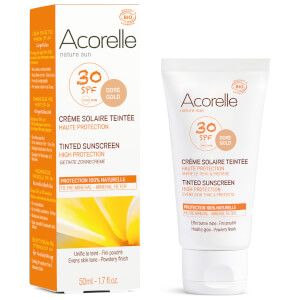
Acorelle Organic Tinted SPF30 Sunscreen - Gold
Works for
0 of 1 advertised claim delivered
Sun protectionSPF 30 · 1 UV filter · Partial spectrumWeak protection
This product does not offer good protection against UVA rays.
This product can be considered "reef safe" because it does not contain the UV filters (oxybenzone and octinoxate) that can be harmful to coral reefs when present in the water in high concentrations.
Anti-agingNot advertised by the brand · 2 ingredients credited for this claimModerate support
This product contains lysine. This ingredient might be able to help reduce and prevent fine lines and wrinkles, improve skin elasticity and firmness, but there is not enough evidence that it actually works. The biggest anti-aging effect in this product comes from sun protection. Sun damage is the main factor causing early signs of skin aging. We, however, do not recommend using this product as a sunscreen because the protection it offers is not strong enough).
MoisturizingNot advertised by the brand · 13 ingredients credited for this claimGood support
This product can help soften the skin and reduce its moisture loss with emollients and occlusives: cera alba, helianthus annuus seed oil.
Keep in mind that this product does not contain effective ingredients to attract water to the upper layer of the skin. This is why an additional product with humectants like glycerin or hyaluronic acid can be helpful (apply it before this product for the best results).
Can it cause trouble?
Irritancy1 strong irritant: Rosa damascena flower extractMedium risk
Comedogenic2 ingredients rated 2 or more on the 0–5 pore-clogging scale2 flagged
User reviews
Be the first — your take helps the next person decide.
Ingredients
Filter by role to see what each ingredient is doing.
Dicaprylyl carbonate~22–33%
- Irritation risk
- Low
Helps products spread more easily and works as an emollient to soften skin
More about Dicaprylyl carbonateTitanium dioxide~6.7–10%
- Irritation risk
- Low
Works as a UV filter when used in high concentrations. It is photostable and is effective mostly against the UVB light, with some protection in the UVA range. In small concentrations, used for its ability to improve the color of cosmetic products. Is usually well tolerated by the skin
More about Titanium dioxideRosa damascena flower extract~4.2–6.3%
Zea mays starch~3.5–5.2%
- Irritation risk
- Medium
- Comedogenicity
- 3/5
Used to thicken the product's consistency
More about Zea mays starchCera alba~3.1–4.6%
- Irritation risk
- Medium
Forms a protective barrier that holds water and keeps dry skin hydrated. Keeps an emulsion from separating into its oil and liquid components, and increases the thickness of a product. Can be an allergen
More about Cera albaPolyglyceryl-6 stearate~2.1–3.2%
- Irritation risk
- Low
Helps soften the upper layer of the skin
More about Polyglyceryl-6 stearateSorbitan isostearate~1.6–2.4%
- Irritation risk
- Low
Helps oil and water mix together
More about Sorbitan isostearatePolyglyceryl-3 polyricinoleate~1.3–2%
- Irritation risk
- Medium
Helps oil and water mix together
More about Polyglyceryl-3 polyricinoleateAluminum hydroxide~1.2–1.7%
- Irritation risk
- Low
Is used to add opaque (non-transparent) appearance to formulations. Can be used to coat other ingredients for even dispersion. This is a different ingredient compared to the ones used in antipersperants (aluminium chloride and aluminium chlorohydrate)
More about Aluminum hydroxideStearic acid~0.95–1.45%
- Irritation risk
- Low
Helps oil and water mix together and works as an emollient
More about Stearic acidPolyglyceryl-3 diisostearate~0.6–1.4%
- Irritation risk
- Medium
- Comedogenicity
- 3/5
Helps oil and water mix together
More about Polyglyceryl-3 diisostearateCoco-caprylate~0.55–1.3%
- Irritation risk
- Medium
An emollient that softens skin and creates a nice product texture
More about Coco-caprylateSorbitan caprylate~0.45–1.1%
- Irritation risk
- Medium
Helps oil and water mix together
More about Sorbitan caprylateBisabolol~0.4–0.95%
- Irritation risk
- Low
An active component of chamomile plant that historically has been used to calm down irritated skin. A recent study shows that bisabolol indeed can have some anti-inflammatory effect on skin, even though conclusive data is lacking. Bisabolol has a sweet floral scent and can be added to products for its aromatic properties
More about BisabololHelianthus annuus hybrid oil~0.45–1.1%
- Irritation risk
- Low
Helps soften the upper layer of the skin
More about Helianthus annuus hybrid oilPropolis extract~0.4–1%
- Irritation risk
- High
A complex substance produced by honey bees. Can have anti-bacterial and some anti-oxidant effect. Is an allergen and can be irritating
More about Propolis extractPongamia glabra seed oil~0.4–0.95%
- Irritation risk
- Low
A plant oil that helps soften the upper layer of the skin
More about Pongamia glabra seed oilHelianthus annuus seed oil~0.45–1%
- Irritation risk
- Low
A great emollient due to its high linoleic acid content. One of the most effective plant oils in helping skin hydration and repairing skin barrier function
More about Helianthus annuus seed oilArgania spinosa kernel oil~0.4–0.95%
- Irritation risk
- Medium
An emollient that helps soften the upper layer of the skin. Might have some weak anti-oxidant properties
More about Argania spinosa kernel oilOlea europaea fruit oil~0.4–0.9%
- Irritation risk
- Medium
An emollient that helps soften the skin but is not effective for restoring its barrier function. Might be helpful to calm down inflammation
More about Olea europaea fruit oilPollen extract~0.4–0.95%
- Irritation risk
- Low
Tocopherol~0.35–0.8%
- Irritation risk
- Low
Pure form of vitamin E. Can help moisturise and protect the skin from free radicals. Often used to help stabilise other ingredients or the formula itself
More about TocopherolWater~0.3–0.7%
Mica~0.35–0.75%
- Irritation risk
- Low
Creates an illusion of smoother and more radiant skin tone. Adds shimmer to the skin by reflecting light
More about MicaPolyglyceryl-6 behenate~0.2–0.8%
Sodium benzoate~0.25–0.5%
Potassium sorbate~0.3–0.6%
Polyepsilon-lysine~0.2–0.75%
- Irritation risk
- Low
Citric acid~0.2–0.7%
- Irritation risk
- Medium
Can work as an exfoliant but is typically used to adjust the product pH
More about Citric acidSodium lauroyl glutamate~0.15–0.7%
- Irritation risk
- Medium
Used as a cleansing agent. It creates foam
More about Sodium lauroyl glutamateLysine~0.1–0.5%
- Irritation risk
- Low
An amino-acid that helps to attract water to the upper layer of the skin. In combination with other amino-acids, might help to reduce fine lines and wrinkles
More about LysineMagnesium chloride~0.1–0.4%
Ci 77492~0.1–0.3%
Ci 77891~0.05–0.2%
- Irritation risk
- Low
Ci 77499~0.05–0.25%
Ci 77491~0.05–0.25%
- Irritation risk
- Low
A red colorant made of iron oxide. Typically is not irritating
More about Ci 77491Ingredient list view
Dicaprylyl carbonate, Titanium dioxide, Rosa damascena flower extract, Zea mays starch, Cera alba, Polyglyceryl-6 stearate, Sorbitan isostearate, Polyglyceryl-3 polyricinoleate, Aluminum hydroxide, Stearic acid, Polyglyceryl-3 diisostearate, Coco-caprylate, Sorbitan caprylate, Bisabolol, Helianthus annuus hybrid oil, Propolis extract, Pongamia glabra seed oil, Helianthus annuus seed oil, Argania spinosa kernel oil, Olea europaea fruit oil, Pollen extract, Tocopherol, Water, Mica, Polyglyceryl-6 behenate, Sodium benzoate, Potassium sorbate, Polyepsilon-lysine, Citric acid, Sodium lauroyl glutamate, Lysine, Magnesium chloride, Ci 77492, Ci 77891, Ci 77499, Ci 77491
Compare prices
Retailers ranked by price — lowest first.

.png)
Product summary
We do not recommend "Acorelle - Organic Tinted SPF30 Sunscreen - Gold" because it does not provide good UVA protection. UVA sun rays don't burn the skin, but they still lead to photoaging and hyperpigmentation.
Because it includes good moisturizing ingredients, it can also work as a hydrating day cream.
Sunscreen filters
This moisturizer is a mineral sunscreen. It uses titanium dioxide for sun protection. Titanium dioxide almost never irritates the skin or stings eyes, but it can leave a white cast.
Irritation risk
This formulation includes some common irritants, including ingredients that do not provide a benefit for the skin. We assess the overall irritancy of this moisturizer to be medium. For a detailed overview of all potential irritants: click here
You can see the detailed formula review with the breakdown of all actives in the product and the full ingredient list with estimated concentrations in the tables below.
Price
The product retails for 27.60$ in the United States, for 35.00CA$ in Canada and for 20.00£ in the United Kingdom.
For a detailed price comparison: click here.
Sources cited in this review
Every concentration estimate and effectiveness label is anchored to one of these 14 studies and safety reviews.
- 1
- 2
- 3
- 4
- 5
- 6

Affiliate links · As an Amazon Associate, WIMJ earns from qualifying purchases.