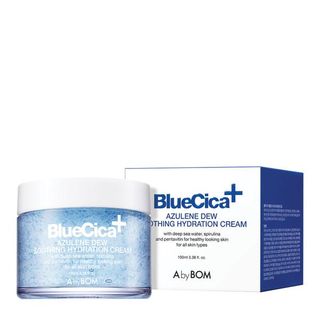
A. by BOM Blue Cica Azulene Dew Soothing Hydration Cream
Works for
1 of 1 advertised claim delivered
Moisturizing21 ingredients credited for this claimStrong support
“Blue Cica Azulene Dew Soothing Hydration Cream”
This product can help improve hydration of the skin with the two types of ingredients.
The first type is called “humectants”:
these ingredients help attract water.
When humectants are on the surface of the skin, they “pull in” the moisture from the outside environment, or from
within deeper layers of the skin. The following ingredients in this product do the job:
algae extract, anhydroxylitol.
This product also contains ingredients called “occlusives”. They help reduce the speed with which our skin loses moisture to the outside environment. These ingredients also help soften the upper layer of the skin, so it feels less tight and nicer to the touch. The following ingredients in this product do the job: caprylic/capric triglyceride, algae extract.
The following ingredients in this product are especially good for supporting the skin barrier and helping with the hydration level: ceramide np
Can it cause trouble?
Irritancy6 strong irritants: Hamamelis virginiana extract, Eclipta prostrata leaf extract + 4 more — patch-test recommendedHigh risk
Comedogenic3 ingredients rated 2 or more on the 0–5 pore-clogging scale3 flagged


User reviews
Be the first — your take helps the next person decide.
Ingredients
Filter by role to see what each ingredient is doing.
Water~45–55%
Glycerin~4.8–5.8%
- Irritation risk
- Low
One of the best moisturizing ingredients. Naturally present in skin. It attracts water to the upper layer of the skin working as a humectant
More about Glycerin1,2-hexanediol~1.9–2.3%
Caprylic/capric triglyceride~3.1–3.8%
- Irritation risk
- Medium
A good mix of fatty acids that forms a protective layer on the skin. Improves the shelf life of products. Derived from coconut and glycerin
More about Caprylic/capric triglycerideMethylpropanediol~2.3–2.9%
Hamamelis virginiana extract~1.9–2.3%
- Irritation risk
- High
A plant extract that can help calm down inflammation in skin. Can, however, itself be irritating
More about Hamamelis virginiana extractAlgae extract~1.8–2.1%
- Irritation risk
- Low
- Comedogenicity
- 3/5
Plant extract that helps the skin to attract water and make it more smooth for touch. Also shows promise of anti-aging properties, but research is not extensive yet
More about Algae extractEclipta prostrata leaf extract~1.5–1.8%
- Irritation risk
- High
A plant extract that is mostly used as a fragrance. Might have some anti-oxidant effect
More about Eclipta prostrata leaf extractCentella asiatica extract~1.1–1.3%
- Irritation risk
- Medium
A plant extract that has been shown to be able to reduce inflammation in skin, support restoration of skin barrier function, as well as support collagen production. Contains active compounds called centelloids: asiaticoside, madecasosside, asiatic acid and madecassic acid. Might be helpful in preventing stretch marks. It can be itself be irritating though.
More about Centella asiatica extractFicus carica fruit extract~1–1.2%
- Irritation risk
- Medium
A plant extract that can help neutralize free radicals. The concentrations typically used in cosmetics are too small to have an effect
More about Ficus carica fruit extractUlmus davidiana root extract~0.7–1.05%
- Irritation risk
- High
A plant root extract that helps attract water to the upper layer of the skin. It might have an anti-inflammatory effect and could help neturalize free radicals in skin
More about Ulmus davidiana root extractAmaranthus caudatus seed extract~0.6–0.85%
- Irritation risk
- Low
Melia azadirachta leaf extract~0.55–0.8%
- Irritation risk
- High
A plant extract that has anti-bacterial properties. Can be used to preserve the product. Can be irritating
More about Melia azadirachta leaf extractMelia azadirachta flower extract~0.5–0.75%
- Irritation risk
- Medium
A plant extract that might be helpful to neutralize free radicals in skin
More about Melia azadirachta flower extractCoccinia indica fruit extract~0.45–0.7%
- Irritation risk
- Medium
A plant extract that might have some anti-oxidant effect helping neutralize free radicals in skin
More about Coccinia indica fruit extractSolanum melongena fruit extract~0.45–0.65%
- Irritation risk
- Medium
Eggplant fruit extract. Might have some anti-oxidant effect
More about Solanum melongena fruit extractSpirulina platensis extract~0.45–0.65%
- Irritation risk
- Low
- Comedogenicity
- 3/5
An algae extract. Might help to attract water to the upper layer of the skin and have an anti-oxidant effect
More about Spirulina platensis extractAloe barbadensis flower extract~0.45–0.65%
- Irritation risk
- High
A plant extract that might have some anti-oxidant effect
More about Aloe barbadensis flower extractOcimum sanctum leaf extract~0.3–0.6%
- Irritation risk
- High
A plant extract that is rich in a fragrance compound eugenol that is a frequent allergen and can be irritating. It might also contain anti-oxidants to help neutralize free radicals
More about Ocimum sanctum leaf extractCurcuma longa root extract~0.3–0.55%
- Irritation risk
- High
A plant extract that can contain an active compound curcumin, that may have some anti-inflammatory properties when applied to the skin, but solid research is lacking and the typical concentration used in skincare products is too low. Can be an irritant
More about Curcuma longa root extractCorallina officinalis extract~0.3–0.55%
- Irritation risk
- Low
- Comedogenicity
- 3/5
Red algae extract that helps attract water to the upper layer of the skin and might contain antioxidants
More about Corallina officinalis extractChamomilla recutita extract~0.3–0.5%
- Irritation risk
- High
Plant extract that can have healing and anti-inflammatory properties. It is a potential allergen and can be irritating
More about Chamomilla recutita extractChrysanthemum parthenium extract~0.25–0.45%
- Irritation risk
- High
Could have anti-inflammatory effect on skin, but can be irritating as well. Can be added to products for its smell
More about Chrysanthemum parthenium extractHydrogenated lecithin~0.3–0.55%
- Irritation risk
- Low
Helps to retain moisture by creating a protective barrier on the skin. Rich in fatty acids. Improves product texture and helps with the penetration of other ingredients.
More about Hydrogenated lecithinSodium hyaluronate~0.25–0.5%
- Irritation risk
- Low
One of the best moisturizing ingredients. Attracts water into the upper layer of the skin
More about Sodium hyaluronateAcrylates/c10-30 alkyl acrylate crosspolymer~0.3–0.55%
- Irritation risk
- Medium
Maintains the texture of skincare products. Allows the product to spread evenly. Helps oil and water mix together
More about Acrylates/c10-30 alkyl acrylate crosspolymerGelatin~0.3–0.55%
Tromethamine~0.25–0.5%
Butylene glycol~0.25–0.5%
- Irritation risk
- Low
Used to create a nice product texture and help delivery of other ingredients. Might be somewhat helpful in attracting water to the upper layer of the skin
More about Butylene glycolXylitylglucoside~0.25–0.5%
- Irritation risk
- Low
Helps attract water to the upper layer of the skin and repair the skin barrier function
More about XylitylglucosideAnhydroxylitol~0.25–0.5%
- Irritation risk
- Low
Helps attract water to the upper layer of the skin and repair the skin barrir function
More about AnhydroxylitolSea water~0.25–0.5%
- Irritation risk
- Low
Dissolves other ingredients. It does not have additional skin benefits compared to plain water
More about Sea waterSodium polyacrylate starch~0.3–0.55%
- Irritation risk
- Low
Used to create a thicker product consistency
More about Sodium polyacrylate starchXylitol~0.25–0.5%
- Irritation risk
- Low
Helps attract water to the upper layer of the skin and repair the skin barrier function
More about XylitolCellulose gum~0.3–0.55%
- Irritation risk
- Low
Used to create thicker product consistency and stabilize emulsions
More about Cellulose gumFructooligosaccharides~0.25–0.5%
- Irritation risk
- Low
Help attract water to the upper layer of the skin
More about FructooligosaccharidesGlucose~0.25–0.5%
- Irritation risk
- Low
Helps attract water to the upper layer of the skin. Could be helpful in restoring the skin barrier function
More about GlucoseBeta-glucan~0.25–0.5%
- Irritation risk
- Low
Helps attract water to the upper layer of the skin, calm down inflammation and irritation, restore the barrier function and support wound healing. It can be helpful in reducing fine lines and wrinkles
More about Beta-glucanHydrolyzed hyaluronic acid~0.25–0.5%
- Irritation risk
- Low
One of the best moisturizing ingredients. Attracts water into the upper layer of the skin. A version of it is naturally present in skin
More about Hydrolyzed hyaluronic acidGuaiazulene~0.25–0.5%
- Irritation risk
- Low
A blue-colored ingredient that is traditionally used as a colorant. It has anti-inflammatory properties. For example, it is successfully used to treat diaper rash for new borns. It can help support the skin barrier by reducing inflammation
More about GuaiazuleneCeramide np~0.3–0.55%
- Irritation risk
- Low
A type of lipid similar to ceramides naturally present in skin. Helps to soften the upper layer of the skin and supports the skin barrier function to keep it hydrated. Can help to prevent inflammation in skin
More about Ceramide npSaccharide isomerate~0.25–0.45%
- Irritation risk
- Low
Helps attract water to the upper layer of the skin
More about Saccharide isomerateMagnesium aspartate~0.25–0.45%
- Irritation risk
- Low
Might be helpful in restoring skin barrier function and calm down inflammation in skin
More about Magnesium aspartateZinc gluconate~0.25–0.45%
- Irritation risk
- Medium
Typically used to stabilize the product formulations. It is a salt of a polyhydroxy acid (PHA) and in larger concentrations, can help shed the dead cells from the skin surface revealing smoother skin. It can help attract water to the upper layer of the skin. Might to be helpful against acne and clogged pores. Could be helpful in neutralizing free radicals, but solid research is missing. Due to the zinc content, might help calm down inflammation in skin
More about Zinc gluconateCopper gluconate~0.25–0.45%
- Irritation risk
- Medium
Typically used to stabilize the product formulations. It is a salt of polyhydroxy acid (PHA) and in larger concentrations, can help shed the dead cells from the skin surface revealing smoother skin. It can help attract water to the upper layer of the skin. Might to be helpful against acne and clogged pores. Could be helpful in neutralizing free radicals, but solid research is missing
More about Copper gluconatePeg-40 hydrogenated castor oil~0.25–0.5%
- Irritation risk
- Medium
Helps oil and water mix together
More about Peg-40 hydrogenated castor oilParfum~0.2–0.35%
- Irritation risk
- High
An aromatic blend of unspecified and possibly irritating ingredients
More about ParfumEthylhexylglycerin~0.2–0.35%
Dipropylene glycol~0.15–0.25%
- Irritation risk
- Low
Helps to dissolve other ingredients in a formulation. Slows down the rate of product drying
More about Dipropylene glycolAlcohol~0.15–0.3%
- Irritation risk
- High
Can be drying and contribute to skin irritation. Used in formulars to dissolve other ingredients, create a thinner product consistency or for its antibacterial properties
More about AlcoholSodium hydroxide~0.15–0.3%
Phenoxyethanol~0.15–0.3%
- Irritation risk
- Low
A preservative. It helps prevent bacterial growth in cosmetic products
More about PhenoxyethanolSodium citrate~0.05–0.15%
- Irritation risk
- Medium
Helps to control the skin's pH level. Maintains the skin's natural film of amino-lactic acids and oils. Helps to preserve products
More about Sodium citrateCitric acid~0.05–0.1%
- Irritation risk
- Medium
Can work as an exfoliant but is typically used to adjust the product pH
More about Citric acidIngredient list view
Water, Glycerin, 1,2-hexanediol, Caprylic/capric triglyceride, Methylpropanediol, Hamamelis virginiana extract, Algae extract, Eclipta prostrata leaf extract, Centella asiatica extract, Ficus carica fruit extract, Ulmus davidiana root extract, Amaranthus caudatus seed extract, Melia azadirachta leaf extract, Melia azadirachta flower extract, Coccinia indica fruit extract, Solanum melongena fruit extract, Spirulina platensis extract, Aloe barbadensis flower extract, Ocimum sanctum leaf extract, Curcuma longa root extract, Corallina officinalis extract, Chamomilla recutita extract, Chrysanthemum parthenium extract, Hydrogenated lecithin, Sodium hyaluronate, Acrylates/c10-30 alkyl acrylate crosspolymer, Gelatin, Tromethamine, Butylene glycol, Xylitylglucoside, Anhydroxylitol, Sea water, Sodium polyacrylate starch, Xylitol, Cellulose gum, Fructooligosaccharides, Glucose, Beta-glucan, Hydrolyzed hyaluronic acid, Guaiazulene, Ceramide np, Saccharide isomerate, Magnesium aspartate, Zinc gluconate, Copper gluconate, Peg-40 hydrogenated castor oil, Parfum, Ethylhexylglycerin, Dipropylene glycol, Alcohol, Sodium hydroxide, Phenoxyethanol, Sodium citrate, Citric acid
Compare prices
Retailers ranked by price — lowest first.
Worth comparing, line by line.
Match % combines shared ingredients, the first five ingredients, shared actives and hero ingredients, irritancy (lower counts in the alternative's favour), texture and body area. Only products in the same routine step are compared.
| A. by BOMBlue Cica Azulene Dew Soothing Hydration CreamYOUR PRODUCT | NEOGEN X SUR.MEDICSurmedic 24K Gold Caviar Repair Vital Cream | MEDI-PEELDerma Maison Time Wrinkle Perfect Cream | MEDIHEALBaobab Soothing Moisture Cream | |
|---|---|---|---|---|
| Match | — | 62% | 61% | 60% |
| Price | $40.80 | $39.59−$1.21 | $47.60+$6.80 | — |
| Shared key ingredients | — | 9 of 20 | 8 of 20 | 9 of 20 |
| Key difference | — | Copper Tripeptide-1 | Adenosine | Copper Tripeptide-1 |
| Irritancy | High | Medium | Medium | Medium |
| Drying alcohol | Contains drying alcohol | — | — | — |
| View product | Shop | Shop | Shop |


Product summary
"A. By BOM - Blue Cica Azulene Dew Soothing Hydration Cream" has a good moisturizing formula. The formulation is based on a combination of good humectants and emollients. Both are needed to increase the skin hydration level. Humectants in this product (algae extract, anhydroxylitol, fructooligosaccharides, glycerin and hydrolyzed hyaluronic acid) help to increase the water content in the upper layer of the skin. (These ingredients do so by "capturing" water molecules from the outside air or from within the deeper layers of the skin). Emollients in this formulation (ceramide np, algae extract and caprylic/capric triglyceride) help to reduce the moisture loss from the skin. They also soften the skin surface and relieve the feeling of dryness and tightness.
Ingredient callouts
- As a plus, this moisturizer also contains Ceramides (ceramide np 0.30% - 0.55%). Ceramides are a type of lipids that our skin produces itself. They are a building block of the skin's barrier. Ceramides used in skincare are synthetic or extracted from plants. They work well for softening the skin surface and "patch holes" in the skin's barrier.
Irritation risk
We assess the overall irritancy of this moisturizer to be high. For a detailed overview of all potential irritants: click here
You can see the detailed formula review with the breakdown of all actives in the product and the full ingredient list with estimated concentrations in the tables below.
Sources cited in this review
Every concentration estimate and effectiveness label is anchored to one of these 47 studies and safety reviews.
- 1
- 2
- 3
- 4
- 5
- 6

Affiliate links · As an Amazon Associate, WIMJ earns from qualifying purchases.