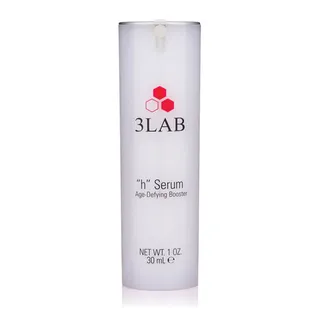
Works for
MoisturizingOligopeptide-4, Oligopeptide-5 + 15 moreWorks well
“Powerful antioxidants protect the skin against the most prevalent cause of wrinkles and natural degradation.”
This product can help improve hydration of the skin with the two types of ingredients.
The first type is called “humectants”:
these ingredients help attract water.
When humectants are on the surface of the skin, they “pull in” the moisture from the outside environment, or from
within deeper layers of the skin. The following ingredients in this product do the job:
anhydroxylitol, glycerin.
This product also contains ingredients called “occlusives”. They help reduce the speed with which our skin loses moisture to the outside environment. These ingredients also help soften the upper layer of the skin, so it feels less tight and nicer to the touch. The following ingredients in this product do the job: dimethicone, squalane.
The following ingredients in this product are especially good for supporting the skin barrier and helping with the hydration level: oligopeptide-4, oligopeptide-5
Anti-agingOligopeptide-4, Oligopeptide-5 + 2 moreMay help
“Reduces the appearance of lines and wrinkles.”
This product contains oligopeptide-4, oligopeptide-5. There is some human evidence that these ingredients help reduce and prevent fine lines and wrinkles and improve skin elasticity and firmness, though it is smaller or less consistent than the evidence for the best anti-aging ingredients.
ExfoliationNo ingredient credited for this claimNot delivered
“Expedites recovery from keratolytic abrasions affected by skin peeling treatments.”
This product does not contain effective exfoliating ingredients. It might be able to deliver physical exfoliation, that is scrub off some of the dead cells on the surface of the skin. We do not recommend physical exfoliation, because it is not uniform (some bits of skin can get exfoliated too much while others not at all). It can also traumatize the skin and aggrevate acne and other skin conditions.
Evens skin toneCamellia sinensis leaf extract, Phyllanthus emblica fruit extract + 1 moreNot delivered
“With a powerful, antioxidant formula, 3LAB h Serum delivers unprecedented effectiveness in reducing the skin degradation associated with wrinkles, loss of firmness and elasticity and uneven pigmentation.”
Effective ingredients missing or their concentration is too low
Anti-oxidationSide benefit · Camellia sinensis leaf extract, Ginkgo biloba leaf extract + 5 moreMay help
This product contains antioxidants (camellia sinensis leaf extract, ginkgo biloba leaf extract) that can help neutralize free radicals in skin to lessen the damage it gets from the UV light (sun). There is some human evidence for this effect in skin, though it is smaller or less consistent than the evidence for the best antioxidants.
Can it cause trouble?
Irritancy2 strong irritants: Sodium anisate, ParfumMedium risk
Comedogenic1 ingredient rated 2 or more on the 0–5 pore-clogging scale1 flagged
User reviews
Be the first — your take helps the next person decide.
Ingredients
Filter by role to see what each ingredient is doing.
Water~45–55%
Neopentyl glycol dicaprate~4.6–5.7%
- Irritation risk
- Low
Helps soften the upper layer of the skin
More about Neopentyl glycol dicaprateDimethyl isosorbide~4.2–5.2%
- Irritation risk
- Low
Used to dissolve other ingredients in a product and can enhance their ability to penetrate the skin
More about Dimethyl isosorbideButylene glycol~3.1–3.7%
- Irritation risk
- Low
Used to create a nice product texture and help delivery of other ingredients. Might be somewhat helpful in attracting water to the upper layer of the skin
More about Butylene glycolGlycerin~2.4–3%
- Irritation risk
- Low
One of the best moisturizing ingredients. Naturally present in skin. It attracts water to the upper layer of the skin working as a humectant
More about GlycerinOligopeptide-4~1.9–2.4%
- Irritation risk
- Low
A type of peptide. Peptides are excellent moisturizers and might be able support collagen production reducing fine lines and wrinkles
More about Oligopeptide-4C10-18 triglycerides~1.7–2.1%
- Irritation risk
- Low
Helps soften the skin and attract water to its upper layer. Helps create nice product texture
More about C10-18 triglyceridesC12-20 acid peg-8 ester~1.5–1.8%
- Irritation risk
- Medium
Helps oil and water mix together
More about C12-20 acid peg-8 esterOligopeptide-5~1.2–1.5%
- Irritation risk
- Low
A type of peptide. Peptides are excellent moisturizers and might be able support collagen production reducing fine lines and wrinkles
More about Oligopeptide-5Ppg-3 benzyl ether myristate~1.2–1.4%
- Irritation risk
- Low
Sodium hyaluronate~0.75–1.1%
- Irritation risk
- Low
One of the best moisturizing ingredients. Attracts water into the upper layer of the skin
More about Sodium hyaluronateDimethicone~0.7–1.05%
- Irritation risk
- Low
A silicone that helps to reduce water loss from the surface of the skin. Can temporarily "fill in" lines and wrinkles, absorb oil, and create a nice product finish
More about DimethiconeLecithin~0.6–0.9%
- Irritation risk
- Low
Used mostly for creating emulsions - helping oil and water mix together. Helps soften the upper layer of the skin
More about LecithinRh-polypeptide-7~0.55–0.85%
- Irritation risk
- Low
Phyllanthus emblica fruit extract~0.5–0.75%
- Irritation risk
- Medium
A plant extract that might be helpful in neutralizing free radicals and have a skin lightening effect if used in high enough concentrations
More about Phyllanthus emblica fruit extractHydrolyzed glycosaminoglycans~0.5–0.75%
- Irritation risk
- Low
Long sugars that help attract water to the upper layer of the skin
More about Hydrolyzed glycosaminoglycansBeta vulgaris root extract~0.5–0.7%
- Irritation risk
- Medium
A plant extract that might have some antioxidant properties, but mostly used in cosmetics for its color
More about Beta vulgaris root extractHaberlea rhodopensis leaf extract~0.45–0.65%
- Irritation risk
- Medium
A plant extract that if used in high concentration might help to neutralize free radicals in skin
More about Haberlea rhodopensis leaf extractYeast extract~0.4–0.65%
- Irritation risk
- Low
Helps attract water to the upper layer of the skin and might have some anti-oxidant and skin lightening properties. It can help calm down inflammation in skin
More about Yeast extractGinkgo biloba leaf extract~0.35–0.65%
- Irritation risk
- High
A plant extract that might help neutralize free radicals and reduce inflammation in skin. It can be irritating
More about Ginkgo biloba leaf extractCamellia sinensis leaf extract~0.4–0.6%
- Irritation risk
- Low
Can contain potent anti-oxidant compounds (abbreviated ECG, GCG, EGC, and EGCG) that might help protect the skin from free radicals. Can help calm down inflammation and has some anti-bacterial properties. Unfortunately, these antioxidants are unstable and lose their effectiveness very quickly in products. The concentration of the antioxidant compounds in the extract also tends to be low to be effective in topical formulation
More about Camellia sinensis leaf extractDiacetyl boldine~0.3–0.6%
- Irritation risk
- Low
Cetearyl alcohol~0.4–0.6%
- Irritation risk
- Low
- Comedogenicity
- 2/5
A non-drying alcohol. Works as an emollient. Helps water and oil mix together and creates a nice product texture
More about Cetearyl alcoholCetearyl glucoside~0.35–0.6%
- Irritation risk
- Medium
Helps water and oil in the product mix well together and improves product texture
More about Cetearyl glucosideOctyldodecyl behenate~0.35–0.65%
- Irritation risk
- Low
Tocopheryl acetate~0.3–0.6%
- Irritation risk
- Medium
A more stable but less bio-available form of vitamin E compared to Tocopherol. Might help moisturize and protect the skin from free radicals, but mostly used in low concentrations to stabilize other ingredients.
More about Tocopheryl acetatePolymethyl methacrylate~0.35–0.65%
- Irritation risk
- Low
Is used to enhance product texture and can help to optically mask skin imperfections
More about Polymethyl methacrylateXylitylglucoside~0.3–0.55%
- Irritation risk
- Low
Helps attract water to the upper layer of the skin and repair the skin barrier function
More about XylitylglucosideAnhydroxylitol~0.3–0.6%
- Irritation risk
- Low
Helps attract water to the upper layer of the skin and repair the skin barrir function
More about AnhydroxylitolXylitol~0.3–0.55%
- Irritation risk
- Low
Helps attract water to the upper layer of the skin and repair the skin barrier function
More about XylitolHydroxyethyl acrylate/sodium acryloyldimethyl taurate copolymer~0.3–0.6%
- Irritation risk
- Medium
A gelling agent that thickens the product consistency and leaves the skin with a velvety finish
More about Hydroxyethyl acrylate/sodium acryloyldimethyl taurate copolymerCaprylic/capric triglyceride~0.4–0.6%
- Irritation risk
- Medium
A good mix of fatty acids that forms a protective layer on the skin. Improves the shelf life of products. Derived from coconut and glycerin
More about Caprylic/capric triglycerideSqualane~0.35–0.65%
- Irritation risk
- Low
An oil naturally present in skin. Works as an emollient to soften the skin and form a protective layer on its surface without a greasy feeling.
More about SqualaneHydroxyethylcellulose~0.3–0.55%
- Irritation risk
- Low
Used to thicken product formulations and create gel-like textures
More about HydroxyethylcellulosePolysorbate 60~0.3–0.55%
Steareth-2~0.3–0.55%
Sodium phosphate~0.25–0.5%
Sodium chloride~0.25–0.5%
- Irritation risk
- Low
Used to stabilize mixtures of oil and water, and create thicker, gel-like product textures
More about Sodium chlorideEdta~0.2–0.4%
Sodium levulinate~0.2–0.35%
Sodium anisate~0.15–0.3%
Xanthan gum~0.15–0.3%
- Irritation risk
- Low
Used to create a thicker product consistency
More about Xanthan gumPropyl gallate~0.2–0.35%
- Irritation risk
- Medium
Helps preserve product formulations and can mask the smell of other ingredients in a product
More about Propyl gallateCitric acid~0.15–0.25%
- Irritation risk
- Medium
Can work as an exfoliant but is typically used to adjust the product pH
More about Citric acidDisodium edta~0.05–0.1%
Parfum~0.1–0.15%
- Irritation risk
- High
An aromatic blend of unspecified and possibly irritating ingredients
More about ParfumIngredient list view
Water, Neopentyl glycol dicaprate, Dimethyl isosorbide, Butylene glycol, Glycerin, Oligopeptide-4, C10-18 triglycerides, C12-20 acid peg-8 ester, Oligopeptide-5, Ppg-3 benzyl ether myristate, Sodium hyaluronate, Dimethicone, Lecithin, Rh-polypeptide-7, Phyllanthus emblica fruit extract, Hydrolyzed glycosaminoglycans, Beta vulgaris root extract, Haberlea rhodopensis leaf extract, Yeast extract, Ginkgo biloba leaf extract, Camellia sinensis leaf extract, Diacetyl boldine, Cetearyl alcohol, Cetearyl glucoside, Octyldodecyl behenate, Tocopheryl acetate, Polymethyl methacrylate, Xylitylglucoside, Anhydroxylitol, Xylitol, Hydroxyethyl acrylate/sodium acryloyldimethyl taurate copolymer, Caprylic/capric triglyceride, Squalane, Hydroxyethylcellulose, Polysorbate 60, Steareth-2, Sodium phosphate, Sodium chloride, Edta, Sodium levulinate, Sodium anisate, Xanthan gum, Propyl gallate, Citric acid, Disodium edta, Parfum
Compare prices
Retailers ranked by price — lowest first.
Worth comparing, line by line.
Match % combines shared ingredients, the first five ingredients, shared actives and hero ingredients, irritancy (lower counts in the alternative's favour), texture and body area. Only products in the same routine step are compared.
| 3LABh SerumYOUR PRODUCT | Pure & CareSerum Oil-Cocktail Night Repair- 1 pcs | IOMA1 Hydra Optimum Moisture Serum | NeutrogenaHydro Boost Hyaluronic Acid Concentrated Serum | |
|---|---|---|---|---|
| Match | — | 47% | 46% | 44% |
| Price | — | — | — | $12.54 |
| Shared key ingredients | — | 8 of 15 | 5 of 15 | 5 of 15 |
| Key difference | — | Oligopeptide-1 | — | Panthenol |
| Irritancy | Medium | Medium | Low | Low |
| Drying alcohol | — | — | — | — |
| View product | Shop | Shop | Shop |


More alternatives: Triple Hyaluronic Acid & Lipopeptide SerumNeolastin Face & Neck Regenerative Serum
Product summary
"3LAB - h Serum" is effective for: Moisturizing
This product could be helpful for: Anti-aging, but its actives are not the most effective or are not well-studied.
Ingredient callouts
- Peptides (oligopeptide-5 1.20% - 1.50% and oligopeptide-4 1.90% - 2.40%). Peptides are a very big group of ingredients. They all consist of a different combination of aminoacids. Our skin produces Peptides naturally. Some of them work as natural antibiotics, promote wound-healing and production of collagen. The scientists are still studying how effective the topical application of Peptides is, but it is very likely that theynare helpful. Peptides might be able to support skin barrier restoration and even have an anti-aging benefit. At the very least, they certainly help attract water to the skin and support the hydration in this way.
- Humectants (sodium hyaluronate 0.75% - 1.10%, hydrolyzed glycosaminoglycans 0.50% - 0.75%, anhydroxylitol 0.30% - 0.60%, xylitylglucoside 0.30% - 0.55% and glycerin 2.40% - 3.00%). These ingredients help attract water to the upper layer of the skin and improve the skin hydration.
Price
The product retails for 187.50$ in the United States, for 188.33£ in the United Kingdom and for 332.50CA$ in Canada.
For a detailed price comparison: click here.
Sources cited in this review
Every concentration estimate and effectiveness label is anchored to one of these 15 studies and safety reviews.
- 1
- 2
- 3Hyaluronic acid: A key molecule in skin agingncbi.nlm.nih.gov
- 4
- 5
- 6Final Report on the Safety Assessment of Dimethicone Copolyoljournals.sagepub.com

Affiliate links · As an Amazon Associate, WIMJ earns from qualifying purchases.