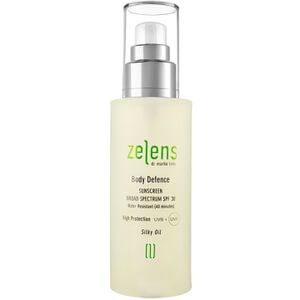
Zelens Body Defence Sunscreen SPF 30

Zelens Body Defence Sunscreen SPF 30

SPF 30Efficacy100/100IrritancyHigh·6 UV filters
Edit

Works for

3 of 3 advertised claims delivered

Sun protection
SPF 30 · 6 UV filters
Broad spectrum
SPF 30Broad spectrumChemical filtersWater-resistantNo white cast

This product offers a good level of protection against both UVB and UVA rays.

This sunscreen uses organic (so-called "chemical") sunscreen filters. Organic, or "chemical" filters usually provide reliable sun protection and rarely leave a white cast. Sunscreens with organic filters can sting eyes.

UV spectrum
UVB290–320 nmUVA II320–340 nmUVA I340–400 nm
Butyloctyl Salicylate
Octinoxate
Octisalate
Homosalate
Octocrylene
Avobenzone
FilterCoverageWhat it doesEst. amount
Butyloctyl SalicylateUVBA synthetic ester of salicylic acid that is used to help disperse pigments and boost effectiveness of sunscreen ingredients. It is able to absorb UV light (working as an organic, or chemical filter), but is not approved as a sunscreen ingredient on its own~4.6–6.9%
OctinoxateEthylhexyl MethoxycinnamateUVBOctinoxate. When used in higher concentrations, works as a sunscreen protecting the skin from UVB rays. When used in lower concentration, helps to preserve the product formulation. Is shown to be harmful to coral reefs - consider avoiding bathing in coral reef areas when wearing a product with this ingredient. It can be irritating~4–6.1%
OctisalateEthylhexyl SalicylateUVBOctisalate. A UV filter. It offers some protection against the sun rays that cause sunburn (UVB), but does not protect against the most aging sun rays (UVA). It loses its effectiveness quickly when exposed to sunlight. It is an organic, or so called "chemical" sunscreen~3.5–5.2%
HomosalateUVB Photo-stable A weak sunscreen that offers some protection against the sun rays that cause sunburn (UVB), but does not offer meaningful protection against protect against the most aging sun rays (UVA). It loses its effectiveness quickly when exposed to sunlight. It is an organic, or so called "chemical" sunscreen. When used in low concentrations, helps to stabilize the product formulation~2.7–4%
OctocryleneUVB Photo-stable A weak sunscreen that protects against the sun rays that cause sunburn (UVB) and is somewhat effective against the UVA rays. It is quite stable and can help stabilize other, more vulnerable, sunscreen ingredients like Avobenzone. It is an organic, or so called "chemical" sunscreen~1.7–2.5%
AvobenzoneButyl MethoxydibenzoylmethaneUVA1Avobenzone. An organic, or so-called "chemical" UV filter. Protects against both UVA and UVB rays. Needs to be combined with other filters in a formulation to be stable.~2.2–3.3%
~ marks concentrations estimated from label position and typical use levels
Evens skin tone
Emblica officinalis fruit extract, Camellia sinensis leaf extract
Strong evidence
What the product description says
“Innovative Imudilin® reinforces the immune system, whilst a dose of Vitamin C brightens dull skin and lightens pigmentation spots.”
Source: Mankind

This product offers broad spectrum sun protection. It means that it can prevent hyperpigmentation and help keep the skin tone even (sun damage is the main factor causing age spots, darkening of post-acne marks and other discolorations).

Emblica officinalis fruit extractEffect: LowA plant extract that might be helping in neutralizing free radicals in skin. It could help reduce hyperpigmentation. There is some research to confirm its effectiveness in skin~0.4–0.95%
Camellia sinensis leaf extractEffect: LowCan contain potent anti-oxidant compounds (abbreviated ECG, GCG, EGC, and EGCG) that might help protect the skin from free radicals. Can help calm down inflammation and has some anti-bacterial properties. Unfortunately, these antioxidants are unstable and lose their effectiveness very quickly in products. The concentration of the antioxidant compounds in the extract also tends to be low to be effective in topical formulation~0.45–1%
Anti-aging
Centella asiatica extract, Camellia sinensis leaf extract + 1 more
Strong evidence
What the product description says
“Providing broad spectrum sun protection against UVA and UVB rays, the Zelens Body Defence Sunscreen SPF 30 strengthens the skin's natural barrier and helps to delay signs of ageing.”
Source: Recreate Yourself

This product can help prevent early signs of skin aging because it offers a good level of broad spectrum sun protection. Sun damage is the main cause of premature skin aging, and protecting your skin from the sun is the best anti-aging strategy.

These ingredients in the product might also be helpful for reducing and preventing fine lines, wrinkles, and skin elasticity, even though there is no conclusive evidence for their effectiveness: centella asiatica extract.

Centella asiatica extractKey activeEffect: MediumA plant extract that has been shown to be able to reduce inflammation in skin, support restoration of skin barrier function, as well as support collagen production. Contains active compounds called centelloids: asiaticoside, madecasosside, asiatic acid and madecassic acid. Might be helpful in preventing stretch marks. It can be itself be irritating though.~0.45–1%
Camellia sinensis leaf extractEffect: LowCan contain potent anti-oxidant compounds (abbreviated ECG, GCG, EGC, and EGCG) that might help protect the skin from free radicals. Can help calm down inflammation and has some anti-bacterial properties. Unfortunately, these antioxidants are unstable and lose their effectiveness very quickly in products. The concentration of the antioxidant compounds in the extract also tends to be low to be effective in topical formulation~0.45–1%
TocopherolEffect: Low, below effective dosePure form of vitamin E. Can help moisturise and protect the skin from free radicals. Often used to help stabilise other ingredients or the formula itself~0.15–0.5%
Anti-oxidation
Not advertised by the brand · Ginkgo biloba leaf extract, Centella asiatica extract + 7 more
Moderate evidence

This product contains antioxidants (camellia sinensis leaf extract, centella asiatica extract, emblica officinalis fruit extract, ginkgo biloba leaf extract) that might be able to help neutralize free radicals in skin to lessen the damage it gets from the UV light (sun). There is not enough evidence to confirm their effectiveness in skin though.

Ginkgo biloba leaf extractKey activeEffect: MediumA plant extract that might help neutralize free radicals and reduce inflammation in skin. It can be irritating~0.35–0.85%
Centella asiatica extractKey activeEffect: MediumA plant extract that has been shown to be able to reduce inflammation in skin, support restoration of skin barrier function, as well as support collagen production. Contains active compounds called centelloids: asiaticoside, madecasosside, asiatic acid and madecassic acid. Might be helpful in preventing stretch marks. It can be itself be irritating though.~0.45–1%
Camellia sinensis leaf extractKey activeEffect: MediumCan contain potent anti-oxidant compounds (abbreviated ECG, GCG, EGC, and EGCG) that might help protect the skin from free radicals. Can help calm down inflammation and has some anti-bacterial properties. Unfortunately, these antioxidants are unstable and lose their effectiveness very quickly in products. The concentration of the antioxidant compounds in the extract also tends to be low to be effective in topical formulation~0.45–1%
Emblica officinalis fruit extractKey activeEffect: MediumA plant extract that might be helping in neutralizing free radicals in skin. It could help reduce hyperpigmentation. There is some research to confirm its effectiveness in skin~0.4–0.95%
Perilla frutescens leaf extractEffect: LowUsed as a fragrance for its mint-like smell~0.5–1.15%
Vitis vinifera seed oilEffect: LowA great emollient that can also have anti-oxidant properties~0.85–1.25%
Daucus carota sativa root extractEffect: LowCarrot extract. Might have anti-oxidant properties and be used to add orange color~0.35–0.85%
TocopherolUnder-dosedEffect: HighPure form of vitamin E. Can help moisturise and protect the skin from free radicals. Often used to help stabilise other ingredients or the formula itself~0.15–0.5%
Silybum marianum extractUnder-dosedEffect: MediumMight be able to help neutralize free radical, calm down inflammation in skin, and even skin tone~0.35–0.85%
Moisturizing
Not advertised by the brand · Caprylic/capric triglyceride, Glycine soja oil + 11 more
Good evidence

This product can help soften the skin and reduce its moisture loss with emollients and occlusives: caprylic/capric triglyceride, glycine soja oil.

Keep in mind that this product does not contain effective ingredients to attract water to the upper layer of the skin. This is why an additional product with humectants like glycerin or hyaluronic acid can be helpful (apply it before this product for the best results).

Caprylic/capric triglycerideKey active· Emollient, OcclusiveEffect: HighA good mix of fatty acids that forms a protective layer on the skin. Improves the shelf life of products. Derived from coconut and glycerin~22–34%
Glycine soja oilKey active· EmollientEffect: HighA good emollient that helps soften the skin and helps repair its barrier function. It can clog pores if used in high concentrations.~0.4–0.95%
Centella asiatica extractKey activeEffect: HighA plant extract that has been shown to be able to reduce inflammation in skin, support restoration of skin barrier function, as well as support collagen production. Contains active compounds called centelloids: asiaticoside, madecasosside, asiatic acid and madecassic acid. Might be helpful in preventing stretch marks. It can be itself be irritating though.~0.45–1%
Sesamum indicum seed oilKey active· EmollientEffect: HighA good moisturizing plant oil. Due to the high linoleic acid content, it helps soften the upper layer of the skin, reduce water loss and support skin barrier function~0.95–1.4%
Glycine soja sterolsKey active· EmollientEffect: HighAn emollient that helps soften the skin~0.45–1%
Vitis vinifera seed oilKey active· EmollientEffect: HighA great emollient that can also have anti-oxidant properties~0.85–1.25%
Olea europaea fruit oilKey active· EmollientEffect: MediumAn emollient that helps soften the skin but is not effective for restoring its barrier function. Might be helpful to calm down inflammation~1.1–1.6%
PhospholipidsKey activeEffect: MediumEmollients that are naturaly present in skin. In addition, they help water and oil mix together in the product~0.5–1.2%
Neopentyl glycol diheptanoate· EmollientEffect: LowHelps soften the upper layer of the skin and create a nice product consistency~3.9–5.9%
Dicaprylyl ether· EmollientEffect: LowHelps soften the upper layer of the skin while creating a non-greasy feel on the skin. Helps to dissolve other ingredients~1.5–2.3%
Camellia sinensis leaf extractEffect: LowCan contain potent anti-oxidant compounds (abbreviated ECG, GCG, EGC, and EGCG) that might help protect the skin from free radicals. Can help calm down inflammation and has some anti-bacterial properties. Unfortunately, these antioxidants are unstable and lose their effectiveness very quickly in products. The concentration of the antioxidant compounds in the extract also tends to be low to be effective in topical formulation~0.45–1%
TocopherolEffect: Low, below effective dosePure form of vitamin E. Can help moisturise and protect the skin from free radicals. Often used to help stabilise other ingredients or the formula itself~0.15–0.5%
Silybum marianum extractEffect: Low, below effective doseMight be able to help neutralize free radical, calm down inflammation in skin, and even skin tone~0.35–0.85%

Can it cause trouble?

Irritancy
13 strong irritants: Perilla frutescens leaf extract, Zingiber officinale root oil + 11 more — patch-test recommended
High risk
We flagged 28 ingredients with irritancy potential. Severity depends on your sensitivity threshold; the table lists the worst offenders first.
IngredientFunctionIrritationEst. amount
Ethylhexyl methoxycinnamateOctinoxate. When used in higher concentrations, works as a sunscreen protecting the skin from UVB rays. When used in lower concentration, helps to preserve the product formulation. Is shown to be harmful to coral reefs - consider avoiding bathing in coral reef areas when wearing a product with this ingredient. It can be irritatingHigh~4–6.1%est.
Perilla frutescens leaf extractUsed as a fragrance for its mint-like smellHigh~0.5–1.15%est.
Curcuma longa root extractA plant extract that can contain an active compound curcumin, that may have some anti-inflammatory properties when applied to the skin, but solid research is lacking and the typical concentration used in skincare products is too low. Can be an irritantHigh~0.45–1.05%est.
Silybum marianum extractMight be able to help neutralize free radical, calm down inflammation in skin, and even skin toneHigh~0.35–0.85%est.
Ginkgo biloba leaf extractA plant extract that might help neutralize free radicals and reduce inflammation in skin. It can be irritatingHigh~0.35–0.85%est.
Zingiber officinale root oilAn essential oil that is likely to be irritating and can cause photosensitivityHigh~0.3–0.75%est.
Citrus limon peel oilA highly irritating fragranceHigh~0.35–0.8%est.
Citrus aurantium leaf oilUsed as a fragranceHigh~0.35–0.85%est.
Coriandrum sativum seed oilUsed as a fragranceHigh~0.4–1%est.
Litsea cubeba fruit oilAn essential oil with a lemon-like smell that is extracted from a fruit grown in Asia. Used as a fragranceHigh~0.3–0.7%est.
Salvia sclarea flower oil—High~0.15–0.6%est.
Thymus vulgaris oil—High~0.1–0.5%est.
LimoneneA common frangrance that can easily irritate skin, especially if exposed to air, light or heatHigh~0.15–0.5%est.
LinaloolA fragrance. Can be irritatingHigh~0.1–0.45%est.
GeraniolA fragrance. Can be irritatingHigh~0.1–0.35%est.
CitralA fragrance with a lemon scent. A likely irritantHigh~0.1–0.4%est.
Caprylic/capric triglycerideA good mix of fatty acids that forms a protective layer on the skin. Improves the shelf life of products. Derived from coconut and glycerinMedium~22–34%est.
Butyloctyl salicylateA synthetic ester of salicylic acid that is used to help disperse pigments and boost effectiveness of sunscreen ingredients. It is able to absorb UV light (working as an organic, or chemical filter), but is not approved as a sunscreen ingredient on its ownMedium~4.6–6.9%est.
HomosalateA weak sunscreen that offers some protection against the sun rays that cause sunburn (UVB), but does not offer meaningful protection against protect against the most aging sun rays (UVA). It loses its effectiveness quickly when exposed to sunlight. It is an organic, or so called "chemical" sunscreen. When used in low concentrations, helps to stabilize the product formulationMedium~2.7–4%est.
Butyl methoxydibenzoylmethaneAvobenzone. An organic, or so-called "chemical" UV filter. Protects against both UVA and UVB rays. Needs to be combined with other filters in a formulation to be stable.Medium~2.2–3.3%est.
OctocryleneA weak sunscreen that protects against the sun rays that cause sunburn (UVB) and is somewhat effective against the UVA rays. It is quite stable and can help stabilize other, more vulnerable, sunscreen ingredients like Avobenzone. It is an organic, or so called "chemical" sunscreenMedium~1.7–2.5%est.
Olea europaea fruit oilAn emollient that helps soften the skin but is not effective for restoring its barrier function. Might be helpful to calm down inflammationMedium~1.1–1.6%est.
Vitis vinifera seed oilA great emollient that can also have anti-oxidant propertiesMedium~0.85–1.25%est.
Centella asiatica extractA plant extract that has been shown to be able to reduce inflammation in skin, support restoration of skin barrier function, as well as support collagen production. Contains active compounds called centelloids: asiaticoside, madecasosside, asiatic acid and madecassic acid. Might be helpful in preventing stretch marks. It can be itself be irritating though.Medium~0.45–1%est.
Emblica officinalis fruit extractA plant extract that might be helping in neutralizing free radicals in skin. It could help reduce hyperpigmentation. There is some research to confirm its effectiveness in skinMedium~0.4–0.95%est.
Glycine soja oilA good emollient that helps soften the skin and helps repair its barrier function. It can clog pores if used in high concentrations.Medium~0.4–0.95%est.
Comedogenic
1 ingredient rated 2 or more on the 0–5 pore-clogging scale
1 flagged
These ingredients have a comedogenic rating of 2 or more on a 0–5 scale; the table shows each one's rating. In leave-on products they can clog pores in acne-prone skin.
IngredientFunctionRatingEst. amount
Glycine soja oilA good emollient that helps soften the skin and helps repair its barrier function. It can clog pores if used in high concentrations.2/5~0.4–0.95%est.
Edit

User reviews

Would you recommend?
No community reviews yet.

Be the first — your take helps the next person decide.

Write a review · ~30s

Ingredients

Filter by role to see what each ingredient is doing.

Caprylic/capric triglyceride~22–34%
Key activeIrritant · medium
Irritation risk
Medium
Works for
Moisturizing

A good mix of fatty acids that forms a protective layer on the skin. Improves the shelf life of products. Derived from coconut and glycerin

More about Caprylic/capric triglyceride
Neopentyl glycol diheptanoate~3.9–5.9%
Formula
Irritation risk
Low
Works for
Moisturizing

Helps soften the upper layer of the skin and create a nice product consistency

More about Neopentyl glycol diheptanoate
Butyloctyl salicylate~4.6–6.9%
UV filterKey activeIrritant · medium
Irritation risk
Medium
Works for
Sun protection

A synthetic ester of salicylic acid that is used to help disperse pigments and boost effectiveness of sunscreen ingredients. It is able to absorb UV light (working as an organic, or chemical filter), but is not approved as a sunscreen ingredient on its own

More about Butyloctyl salicylate
Ethylhexyl methoxycinnamate~4–6.1%
UV filterKey activeIrritant · high
Irritation risk
High
Works for
Sun protection

Octinoxate. When used in higher concentrations, works as a sunscreen protecting the skin from UVB rays. When used in lower concentration, helps to preserve the product formulation. Is shown to be harmful to coral reefs - consider avoiding bathing in coral reef areas when wearing a product with this ingredient. It can be irritating

More about Ethylhexyl methoxycinnamate
Ethylhexyl salicylate~3.5–5.2%
UV filter
Irritation risk
Low
Works for
Sun protection

Octisalate. A UV filter. It offers some protection against the sun rays that cause sunburn (UVB), but does not protect against the most aging sun rays (UVA). It loses its effectiveness quickly when exposed to sunlight. It is an organic, or so called "chemical" sunscreen

More about Ethylhexyl salicylate
Homosalate~2.7–4%
UV filterKey activeIrritant · medium
Irritation risk
Medium
Works for
Sun protection

A weak sunscreen that offers some protection against the sun rays that cause sunburn (UVB), but does not offer meaningful protection against protect against the most aging sun rays (UVA). It loses its effectiveness quickly when exposed to sunlight. It is an organic, or so called "chemical" sunscreen. When used in low concentrations, helps to stabilize the product formulation

More about Homosalate
Butyl methoxydibenzoylmethane~2.2–3.3%
UV filterKey activeIrritant · medium
Irritation risk
Medium
Works for
Sun protection

Avobenzone. An organic, or so-called "chemical" UV filter. Protects against both UVA and UVB rays. Needs to be combined with other filters in a formulation to be stable.

More about Butyl methoxydibenzoylmethane
Dicaprylyl ether~1.5–2.3%
Formula
Irritation risk
Low
Works for
Moisturizing

Helps soften the upper layer of the skin while creating a non-greasy feel on the skin. Helps to dissolve other ingredients

More about Dicaprylyl ether
Octocrylene~1.7–2.5%
UV filterKey activeIrritant · medium
Irritation risk
Medium
Works for
Sun protection

A weak sunscreen that protects against the sun rays that cause sunburn (UVB) and is somewhat effective against the UVA rays. It is quite stable and can help stabilize other, more vulnerable, sunscreen ingredients like Avobenzone. It is an organic, or so called "chemical" sunscreen

More about Octocrylene
Olea europaea fruit oil~1.1–1.6%
Key activeIrritant · medium
Irritation risk
Medium
Works for
Moisturizing

An emollient that helps soften the skin but is not effective for restoring its barrier function. Might be helpful to calm down inflammation

More about Olea europaea fruit oil
Sesamum indicum seed oil~0.95–1.4%
Key active
Irritation risk
Low
Works for
Moisturizing

A good moisturizing plant oil. Due to the high linoleic acid content, it helps soften the upper layer of the skin, reduce water loss and support skin barrier function

More about Sesamum indicum seed oil
Vitis vinifera seed oil~0.85–1.25%
Key activeIrritant · medium
Irritation risk
Medium
Works for
MoisturizingAnti-oxidation

A great emollient that can also have anti-oxidant properties

More about Vitis vinifera seed oil
Polyester-7~0.8–1.25%
Formula
Irritation risk
Low
More about Polyester-7
Phospholipids~0.5–1.2%
Key active
Irritation risk
Low
Works for
Moisturizing

Emollients that are naturaly present in skin. In addition, they help water and oil mix together in the product

More about Phospholipids
Perilla frutescens leaf extract~0.5–1.15%
Irritant · high
Irritation risk
High
Works for
Anti-oxidation

Used as a fragrance for its mint-like smell

More about Perilla frutescens leaf extract
Astragalus membranaceus root extract~0.55–1.25%
Formula
Curcuma longa root extract~0.45–1.05%
Irritant · high
Irritation risk
High
Works for
Anti-inflammatory

A plant extract that can contain an active compound curcumin, that may have some anti-inflammatory properties when applied to the skin, but solid research is lacking and the typical concentration used in skincare products is too low. Can be an irritant

More about Curcuma longa root extract
Camellia sinensis leaf extract~0.45–1%
Key active
Irritation risk
Low
Works for
AntibacterialAnti-oxidationAnti-agingAnti-blemishEvens skin toneMoisturizing

Can contain potent anti-oxidant compounds (abbreviated ECG, GCG, EGC, and EGCG) that might help protect the skin from free radicals. Can help calm down inflammation and has some anti-bacterial properties. Unfortunately, these antioxidants are unstable and lose their effectiveness very quickly in products. The concentration of the antioxidant compounds in the extract also tends to be low to be effective in topical formulation

More about Camellia sinensis leaf extract
Centella asiatica extract~0.45–1%
Key activeIrritant · medium
Irritation risk
Medium
Works for
Reduces irritationAnti-inflammatoryReduces rednessMoisturizingAnti-agingAnti-oxidationAnti-blemish

A plant extract that has been shown to be able to reduce inflammation in skin, support restoration of skin barrier function, as well as support collagen production. Contains active compounds called centelloids: asiaticoside, madecasosside, asiatic acid and madecassic acid. Might be helpful in preventing stretch marks. It can be itself be irritating though.

More about Centella asiatica extract
Emblica officinalis fruit extract~0.4–0.95%
Key activeIrritant · medium
Irritation risk
Medium
Works for
Anti-oxidationEvens skin tone

A plant extract that might be helping in neutralizing free radicals in skin. It could help reduce hyperpigmentation. There is some research to confirm its effectiveness in skin

More about Emblica officinalis fruit extract
Echinacea angustifolia leaf extract~0.35–0.8%
Formula
Polypodium leucotomos root extract~0.4–0.9%
Formula
Rhodiola rosea root extract~0.45–1%
Formula
Silybum marianum extract~0.35–0.85%
Under-dosedIrritant · high
Irritation risk
High
Works for
Anti-inflammatoryAnti-oxidationMoisturizing

Might be able to help neutralize free radical, calm down inflammation in skin, and even skin tone

More about Silybum marianum extract
Ginkgo biloba leaf extract~0.35–0.85%
Key activeIrritant · high
Irritation risk
High
Works for
Anti-oxidationAnti-blemishAntibacterialAnti-inflammatory

A plant extract that might help neutralize free radicals and reduce inflammation in skin. It can be irritating

More about Ginkgo biloba leaf extract
Pinus strobus bark extract~0.4–0.9%
Formula
Daucus carota sativa root extract~0.35–0.85%
Formula
Irritation risk
Low
Works for
Anti-oxidation

Carrot extract. Might have anti-oxidant properties and be used to add orange color

More about Daucus carota sativa root extract
Glycine soja sterols~0.45–1%
Key active
Irritation risk
Low
Works for
Moisturizing

An emollient that helps soften the skin

More about Glycine soja sterols
Glycolipids~0.35–0.85%
Formula
Irritation risk
Low
More about Glycolipids
Glycine soja oil~0.4–0.95%
Key activeComedogenic 2/5Irritant · medium
Irritation risk
Medium
Comedogenicity
2/5
Works for
Moisturizing

A good emollient that helps soften the skin and helps repair its barrier function. It can clog pores if used in high concentrations.

More about Glycine soja oil
Zingiber officinale root oil~0.3–0.75%
Irritant · high
Irritation risk
High

An essential oil that is likely to be irritating and can cause photosensitivity

More about Zingiber officinale root oil
Citrus bergamia melarosa peel oil expressed~0.35–0.8%
Irritant · high
Citrus limon peel oil~0.35–0.8%
Irritant · high
Irritation risk
High

A highly irritating fragrance

More about Citrus limon peel oil
Citrus aurantium leaf oil~0.35–0.85%
Irritant · high
Irritation risk
High

Used as a fragrance

More about Citrus aurantium leaf oil
Citrus aurantifolia peel oil distilled~0.35–0.85%
Irritant · high
Juniperus mexicana wood oil~0.35–0.8%
Formula
Coriandrum sativum seed oil~0.4–1%
Irritant · high
Irritation risk
High

Used as a fragrance

More about Coriandrum sativum seed oil
Elettaria cardamomum seed oil~0.35–0.75%
Formula
Ferula kokanica resin oil~0.35–0.75%
Formula
Litsea cubeba fruit oil~0.3–0.7%
Irritant · high
Irritation risk
High
Works for
Antibacterial

An essential oil with a lemon-like smell that is extracted from a fruit grown in Asia. Used as a fragrance

More about Litsea cubeba fruit oil
Myristica fragrans fruit oil~0.15–0.65%
Formula
Salvia sclarea flower oil~0.15–0.6%
Irritant · high
Thymus vulgaris oil~0.1–0.5%
Irritant · high
Tocopherol~0.15–0.5%
Under-dosed
Irritation risk
Low
Works for
Anti-oxidationAnti-agingAnti-inflammatoryMoisturizing

Pure form of vitamin E. Can help moisturise and protect the skin from free radicals. Often used to help stabilise other ingredients or the formula itself

More about Tocopherol
Limonene~0.15–0.5%
Irritant · high
Irritation risk
High

A common frangrance that can easily irritate skin, especially if exposed to air, light or heat

More about Limonene
Linalool~0.1–0.45%
Irritant · high
Irritation risk
High

A fragrance. Can be irritating

More about Linalool
Geraniol~0.1–0.35%
Irritant · high
Irritation risk
High

A fragrance. Can be irritating

More about Geraniol
Citral~0.1–0.4%
Irritant · high
Irritation risk
High

A fragrance with a lemon scent. A likely irritant

More about Citral
Ingredient list view

Caprylic/capric triglyceride, Neopentyl glycol diheptanoate, Butyloctyl salicylate, Ethylhexyl methoxycinnamate, Ethylhexyl salicylate, Homosalate, Butyl methoxydibenzoylmethane, Dicaprylyl ether, Octocrylene, Olea europaea fruit oil, Sesamum indicum seed oil, Vitis vinifera seed oil, Polyester-7, Phospholipids, Perilla frutescens leaf extract, Astragalus membranaceus root extract, Curcuma longa root extract, Camellia sinensis leaf extract, Centella asiatica extract, Emblica officinalis fruit extract, Echinacea angustifolia leaf extract, Polypodium leucotomos root extract, Rhodiola rosea root extract, Silybum marianum extract, Ginkgo biloba leaf extract, Pinus strobus bark extract, Daucus carota sativa root extract, Glycine soja sterols, Glycolipids, Glycine soja oil, Zingiber officinale root oil, Citrus bergamia melarosa peel oil expressed, Citrus limon peel oil, Citrus aurantium leaf oil, Citrus aurantifolia peel oil distilled, Juniperus mexicana wood oil, Coriandrum sativum seed oil, Elettaria cardamomum seed oil, Ferula kokanica resin oil, Litsea cubeba fruit oil, Myristica fragrans fruit oil, Salvia sclarea flower oil, Thymus vulgaris oil, Tocopherol, Limonene, Linalool, Geraniol, Citral

Compare prices

Retailers ranked by price — lowest first.

Lookfantastic
≈ $36.78
Buy
Lookfantastic Australia
≈ $45.44
Buy
Lookfantastic Australia
≈ $45.44
Buy
Recreate Yourself
≈ $45.44
Buy
Recreate Yourself
≈ $45.44
Buy
Lookfantastic
≈ $58.85
Buy
Mankind
≈ $73.57
Buy
Mankind
≈ $73.57
Buy
Amazon UK
Price unavailable
Check
Amazon UK
Price unavailable
Check

Affiliate links · prices updated regularly · As an Amazon Associate, WIMJ earns from qualifying purchases.

Cheaper alternatives? See how this stacks up against similar formulas.
We compare ingredient profiles across our catalog — pick the closest match for your budget.
Open dupe finder

Product summary

The ingredient list suggests that "Zelens - Body Defence Sunscreen SPF 30" can provide reliable sun protection. We love that it can protect from both UVA and UVB rays (not all sunscreens with SPF ratings give UVA protection. UVA rays do not cause sunburn, but still damage our skin and lead to early aging).

Its formula is also hydrating, so you might not need an additional moistruizer during the day. Like all broad-spectrum sunscreens, this product has an anti-aging benefit.

Sunscreen filters

This sunscreen uses so-called "chemical", or organic UV filters (organic simply means that their molecules contain atoms of carbon). These filters typically give good sun protection and rarely leave a white cast, but they can be irritating for sensitive skin. The UV filters in this sunscreen are: avobenzone 2.20% - 3.30%, butyloctyl salicylate 4.60% - 6.90%, octinoxate 4.00% - 6.10%, octisalate 3.50% - 5.20%, homosalate 2.70% - 4.00% and octocrylene 1.70% - 2.50%.

Irritation risk

There are quite a few common irritants in this product, including ingredients without particular skin benefits. We would not recommend it for sensitive skin. We assess the overall irritancy of this sunscreen to be high. For a detailed overview of all potential irritants: click here

You can see the detailed formula review with the breakdown of all actives in the product and the full ingredient list with estimated concentrations in the tables below.

Price

The product retails for 58.50$ in the United States, from 27.50£ up to 55.00£ in the United Kingdom, for 70.20CA$ in Canada and for 64.80A$ in Australia.

For a detailed price comparison: click here.

Sources cited in this review

Every concentration estimate and effectiveness label is anchored to one of these 22 studies and safety reviews.

  1. 1
  2. 2
  3. 3
  4. 4
  5. 5
  6. 6
Zelens Body Defence Sunscreen SPF 30
ZelensBody Defence Sunscreen SPF 30

Affiliate links · As an Amazon Associate, WIMJ earns from qualifying purchases.

As an Amazon Associate, WIMJ earns from qualifying purchases.