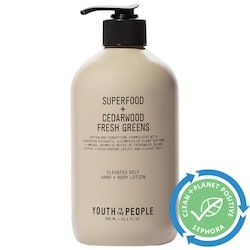
Youth To The People Superfood Omega Hand + Body Lotion with Kale + Green Tea
Works for
2 of 2 advertised claims delivered
Anti-aging6 ingredients credited for this claimModerate support
“What Else You Need to Know This non-greasy hand and body lotion quickly absorbs to visibly soften skin, reduce the look of dry fine lines, and leave skin looking younger.”
This product contains serine, threonine. These ingredients might be able to help reduce and prevent fine lines and wrinkles, improve skin elasticity and firmness, but there is not enough evidence that it actually works.
Moisturizing28 ingredients credited for this claimGood support
“, Jojoba Seed Oil Non-greasy emollient restores and maintains moisture barrier function.”
This product can help improve hydration of the skin with the two types of ingredients.
The first type is called “humectants”:
these ingredients help attract water.
When humectants are on the surface of the skin, they “pull in” the moisture from the outside environment, or from
within deeper layers of the skin. The following ingredients in this product do the job:
alanine, arginine.
This product also contains ingredients called “occlusives”. They help reduce the speed with which our skin loses moisture to the outside environment. These ingredients also help soften the upper layer of the skin, so it feels less tight and nicer to the touch. The following ingredients in this product do the job: arginine, butyrospermum parkii butter.
Anti-oxidationNot advertised by the brand · 10 ingredients credited for this claimModerate support
This product contains antioxidants (camellia sinensis leaf extract) that might be able to help neutralize free radicals in skin to lessen the damage it gets from the UV light (sun). There is not enough evidence to confirm their effectiveness in skin though.
Can it cause trouble?
Irritancy6 strong irritants: Citral, Citronellol + 4 more — patch-test recommendedHigh risk
Comedogenic3 ingredients rated 2 or more on the 0–5 pore-clogging scale3 flagged
User reviews
Be the first — your take helps the next person decide.
Ingredients
Filter by role to see what each ingredient is doing.
Water~45–55%
Caprylic/capric triglyceride~5.7–7%
- Irritation risk
- Medium
A good mix of fatty acids that forms a protective layer on the skin. Improves the shelf life of products. Derived from coconut and glycerin
More about Caprylic/capric triglycerideGlycerin~4–4.9%
- Irritation risk
- Low
One of the best moisturizing ingredients. Naturally present in skin. It attracts water to the upper layer of the skin working as a humectant
More about GlycerinCetyl alcohol~2.6–3.2%
- Irritation risk
- Low
A non-drying alcohol that works to soften the skin and stabilize product formulations helping oil and water mix together
More about Cetyl alcoholButyrospermum parkii butter~2.5–3%
- Irritation risk
- Low
- Comedogenicity
- 3/5
A great moisturising ingredient that softens the skin and reduces water loss from its upper layer. It also can be helpful in protecting skin from free radicals
More about Butyrospermum parkii butterCarthamus tinctorius seed oil~2–2.4%
- Irritation risk
- Low
An emollient that helps soften the skin and might help calm down inflammation
More about Carthamus tinctorius seed oilBrassica oleracea acephala leaf extract~1.6–2%
- Irritation risk
- Medium
Might be helpful in neutralizing free radicals in skin but solid research is lacking. Helps attract water to the upper layer of the skin
More about Brassica oleracea acephala leaf extractCamellia sinensis leaf extract~1.4–1.7%
- Irritation risk
- Low
Can contain potent anti-oxidant compounds (abbreviated ECG, GCG, EGC, and EGCG) that might help protect the skin from free radicals. Can help calm down inflammation and has some anti-bacterial properties. Unfortunately, these antioxidants are unstable and lose their effectiveness very quickly in products. The concentration of the antioxidant compounds in the extract also tends to be low to be effective in topical formulation
More about Camellia sinensis leaf extractChamomilla recutita flower extract~1.1–1.4%
- Irritation risk
- High
Plant extract that can have healing and anti-inflammatory properties. It is a potential allergen and can be irritating
More about Chamomilla recutita flower extractChamomilla recutita extract~0.9–1.1%
- Irritation risk
- High
Plant extract that can have healing and anti-inflammatory properties. It is a potential allergen and can be irritating
More about Chamomilla recutita extractChlorella vulgaris extract~0.65–0.95%
- Irritation risk
- Medium
- Comedogenicity
- 3/5
A plant extract that can help to attract water to the upper layer of the skin and might have some anti-oxidant and anti-inflammatory properties
More about Chlorella vulgaris extractHydrolyzed algin~0.55–0.8%
- Irritation risk
- Low
- Comedogenicity
- 3/5
Derived from brown algae. Helps attract water to the upper layer of the skin
More about Hydrolyzed alginMaris aqua~0.5–0.7%
Sea water~0.4–0.65%
- Irritation risk
- Low
Dissolves other ingredients. It does not have additional skin benefits compared to plain water
More about Sea waterMedicago sativa extract~0.35–0.6%
- Irritation risk
- Medium
A plant extract that might help neutralize free radicals in skin
More about Medicago sativa extractSpinacia oleracea leaf extract~0.35–0.6%
- Irritation risk
- Medium
A plant extract that might have some anti-oxidant properties
More about Spinacia oleracea leaf extractAlanine~0.3–0.6%
- Irritation risk
- Low
An amino-acid that helps to attract water to the upper layer of the skin and might help to lighten the skin, but solid evidence is lacking
More about AlanineArginine~0.3–0.55%
- Irritation risk
- Low
An amino acid that is naturally present in skin and helps keep it hydrated. When used together with AHAs, it can reduce their irritating effect on the skin
More about ArginineBetaine~0.25–0.5%
- Irritation risk
- Low
Helps attract water to the upper layer of the skin and improves the product texture
More about BetaineGlutamic acid~0.25–0.5%
- Irritation risk
- Low
An amino-acid that helps attract water to the upper layer of the skin
More about Glutamic acidGlycine~0.25–0.45%
- Irritation risk
- Low
Helps to attract water to the upper layer of the skin and can help restore the skin barrier function
More about GlycineLactobacillus ferment~0.2–0.4%
- Irritation risk
- Low
A fermentation product created by bacteria Lactobacillus. The fermented product has anti-bacterial properties and might be helpful in calming down inflammation, but studies are lacking. Helps attract water to the upper layer of the skin. Can be used as a preservative
More about Lactobacillus fermentLysine hcl~0.2–0.35%
Pca~0.2–0.4%
- Irritation risk
- Low
Naturally present in skin and helps to attract water to its upper layer
More about PcaProline~0.2–0.4%
Serine~0.2–0.35%
- Irritation risk
- Low
An amino-acid that helps to attract water to the upper layer of the skin. In combination with other amino-acids, might help to reduce fine lines and wrinkles
More about SerineSodium hyaluronate~0.2–0.4%
- Irritation risk
- Low
One of the best moisturizing ingredients. Attracts water into the upper layer of the skin
More about Sodium hyaluronateSodium hydroxide~0.2–0.4%
Sodium lactate~0.2–0.4%
- Irritation risk
- Medium
Helps attract water to the upper layer of the skin. Is often used to adjust the pH level of the product
More about Sodium lactateSodium pca~0.2–0.4%
- Irritation risk
- Low
Naturally present in skin and helps to attract water to its upper layer
More about Sodium pcaTetrahexyldecyl ascorbate~0.2–0.4%
- Irritation risk
- Medium
Being a lipid soluble form of vitamin C, it is more stable than ascorbic acid, but still degrades quickly and needs to be stabilized in a formulation with another ingredient. It is claimed to penetrate skin better than pure vitamin C and have the the similar benefits, but solid studies of its effectiveness are lacking. Is likely to require a higher concentration in a product than pure vitamin C to be effective. It might be able to help reduce pore clogging.
More about Tetrahexyldecyl ascorbateTetrasodium glutamate diacetate~0.2–0.4%
- Irritation risk
- Low
Helps stabilize the product formulation
More about Tetrasodium glutamate diacetateThreonine~0.2–0.4%
- Irritation risk
- Low
An amino-acid that helps to attract water to the upper layer of the skin. In combination with other amino-acids, might help to reduce fine lines and wrinkles
More about ThreonineTocopherol~0.2–0.4%
- Irritation risk
- Low
Pure form of vitamin E. Can help moisturise and protect the skin from free radicals. Often used to help stabilise other ingredients or the formula itself
More about TocopherolCetearyl olivate~0.2–0.4%
Helianthus annuus seed oil~0.25–0.45%
- Irritation risk
- Low
A great emollient due to its high linoleic acid content. One of the most effective plant oils in helping skin hydration and repairing skin barrier function
More about Helianthus annuus seed oilMangifera indica seed butter~0.2–0.35%
- Irritation risk
- Low
Helps to soften the upper layer of the skin and might have some anti-oxidant effect
More about Mangifera indica seed butterSimmondsia chinensis seed oil~0.25–0.5%
- Irritation risk
- Medium
Softens the upper layer of skin and helps restore the healthy skin barrier. Has shown to help calm down inflammation in skin. It is a stable oil, meaning that it retains its properties even when exposed to air.
More about Simmondsia chinensis seed oilSorbitan olivate~0.2–0.4%
Squalane~0.25–0.45%
- Irritation risk
- Low
An oil naturally present in skin. Works as an emollient to soften the skin and form a protective layer on its surface without a greasy feeling.
More about SqualaneCarbomer~0.2–0.35%
- Irritation risk
- Low
Helps create a thicker or gel-like product texture. It is not a surfactant but can be used in gentle cleansing formulations
More about CarbomerMaltodextrin~0.2–0.35%
- Irritation risk
- Low
Used to stabilize the product formulation and can help absorb oil
More about MaltodextrinCitral~0.15–0.3%
Citronellol~0.15–0.25%
Hexyl cinnamal~0.15–0.25%
Limonene~0.15–0.25%
- Irritation risk
- High
A common frangrance that can easily irritate skin, especially if exposed to air, light or heat
More about LimoneneLinalool~0.15–0.25%
Ethylhexylglycerin~0.15–0.3%
Phenoxyethanol~0.15–0.3%
- Irritation risk
- Low
A preservative. It helps prevent bacterial growth in cosmetic products
More about PhenoxyethanolSodium benzoate~0.15–0.25%
Parfum~0.05–0.15%
- Irritation risk
- High
An aromatic blend of unspecified and possibly irritating ingredients
More about ParfumIngredient list view
Water, Caprylic/capric triglyceride, Glycerin, Cetyl alcohol, Butyrospermum parkii butter, Carthamus tinctorius seed oil, Brassica oleracea acephala leaf extract, Camellia sinensis leaf extract, Chamomilla recutita flower extract, Chamomilla recutita extract, Chlorella vulgaris extract, Hydrolyzed algin, Maris aqua, Sea water, Medicago sativa extract, Spinacia oleracea leaf extract, Alanine, Arginine, Betaine, Glutamic acid, Glycine, Lactobacillus ferment, Lysine hcl, Pca, Proline, Serine, Sodium hyaluronate, Sodium hydroxide, Sodium lactate, Sodium pca, Tetrahexyldecyl ascorbate, Tetrasodium glutamate diacetate, Threonine, Tocopherol, Cetearyl olivate, Helianthus annuus seed oil, Mangifera indica seed butter, Simmondsia chinensis seed oil, Sorbitan olivate, Squalane, Carbomer, Maltodextrin, Citral, Citronellol, Hexyl cinnamal, Limonene, Linalool, Ethylhexylglycerin, Phenoxyethanol, Sodium benzoate, Parfum
Compare prices
Retailers ranked by price — lowest first.

Affiliate links · prices updated regularly
Sources cited in this review
Every concentration estimate and effectiveness label is anchored to one of these 23 studies and safety reviews.
- 1
- 2
- 3
- 4
- 5
- 6Functional glycine receptor in cultured human keratinocytesonlinelibrary.wiley.com

Affiliate links · As an Amazon Associate, WIMJ earns from qualifying purchases.