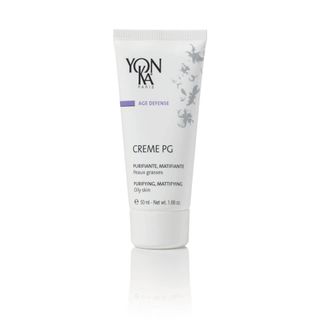
Yon-Ka Paris Skincare Creme PG
Works for
0 of 3 advertised claims delivered
Evens skin tone1 ingredient credited for this claimLimited support
“Citric acid brightens the skin while lavender oil soothes and relieves inflammation.”
This product contains ingredients (glycine soja protein) that could help reduce hyperpigmentation (for example, post-acne marks or age spots) in theory, but there is not enough evidence that they actually work.
Moisturizing5 ingredients credited for this claimLimited support
“Yon-Ka Creme PG hydrates, softens and refines oily, acne-prone skin.”
Contains humectants (glycine soja protein, propylene glycol) to help attract water to the upper layer of the skin and emollients (cetyl palmitate, glycine soja protein) to help soften the skin, but these ingredients are not the most effective.
Anti-blemishNo ingredient credited for this claimNo support
“Burdock root extract heals and prevents blemishes.”
Effective ingredients missing or their concentration is too low.
Anti-agingNot advertised by the brand · 2 ingredients credited for this claimModerate support
This product contains retinyl acetate. This ingredient might be able to help reduce and prevent fine lines and wrinkles, improve skin elasticity and firmness, but there is not enough evidence that it actually works.
Can it cause trouble?
Irritancy11 strong irritants: Lavandula angustifolia oil, Pelargonium graveolens flower oil + 9 more — patch-test recommendedHigh risk
Comedogenic2 ingredients rated 2 or more on the 0–5 pore-clogging scale2 flagged
User reviews
Be the first — your take helps the next person decide.
Ingredients
Filter by role to see what each ingredient is doing.
Olea europaea fruit oil~23–34%
- Irritation risk
- Medium
An emollient that helps soften the skin but is not effective for restoring its barrier function. Might be helpful to calm down inflammation
More about Olea europaea fruit oilGlycol stearate~6–8.9%
Glyceryl stearate se~3.6–5.4%
- Irritation risk
- Low
- Comedogenicity
- 2/5
Used to stabilize the product formulations and works as an emollient
More about Glyceryl stearate seCetyl palmitate~3.9–5.8%
- Irritation risk
- Low
An emollient that helps soften the skin and is used to improve product texture and stability
More about Cetyl palmitateTea-stearate~2.9–4.3%
Glyceryl myristate~2.2–3.3%
Peg-32 stearate~1.6–2.5%
Propylene glycol~1.4–2.1%
- Irritation risk
- High
Helps oil and water mix together and can enhance the penetration of other ingredients into the skin. It can be irritating
More about Propylene glycolLavandula angustifolia oil~1.1–1.6%
- Irritation risk
- High
An essential oil. Potential allergen and can be irritating. It has some anti-bacterial properties
More about Lavandula angustifolia oilPelargonium graveolens flower oil~0.95–1.4%
- Irritation risk
- High
An essential oil. Can be irritating. Can become an allergen with oxidation
More about Pelargonium graveolens flower oilRosmarinus officinalis leaf oil~0.55–1.3%
- Irritation risk
- High
A plant oil with high content of volatile compounds that can irritate the skin. Can be used as a fragrance. Has anti-bacterial properties and might help neutralize free radicals on the surface of the skin
More about Rosmarinus officinalis leaf oilCupressus sempervirens oil~0.5–1.1%
- Irritation risk
- Low
Thymus vulgaris oil~0.4–0.95%
- Irritation risk
- High
Peg-6 stearate~0.4–0.95%
Peg-35 castor oil~0.4–0.9%
Glycine soja protein~0.45–1%
- Irritation risk
- Low
A plant extract that helps to attract water to the upper layer of the skin and soften it. It might be helpful in neutralizing free radicals. It might be somewhat helpful for evening out the skin tone. It might be able to support elastin production but solid research is lacking
More about Glycine soja proteinRetinyl acetate~0.4–0.9%
Tocopheryl acetate0.2%
- Irritation risk
- Medium
A more stable but less bio-available form of vitamin E compared to Tocopherol. Might help moisturize and protect the skin from free radicals, but mostly used in low concentrations to stabilize other ingredients.
More about Tocopheryl acetateArctium lappa root extract~0.35–0.8%
- Irritation risk
- High
Plant extract. Has some anti-microbial and anti-oxidant properties. Can be irritating
More about Arctium lappa root extractHedera helix extract~0.3–0.7%
- Irritation risk
- High
A plant extract that has an anti-bacterial effect
More about Hedera helix extractPhenoxyethanol~0.2–0.8%
- Irritation risk
- Low
A preservative. It helps prevent bacterial growth in cosmetic products
More about PhenoxyethanolMethylparaben~0.15–0.3%
Propylparaben~0.2–0.4%
Citric acid~0.15–0.65%
- Irritation risk
- Medium
Can work as an exfoliant but is typically used to adjust the product pH
More about Citric acidLinalool~0.15–0.55%
Citronellol~0.1–0.5%
Geraniol~0.1–0.45%
Limonene~0.1–0.4%
- Irritation risk
- High
A common frangrance that can easily irritate skin, especially if exposed to air, light or heat
More about LimoneneCitral~0.1–0.35%
Coumarin~0.1–0.3%
Ingredient list view
Olea europaea fruit oil, Glycol stearate, Glyceryl stearate se, Cetyl palmitate, Tea-stearate, Glyceryl myristate, Peg-32 stearate, Propylene glycol, Lavandula angustifolia oil, Pelargonium graveolens flower oil, Rosmarinus officinalis leaf oil, Cupressus sempervirens oil, Thymus vulgaris oil, Peg-6 stearate, Peg-35 castor oil, Glycine soja protein, Retinyl acetate, Tocopheryl acetate, Arctium lappa root extract, Hedera helix extract, Phenoxyethanol, Methylparaben, Propylparaben, Citric acid, Linalool, Citronellol, Geraniol, Limonene, Citral, Coumarin
Compare prices
Retailers ranked by price — lowest first.

Affiliate links · prices updated regularly
Sources cited in this review
Every concentration estimate and effectiveness label is anchored to one of these 16 studies and safety reviews.
- 1Use of “natural” oils for moisturization: Review of olive, coconut, and sunflower seed oilonlinelibrary.wiley.com
- 2Surfactants and experimental irritant contact dermatitisncbi.nlm.nih.gov
- 3Propylene Glycolpubmed.ncbi.nlm.nih.gov
- 4Skin-sensitizing and irritant properties of propylene glycolonlinelibrary.wiley.com
- 5
- 6

Affiliate links · As an Amazon Associate, WIMJ earns from qualifying purchases.