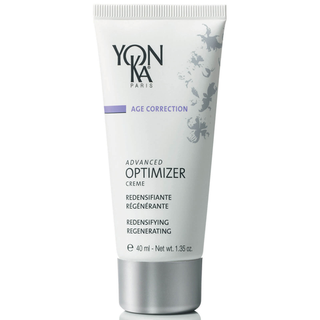
Yon-Ka Paris Advanced Optimizer Creme
Works for
2 of 2 advertised claims delivered
Anti-agingUbiquinone, Lactic acidModerate evidence
“Reduces the appearance of lines and wrinkles”
This product contains ubiquinone. This ingredient help neutralize free radicals in skin. By doing so, they might be able to prevent early signs of aging (like fine lines and wrinkles), at least to some extent. These ingredients will not be able to "reverse" signs of aging.
MoisturizingGlycerin, Glycine soja sterols + 12 moreGood evidence
“Generous and comfortable, Advanced Optimizer Creme”
This product can help improve hydration of the skin with the two types of ingredients.
The first type is called “humectants”:
these ingredients help attract water.
When humectants are on the surface of the skin, they “pull in” the moisture from the outside environment, or from
within deeper layers of the skin. The following ingredients in this product do the job:
glycerin, sodium hyaluronate.
This product also contains ingredients called “occlusives”. They help reduce the speed with which our skin loses moisture to the outside environment. These ingredients also help soften the upper layer of the skin, so it feels less tight and nicer to the touch. The following ingredients in this product do the job: squalane, glycine soja sterols.
Anti-oxidationNot advertised by the brand · Ubiquinone, Rosa canina fruit extract + 1 moreStrong evidence
This product contains antioxidants (ubiquinone) that can help neutralize free radicals in skin. By doing so, they can lessen the damage the skin gets from the UV light (sun).
Can it cause trouble?
Irritancy7 strong irritants: Hydroxycitronellal, Hexyl cinnamal + 5 more — patch-test recommendedHigh risk
Comedogenic4 ingredients rated 2 or more on the 0–5 pore-clogging scale4 flagged

User reviews
Be the first — your take helps the next person decide.
Ingredients
Filter by role to see what each ingredient is doing.
Water~45–55%
Hydrogenated polyisobutene~5.7–6.9%
- Irritation risk
- Low
Used to improve the product consistency and soften the upper layer of the skin
More about Hydrogenated polyisobuteneTea-stearate~4.6–5.6%
Decyl oleate~3.4–4.1%
- Irritation risk
- Low
- Comedogenicity
- 2/5
Helps soften the upper layer of the skin
More about Decyl oleateSoluble collagen~2.7–3.3%
- Irritation risk
- Low
A typically plant-derived compound that is supposed mimic human collagen. Cannot penetrate the skin barrier so is not particularly useful in skincare products beyond attracting water to the upper layer of the skin
More about Soluble collagenHydrogenated coconut oil~2.2–2.6%
- Irritation risk
- Low
- Comedogenicity
- 3/5
Propylene glycol~1.8–2.2%
- Irritation risk
- High
Helps oil and water mix together and can enhance the penetration of other ingredients into the skin. It can be irritating
More about Propylene glycolGlycerin~1.6–1.9%
- Irritation risk
- Low
One of the best moisturizing ingredients. Naturally present in skin. It attracts water to the upper layer of the skin working as a humectant
More about GlycerinCetyl alcohol~1.4–1.8%
- Irritation risk
- Low
A non-drying alcohol that works to soften the skin and stabilize product formulations helping oil and water mix together
More about Cetyl alcoholPeg-5 pentaerythrityl ether~1.2–1.4%
- Irritation risk
- Low
Ppg-5 pentaerythrityl ether~1–1.2%
- Irritation risk
- Low
Squalane~0.9–1.1%
- Irritation risk
- Low
An oil naturally present in skin. Works as an emollient to soften the skin and form a protective layer on its surface without a greasy feeling.
More about SqualaneHydrolyzed lupine protein~0.7–1.05%
- Irritation risk
- Low
Rosa canina fruit extract~0.65–0.95%
- Irritation risk
- Medium
A plant extract that might have some anti-oxidant properties, but evidence is lacking
More about Rosa canina fruit extractEquisetum arvense leaf extract~0.65–1%
- Irritation risk
- Low
Glyceryl stearate~0.7–1%
- Irritation risk
- Low
An emollient that softens the skin and forms a protective layer on its surface. Helps water and oil mix together
More about Glyceryl stearateHydrolyzed milk protein~0.55–0.85%
Sodium hyaluronate~0.55–0.8%
- Irritation risk
- Low
One of the best moisturizing ingredients. Attracts water into the upper layer of the skin
More about Sodium hyaluronatePeg-100 stearate~0.55–0.85%
- Irritation risk
- Low
Helps oil and water mix togehter and creates a nice product texture
More about Peg-100 stearateButyrospermum parkii butter extract~0.5–0.75%
- Irritation risk
- Low
- Comedogenicity
- 3/5
A great moisturising ingredient that softens the skin and reduces water loss from its upper layer. It also can be helpful in protecting skin from free radicals
More about Butyrospermum parkii butter extractSclerotium gum~0.45–0.65%
- Irritation risk
- Low
Used to create gel-like formulas and stabilize emulsions
More about Sclerotium gumGlycine soja sterols~0.5–0.7%
- Irritation risk
- Low
An emollient that helps soften the skin
More about Glycine soja sterolsTocopheryl acetate~0.45–0.65%
- Irritation risk
- Medium
A more stable but less bio-available form of vitamin E compared to Tocopherol. Might help moisturize and protect the skin from free radicals, but mostly used in low concentrations to stabilize other ingredients.
More about Tocopheryl acetateUbiquinone~0.4–0.6%
- Irritation risk
- Low
Coenzyme Q10. It helps neutralize free radicals in skin, improves skin hydration and might be helpful agains fine lines and wrinkles. It can be an allergen
More about UbiquinonePhenoxyethanol~0.3–0.55%
- Irritation risk
- Low
A preservative. It helps prevent bacterial growth in cosmetic products
More about PhenoxyethanolMethylparaben~0.15–0.3%
Lactic acid~0.3–0.5%
- Irritation risk
- Medium
An exfoliating and moisturizing alpha-hydroxy acid (AHA). Typically causes less irritation than other AHAs, for example, glycolic acid. At high concentrations (about 15%), lactic acid can help reduce lines and wrinkles. Recent studies show that lactic acid can support the "good" bacteria living on skin's surface (healthy skin microbiome)
More about Lactic acidCitric acid~0.3–0.5%
- Irritation risk
- Medium
Can work as an exfoliant but is typically used to adjust the product pH
More about Citric acidChlorphenesin~0.16–0.32%
Sodium benzoate~0.25–0.4%
Sorbic acid~0.2–0.4%
Hydroxycitronellal~0.2–0.35%
- Irritation risk
- High
A fragrance. A likely allergen and can be irritating
More about HydroxycitronellalHexyl cinnamal~0.15–0.3%
Citronellol~0.15–0.25%
Linalool~0.1–0.2%
Geraniol~0.1–0.2%
Alpha-isomethyl ionone~0.1–0.15%
- Irritation risk
- High
A fragrance. Potential allergen and can be irritating
More about Alpha-isomethyl iononeLimonene~0.05–0.1%
- Irritation risk
- High
A common frangrance that can easily irritate skin, especially if exposed to air, light or heat
More about LimoneneEvernia prunastri extract~0.05%
- Irritation risk
- Low
Ingredient list view
Water, Hydrogenated polyisobutene, Tea-stearate, Decyl oleate, Soluble collagen, Hydrogenated coconut oil, Propylene glycol, Glycerin, Cetyl alcohol, Peg-5 pentaerythrityl ether, Ppg-5 pentaerythrityl ether, Squalane, Hydrolyzed lupine protein, Rosa canina fruit extract, Equisetum arvense leaf extract, Glyceryl stearate, Hydrolyzed milk protein, Sodium hyaluronate, Peg-100 stearate, Butyrospermum parkii butter extract, Sclerotium gum, Glycine soja sterols, Tocopheryl acetate, Ubiquinone, Phenoxyethanol, Methylparaben, Unknown, Lactic acid, Citric acid, Chlorphenesin, Sodium benzoate, Sorbic acid, Hydroxycitronellal, Hexyl cinnamal, Citronellol, Linalool, Geraniol, Alpha-isomethyl ionone, Limonene, Evernia prunastri extract
Compare prices
Retailers ranked by price — lowest first.
Affiliate links · prices updated regularly · As an Amazon Associate, WIMJ earns from qualifying purchases.
Worth comparing, line by line.
Match % combines shared ingredients, the first five ingredients, shared actives and hero ingredients, irritancy (lower counts in the alternative's favour), texture and body area. Only products in the same routine step are compared.
| Yon-Ka ParisAdvanced Optimizer CremeYOUR PRODUCT | PRIORI SkincarePRIORI LCA - Skin Renewal Creme | Maria ÅkerbergFace Cream Sensitive | WeledaAlmond Soothing Facial Cream | |
|---|---|---|---|---|
| Match | — | 52% | 52% | 52% |
| Price | $218.00 | $94.90−$123.10 | $29.87−$188.13 | $18.81−$199.19 |
| Shared key ingredients | — | 2 of 8 | 1 of 8 | 1 of 8 |
| Key difference | — | Retinyl Palmitate | Beeswax | — |
| Irritancy | High | Medium | Medium | Medium |
| Drying alcohol | — | — | — | Contains drying alcohol |
| View product | Shop | Shop | Shop |


Sources cited in this review
Every concentration estimate and effectiveness label is anchored to one of these 10 studies and safety reviews.
- 1
- 2Surfactants and experimental irritant contact dermatitisncbi.nlm.nih.gov
- 3Propylene Glycolpubmed.ncbi.nlm.nih.gov
- 4Skin-sensitizing and irritant properties of propylene glycolonlinelibrary.wiley.com
- 5
- 6Hyaluronic acid: A key molecule in skin agingncbi.nlm.nih.gov

Affiliate links · As an Amazon Associate, WIMJ earns from qualifying purchases.