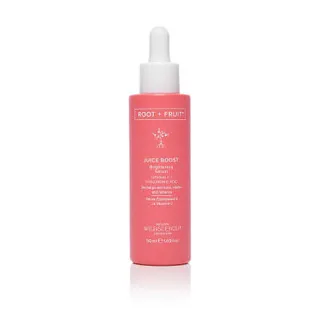
Wild Science Lab Root + Fruit Juice Boost Brightening Serum
Works for
MoisturizingGlycerin, Betaine + 4 moreWorks
“Juice Boost Brightening serum is a daily reactivation solution to encourage a brighter, firmer and more hydrated complexion.”
This product contains good ingredients to attract water to the upper layer of the skin. These ingredients are called "humectants": betaine, glycerin.
When humectants are on the surface of the skin, they “pull in” the moisture from the outside environment, or from within deeper layers of the skin. If the air is dry, humectants can speed up the moisture loss from the skin. This is why it is a good idea to use another product on top of this one to help "seal in" the moisture (look for ingredients like dimethicone, squalane, oils and butters).
Anti-agingAloe barbadensis leaf juice, Sodium ascorbyl phosphateNot delivered
“Lacklustre skin tone, dull uneven patches, dehydration and signs of fine lines and wrinkles.”
Effective ingredients missing or their concentration is too low.
Evens skin toneNo ingredient credited for this claimNot delivered
“Lacklustre skin tone, dull uneven patches, dehydration and signs of fine lines and wrinkles.”
Effective ingredients missing or their concentration is too low
Can it cause trouble?
Irritancy12 strong irritants: Citrus aurantium dulcis peel oil, Citrus grandis peel oil + 10 more — patch-test recommendedHigh risk
ComedogenicClean of flagged comedogenic ingredientsNone flagged


User reviews
Be the first — your take helps the next person decide.
Ingredients
Filter by role to see what each ingredient is doing.
Aloe barbadensis leaf juice~23–34%
- Irritation risk
- Medium
Traditionally used to treat sunburns, dermatitis and inflammation, but evidence for its effectiveness is lacking. The extract can contain humectants that help attract water into the skin
More about Aloe barbadensis leaf juiceGlycerin~3.2–4.7%
- Irritation risk
- Low
One of the best moisturizing ingredients. Naturally present in skin. It attracts water to the upper layer of the skin working as a humectant
More about GlycerinPolysorbate 20~3.3–4.9%
Sodium ascorbyl phosphate~3.6–5.3%
- Irritation risk
- Medium
A stable derivative of vitamin C. It is oil-soluble which means it is more likely to penetrate the skin compared to the pure form of vitamin C (which is water-soluble), but it is less bio-available and is way less effective in stimulating collagen and reducing wrinkles compared to the pure form of vitamin C (L-ascorbic acid) and its other derivatives (for example, magnesium ascorbyl phosphate). At the same time, this vitamin C derivative has been shown in studies to be effective in reducing acne, blemishes and clogged pores. It is less irritating then the pure form of vitamin C
More about Sodium ascorbyl phosphateBetaine~2.6–3.9%
- Irritation risk
- Low
Helps attract water to the upper layer of the skin and improves the product texture
More about BetaineSodium hyaluronate~1.8–2.7%
- Irritation risk
- Low
One of the best moisturizing ingredients. Attracts water into the upper layer of the skin
More about Sodium hyaluronateCitrus aurantium dulcis peel oil~1.3–2%
- Irritation risk
- High
An essentil oil from orange peel. Potential allergen and can be irritating
More about Citrus aurantium dulcis peel oilCitrus grandis peel oil~1.1–1.6%
- Irritation risk
- High
A plant oil with high content of volatile compounds that, especially when exposed to air, can cause allergic reactions and irritate the skin
More about Citrus grandis peel oilLitsea cubeba fruit oil~0.95–1.45%
- Irritation risk
- High
An essential oil with a lemon-like smell that is extracted from a fruit grown in Asia. Used as a fragrance
More about Litsea cubeba fruit oilLavandula angustifolia flower oil~0.8–1.2%
- Irritation risk
- High
A fragrant plant oil, can be irritating
More about Lavandula angustifolia flower oilCitrus nobilis oil~0.5–1.15%
- Irritation risk
- High
Cymbopogon martini oil~0.4–0.9%
- Irritation risk
- High
Aromatic plant oil used in cosmetics as a fragrance. A likely irritant
More about Cymbopogon martini oilGardenia florida fruit extract~0.35–0.85%
- Irritation risk
- High
Used as a fragrance. Can be irritating.
More about Gardenia florida fruit extractDisodium acetyl glucosamine phosphate~0.3–0.75%
- Irritation risk
- Low
Sodium glucuronate~0.2–0.75%
- Irritation risk
- Low
Magnesium sulfate~0.3–0.75%
Lysolecithin~0.3–0.7%
- Irritation risk
- Low
Lecithin derivative. It helps oil and water mix together and can enhance penetration of other ingredients. It helps soften the upper layer of the skin
More about LysolecithinSclerotium gum~0.2–0.7%
- Irritation risk
- Low
Used to create gel-like formulas and stabilize emulsions
More about Sclerotium gumXanthan gum~0.2–0.7%
- Irritation risk
- Low
Used to create a thicker product consistency
More about Xanthan gumPullulan~0.15–0.7%
- Irritation risk
- High
Creates a thin drying film on the skin resulting in a short-term tightening effect
More about PullulanSilica~0.2–0.8%
Maltodextrin~0.15–0.65%
- Irritation risk
- Low
Used to stabilize the product formulation and can help absorb oil
More about MaltodextrinPhenoxyethanol~0.15–0.5%
- Irritation risk
- Low
A preservative. It helps prevent bacterial growth in cosmetic products
More about PhenoxyethanolEthylhexylglycerin~0.1–0.5%
Hydroxyacetophenone~0.1–0.45%
Pentylene glycol~0.15–0.7%
- Irritation risk
- Medium
Used to preserve products, dissolve other ingredients and create a nice product texture
More about Pentylene glycolCitric acid~0.1–0.4%
- Irritation risk
- Medium
Can work as an exfoliant but is typically used to adjust the product pH
More about Citric acidLimonene~0.1–0.35%
- Irritation risk
- High
A common frangrance that can easily irritate skin, especially if exposed to air, light or heat
More about LimoneneLinalool~0.1–0.3%
Geraniol~0.05–0.25%
Citral~0.05–0.25%
Cymbopogon nardus oil~0.05–0.2%
- Irritation risk
- High
Ingredient list view
Aloe barbadensis leaf juice, Glycerin, Polysorbate 20, Sodium ascorbyl phosphate, Betaine, Sodium hyaluronate, Citrus aurantium dulcis peel oil, Citrus grandis peel oil, Litsea cubeba fruit oil, Lavandula angustifolia flower oil, Citrus nobilis oil, Cymbopogon martini oil, Gardenia florida fruit extract, Disodium acetyl glucosamine phosphate, Sodium glucuronate, Magnesium sulfate, Lysolecithin, Sclerotium gum, Xanthan gum, Pullulan, Silica, Maltodextrin, Phenoxyethanol, Ethylhexylglycerin, Hydroxyacetophenone, Pentylene glycol, Citric acid, Limonene, Linalool, Geraniol, Citral, Cymbopogon nardus oil
Compare prices
Retailers ranked by price — lowest first.
Affiliate links · As an Amazon Associate, WIMJ earns from qualifying purchases.
Worth comparing, line by line.
Match % combines shared ingredients, the first five ingredients, shared actives and hero ingredients, irritancy (lower counts in the alternative's favour), texture and body area. Only products in the same routine step are compared.
| Wild Science LabRoot + Fruit Juice Boost Brightening SerumYOUR PRODUCT | NOW FoodsVitamin C + Ferulic Acid Serum | RaaieMORNING DEW VITAMIN C SERUM | Bioelementsvc10 daily glow | |
|---|---|---|---|---|
| Match | — | 64% | 63% | 63% |
| Price | — | $11.99 | — | $66.00 |
| Shared key ingredients | — | 3 of 5 | 5 of 5 | 4 of 5 |
| Key difference | — | Ferulic Acid | Ascorbyl Tetraisopalmitate | Ascorbyl Glucoside |
| Irritancy | High | Medium | High | Medium |
| Drying alcohol | — | — | — | — |
| View product | Shop | Shop | Shop |


More alternatives: Sympli Beautiful Vitamin C Stem Cell SerumYoun Beauty CE Antioxidant Serum
Product summary
"Wild Science Lab - Root + Fruit Juice Boost Brightening Serum" could be helpful for: Moisturizing, but its actives are not the most effective or are not well-studied.
Ingredient callouts
- Humectants (sodium hyaluronate 1.80% - 2.70%, betaine 2.60% - 3.90% and glycerin 3.20% - 4.70%). These ingredients help attract water to the upper layer of the skin and improve the skin hydration.
Price
The product retails for 38.00£ in the United Kingdom.
For a detailed price comparison: click here.
Sources cited in this review
Every concentration estimate and effectiveness label is anchored to one of these 15 studies and safety reviews.
- 1
- 2
- 3Sodium ascorbyl phosphate in topical microemulsionssciencedirect.com
- 4
- 5
- 6

Affiliate links · As an Amazon Associate, WIMJ earns from qualifying purchases.