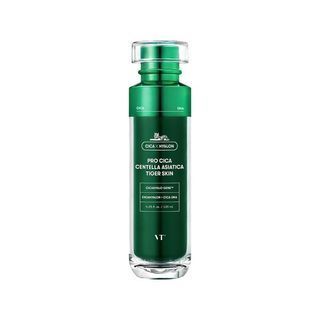
Works for
2 of 2 advertised claims delivered
MoisturizingLactobionic acid, Madecassoside + 17 moreStrong evidence
“The CICAHYALO-GENE contains Centella Asiatica Extract, 3 types of Hyaluronic Acid and Green Propolis Extract etc.”
This product can help improve hydration of the skin with the two types of ingredients.
The first type is called “humectants”:
these ingredients help attract water.
When humectants are on the surface of the skin, they “pull in” the moisture from the outside environment, or from
within deeper layers of the skin. The following ingredients in this product do the job:
glycerin, glyceryl glucoside.
This product also contains ingredients called “occlusives”. They help reduce the speed with which our skin loses moisture to the outside environment. These ingredients also help soften the upper layer of the skin, so it feels less tight and nicer to the touch. The following ingredients in this product do the job: beta-sitosterol.
The following ingredients in this product are especially good for supporting the skin barrier and helping with the hydration level: ceramide np, lactobionic acid, madecassoside
ExfoliationLactobionic acid, Capryloyl salicylic acidStrong evidence
“PHA & LHA infused help remove dead skin celles gently, smoothing out skin texture.”
This product can help exfoliate the skin. In other words, it helps break down the bonds between dead cells on the surface of the skin and speed up the skin turnover. Skin often appears softer and brighter after exfoliation, but overdoing it can result in disrupted skin barrier. The following ingredient is doing the exfoliating job in this product: capryloyl salicylic acid, lactobionic acid.
Anti-oxidationNot advertised by the brand · Madecassoside, Asiaticoside + 6 moreStrong evidence
This product contains antioxidants (asiaticoside, lactobionic acid, madecassoside) that can help neutralize free radicals in skin. By doing so, they can lessen the damage the skin gets from the UV light (sun).
The following ingredients - centella asiatica extract also can have an antioxidant effect, but there is less evidence to confirm their effectiveness in skin.
Anti-agingNot advertised by the brand · Lactobionic acid, Asiaticoside + 4 moreStrong evidence
This product can help reduce and prevent fine lines and wrinkles, improve skin elasticity and firmness because it contains lactobionic acid.
These ingredients in the product can also be helpful, even though there is less evidence for their effectiveness: asiaticoside, centella asiatica extract, madecassoside.
Keep in mind that it typically takes at least 6 weeks to notice any results because the changes that are needed to improve fine lines and elasticity happen in the deeper layers of the skin. No topical anti-aging product can “erase” wrinkles or fully reverse signs of aging.
Evens skin toneNot advertised by the brand · Lactobionic acid, Capryloyl salicylic acid + 2 moreStrong evidence
This product can help reduce hypepigmentation and even out the skin tone because it contains the following effective ingredients: lactobionic acid
The following ingredient (ingredients) in this product might be helpful, but there is no evidence to confirm that it actually can help even out the skin tone: capryloyl salicylic acid, madecassoside.
Keep in mind that you would need to apply any topical skincare targetted at hypigmentation consistently for a couple of months to get a result. No topical skincare product can help get rid of hyperpigmentation (including post-acne marks and age spots) instantly.
Can it cause trouble?
Irritancy2 strong irritants: Jasminum officinale flower water, Vanilla planifolia fruit extractMedium risk
Comedogenic1 ingredient rated 2 or more on the 0–5 pore-clogging scale1 flagged
User reviews
Be the first — your take helps the next person decide.
Ingredients
Filter by role to see what each ingredient is doing.
Water~40–60%
Butylene glycol~5.1–7.6%
- Irritation risk
- Low
Used to create a nice product texture and help delivery of other ingredients. Might be somewhat helpful in attracting water to the upper layer of the skin
More about Butylene glycolPropanediol~3.5–5.3%
- Irritation risk
- Low
Acts as a solvent for other ingredients. Speeds up the absorption of other ingredients into the skin
More about Propanediol1,2-hexanediol~1.9–2.9%
Glycerin~2–3%
- Irritation risk
- Low
One of the best moisturizing ingredients. Naturally present in skin. It attracts water to the upper layer of the skin working as a humectant
More about GlycerinCentella asiatica extract~1.5–2.2%
- Irritation risk
- Medium
A plant extract that has been shown to be able to reduce inflammation in skin, support restoration of skin barrier function, as well as support collagen production. Contains active compounds called centelloids: asiaticoside, madecasosside, asiatic acid and madecassic acid. Might be helpful in preventing stretch marks. It can be itself be irritating though.
More about Centella asiatica extractC12-14 pareth-12~1.3–1.9%
Carbomer~1.1–1.7%
- Irritation risk
- Low
Helps create a thicker or gel-like product texture. It is not a surfactant but can be used in gentle cleansing formulations
More about CarbomerEthylhexylglycerin~0.85–1.3%
Coptis japonica root extract~0.5–1.1%
- Irritation risk
- High
A plant extract that might have some anti-oxidant properties
More about Coptis japonica root extractDisodium edta~0.35–0.85%
Sodium hyaluronate~0.2–0.8%
- Irritation risk
- Low
One of the best moisturizing ingredients. Attracts water into the upper layer of the skin
More about Sodium hyaluronateTheobroma cacao seed extract~0.2–0.7%
- Irritation risk
- Low
- Comedogenicity
- 3/5
Hyaluronic acid~0.15–0.65%
- Irritation risk
- Low
One of the best moisturizing ingredients. Attracts water into the upper layer of the skin. Naturally present in skin. Typically has large molecule size unless advertised otherwise on the product label. Helps support skin's barrier function and may help to reduce inflammation
More about Hyaluronic acidHydrolyzed hyaluronic acid~0.15–0.55%
- Irritation risk
- Low
One of the best moisturizing ingredients. Attracts water into the upper layer of the skin. A version of it is naturally present in skin
More about Hydrolyzed hyaluronic acidTromethamine~0.15–0.6%
Glyceryl glucoside~0.15–0.5%
- Irritation risk
- Low
Can help to restore skin barrier function and soften its upper layer
More about Glyceryl glucosideDextrin~0.15–0.5%
- Irritation risk
- Low
A sugar that is used to stabilize the product formulation. Can help attract water to the upper layer of the skin
More about DextrinApium graveolens extract~0.1–0.45%
- Irritation risk
- Low
Prunus avium fruit extract~0.1–0.4%
- Irritation risk
- Low
Pogostemon cablin oil~0.1–0.35%
- Irritation risk
- Low
Simmondsia chinensis seed oil~0.1–0.5%
- Irritation risk
- Medium
Softens the upper layer of skin and helps restore the healthy skin barrier. Has shown to help calm down inflammation in skin. It is a stable oil, meaning that it retains its properties even when exposed to air.
More about Simmondsia chinensis seed oilPrunus amygdalus amara kernel oil~0.1–0.3%
- Irritation risk
- Low
Dna~0.1–0.35%
- Irritation risk
- Low
Agrimonia eupatoria extract~0.1–0.4%
- Irritation risk
- Low
Camellia sinensis leaf extract~0.1–0.45%
- Irritation risk
- Low
Can contain potent anti-oxidant compounds (abbreviated ECG, GCG, EGC, and EGCG) that might help protect the skin from free radicals. Can help calm down inflammation and has some anti-bacterial properties. Unfortunately, these antioxidants are unstable and lose their effectiveness very quickly in products. The concentration of the antioxidant compounds in the extract also tends to be low to be effective in topical formulation
More about Camellia sinensis leaf extractHydrogenated lecithin~0.1–0.45%
- Irritation risk
- Low
Helps to retain moisture by creating a protective barrier on the skin. Rich in fatty acids. Improves product texture and helps with the penetration of other ingredients.
More about Hydrogenated lecithinArtemisia vulgaris oil~0.1–0.35%
- Irritation risk
- Low
Beta-sitosterol~0.1–0.45%
- Irritation risk
- Low
A phytosterol that can support skin's barrier function and help the skin stay hydrated
More about Beta-sitosterolPyrus malus leaf extract~0.1–0.4%
- Irritation risk
- Low
Polyquaternium-51~0.1–0.45%
- Irritation risk
- Low
An emollient that helps create a nice silky finish on the skin
More about Polyquaternium-51Jasminum officinale flower water~0.1–0.4%
- Irritation risk
- High
Used as a fragrance. Can lead to irritation
More about Jasminum officinale flower waterVanilla planifolia fruit extract~0.1–0.4%
- Irritation risk
- High
A plant extract used as a fragrance. Can be irritating
More about Vanilla planifolia fruit extractMagnolia kobus bark extract~0.1–0.4%
- Irritation risk
- Low
Lonicera caprifolium flower extract~0.1–0.35%
- Irritation risk
- High
A plant extract that might help neutralize free radicals in skin. Can contain volalite oils and be irritating
More about Lonicera caprifolium flower extractPelargonium graveolens extract~0.1–0.4%
- Irritation risk
- Low
Uncaria tomentosa bark extract~0.1–0.4%
- Irritation risk
- Low
Agrimonia eupatoria extract~0.1–0.4%
- Irritation risk
- Low
Corydalis turtschaninovii root extract~0.1–0.4%
- Irritation risk
- Low
Cupressus sempervirens leaf extract~0.1–0.35%
- Irritation risk
- Low
Nepeta cataria extract~0.1–0.35%
- Irritation risk
- Low
Capryloyl salicylic acid~0.1–0.35%
- Irritation risk
- High
Lactobionic acid~0.1–0.35%
- Irritation risk
- Medium
A polyhydroxy acid (PHA) that helps shed dead cells from the surface of the skin revealing a smoother, more even skin. PHAs tend to be gentler on the skin compared to AHAs (for example, glycolic acid). It also has hydrating properties and helps attract water to the upper layer of the skin. It can help calm down inflammation in skin and support restoration of the barrier function. It has an anti-oxidant effect as well. It can help reduce fine line, wrinkles and improve skin elasticity
More about Lactobionic acidAsiaticoside~0.05–0.25%
- Irritation risk
- Medium
An active compound of Centella Asiatica plant extract. In combination with other active compounds of Centella Asiatica extract (madecasosside, asiatic acid and madecassic acid), asiaticoside has been shown to be helpful in wound-healing, restoring skin barrier function and supporting collagen production in skin. It can, however, itself be irritating
More about AsiaticosideMadecassoside~0.05–0.25%
- Irritation risk
- Medium
An antioxidant that is typically derived from plant Centella Asiatica. It can help neutralize free radicals in skin and support skin barrier function. It could, however, itself be irritating. It is often unstable in formulations
More about MadecassosideAsiatic acid~0.05–0.2%
- Irritation risk
- Medium
An active compound of Centella Asiatica plant extract. In combination with other active compounds of Centella Asiatica extract (asiaticoside, madecasosside and madecassic acid) asiatic acid has been shown to be helpful in wound-healing, restoring skin barrier function and supporting collagen production in skin. It can, however, itself be irritating
More about Asiatic acidCeramide np~0.1–0.35%
- Irritation risk
- Low
A type of lipid similar to ceramides naturally present in skin. Helps to soften the upper layer of the skin and supports the skin barrier function to keep it hydrated. Can help to prevent inflammation in skin
More about Ceramide npMadecassic acid~0.05–0.2%
- Irritation risk
- Medium
An active compound of Centella Asiatica plant extract. In combination with other active compounds of Centella Asiatica extract (asiaticoside, madecasosside and asiatic acid), madecassic acid has been shown to be helpful in wound-healing, restoring skin barrier function and supporting collagen production in skin. It can, however, itself be irritating
More about Madecassic acidPropolis extract~0.05–0.2%
- Irritation risk
- High
A complex substance produced by honey bees. Can have anti-bacterial and some anti-oxidant effect. Is an allergen and can be irritating
More about Propolis extractIngredient list view
Water, Butylene glycol, Propanediol, 1,2-hexanediol, Glycerin, Centella asiatica extract, C12-14 pareth-12, Carbomer, Ethylhexylglycerin, Coptis japonica root extract, Disodium edta, Sodium hyaluronate, Theobroma cacao seed extract, Hyaluronic acid, Hydrolyzed hyaluronic acid, Tromethamine, Glyceryl glucoside, Dextrin, Apium graveolens extract, Prunus avium fruit extract, Pogostemon cablin oil, Simmondsia chinensis seed oil, Prunus amygdalus amara kernel oil, Dna, Agrimonia eupatoria extract, Camellia sinensis leaf extract, Hydrogenated lecithin, Artemisia vulgaris oil, Beta-sitosterol, Pyrus malus leaf extract, Polyquaternium-51, Jasminum officinale flower water, Vanilla planifolia fruit extract, Magnolia kobus bark extract, Lonicera caprifolium flower extract, Pelargonium graveolens extract, Uncaria tomentosa bark extract, Agrimonia eupatoria extract, Corydalis turtschaninovii root extract, Cupressus sempervirens leaf extract, Nepeta cataria extract, Capryloyl salicylic acid, Lactobionic acid, Asiaticoside, Madecassoside, Asiatic acid, Ceramide np, Madecassic acid, Propolis extract
Compare prices
Retailers ranked by price — lowest first.

Product summary
"VT - Pro Cica Centella Asiatica Tiger Skin" is effective for: Anti-aging, Moisturizing, Evens skin tone and Exfoliation
Ingredient callouts
- Another benefit is that this moisturizer contain ceramides (ceramide np 0.10% - 0.35%). Ceramides are an important part of our natural skin barrier. The Ceramides used in skincare are synthetic or come from plants. They help soften the skin and can help "fill the gaps" in the skin barrier, keeping the skin hydrated and resilient for longer.
- Actives derived from an extract of the Centella Asiatica plant (also known as Gotu Kola) - madecassic acid 0.05% - 0.20%, asiatic acid 0.05% - 0.20%, madecassoside 0.05% - 0.25% and asiaticoside 0.05% - 0.25% The Centella Asiatica Actives help strengthen and restore the skin barrier, decrease inflammation in skin and neutralize free radicals. They also can help to reduce scarring. The good news is that these actives work even in low concentrations.
Price
The product retails for 22.50$ in the United States.
For a detailed price comparison: click here.
Sources cited in this review
Every concentration estimate and effectiveness label is anchored to one of these 34 studies and safety reviews.
- 1
- 2
- 3
- 4Centella asiatica in cosmetologyncbi.nlm.nih.gov
- 5
- 6

Affiliate links · As an Amazon Associate, WIMJ earns from qualifying purchases.