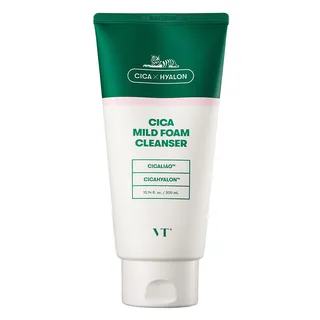
VT Cosmetics Cica Mild Foam Cleanser
Works for
CleansingStearic acid, Cocamidopropyl betaine + 5 moreCan be harsh
“Cica Mild Foam Cleanser”
This product works by removing dirt and oil from the surface of the skin.
The following cleansing agents are typically mild, but still can cause an irritation or allergy for some people cocamidopropyl betaine.
Keep in mind that cleansing can disrupt the skin barrier, and most people do not need to cleanse their skin more than once per day.
Can it cause trouble?
Irritancy4 strong irritants: Lavandula angustifolia flower extract, Mentha piperita leaf extract + 2 more — patch-test recommendedHigh risk
Comedogenic2 ingredients rated 2 or more on the 0–5 pore-clogging scale2 flagged

User reviews
1 of 2 community members would buy it again.
Ingredients
Filter by role to see what each ingredient is doing.
Water~45–55%
Stearic acid~8.6–10.5%
- Irritation risk
- Low
Helps oil and water mix together and works as an emollient
More about Stearic acidCocamidopropyl betaine~6.2–7.5%
- Irritation risk
- High
Helps water and oil mix together. Used as a cleansing ingredient. Could be an allergen
More about Cocamidopropyl betaineLauric acid~3.3–4%
- Irritation risk
- Medium
- Comedogenicity
- 3/5
Helps water and oil mix together. Has anti-bacterial properties that might be helpful in preventing blemishes
More about Lauric acidMyristic acid~2.3–2.9%
- Irritation risk
- Medium
- Comedogenicity
- 3/5
Helps oil and water mix together. Could be comedogenic
More about Myristic acidPotassium hydroxide~2–2.4%
Glycerin~1.8–2.1%
- Irritation risk
- Low
One of the best moisturizing ingredients. Naturally present in skin. It attracts water to the upper layer of the skin working as a humectant
More about GlycerinPotassium cocoyl glycinate~1.5–1.8%
Peg-90~1.2–1.5%
- Irritation risk
- Low
Glyceryl stearate~1–1.3%
- Irritation risk
- Low
An emollient that softens the skin and forms a protective layer on its surface. Helps water and oil mix together
More about Glyceryl stearatePeg-100 stearate~0.9–1.1%
- Irritation risk
- Low
Helps oil and water mix togehter and creates a nice product texture
More about Peg-100 stearateMadecassic acid~0.6–0.9%
- Irritation risk
- Medium
An active compound of Centella Asiatica plant extract. In combination with other active compounds of Centella Asiatica extract (asiaticoside, madecasosside and asiatic acid), madecassic acid has been shown to be helpful in wound-healing, restoring skin barrier function and supporting collagen production in skin. It can, however, itself be irritating
More about Madecassic acidMadecassoside~0.55–0.85%
- Irritation risk
- Medium
An antioxidant that is typically derived from plant Centella Asiatica. It can help neutralize free radicals in skin and support skin barrier function. It could, however, itself be irritating. It is often unstable in formulations
More about MadecassosideAsiaticoside~0.5–0.75%
- Irritation risk
- Medium
An active compound of Centella Asiatica plant extract. In combination with other active compounds of Centella Asiatica extract (madecasosside, asiatic acid and madecassic acid), asiaticoside has been shown to be helpful in wound-healing, restoring skin barrier function and supporting collagen production in skin. It can, however, itself be irritating
More about AsiaticosideAsiatic acid~0.5–0.75%
- Irritation risk
- Medium
An active compound of Centella Asiatica plant extract. In combination with other active compounds of Centella Asiatica extract (asiaticoside, madecasosside and madecassic acid) asiatic acid has been shown to be helpful in wound-healing, restoring skin barrier function and supporting collagen production in skin. It can, however, itself be irritating
More about Asiatic acidPropolis extract~0.5–0.8%
- Irritation risk
- High
A complex substance produced by honey bees. Can have anti-bacterial and some anti-oxidant effect. Is an allergen and can be irritating
More about Propolis extractCentella asiatica extract~0.6–0.85%
- Irritation risk
- Medium
A plant extract that has been shown to be able to reduce inflammation in skin, support restoration of skin barrier function, as well as support collagen production. Contains active compounds called centelloids: asiaticoside, madecasosside, asiatic acid and madecassic acid. Might be helpful in preventing stretch marks. It can be itself be irritating though.
More about Centella asiatica extractSodium hyaluronate~0.45–0.7%
- Irritation risk
- Low
One of the best moisturizing ingredients. Attracts water into the upper layer of the skin
More about Sodium hyaluronateLavandula angustifolia flower extract~0.5–0.75%
- Irritation risk
- High
Essential oil that can be irritating
More about Lavandula angustifolia flower extractMonarda didyma leaf extract~0.35–0.65%
- Irritation risk
- Low
Mentha piperita leaf extract~0.35–0.6%
- Irritation risk
- High
Used as a fragrance and can be irritating
More about Mentha piperita leaf extractFreesia refracta extract~0.3–0.6%
- Irritation risk
- Low
Chamomilla recutita flower extract~0.3–0.55%
- Irritation risk
- High
Plant extract that can have healing and anti-inflammatory properties. It is a potential allergen and can be irritating
More about Chamomilla recutita flower extractRosmarinus officinalis leaf extract~0.3–0.5%
- Irritation risk
- High
Can be helpful in reducing inflammation in skin, including inflamed acne. It can be irritating
More about Rosmarinus officinalis leaf extractHydrolyzed hyaluronic acid~0.3–0.55%
- Irritation risk
- Low
One of the best moisturizing ingredients. Attracts water into the upper layer of the skin. A version of it is naturally present in skin
More about Hydrolyzed hyaluronic acidSodium acetylated hyaluronate~0.25–0.5%
- Irritation risk
- Low
A type of hyaluronic acid that works as an excellent moisturizer by attracting water into the upper layer of the skin. Is typically feels less sticky on the skin compared to the usual hyaluronic acid
More about Sodium acetylated hyaluronatePolyquaternium-7~0.25–0.5%
- Irritation risk
- Low
Helps soften the upper layer of the skin and create a nice product finish
More about Polyquaternium-7Tocopheryl acetate~0.25–0.45%
- Irritation risk
- Medium
A more stable but less bio-available form of vitamin E compared to Tocopherol. Might help moisturize and protect the skin from free radicals, but mostly used in low concentrations to stabilize other ingredients.
More about Tocopheryl acetateDisodium edta~0.15–0.3%
1,2-hexanediol~0.1–0.25%
Peg-14m~0.15–0.3%
- Irritation risk
- Low
Acrylates/c10-30 alkyl acrylate crosspolymer~0.1–0.2%
- Irritation risk
- Medium
Maintains the texture of skincare products. Allows the product to spread evenly. Helps oil and water mix together
More about Acrylates/c10-30 alkyl acrylate crosspolymerSodium polyacrylate~0.15–0.25%
- Irritation risk
- Low
Used to create a gel-like product texture, as well as to stabilize emulsions
More about Sodium polyacrylateParfum~0.05–0.1%
- Irritation risk
- High
An aromatic blend of unspecified and possibly irritating ingredients
More about ParfumIngredient list view
Water, Stearic acid, Cocamidopropyl betaine, Lauric acid, Myristic acid, Potassium hydroxide, Glycerin, Potassium cocoyl glycinate, Peg-90, Glyceryl stearate, Peg-100 stearate, Madecassic acid, Madecassoside, Asiaticoside, Asiatic acid, Propolis extract, Centella asiatica extract, Sodium hyaluronate, Lavandula angustifolia flower extract, Monarda didyma leaf extract, Mentha piperita leaf extract, Freesia refracta extract, Chamomilla recutita flower extract, Rosmarinus officinalis leaf extract, Hydrolyzed hyaluronic acid, Sodium acetylated hyaluronate, Polyquaternium-7, Tocopheryl acetate, Disodium edta, 1,2-hexanediol, Peg-14m, Acrylates/c10-30 alkyl acrylate crosspolymer, Sodium polyacrylate, Parfum
Compare prices
Retailers ranked by price — lowest first.

Worth comparing, line by line.
Match % combines shared ingredients, the first five ingredients, shared actives and hero ingredients, irritancy (lower counts in the alternative's favour), texture and body area. Only products in the same routine step are compared.
| VT CosmeticsCica Mild Foam CleanserYOUR PRODUCT | the Torriden StoreBalanceful Cica Cleansing Gel | LeadersCalming Biotics Gel Cleanser | MISSHATime Revolution Brightening Care Whipping Foam Cleanser | |
|---|---|---|---|---|
| Match | — | 50% | 50% | 44% |
| Price | $13.00 | $4.09−$8.91 | $22.00+$9.00 | — |
| Shared key ingredients | — | 6 of 18 | 6 of 18 | 8 of 18 |
| Key difference | — | Capryloyl Salicylic Acid | Capryloyl Salicylic Acid | Niacinamide |
| Irritancy | High | Medium | Medium | Medium |
| Drying alcohol | — | — | Contains drying alcohol | — |
| View product | Shop | Shop | Shop |


More alternatives: Secret Key Snail Repairing Foam Cleansermirenesse Power Lift Micro Dynamic Foam Cleanser
Sources cited in this review
Every concentration estimate and effectiveness label is anchored to one of these 29 studies and safety reviews.
- 1
- 2
- 3Contact dermatitis due to Madecassolonlinelibrary.wiley.com
- 4Centella asiatica in Dermatology: An Overviewonlinelibrary.wiley.com
- 5Centella asiatica in Dermatology: An Overviewonlinelibrary.wiley.com
- 6

Affiliate links · As an Amazon Associate, WIMJ earns from qualifying purchases.