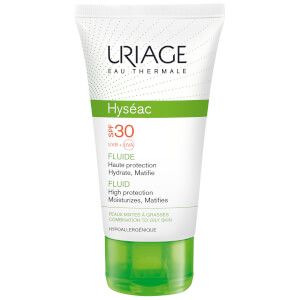
Uriage Hyséac High Protection Emulsion for Combination to Oily Skin SPF50+
Works for
0 of 2 advertised claims delivered
Sun protectionSPF 50 · 3 UV filters · Broad spectrumWeak protectionLow filter dose
This product can be considered "reef safe" because it does not contain the UV filters (oxybenzone and octinoxate) that can be harmful to coral reefs when present in the water in high concentrations.
Anti-blemishNo ingredient credited for this claimNo support
“prevents the appearance of new blemishes”
Effective ingredients missing or their concentration is too low.
MoisturizingNot advertised by the brand · 5 ingredients credited for this claimGood support
This product can help improve hydration of the skin with the two types of ingredients.
The first type is called “humectants”:
these ingredients help attract water.
When humectants are on the surface of the skin, they “pull in” the moisture from the outside environment, or from
within deeper layers of the skin. The following ingredients in this product do the job:
glycerin, butylene glycol.
This product also contains ingredients called “occlusives”. They help reduce the speed with which our skin loses moisture to the outside environment. These ingredients also help soften the upper layer of the skin, so it feels less tight and nicer to the touch. The following ingredients in this product do the job: caprylic/capric triglyceride, dicaprylyl carbonate.
Can it cause trouble?
Irritancy1 strong irritant: ParfumMedium risk
ComedogenicClean of flagged comedogenic ingredientsNone flagged
User reviews
Be the first — your take helps the next person decide.
Ingredients
Filter by role to see what each ingredient is doing.
Water~45–55%
Caprylic/capric triglyceride~6.3–7.7%
- Irritation risk
- Medium
A good mix of fatty acids that forms a protective layer on the skin. Improves the shelf life of products. Derived from coconut and glycerin
More about Caprylic/capric triglycerideCorn starch modified~4.3–5.2%
Glycerin~3.1–3.8%
- Irritation risk
- Low
One of the best moisturizing ingredients. Naturally present in skin. It attracts water to the upper layer of the skin working as a humectant
More about GlycerinButylene glycol oleate~2.4–2.9%
Dicaprylyl carbonate~2–2.4%
- Irritation risk
- Low
Helps products spread more easily and works as an emollient to soften skin
More about Dicaprylyl carbonateWater~1.7–2%
Methylene bis-benzotriazolyl tetramethylbutylphenol~2–2.4%
- Irritation risk
- Medium
Tinosorb M. A UV filter. Is effective against both UVA and UVB rays. It also provides some protection against visible light. It is photostable and can also be used to improve photostability of other sunscreen ingredients. Its physical properties help to create lightweight sunscreen formulations. It can leave a slight white cast. Unfortunately, it is not approved by the FDA (US) yet
More about Methylene bis-benzotriazolyl tetramethylbutylphenolEthylhexyl triazone~1.7–2%
- Irritation risk
- Medium
Uvinul T. A UV filter. Effective against UVB rays. It is photostable. Can increase water resistance properties of the sunscreen. Unfortunately, not approved by the FDA (US) yet
More about Ethylhexyl triazoneButyl methoxydibenzoylmethane~1.4–1.7%
- Irritation risk
- Medium
Avobenzone. An organic, or so-called "chemical" UV filter. Protects against both UVA and UVB rays. Needs to be combined with other filters in a formulation to be stable.
More about Butyl methoxydibenzoylmethaneGlycerin~0.7–1.05%
- Irritation risk
- Low
One of the best moisturizing ingredients. Naturally present in skin. It attracts water to the upper layer of the skin working as a humectant
More about GlycerinNylon-12~0.65–0.95%
C20-22 alkyl phosphate~0.45–0.7%
C20-22 alcohols~0.4–0.65%
- Irritation risk
- Low
Butylene glycol~0.35–0.65%
- Irritation risk
- Low
Used to create a nice product texture and help delivery of other ingredients. Might be somewhat helpful in attracting water to the upper layer of the skin
More about Butylene glycolDecyl glucoside~0.45–0.7%
- Irritation risk
- High
Helps oil and water mix together. Can be irritating
More about Decyl glucosideTriacontanyl pvp~0.35–0.6%
- Irritation risk
- Low
Xanthan gum~0.3–0.55%
- Irritation risk
- Low
Used to create a thicker product consistency
More about Xanthan gumChlorphenesin~0.16–0.32%
Parfum~0.2–0.35%
- Irritation risk
- High
An aromatic blend of unspecified and possibly irritating ingredients
More about ParfumBenzoic acid~0.2–0.35%
Tetrasodium edta~0.2–0.35%
Tocopheryl acetate~0.2–0.35%
- Irritation risk
- Medium
A more stable but less bio-available form of vitamin E compared to Tocopherol. Might help moisturize and protect the skin from free radicals, but mostly used in low concentrations to stabilize other ingredients.
More about Tocopheryl acetateO-cymen-5-ol~0.05–0.1%
Sodium hydroxide~0.15–0.25%
Propylene glycol~0.1–0.2%
- Irritation risk
- High
Helps oil and water mix together and can enhance the penetration of other ingredients into the skin. It can be irritating
More about Propylene glycolCitric acid~0.05–0.1%
- Irritation risk
- Medium
Can work as an exfoliant but is typically used to adjust the product pH
More about Citric acidGlycyrrhiza inflata root extract~0.1–0.15%
- Irritation risk
- Medium
A plant extract that can help lighten the skin and calm down inflammation. Might be helpful in neutralizing free radicals
More about Glycyrrhiza inflata root extractIngredient list view
Water, Caprylic/capric triglyceride, Corn starch modified, Glycerin, Butylene glycol oleate, Dicaprylyl carbonate, Water, Methylene bis-benzotriazolyl tetramethylbutylphenol, Ethylhexyl triazone, Butyl methoxydibenzoylmethane, Glycerin, Nylon-12, C20-22 alkyl phosphate, C20-22 alcohols, Butylene glycol, Decyl glucoside, Triacontanyl pvp, Xanthan gum, Chlorphenesin, Parfum, Benzoic acid, Tetrasodium edta, Tocopheryl acetate, O-cymen-5-ol, Sodium hydroxide, Propylene glycol, Citric acid, Glycyrrhiza inflata root extract
Compare prices
Retailers ranked by price — lowest first.

.png)
Product summary
"Uriage - Hyséac High Protection Emulsion for Combination to Oily Skin SPF50+" is using UV filters in a relatively low concentration. Because of this, it might not be able to provide reliable sun protection.
As a plus, this sunscreen uses some of the new generation UV filters (Tinosorb M). These filters are more stable and more gentle on the skin.
It contains good moisturizing ingredients and can double as a hydrating day cream.
Sunscreen filters
This sunscreen uses so-called "chemical", or organic UV filters (organic simply means that their molecules contain atoms of carbon). These filters typically give good sun protection and rarely leave a white cast, but they can be irritating for sensitive skin. The UV filters in this sunscreen are: avobenzone 1.10% - 1.40%, uvinul t 1.40% - 1.70% and tinosorb m 1.60% - 1.90%.
Irritation risk
There are some common irritants in this product, including ingredients that do not have benefits for the skin. We assess the overall irritancy of it to be medium. For a detailed overview of all potential irritants: click here
You can see the detailed formula review with the breakdown of all actives in the product and the full ingredient list with estimated concentrations in the tables below.
Price
The product retails for 13.19$ in the United States and at around 13.32£ in the United Kingdom.
For a detailed price comparison: click here.
Sources cited in this review
Every concentration estimate and effectiveness label is anchored to one of these 7 studies and safety reviews.
- 1
- 2
- 3
- 4Allergic contact dermatitis caused by isopropyl methylphenol, a new haptenonlinelibrary.wiley.com
- 5Surfactants and experimental irritant contact dermatitisncbi.nlm.nih.gov
- 6Propylene Glycolpubmed.ncbi.nlm.nih.gov

Affiliate links · As an Amazon Associate, WIMJ earns from qualifying purchases.