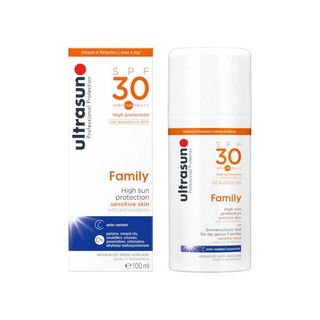
Ultrasun Family SPF 30
Works for
2 of 2 advertised claims delivered
Sun protectionSPF 30 · 4 UV filtersBroad spectrum
This product offers a good level of protection against both UVB and UVA rays.
This sunscreen uses organic (so-called "chemical") sunscreen filters. Organic, or "chemical" filters usually provide reliable sun protection and rarely leave a white cast. Sunscreens with organic filters can sting eyes.
Moisturizing12 ingredients credited for this claimStrong support
“Providing broad-spectrum protection from UVA, UVB, blue light and infrared-A rays, the brand utilises patented Lamellar technology to deliver long-lasting, high-level, water-resistant protection while also helping to strengthen your skin barrier.”
This product can help improve hydration of the skin with the two types of ingredients.
The first type is called “humectants”:
these ingredients help attract water.
When humectants are on the surface of the skin, they “pull in” the moisture from the outside environment, or from
within deeper layers of the skin. The following ingredients in this product do the job:
glycerin, propylene glycol.
This product also contains ingredients called “occlusives”. They help reduce the speed with which our skin loses moisture to the outside environment. These ingredients also help soften the upper layer of the skin, so it feels less tight and nicer to the touch. The following ingredients in this product do the job: dimethicone, cyclopentasiloxane.
The following ingredients in this product are especially good for supporting the skin barrier and helping with the hydration level: paraffinum liquidum
Anti-oxidationNot advertised by the brand · 3 ingredients credited for this claimStrong support
This product contains antioxidants (superoxide dismutase) that can help neutralize free radicals in skin. By doing so, they can lessen the damage the skin gets from the UV light (sun).
Evens skin toneNot advertised by the brand · No ingredient credited for this claimStrong support
This product offers broad spectrum sun protection. It means that it can prevent hyperpigmentation and help keep the skin tone even (sun damage is the main factor causing age spots, darkening of post-acne marks and other discolorations).
Anti-agingNot advertised by the brand · No ingredient credited for this claimStrong support
This product can help prevent early signs of skin aging because it offers a good level of broad spectrum sun protection. Sun damage is the main cause of premature skin aging, and protecting your skin from the sun is the best anti-aging strategy.
Can it cause trouble?
Irritancy3 strong irritants: Alcohol, Menthol + 1 more — patch-test recommendedHigh risk
ComedogenicClean of flagged comedogenic ingredientsNone flagged


User reviews
Be the first — your take helps the next person decide.
Ingredients
Filter by role to see what each ingredient is doing.
Water~45–55%
Propylene glycol~4.3–5.2%
- Irritation risk
- High
Helps oil and water mix together and can enhance the penetration of other ingredients into the skin. It can be irritating
More about Propylene glycolAlcohol~4.1–5.1%
- Irritation risk
- High
Can be drying and contribute to skin irritation. Used in formulars to dissolve other ingredients, create a thinner product consistency or for its antibacterial properties
More about AlcoholLecithin~2.8–3.4%
- Irritation risk
- Low
Used mostly for creating emulsions - helping oil and water mix together. Helps soften the upper layer of the skin
More about LecithinEthylhexyl methoxycinnamate~3.2–3.9%
- Irritation risk
- High
Octinoxate. When used in higher concentrations, works as a sunscreen protecting the skin from UVB rays. When used in lower concentration, helps to preserve the product formulation. Is shown to be harmful to coral reefs - consider avoiding bathing in coral reef areas when wearing a product with this ingredient. It can be irritating
More about Ethylhexyl methoxycinnamateButyl methoxydibenzoylmethane~2.6–3.1%
- Irritation risk
- Medium
Avobenzone. An organic, or so-called "chemical" UV filter. Protects against both UVA and UVB rays. Needs to be combined with other filters in a formulation to be stable.
More about Butyl methoxydibenzoylmethaneTitanium dioxide~2.1–2.6%
- Irritation risk
- Low
Works as a UV filter when used in high concentrations. It is photostable and is effective mostly against the UVB light, with some protection in the UVA range. In small concentrations, used for its ability to improve the color of cosmetic products. Is usually well tolerated by the skin
More about Titanium dioxideMethylene bis-benzotriazolyl tetramethylbutylphenol~2–2.5%
- Irritation risk
- Medium
Tinosorb M. A UV filter. Is effective against both UVA and UVB rays. It also provides some protection against visible light. It is photostable and can also be used to improve photostability of other sunscreen ingredients. Its physical properties help to create lightweight sunscreen formulations. It can leave a slight white cast. Unfortunately, it is not approved by the FDA (US) yet
More about Methylene bis-benzotriazolyl tetramethylbutylphenolSodium acrylates copolymer~1.2–1.4%
- Irritation risk
- Medium
Used to create a thicker product consistency
More about Sodium acrylates copolymerDimethicone~1–1.3%
- Irritation risk
- Low
A silicone that helps to reduce water loss from the surface of the skin. Can temporarily "fill in" lines and wrinkles, absorb oil, and create a nice product finish
More about DimethiconePentylene glycol~0.75–1.15%
- Irritation risk
- Medium
Used to preserve products, dissolve other ingredients and create a nice product texture
More about Pentylene glycolTocopheryl acetate~0.6–0.9%
- Irritation risk
- Medium
A more stable but less bio-available form of vitamin E compared to Tocopherol. Might help moisturize and protect the skin from free radicals, but mostly used in low concentrations to stabilize other ingredients.
More about Tocopheryl acetateAluminum hydroxide~0.65–0.95%
- Irritation risk
- Low
Is used to add opaque (non-transparent) appearance to formulations. Can be used to coat other ingredients for even dispersion. This is a different ingredient compared to the ones used in antipersperants (aluminium chloride and aluminium chlorohydrate)
More about Aluminum hydroxideDecyl glucoside~0.7–1.05%
- Irritation risk
- High
Helps oil and water mix together. Can be irritating
More about Decyl glucosideDisodium edta~0.5–0.7%
Paraffinum liquidum~0.5–0.75%
- Irritation risk
- Low
Mineral oil. One of the most effective and well studied occlusive and emollient moisturizing ingredients. Helps reduce moisture loss in skin and repair skin barrier function
More about Paraffinum liquidumPentadecalactone~0.45–0.7%
- Irritation risk
- Low
Ppg-1 trideceth-6~0.45–0.65%
Stearic acid~0.65–0.95%
- Irritation risk
- Low
Helps oil and water mix together and works as an emollient
More about Stearic acidXanthan gum~0.35–0.65%
- Irritation risk
- Low
Used to create a thicker product consistency
More about Xanthan gumWater~0.3–0.6%
Peg/ppg-17/18 dimethicone~0.35–0.65%
Allantoin~0.25–0.5%
- Irritation risk
- Low
Helps calm down inflammation in skin and can help reduce itching. Helps to repair the skin barrier and keep skin hydrated
More about AllantoinBisabolol~0.25–0.5%
- Irritation risk
- Low
An active component of chamomile plant that historically has been used to calm down irritated skin. A recent study shows that bisabolol indeed can have some anti-inflammatory effect on skin, even though conclusive data is lacking. Bisabolol has a sweet floral scent and can be added to products for its aromatic properties
More about BisabololLactoperoxidase~0.3–0.55%
- Irritation risk
- Low
Helps attract water to the upper layer of the skin. In theory, could support healthy skin's microbiome, but evidence of effectiveness in skin is lacking
More about LactoperoxidaseLecithin~0.35–0.6%
- Irritation risk
- Low
Used mostly for creating emulsions - helping oil and water mix together. Helps soften the upper layer of the skin
More about LecithinSuperoxide dismutase~0.3–0.55%
- Irritation risk
- Low
An antioxidant enzyme that is naturally present in skin. It can help support skin barrier function and reduce inflammation in skin. It is used in topical medications for inflammatory skin conditions including atopic dermatitis (eczema) and psoriasis. There are three types of natural Superoxide Dismutase in human skin. The compound used in topical treatments and cosmetics are mimics of typically one of these natural variants
More about Superoxide dismutaseTocopheryl acetate~0.3–0.55%
- Irritation risk
- Medium
A more stable but less bio-available form of vitamin E compared to Tocopherol. Might help moisturize and protect the skin from free radicals, but mostly used in low concentrations to stabilize other ingredients.
More about Tocopheryl acetateAlcohol~0.3–0.55%
- Irritation risk
- High
Can be drying and contribute to skin irritation. Used in formulars to dissolve other ingredients, create a thinner product consistency or for its antibacterial properties
More about AlcoholGlycerin~0.3–0.6%
- Irritation risk
- Low
One of the best moisturizing ingredients. Naturally present in skin. It attracts water to the upper layer of the skin working as a humectant
More about GlycerinMenthol~0.25–0.5%
- Irritation risk
- High
Paraffinum liquidum~0.3–0.55%
- Irritation risk
- Low
Mineral oil. One of the most effective and well studied occlusive and emollient moisturizing ingredients. Helps reduce moisture loss in skin and repair skin barrier function
More about Paraffinum liquidumParfum~0.25–0.45%
- Irritation risk
- High
An aromatic blend of unspecified and possibly irritating ingredients
More about ParfumPpg-1 trideceth-6~0.25–0.5%
Sodium acrylates copolymer~0.2–0.4%
- Irritation risk
- Medium
Used to create a thicker product consistency
More about Sodium acrylates copolymerCyclohexasiloxane~0.25–0.45%
- Irritation risk
- Low
A silicone that serves as an emollient. Helps create a nice non-greasy feels
More about CyclohexasiloxaneCyclopentasiloxane~0.25–0.45%
- Irritation risk
- Low
A silicone that helps improve the product texture and spreadability. Can absorb oil creating a short-term mattifying effect on the skin
More about CyclopentasiloxanePhenoxyethanol~0.15–0.25%
- Irritation risk
- Low
A preservative. It helps prevent bacterial growth in cosmetic products
More about PhenoxyethanolButylparaben~0.1–0.2%
Ethylparaben~0.15–0.25%
Isobutylparaben~0.15–0.25%
Methylparaben~0.1–0.2%
Propylparaben~0.1–0.2%
Ingredient list view
Water, Propylene glycol, Alcohol, Lecithin, Ethylhexyl methoxycinnamate, Butyl methoxydibenzoylmethane, Titanium dioxide, Methylene bis-benzotriazolyl tetramethylbutylphenol, Sodium acrylates copolymer, Dimethicone, Pentylene glycol, Tocopheryl acetate, Aluminum hydroxide, Decyl glucoside, Disodium edta, Paraffinum liquidum, Pentadecalactone, Ppg-1 trideceth-6, Stearic acid, Xanthan gum, Water, Peg/ppg-17/18 dimethicone, Allantoin, Bisabolol, Lactoperoxidase, Lecithin, Superoxide dismutase, Tocopheryl acetate, Alcohol, Glycerin, Menthol, Paraffinum liquidum, Parfum, Ppg-1 trideceth-6, Sodium acrylates copolymer, Cyclohexasiloxane, Cyclopentasiloxane, Phenoxyethanol, Butylparaben, Ethylparaben, Isobutylparaben, Methylparaben, Propylparaben
Compare prices
Retailers ranked by price — lowest first.
Affiliate links · prices updated regularly · As an Amazon Associate, WIMJ earns from qualifying purchases.
Worth comparing, line by line.
Match % combines shared ingredients, the first five ingredients, shared actives and hero ingredients, irritancy (lower counts in the alternative's favour), texture and body area. Only products in the same routine step are compared.
| UltrasunFamily SPF 30YOUR PRODUCT | NiveaKids Protect & Care Sun Lotion SPF 50+ | KUMANO COSMEReihaku Hatomugi UV Milky Gel SPF 31 PA+++ | VichyIdéal Soleil Invisible Hydrating Mist SPF50 + Soothing After-Sun Milk Free | |
|---|---|---|---|---|
| Match | — | 60% | 53% | 51% |
| Price | $19.02 | $5.29−$13.73 | $17.10−$1.92 | $20.89+$1.87 |
| Shared key ingredients | — | 6 of 12 | 3 of 12 | 4 of 12 |
| Key difference | — | Tinosorb S | Uvinul A Plus | Butyrospermum Parkii Butter |
| Irritancy | High | Medium | Medium | Medium |
| SPF | SPF 30 | SPF 50 | SPF 31 | SPF 50 |
| Drying alcohol | Contains drying alcohol | Contains drying alcohol | Contains drying alcohol | Contains drying alcohol |
| View product | Shop | Shop | Shop |


Product summary
Based on the ingredient list, we assess that "Ultrasun - Family SPF 30" can provide reliable sun protection. It can protect from both UVA and UVB rays. This is great news because not all sunscreens with SPF ratings give UVA protection. (UVA rays do not cause sunburn, but still damage our skin and lead to early aging).
As a plus, this sunscreen uses some of the new generation UV filters (Tinosorb M). These filters are more stable and more gentle on the skin.
It should also be hydrating enough to use without an additional moisturizer during the day. Like all broad-spectrum sunscreens, this product helps prevent early signs of aging.
Sunscreen filters
This sunscreen uses a mixture of both mineral and organic (so-called "chemical") UV filters. The organic filters in the product are: avobenzone, octinoxate and tinosorb m. As for the mineral filters, this sunscreen uses titanium dioxide.
Irritation risk
There are quite a few common irritants in this product, including ingredients without particular skin benefits. We would not recommend it for sensitive skin. We assess the overall irritancy of this product to be high. For a detailed overview of all potential irritants: click here
You can see the detailed formula review with the breakdown of all actives in the product and the full ingredient list with estimated concentrations in the tables below.
Price
The product retails from 7.62£ up to 50.00£ in the United Kingdom and from 38.00$ up to 50.00$ in the United States.
For a detailed price comparison: click here.
Sources cited in this review
Every concentration estimate and effectiveness label is anchored to one of these 20 studies and safety reviews.
- 1Surfactants and experimental irritant contact dermatitisncbi.nlm.nih.gov
- 2Propylene Glycolpubmed.ncbi.nlm.nih.gov
- 3Skin-sensitizing and irritant properties of propylene glycolonlinelibrary.wiley.com
- 4
- 5
- 6Final Report on the Safety Assessment of Dimethicone Copolyoljournals.sagepub.com

Affiliate links · As an Amazon Associate, WIMJ earns from qualifying purchases.