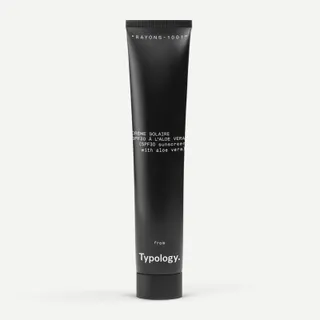
Typology SPF30 face sunscreen — with aloe vera
Works for
Sun protectionSPF 30 · 5 UV filtersBroad spectrum
This product offers a good level of protection against both UVB and UVA rays.
This sunscreen uses organic (so-called "chemical") sunscreen filters. Organic, or "chemical" filters usually provide reliable sun protection and rarely leave a white cast. Sunscreens with organic filters can sting eyes.
This product can be considered "reef safe" because it does not contain the UV filters (oxybenzone and octinoxate) that can be harmful to coral reefs when present in the water in high concentrations.
Anti-agingSide benefit · TocopherolWorks well
This product can help prevent early signs of skin aging because it offers a good level of broad spectrum sun protection. Sun damage is the main cause of premature skin aging, and protecting your skin from the sun is the best anti-aging strategy.
Evens skin toneSide benefit · No ingredient credited for this claimWorks well
This product offers broad spectrum sun protection. It means that it can prevent hyperpigmentation and help keep the skin tone even (sun damage is the main factor causing age spots, darkening of post-acne marks and other discolorations).
MoisturizingSide benefit the brand mentions · Diisopropyl sebacate, Polyglyceryl-6 stearate + 8 moreWorks
“Prevents photoaging through mineral and organic filters which offer broad spectrum UVA and UVB protectionEnriched with hyaluronic acid and aloe vera to deeply hydrate the skin”
This product can help improve hydration of the skin with the two types of ingredients.
The first type is called “humectants”:
these ingredients help attract water.
When humectants are on the surface of the skin, they “pull in” the moisture from the outside environment, or from
within deeper layers of the skin. The following ingredients in this product do the job:
hydrolyzed hyaluronic acid.
This product also contains ingredients called “occlusives”. They help reduce the speed with which our skin loses moisture to the outside environment. These ingredients also help soften the upper layer of the skin, so it feels less tight and nicer to the touch. The following ingredients in this product do the job: helianthus annuus seed wax, diisopropyl sebacate.
Can it cause trouble?
Irritancy10 flagged ingredientsLow risk
Comedogenic2 ingredients rated 2 or more on the 0–5 pore-clogging scale2 flagged
User reviews
Be the first — your take helps the next person decide.
Ingredients
Filter by role to see what each ingredient is doing.
Water~45–55%
Propanediol dicaprylate~6–7.4%
- Irritation risk
- Low
Diisopropyl sebacate~4–4.9%
- Irritation risk
- Low
Helps soften the upper layer of the skin without creatng a greasy finish
More about Diisopropyl sebacateZinc oxide~3.6–4.4%
- Irritation risk
- Low
A broad spectrum sunblock (protects from both UVA and UVB rays). Is suitable for most sensitive skins. In small concentrations, can be used as a colorant
More about Zinc oxideBis-ethylhexyloxyphenol methoxyphenyl triazine~2.9–3.6%
- Irritation risk
- Medium
Tinosorb S. One of the most effective broad spectrum sunscreen ingredients. Protects from both UVA and UVB rays. It is photostable. Approved by the US FDA in 2026 (listed as bemotrizinol on US labels).
More about Bis-ethylhexyloxyphenol methoxyphenyl triazinePolyglyceryl-6 stearate~1.8–2.3%
- Irritation risk
- Low
Helps soften the upper layer of the skin
More about Polyglyceryl-6 stearateCalcium sodium borosilicate~1.5–1.9%
Diethylamino hydroxybenzoyl hexyl benzoate~1.9–2.3%
- Irritation risk
- Medium
Uvinul A Plus. A new generation broad spectrum sunscreen that offers an effective protection especially in the UVA range. It is stable in formulations. Unfortunately, is not approved by the FDA (US) yet
More about Diethylamino hydroxybenzoyl hexyl benzoateEthylhexyl triazone~1.6–1.9%
- Irritation risk
- Medium
Uvinul T. A UV filter. Effective against UVB rays. It is photostable. Can increase water resistance properties of the sunscreen. Unfortunately, not approved by the FDA (US) yet
More about Ethylhexyl triazoneOlus oil~0.9–1.15%
- Irritation risk
- Low
An oil from a mixture of different vegetables. Helps soften the upper layer of the skin
More about Olus oilDisodium phenyl dibenzimidazole tetrasulfonate~1.1–1.3%
- Irritation risk
- Medium
Neo Heliopan AP. A UV filter. Effective against UVA II rays. It is stable. It is water-soluble, which helps to create lightweight sunscreen formulations. Unfortunately, not approved by FDA (US) yet
More about Disodium phenyl dibenzimidazole tetrasulfonatePongamia glabra seed oil~0.5–0.75%
- Irritation risk
- Low
A plant oil that helps soften the upper layer of the skin
More about Pongamia glabra seed oilHydrolyzed hyaluronic acid~0.45–0.65%
- Irritation risk
- Low
One of the best moisturizing ingredients. Attracts water into the upper layer of the skin. A version of it is naturally present in skin
More about Hydrolyzed hyaluronic acidAloe barbadensis leaf juice powder~0.45–0.65%
- Irritation risk
- Medium
Traditionally used to treat sunburns, dermatitis and inflammation, but evidence for its effectiveness is lacking. The extract can contain humectants that help attract water into the skin
More about Aloe barbadensis leaf juice powderTocopherol~0.4–0.6%
- Irritation risk
- Low
Pure form of vitamin E. Can help moisturise and protect the skin from free radicals. Often used to help stabilise other ingredients or the formula itself
More about TocopherolHelianthus annuus seed wax~0.4–0.6%
- Irritation risk
- Low
Helps soften the upper layer of the skin and support skin's barrier function while creating a thicker product consistency
More about Helianthus annuus seed waxChondrus crispus powder~0.5–0.75%
- Irritation risk
- Low
- Comedogenicity
- 3/5
A powder from red algae extract that helps attract water to the upper layer of the skin and create a nicer product consistency
More about Chondrus crispus powderPolyglyceryl-6 behenate~0.25–0.5%
Hydrogenated vegetable oil~0.25–0.45%
- Irritation risk
- Low
- Comedogenicity
- 2/5
An oil from a mixture of different vegetables. Helps soften the upper layer of the skin
More about Hydrogenated vegetable oilEthylhexylglycerin~0.2–0.35%
C18-21 alkane~0.2–0.35%
- Irritation risk
- Low
Candelilla cera~0.2–0.4%
- Irritation risk
- Low
Phenylpropanol~0.15–0.25%
- Irritation risk
- High
Helps mask the smell of other ingredients and helps preserve the product formulation
More about PhenylpropanolSodium gluconate~0.1–0.15%
Diethyl sebacate~0.1–0.2%
- Irritation risk
- Low
Sodium hydroxide~0.05–0.1%
Citric acid~0.01–0.05%
- Irritation risk
- Medium
Can work as an exfoliant but is typically used to adjust the product pH
More about Citric acidIngredient list view
Water, Propanediol dicaprylate, Diisopropyl sebacate, Zinc oxide, Bis-ethylhexyloxyphenol methoxyphenyl triazine, Polyglyceryl-6 stearate, Calcium sodium borosilicate, Diethylamino hydroxybenzoyl hexyl benzoate, Ethylhexyl triazone, Olus oil, Disodium phenyl dibenzimidazole tetrasulfonate, Pongamia glabra seed oil, Hydrolyzed hyaluronic acid, Aloe barbadensis leaf juice powder, Tocopherol, Helianthus annuus seed wax, Chondrus crispus powder, Polyglyceryl-6 behenate, Hydrogenated vegetable oil, Ethylhexylglycerin, C18-21 alkane, Candelilla cera, Phenylpropanol, Sodium gluconate, Diethyl sebacate, Sodium hydroxide, Citric acid
Compare prices
Retailers ranked by price — lowest first.
Worth comparing, line by line.
Match % combines shared ingredients, the first five ingredients, shared actives and hero ingredients, irritancy (lower counts in the alternative's favour), texture and body area. Only products in the same routine step are compared.
| TypologySPF30 face sunscreen — with aloe veraYOUR PRODUCT | ShiseidoAnessa Moisture UV Sunscreen Mild Milk For Sensitive Skin A SPF 35 PA+++ | BiodermaPhotoderm MAX Family Milk SPF 50+ | NeutreaUV Protector SPF50+/PA++++ - Nude | |
|---|---|---|---|---|
| Match | — | 29% | 29% | 28% |
| Price | — | $40.07 | — | — |
| Shared key ingredients | — | 4 of 8 | 4 of 8 | 4 of 8 |
| Key difference | — | Cyclopentasiloxane | Caprylic/Capric Triglyceride | Panthenol |
| Irritancy | Low | Low | Low | Low |
| SPF | SPF 30 | SPF 35 | SPF 50 | SPF 50 |
| Drying alcohol | — | — | — | — |
| View product | Shop | Shop | Shop |


More alternatives: Garancia Incredible Softness Invisible Fluid SPF50+Riemann P20 SPF50+ Sensitive Sun Cream
Product summary
We assess that "Typology Paris - SPF30 face sunscreen — with aloe vera" can provide reliable sun protection based on the ingredient list. We love that it can protect from both UVA and UVB rays (not all sunscreens with SPF ratings give UVA protection. UVA rays do not cause sunburn, but still damage our skin and lead to early aging).
Its formula is also hydrating, so you might not need an additional moistruizer during the day. Like all broad-spectrum sunscreens, this product has an anti-aging benefit.
Sunscreen filters
This is a "mixed" sunscreen in the sense that it uses both mineral and organic (so-called "chemical") sun filters. Here are the organic filters this product uses: tinosorb s, uvinul a plus, neo heliopan ap and uvinul t. As for the mineral filters, this sunscreen uses zinc oxide.
Irritation risk
There are some common irritants in this product, including ingredients that do not have benefits for the skin. We assess the overall irritancy of this sunscreen to be low. For a detailed overview of all potential irritants: click here
You can see the detailed formula review with the breakdown of all actives in the product and the full ingredient list with estimated concentrations in the tables below.
Price
The product retails for 39.90$ in the United States.
For a detailed price comparison: click here.
Sources cited in this review
Every concentration estimate and effectiveness label is anchored to one of these 11 studies and safety reviews.
- 1A review of inorganic UV filters zinc oxide and titanium dioxideonlinelibrary.wiley.com
- 2
- 3
- 4
- 5
- 6

Affiliate links · As an Amazon Associate, WIMJ earns from qualifying purchases.