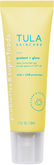
Tula Protect + Glow Daily Sunscreen Gel Broad Spectrum SPF 30
Works for
2 of 2 advertised claims delivered
Sun protectionSPF 30 · 5 UV filtersBroad spectrum
This product offers a good level of protection against both UVB and UVA rays.
This sunscreen uses organic (so-called "chemical") sunscreen filters. Organic, or "chemical" filters usually provide reliable sun protection and rarely leave a white cast. Sunscreens with organic filters can sting eyes.
This product can be considered "reef safe" because it does not contain the UV filters (oxybenzone and octinoxate) that can be harmful to coral reefs when present in the water in high concentrations.
Evens skin toneCamellia sinensis leaf extract, Lactic acidStrong evidence
“Help promote even-looking skin tone. . Wild Butterfly Ginger Root.”
This product offers broad spectrum sun protection. It means that it can prevent hyperpigmentation and help keep the skin tone even (sun damage is the main factor causing age spots, darkening of post-acne marks and other discolorations).
MoisturizingNot advertised by the brand · Lactococcus ferment lysate, Arginine + 10 moreGood evidence
This product can help improve hydration of the skin with the two types of ingredients.
The first type is called “humectants”:
these ingredients help attract water.
When humectants are on the surface of the skin, they “pull in” the moisture from the outside environment, or from
within deeper layers of the skin. The following ingredients in this product do the job:
arginine, glycerin.
This product also contains ingredients called “occlusives”. They help reduce the speed with which our skin loses moisture to the outside environment. These ingredients also help soften the upper layer of the skin, so it feels less tight and nicer to the touch. The following ingredients in this product do the job: arginine, pentylene glycol.
Can it cause trouble?
Irritancy4 strong irritants: Carica papaya fruit extract, Citrus aurantium dulcis peel extract + 2 more — patch-test recommendedHigh risk
ComedogenicClean of flagged comedogenic ingredientsNone flagged
User reviews
Ingredients
Filter by role to see what each ingredient is doing.
Butyl methoxydibenzoylmethane3%
- Irritation risk
- Medium
Avobenzone. An organic, or so-called "chemical" UV filter. Protects against both UVA and UVB rays. Needs to be combined with other filters in a formulation to be stable.
More about Butyl methoxydibenzoylmethaneHomosalate10%
- Irritation risk
- Medium
A weak sunscreen that offers some protection against the sun rays that cause sunburn (UVB), but does not offer meaningful protection against protect against the most aging sun rays (UVA). It loses its effectiveness quickly when exposed to sunlight. It is an organic, or so called "chemical" sunscreen. When used in low concentrations, helps to stabilize the product formulation
More about HomosalateEthylhexyl salicylate5%
- Irritation risk
- Low
Octisalate. A UV filter. It offers some protection against the sun rays that cause sunburn (UVB), but does not protect against the most aging sun rays (UVA). It loses its effectiveness quickly when exposed to sunlight. It is an organic, or so called "chemical" sunscreen
More about Ethylhexyl salicylateTitanium dioxide~29–36%
- Irritation risk
- Low
Works as a UV filter when used in high concentrations. It is photostable and is effective mostly against the UVB light, with some protection in the UVA range. In small concentrations, used for its ability to improve the color of cosmetic products. Is usually well tolerated by the skin
More about Titanium dioxideCi 77891~10–12%
- Irritation risk
- Low
Water~6.1–7.4%
Butyloctyl salicylate~4.8–5.9%
- Irritation risk
- Medium
A synthetic ester of salicylic acid that is used to help disperse pigments and boost effectiveness of sunscreen ingredients. It is able to absorb UV light (working as an organic, or chemical filter), but is not approved as a sunscreen ingredient on its own
More about Butyloctyl salicylatePentylene glycol~3.8–4.7%
- Irritation risk
- Medium
Used to preserve products, dissolve other ingredients and create a nice product texture
More about Pentylene glycolLactococcus ferment lysate~2.8–3.4%
- Irritation risk
- Low
Consists of remains of dead bacteria cells. Is likely helpful in attracting water to the upper layer of the skin. Might be helpful in reducing inflammation and neutralizing free radicals in skin
More about Lactococcus ferment lysate1,2-hexanediol~1.3–1.6%
Silica~2.1–2.5%
Ectoin~1.6–1.9%
- Irritation risk
- Low
Softens the upper layer of the skin and can support skin barrier function
More about EctoinGlycerin~1.4–1.7%
- Irritation risk
- Low
One of the best moisturizing ingredients. Naturally present in skin. It attracts water to the upper layer of the skin working as a humectant
More about GlycerinArginine~0.95–1.2%
- Irritation risk
- Low
An amino acid that is naturally present in skin and helps keep it hydrated. When used together with AHAs, it can reduce their irritating effect on the skin
More about ArginineHydroxyectoin~0.95–1.2%
- Irritation risk
- Low
Ananas sativus fruit extract~0.65–0.95%
- Irritation risk
- Medium
A fruit extract that might help to attract water to the upper layer of the skin, but there is no evidence for any other benefits to the skin
More about Ananas sativus fruit extractCarica papaya fruit extract~0.6–0.9%
- Irritation risk
- High
Lactic acid~0.55–0.85%
- Irritation risk
- Medium
An exfoliating and moisturizing alpha-hydroxy acid (AHA). Typically causes less irritation than other AHAs, for example, glycolic acid. At high concentrations (about 15%), lactic acid can help reduce lines and wrinkles. Recent studies show that lactic acid can support the "good" bacteria living on skin's surface (healthy skin microbiome)
More about Lactic acidCamellia sinensis leaf extract~0.6–0.9%
- Irritation risk
- Low
Can contain potent anti-oxidant compounds (abbreviated ECG, GCG, EGC, and EGCG) that might help protect the skin from free radicals. Can help calm down inflammation and has some anti-bacterial properties. Unfortunately, these antioxidants are unstable and lose their effectiveness very quickly in products. The concentration of the antioxidant compounds in the extract also tends to be low to be effective in topical formulation
More about Camellia sinensis leaf extractHedychium coronarium root extract~0.55–0.85%
- Irritation risk
- Low
Triethyl citrate~0.5–0.75%
Citrus aurantium dulcis peel extract~0.45–0.7%
Citrus limon peel extract~0.45–0.7%
Pyrus communis fruit extract~0.45–0.7%
- Irritation risk
- Medium
Can have some moisturizing properties due to its sugar content
More about Pyrus communis fruit extractPyrus malus fruit extract~0.45–0.7%
- Irritation risk
- Medium
Can have some moisturizing properties due to its sugar content
More about Pyrus malus fruit extractRubus idaeus fruit extract~0.45–0.65%
- Irritation risk
- Medium
A fruit extract that might have some anti-oxidant properties but evidence of effectiveness in skin is lacking
More about Rubus idaeus fruit extractVanilla planifolia fruit extract~0.45–0.65%
- Irritation risk
- High
A plant extract used as a fragrance. Can be irritating
More about Vanilla planifolia fruit extractPimpinella anisum fruit extract~0.45–0.7%
- Irritation risk
- High
A plant extract that can have some anti-oxidant properties. Can be used as a fragrance and to help preserve product formulations. Can be irritating
More about Pimpinella anisum fruit extractMica~0.5–0.7%
- Irritation risk
- Low
Creates an illusion of smoother and more radiant skin tone. Adds shimmer to the skin by reflecting light
More about MicaTocopherol~0.45–0.7%
- Irritation risk
- Low
Pure form of vitamin E. Can help moisturise and protect the skin from free radicals. Often used to help stabilise other ingredients or the formula itself
More about TocopherolAmmonium acryloyldimethyltaurate/vp copolymer~0.45–0.65%
- Irritation risk
- Low
Increases thickness of a product. Texture enhancer for oil-in-water emulsions
More about Ammonium acryloyldimethyltaurate/vp copolymerSynthetic fluorphlogopite~0.45–0.7%
- Irritation risk
- Low
A mineral that is used as an optical filter (makes the skin looks nicer through light reflection) and to improve the texture of cosmetic products
More about Synthetic fluorphlogopiteHydrolyzed wheat protein/pvp crosspolymer~0.55–0.8%
- Irritation risk
- Low
Carbomer~0.45–0.7%
- Irritation risk
- Low
Helps create a thicker or gel-like product texture. It is not a surfactant but can be used in gentle cleansing formulations
More about CarbomerDibutyl lauroyl glutamide~0.55–0.8%
- Irritation risk
- Medium
Helps improve the product texture and soften the upper layer of the skin
More about Dibutyl lauroyl glutamideDibutyl ethylhexanoyl glutamide~0.45–0.7%
- Irritation risk
- Medium
Helps improve the product texture and soften the upper layer of the skin
More about Dibutyl ethylhexanoyl glutamidePropanediol~0.45–0.65%
- Irritation risk
- Low
Acts as a solvent for other ingredients. Speeds up the absorption of other ingredients into the skin
More about PropanediolTrisodium ethylenediamine disuccinate~0.35–0.65%
- Irritation risk
- Medium
Used to improve stability of the formulation
More about Trisodium ethylenediamine disuccinateSodium chloride~0.35–0.65%
- Irritation risk
- Low
Used to stabilize mixtures of oil and water, and create thicker, gel-like product textures
More about Sodium chlorideSodium benzoate~0.25–0.5%
Ethylhexylglycerin~0.3–0.5%
Tin oxide~0.4–0.65%
- Irritation risk
- Low
A colorant that can add a pearl-like appearance to the formulation
More about Tin oxidePhenoxyethanol~0.3–0.6%
- Irritation risk
- Low
A preservative. It helps prevent bacterial growth in cosmetic products
More about PhenoxyethanolIngredient list view
Butyl methoxydibenzoylmethane, Homosalate, Ethylhexyl salicylate, Titanium dioxide, Ci 77891, Water, Butyloctyl salicylate, Pentylene glycol, Lactococcus ferment lysate, 1,2-hexanediol, Silica, Ectoin, Glycerin, Arginine, Hydroxyectoin, Ananas sativus fruit extract, Carica papaya fruit extract, Lactic acid, Camellia sinensis leaf extract, Hedychium coronarium root extract, Triethyl citrate, Citrus aurantium dulcis peel extract, Citrus limon peel extract, Pyrus communis fruit extract, Pyrus malus fruit extract, Rubus idaeus fruit extract, Vanilla planifolia fruit extract, Pimpinella anisum fruit extract, Mica, Tocopherol, Ammonium acryloyldimethyltaurate/vp copolymer, Synthetic fluorphlogopite, Hydrolyzed wheat protein/pvp crosspolymer, Carbomer, Dibutyl lauroyl glutamide, Dibutyl ethylhexanoyl glutamide, Propanediol, Trisodium ethylenediamine disuccinate, Sodium chloride, Sodium benzoate, Ethylhexylglycerin, Tin oxide, Phenoxyethanol
Compare prices
Retailers ranked by price — lowest first.


Product summary
Based on the ingredient list, we assess that "Tula - Protect + Glow Daily Sunscreen Gel Broad Spectrum SPF 30" can provide reliable sun protection. We love that it can protect from both UVA and UVB rays (not all sunscreens with SPF ratings give UVA protection. UVA rays do not cause sunburn, but still damage our skin and lead to early aging).
This moisturizer should also be hydrating enough to use without an additional moisturizer during the day.
Sunscreen filters
This is a "mixed" sunscreen in the sense that it uses both mineral and organic (so-called "chemical") sun filters. Here are the organic filters this product uses: avobenzone, butyloctyl salicylate, octisalate and homosalate. As for the mineral filters, this sunscreen uses titanium dioxide.
Irritation risk
We assess the overall irritancy of this moisturizer to be high. For a detailed overview of all potential irritants: click here
You can see the detailed formula review with the breakdown of all actives in the product and the full ingredient list with estimated concentrations in the tables below.
About the brand
According to Cruelty-Free Kitty "Tula" is cruelty free and so is its parent company.
Price
The product retails from 36.00$ up to 38.00$ in the United States.
For a detailed price comparison: click here.
Sources cited in this review
Every concentration estimate and effectiveness label is anchored to one of these 10 studies and safety reviews.
- 1
- 2
- 3
- 4
- 5Epidermal and dermal effects of topical lactic acidncbi.nlm.nih.gov
- 6Dual Effects of Alpha-Hydroxy Acids on the Skinpdfs.semanticscholar.org

Affiliate links · As an Amazon Associate, WIMJ earns from qualifying purchases.