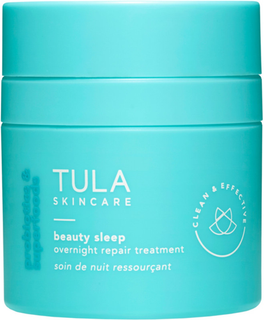
Tula Beauty Sleep Overnight Repair Treatment
Works for
4 of 4 advertised claims delivered
Anti-agingGlycolic acid, Butyrospermum parkii butter + 4 moreStrong evidence
“What Else You Need to Know This nighttime cream visibly improves skin’s smoothness, signs of premature aging, and brightness.”
This product can help reduce and prevent fine lines and wrinkles, improve skin elasticity and firmness because it contains glycolic acid.
Keep in mind that it typically takes at least 6 weeks to notice any results because the changes that are needed to improve fine lines and elasticity happen in the deeper layers of the skin. No topical anti-aging product can “erase” wrinkles or fully reverse signs of aging.
Evens skin toneGlycolic acid, Bifida ferment lysate + 3 moreStrong evidence
“, Vitamin C Gives the appearance of brighter, more even-toned skin.”
This product can help reduce hypepigmentation and even out the skin tone because it contains the following effective ingredients: glycolic acid
Keep in mind that you would need to apply any topical skincare targetted at hypigmentation consistently for a couple of months to get a result. No topical skincare product can help get rid of hyperpigmentation (including post-acne marks and age spots) instantly.
ExfoliationGlycolic acid, Lactic acidStrong evidence
“Fueled by concentrated probiotics, superfoods, vitamin C, and alpha hydroxy acids, this deeply hydrating overnight formula targets the appearance of fine lines, wrinkles, and dull skin to reveal a smoother, firmer-looking complexion.”
This product can help exfoliate the skin. In other words, it helps break down the bonds between dead cells on the surface of the skin and speed up the skin turnover. Skin often appears softer and brighter after exfoliation, but overdoing it can result in disrupted skin barrier. The following ingredient is doing the exfoliating job in this product: glycolic acid.
MoisturizingButyrospermum parkii butter, Lactobacillus + 29 moreGood evidence
“What Else You Need to Know This nighttime cream visibly improves skin’s smoothness, signs of premature aging, and brightness.”
This product can help improve hydration of the skin with the two types of ingredients.
The first type is called “humectants”:
these ingredients help attract water.
When humectants are on the surface of the skin, they “pull in” the moisture from the outside environment, or from
within deeper layers of the skin. The following ingredients in this product do the job:
glycerin, sodium hyaluronate.
This product also contains ingredients called “occlusives”. They help reduce the speed with which our skin loses moisture to the outside environment. These ingredients also help soften the upper layer of the skin, so it feels less tight and nicer to the touch. The following ingredients in this product do the job: butyrospermum parkii butter, cetyl alcohol.
Can it cause trouble?
Irritancy13 strong irritants: Elettaria cardamomum seed extract, Jasminum officinale flower/leaf extract + 11 more — patch-test recommendedHigh risk
Comedogenic3 ingredients rated 2 or more on the 0–5 pore-clogging scale3 flagged
User reviews
Be the first — your take helps the next person decide.
Ingredients
Filter by role to see what each ingredient is doing.
Water~45–55%
Glycerin~4.7–5.8%
- Irritation risk
- Low
One of the best moisturizing ingredients. Naturally present in skin. It attracts water to the upper layer of the skin working as a humectant
More about GlycerinBacillus ferment~4.1–5%
- Irritation risk
- Low
A product of bacterial fermentation. Can help attract water to the upper layer of the skin
More about Bacillus fermentButyrospermum parkii butter~3.1–3.8%
- Irritation risk
- Low
- Comedogenicity
- 3/5
A great moisturising ingredient that softens the skin and reduces water loss from its upper layer. It also can be helpful in protecting skin from free radicals
More about Butyrospermum parkii butterPropanediol~2.3–2.8%
- Irritation risk
- Low
Acts as a solvent for other ingredients. Speeds up the absorption of other ingredients into the skin
More about PropanediolCyclopentasiloxane~1.9–2.3%
- Irritation risk
- Low
A silicone that helps improve the product texture and spreadability. Can absorb oil creating a short-term mattifying effect on the skin
More about CyclopentasiloxanePentaerythrityl tetraethylhexanoate~1.6–2%
- Irritation risk
- Low
Used to create a nice product consistency while softening the upper layer of the skin
More about Pentaerythrityl tetraethylhexanoateTetrahexyldecyl ascorbate~1.4–1.7%
- Irritation risk
- Medium
Being a lipid soluble form of vitamin C, it is more stable than ascorbic acid, but still degrades quickly and needs to be stabilized in a formulation with another ingredient. It is claimed to penetrate skin better than pure vitamin C and have the the similar benefits, but solid studies of its effectiveness are lacking. Is likely to require a higher concentration in a product than pure vitamin C to be effective. It might be able to help reduce pore clogging.
More about Tetrahexyldecyl ascorbateMaltodextrin~1.2–1.4%
- Irritation risk
- Low
Used to stabilize the product formulation and can help absorb oil
More about MaltodextrinCetyl alcohol~1–1.3%
- Irritation risk
- Low
A non-drying alcohol that works to soften the skin and stabilize product formulations helping oil and water mix together
More about Cetyl alcoholMyristyl myristate~0.75–1.1%
- Irritation risk
- Medium
- Comedogenicity
- 3/5
An emollient. Is not recommended for acne-prone skin as it can be comedogenic
More about Myristyl myristatePeg-100 stearate~0.7–1.05%
- Irritation risk
- Low
Helps oil and water mix togehter and creates a nice product texture
More about Peg-100 stearateGlyceryl stearate~0.55–0.8%
- Irritation risk
- Low
An emollient that softens the skin and forms a protective layer on its surface. Helps water and oil mix together
More about Glyceryl stearateDipentaerythrityl pentaisononanoate~0.45–0.7%
- Irritation risk
- Low
Lactobacillus~0.35–0.65%
- Irritation risk
- Low
A non-living ingredient made by fermentation with the bacteria Lactobacillus. It can help attract water to the upper layer of the skin and might help reduce inflammation
More about LactobacillusBifida ferment lysate~0.35–0.65%
- Irritation risk
- Low
Consists of remains of dead yeast bacteria cells. Helps to hydrate the skin and reduce irritation. Might has some anti-oxidant effect
More about Bifida ferment lysatePlankton extract~0.35–0.6%
- Irritation risk
- Medium
- Comedogenicity
- 3/5
Can help attract water to the upper layer of the skin
More about Plankton extractSodium hyaluronate~0.3–0.55%
- Irritation risk
- Low
One of the best moisturizing ingredients. Attracts water into the upper layer of the skin
More about Sodium hyaluronateArginine ferulate~0.25–0.5%
- Irritation risk
- Low
Glycolic acid~0.25–0.5%
- Irritation risk
- High
An alpha-hydroxy acid (AHA) that helps to remove the dead skin cells on the surface of the skin reveling a more even, smoother complexation. It is also able to stimulate collagen production with long-term use. Could help to reduce pore congestion. It can be irritating to the skin. Apply sunscreen daily if using products with glycolic acid
More about Glycolic acidLactic acid~0.25–0.45%
- Irritation risk
- Medium
An exfoliating and moisturizing alpha-hydroxy acid (AHA). Typically causes less irritation than other AHAs, for example, glycolic acid. At high concentrations (about 15%), lactic acid can help reduce lines and wrinkles. Recent studies show that lactic acid can support the "good" bacteria living on skin's surface (healthy skin microbiome)
More about Lactic acidVaccinium angustifolium fruit extract~0.2–0.4%
- Irritation risk
- Medium
A plant extract tha can have anti-oxidant properties, but evidence of effectiveness in skin is lacking
More about Vaccinium angustifolium fruit extractCamellia sinensis leaf extract~0.25–0.45%
- Irritation risk
- Low
Can contain potent anti-oxidant compounds (abbreviated ECG, GCG, EGC, and EGCG) that might help protect the skin from free radicals. Can help calm down inflammation and has some anti-bacterial properties. Unfortunately, these antioxidants are unstable and lose their effectiveness very quickly in products. The concentration of the antioxidant compounds in the extract also tends to be low to be effective in topical formulation
More about Camellia sinensis leaf extractPistacia lentiscus gum~0.25–0.45%
- Irritation risk
- High
A tree rasin that could temporarily tighten the skin and might help regulate sebum production, but the research on its effectiveness in skin is lacking
More about Pistacia lentiscus gumHydrolyzed rice protein~0.2–0.4%
- Irritation risk
- Low
Helps attract water to the upper layer of the skin. Might have some anti-oxidant properties
More about Hydrolyzed rice proteinLactose~0.2–0.4%
- Irritation risk
- Low
Helps attract water to the upper layer of the skin
More about LactoseMilk protein~0.2–0.4%
- Irritation risk
- Low
Helps attract water to the upper layer of the skin
More about Milk proteinSwertia chirata extract~0.2–0.4%
- Irritation risk
- Medium
A plant extract that can have an anti-bacterial and anti-inflammatory effect, but evidence of effectiveness is lacking
More about Swertia chirata extractElettaria cardamomum seed extract~0.2–0.35%
Yogurt extract~0.2–0.4%
- Irritation risk
- Low
Hedychium spicatum extract~0.2–0.4%
- Irritation risk
- Low
Jasminum officinale flower/leaf extract~0.15–0.3%
Prunus armeniaca fruit extract~0.2–0.4%
- Irritation risk
- Medium
A fruit extract that might have some antioxidant properties and might help attract water to the skin, but evidence of effectiveness is lacking
More about Prunus armeniaca fruit extractPlumeria rubra flower extract~0.25–0.45%
- Irritation risk
- High
Used to add a nice smell to the product. Can be irritating
More about Plumeria rubra flower extractEugenia caryophyllus flower extract~0.3–0.5%
- Irritation risk
- High
A plant extract that is used as a fragrance. Can be irritating
More about Eugenia caryophyllus flower extractGardenia taitensis flower extract~0.25–0.45%
Vanilla planifolia fruit extract~0.25–0.45%
- Irritation risk
- High
A plant extract used as a fragrance. Can be irritating
More about Vanilla planifolia fruit extractHibiscus abelmoschus seed extract~0.2–0.4%
- Irritation risk
- Low
Sophora japonica flower extract~0.25–0.5%
- Irritation risk
- Low
Citrullus lanatus fruit extract~0.25–0.45%
- Irritation risk
- Medium
A plant extract that can contain an antioxidant compound
More about Citrullus lanatus fruit extractPyrus malus fruit extract~0.25–0.45%
- Irritation risk
- Medium
Can have some moisturizing properties due to its sugar content
More about Pyrus malus fruit extractLens esculenta fruit extract~0.25–0.45%
- Irritation risk
- Medium
A plant extract containing sugars that might help attract water to the upper layer of the skin. Is claimed by the manufacturer to help reduce pore size but evidence is lacking
More about Lens esculenta fruit extractCitrus aurantium dulcis peel extract~0.2–0.4%
Citrus aurantium dulcis fruit extract~0.25–0.45%
- Irritation risk
- High
A plant extract that is used as a fragrance. Can be irritating and lead to photosensitivity
More about Citrus aurantium dulcis fruit extractLavandula angustifolia flower/leaf/stem extract~0.25–0.45%
Potassium sorbate~0.25–0.5%
Caprylic/capric triglyceride~0.3–0.6%
- Irritation risk
- Medium
A good mix of fatty acids that forms a protective layer on the skin. Improves the shelf life of products. Derived from coconut and glycerin
More about Caprylic/capric triglycerideTocopheryl acetate~0.25–0.5%
- Irritation risk
- Medium
A more stable but less bio-available form of vitamin E compared to Tocopherol. Might help moisturize and protect the skin from free radicals, but mostly used in low concentrations to stabilize other ingredients.
More about Tocopheryl acetatePanthenol~0.25–0.45%
- Irritation risk
- Low
Helps attract water to the upper layer of the skin and can help improve skin barrier function
More about PanthenolLinum usitatissimum seed oil~0.2–0.4%
Sodium phytate~0.25–0.45%
Lecithin~0.3–0.55%
- Irritation risk
- Low
Used mostly for creating emulsions - helping oil and water mix together. Helps soften the upper layer of the skin
More about LecithinTocopherol~0.25–0.5%
- Irritation risk
- Low
Pure form of vitamin E. Can help moisturise and protect the skin from free radicals. Often used to help stabilise other ingredients or the formula itself
More about TocopherolSodium acrylate/sodium acryloyldimethyl taurate copolymer~0.25–0.45%
- Irritation risk
- Low
Used to create a thicker product consistency
More about Sodium acrylate/sodium acryloyldimethyl taurate copolymerMethyldihydrojasmonate~0.25–0.5%
Ethylene brassylate~0.2–0.4%
Methyl undecylenate~0.25–0.45%
- Irritation risk
- Low
Ethyl undecylenate~0.2–0.4%
- Irritation risk
- Low
Phenylisohexanol~0.25–0.5%
- Irritation risk
- Low
Polystyrene~0.3–0.55%
- Irritation risk
- Low
Sodium ascorbate~0.25–0.5%
- Irritation risk
- Low
Peg-40 hydrogenated castor oil~0.3–0.5%
- Irritation risk
- Medium
Helps oil and water mix together
More about Peg-40 hydrogenated castor oilBehenyl alcohol~0.3–0.6%
- Irritation risk
- Low
Non-drying alcohol that helps water and oil mix together. Also serves as an emollient
More about Behenyl alcoholDipentaerythrityl hexahydroxystearate/hexastearate/hexarosinate~0.25–0.45%
- Irritation risk
- Low
Isohexadecane~0.5–0.75%
- Irritation risk
- Low
Improves the texture of the product and helps soften the skin. Helps oil and water mix together and can be used as a cleansing agent
More about IsohexadecaneCaprylyl glycol~0.3–0.5%
- Irritation risk
- Medium
Helps preserve products and creates a nice product texture
More about Caprylyl glycolButylene glycol~0.25–0.45%
- Irritation risk
- Low
Used to create a nice product texture and help delivery of other ingredients. Might be somewhat helpful in attracting water to the upper layer of the skin
More about Butylene glycolAmmonium acryloyldimethyltaurate/vp copolymer~0.25–0.5%
- Irritation risk
- Low
Increases thickness of a product. Texture enhancer for oil-in-water emulsions
More about Ammonium acryloyldimethyltaurate/vp copolymerPolysorbate 80~0.3–0.5%
Alcohol~0.25–0.45%
- Irritation risk
- High
Can be drying and contribute to skin irritation. Used in formulars to dissolve other ingredients, create a thinner product consistency or for its antibacterial properties
More about AlcoholHexylene glycol~0.25–0.45%
- Irritation risk
- Medium
Helps create a more spreadable product texture
More about Hexylene glycolSodium lactate~0.25–0.45%
- Irritation risk
- Medium
Helps attract water to the upper layer of the skin. Is often used to adjust the pH level of the product
More about Sodium lactateSodium pca~0.25–0.45%
- Irritation risk
- Low
Naturally present in skin and helps to attract water to its upper layer
More about Sodium pcaSodium benzoate~0.25–0.4%
Tetrasodium edta~0.2–0.4%
Phenethyl alcohol~0.25–0.4%
Tin oxide~0.3–0.6%
- Irritation risk
- Low
A colorant that can add a pearl-like appearance to the formulation
More about Tin oxidePhenoxyethanol~0.15–0.3%
- Irritation risk
- Low
A preservative. It helps prevent bacterial growth in cosmetic products
More about PhenoxyethanolLimonene~0.15–0.25%
- Irritation risk
- High
A common frangrance that can easily irritate skin, especially if exposed to air, light or heat
More about LimoneneLinalool~0.1–0.2%
Hydroxycitronellal~0.15–0.25%
- Irritation risk
- High
A fragrance. A likely allergen and can be irritating
More about HydroxycitronellalMica~0.15–0.25%
- Irritation risk
- Low
Creates an illusion of smoother and more radiant skin tone. Adds shimmer to the skin by reflecting light
More about MicaTitanium dioxide~0.1–0.15%
- Irritation risk
- Low
Works as a UV filter when used in high concentrations. It is photostable and is effective mostly against the UVB light, with some protection in the UVA range. In small concentrations, used for its ability to improve the color of cosmetic products. Is usually well tolerated by the skin
More about Titanium dioxideCi 77891~0.1–0.15%
- Irritation risk
- Low
Ingredient list view
Water, Glycerin, Bacillus ferment, Butyrospermum parkii butter, Propanediol, Cyclopentasiloxane, Pentaerythrityl tetraethylhexanoate, Tetrahexyldecyl ascorbate, Maltodextrin, Cetyl alcohol, Myristyl myristate, Peg-100 stearate, Glyceryl stearate, Dipentaerythrityl pentaisononanoate, Lactobacillus, Bifida ferment lysate, Plankton extract, Sodium hyaluronate, Arginine ferulate, Glycolic acid, Lactic acid, Vaccinium angustifolium fruit extract, Camellia sinensis leaf extract, Pistacia lentiscus gum, Hydrolyzed rice protein, Lactose, Milk protein, Swertia chirata extract, Elettaria cardamomum seed extract, Yogurt extract, Hedychium spicatum extract, Jasminum officinale flower/leaf extract, Prunus armeniaca fruit extract, Plumeria rubra flower extract, Eugenia caryophyllus flower extract, Gardenia taitensis flower extract, Vanilla planifolia fruit extract, Hibiscus abelmoschus seed extract, Sophora japonica flower extract, Citrullus lanatus fruit extract, Pyrus malus fruit extract, Lens esculenta fruit extract, Citrus aurantium dulcis peel extract, Citrus aurantium dulcis fruit extract, Lavandula angustifolia flower/leaf/stem extract, Potassium sorbate, Caprylic/capric triglyceride, Tocopheryl acetate, Panthenol, Linum usitatissimum seed oil, Sodium phytate, Lecithin, Tocopherol, Sodium acrylate/sodium acryloyldimethyl taurate copolymer, Methyldihydrojasmonate, Ethylene brassylate, Methyl undecylenate, Ethyl undecylenate, Phenylisohexanol, Polystyrene, Sodium ascorbate, Peg-40 hydrogenated castor oil, Behenyl alcohol, Dipentaerythrityl hexahydroxystearate/hexastearate/hexarosinate, Isohexadecane, Caprylyl glycol, Butylene glycol, Ammonium acryloyldimethyltaurate/vp copolymer, Polysorbate 80, Alcohol, Hexylene glycol, Sodium lactate, Sodium pca, Sodium benzoate, Tetrasodium edta, Phenethyl alcohol, Tin oxide, Phenoxyethanol, Limonene, Linalool, Hydroxycitronellal, Mica, Titanium dioxide, Ci 77891
Compare prices
Retailers ranked by price — lowest first.

Sources cited in this review
Every concentration estimate and effectiveness label is anchored to one of these 31 studies and safety reviews.
- 1
- 2Safety Assessment of Pentaerythrityl Tetraesters as Used in Cosmeticsjournals.sagepub.com
- 3
- 4
- 5Bifidobacterium longumlysate, a new ingredient forreactive skinonlinelibrary.wiley.com
- 6Use of Probiotics for Dermal Applicationsresearchgate.net

Affiliate links · As an Amazon Associate, WIMJ earns from qualifying purchases.