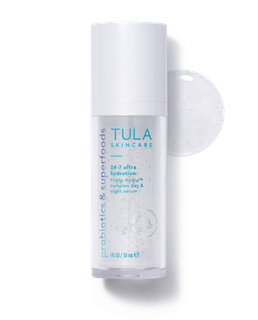
Works for
1 of 2 advertised claims delivered
MoisturizingSqualane, Hydrolyzed sodium hyaluronate + 24 moreGood evidence
“Formulated with prebiotics, hyaluronic acid, peptides + squalane to plump skin with hydration”
This product can help improve hydration of the skin with the two types of ingredients.
The first type is called “humectants”:
these ingredients help attract water.
When humectants are on the surface of the skin, they “pull in” the moisture from the outside environment, or from
within deeper layers of the skin. The following ingredients in this product do the job:
glycerin, hydrolyzed hyaluronic acid.
This product also contains ingredients called “occlusives”. They help reduce the speed with which our skin loses moisture to the outside environment. These ingredients also help soften the upper layer of the skin, so it feels less tight and nicer to the touch. The following ingredients in this product do the job: caprylic/capric triglyceride, squalane.
Anti-agingLactococcus ferment lysate, Lactic acidLimited evidence
“improve the look of fine lines and wrinkles”
This product does not contain ingredients that are able to reduce fine lines and wrinkles or help with skin elasticity, but it can improve the look of the skin temporarily through moisturization. Well-moisturized skin might also be able to repair the sun damage better.This ingredient - lactococcus ferment lysate - could be helpful for preventing or repairing signs of aging in theory, but there is no evidence that it actually works.
Can it cause trouble?
Irritancy21 flagged ingredientsMedium risk
Comedogenic1 ingredient rated 2 or more on the 0–5 pore-clogging scale1 flagged
User reviews
Be the first — your take helps the next person decide.
Ingredients
Filter by role to see what each ingredient is doing.
Water~45–55%
Dipentaerythrityl hexacaprylate/hexacaprate~5.4–6.6%
- Irritation risk
- Low
Pentaerythrityl tetraisostearate~3.9–4.8%
- Irritation risk
- Medium
Used to create a thicker product consistency
More about Pentaerythrityl tetraisostearateIsononyl isononanoate~3.2–3.9%
- Irritation risk
- Low
Forms a protective film on the surface of the skin to prevent moisture loss. Gives a velvety feel to products while reducing tackiness
More about Isononyl isononanoatePropanediol~2.3–2.8%
- Irritation risk
- Low
Acts as a solvent for other ingredients. Speeds up the absorption of other ingredients into the skin
More about PropanediolGlycerin~1.9–2.4%
- Irritation risk
- Low
One of the best moisturizing ingredients. Naturally present in skin. It attracts water to the upper layer of the skin working as a humectant
More about GlycerinCaprylic/capric triglyceride~1.7–2%
- Irritation risk
- Medium
A good mix of fatty acids that forms a protective layer on the skin. Improves the shelf life of products. Derived from coconut and glycerin
More about Caprylic/capric triglycerideSodium hyaluronate~1.3–1.6%
- Irritation risk
- Low
One of the best moisturizing ingredients. Attracts water into the upper layer of the skin
More about Sodium hyaluronateHydrolyzed hyaluronic acid~1.1–1.3%
- Irritation risk
- Low
One of the best moisturizing ingredients. Attracts water into the upper layer of the skin. A version of it is naturally present in skin
More about Hydrolyzed hyaluronic acidSodium hyaluronate crosspolymer~0.8–1.15%
- Irritation risk
- Medium
Attracts water into the upper layer of the skin
More about Sodium hyaluronate crosspolymerHydrolyzed sodium hyaluronate~0.6–0.95%
- Irritation risk
- Low
Attracts water into the upper layer of the skin
More about Hydrolyzed sodium hyaluronateSodium acetylated hyaluronate~0.5–0.8%
- Irritation risk
- Low
A type of hyaluronic acid that works as an excellent moisturizer by attracting water into the upper layer of the skin. Is typically feels less sticky on the skin compared to the usual hyaluronic acid
More about Sodium acetylated hyaluronateSodium polyglutamate~0.45–0.7%
- Irritation risk
- Low
Squalane~0.5–0.75%
- Irritation risk
- Low
An oil naturally present in skin. Works as an emollient to soften the skin and form a protective layer on its surface without a greasy feeling.
More about SqualaneCollagen~0.35–0.65%
- Irritation risk
- Low
Cannot penetrate the skin barrier so is not particularly useful in skincare products
More about CollagenLactococcus ferment lysate~0.35–0.6%
- Irritation risk
- Low
Consists of remains of dead bacteria cells. Is likely helpful in attracting water to the upper layer of the skin. Might be helpful in reducing inflammation and neutralizing free radicals in skin
More about Lactococcus ferment lysateLactobacillus ferment~0.3–0.6%
- Irritation risk
- Low
A fermentation product created by bacteria Lactobacillus. The fermented product has anti-bacterial properties and might be helpful in calming down inflammation, but studies are lacking. Helps attract water to the upper layer of the skin. Can be used as a preservative
More about Lactobacillus fermentLactobacillus~0.3–0.55%
- Irritation risk
- Low
A non-living ingredient made by fermentation with the bacteria Lactobacillus. It can help attract water to the upper layer of the skin and might help reduce inflammation
More about LactobacillusBeta vulgaris root extract~0.25–0.5%
- Irritation risk
- Medium
A plant extract that might have some antioxidant properties, but mostly used in cosmetics for its color
More about Beta vulgaris root extractCurcuma longa root extract~0.25–0.45%
- Irritation risk
- High
A plant extract that can contain an active compound curcumin, that may have some anti-inflammatory properties when applied to the skin, but solid research is lacking and the typical concentration used in skincare products is too low. Can be an irritant
More about Curcuma longa root extractPyrus malus fruit extract~0.25–0.45%
- Irritation risk
- Medium
Can have some moisturizing properties due to its sugar content
More about Pyrus malus fruit extractCitrullus lanatus fruit extract~0.2–0.4%
- Irritation risk
- Medium
A plant extract that can contain an antioxidant compound
More about Citrullus lanatus fruit extractVaccinium angustifolium fruit extract~0.2–0.35%
- Irritation risk
- Medium
A plant extract tha can have anti-oxidant properties, but evidence of effectiveness in skin is lacking
More about Vaccinium angustifolium fruit extractLens esculenta fruit extract~0.2–0.4%
- Irritation risk
- Medium
A plant extract containing sugars that might help attract water to the upper layer of the skin. Is claimed by the manufacturer to help reduce pore size but evidence is lacking
More about Lens esculenta fruit extractHydrolyzed rice protein~0.2–0.4%
- Irritation risk
- Low
Helps attract water to the upper layer of the skin. Might have some anti-oxidant properties
More about Hydrolyzed rice proteinInulin~0.2–0.4%
- Irritation risk
- Low
Helps attract water to the upper layer of the skin. Is claimed to support the growth of "good" bacteria in skin (as a "prebiotic"), but the research is lacking
More about InulinAlpha-glucan oligosaccharide~0.25–0.5%
- Irritation risk
- Low
Helps attract water to the upper layer of the skin
More about Alpha-glucan oligosaccharideLactic acid~0.2–0.4%
- Irritation risk
- Medium
An exfoliating and moisturizing alpha-hydroxy acid (AHA). Typically causes less irritation than other AHAs, for example, glycolic acid. At high concentrations (about 15%), lactic acid can help reduce lines and wrinkles. Recent studies show that lactic acid can support the "good" bacteria living on skin's surface (healthy skin microbiome)
More about Lactic acidSodium pca~0.2–0.4%
- Irritation risk
- Low
Naturally present in skin and helps to attract water to its upper layer
More about Sodium pcaHydrogenated poly(c6-20 olefin)~0.3–0.55%
- Irritation risk
- Low
Hydroxyacetophenone~0.2–0.4%
Leuconostoc/radish root ferment filtrate~0.2–0.4%
- Irritation risk
- Medium
A preservative that comes from radishes fermented by a bacteria. New research suggests that the preservation properties in the ingredient come from an ammonium salt that is not present naturally in radish root but used in its cultivation. Is problematic because the exact amount of the preservative agents is difficult to determine
More about Leuconostoc/radish root ferment filtratePolymnia sonchifolia root juice~0.2–0.4%
- Irritation risk
- High
A plant extract that helps attract water to the upper layer of the skin and might have some anti-oxidant properties
More about Polymnia sonchifolia root juiceRhus verniciflua peel wax~0.2–0.4%
- Irritation risk
- Low
Caprylyl glycol~0.25–0.45%
- Irritation risk
- Medium
Helps preserve products and creates a nice product texture
More about Caprylyl glycolSodium lactate~0.2–0.35%
- Irritation risk
- Medium
Helps attract water to the upper layer of the skin. Is often used to adjust the pH level of the product
More about Sodium lactateCarrageenan~0.2–0.4%
- Irritation risk
- Medium
- Comedogenicity
- 3/5
Helps thicken the product formula and create a nice product formulation
More about CarrageenanPentylene glycol~0.25–0.45%
- Irritation risk
- Medium
Used to preserve products, dissolve other ingredients and create a nice product texture
More about Pentylene glycolMaltodextrin~0.2–0.35%
- Irritation risk
- Low
Used to stabilize the product formulation and can help absorb oil
More about MaltodextrinButylene glycol~0.2–0.35%
- Irritation risk
- Low
Used to create a nice product texture and help delivery of other ingredients. Might be somewhat helpful in attracting water to the upper layer of the skin
More about Butylene glycolSodium chloride~0.2–0.4%
- Irritation risk
- Low
Used to stabilize mixtures of oil and water, and create thicker, gel-like product textures
More about Sodium chlorideEthylhexylglycerin~0.15–0.3%
1,2-hexanediol~0.1–0.2%
Acrylates/c10-30 alkyl acrylate crosspolymer~0.15–0.25%
- Irritation risk
- Medium
Maintains the texture of skincare products. Allows the product to spread evenly. Helps oil and water mix together
More about Acrylates/c10-30 alkyl acrylate crosspolymerTromethamine~0.1–0.25%
Hdi/trimethylol hexyllactone crosspolymer~0.1–0.2%
- Irritation risk
- Low
Used to create a silky product texture and add volume to products
More about Hdi/trimethylol hexyllactone crosspolymerSodium benzoate~0.1–0.2%
Potassium sorbate~0.1–0.2%
Ingredient list view
Water, Dipentaerythrityl hexacaprylate/hexacaprate, Pentaerythrityl tetraisostearate, Isononyl isononanoate, Propanediol, Glycerin, Caprylic/capric triglyceride, Sodium hyaluronate, Hydrolyzed hyaluronic acid, Sodium hyaluronate crosspolymer, Hydrolyzed sodium hyaluronate, Sodium acetylated hyaluronate, Sodium polyglutamate, Squalane, Collagen, Lactococcus ferment lysate, Lactobacillus ferment, Lactobacillus, Beta vulgaris root extract, Curcuma longa root extract, Pyrus malus fruit extract, Citrullus lanatus fruit extract, Vaccinium angustifolium fruit extract, Lens esculenta fruit extract, Hydrolyzed rice protein, Inulin, Alpha-glucan oligosaccharide, Lactic acid, Sodium pca, Hydrogenated poly(c6-20 olefin), Hydroxyacetophenone, Leuconostoc/radish root ferment filtrate, Polymnia sonchifolia root juice, Rhus verniciflua peel wax, Caprylyl glycol, Sodium lactate, Carrageenan, Pentylene glycol, Maltodextrin, Butylene glycol, Sodium chloride, Ethylhexylglycerin, 1,2-hexanediol, Acrylates/c10-30 alkyl acrylate crosspolymer, Tromethamine, Hdi/trimethylol hexyllactone crosspolymer, Sodium benzoate, Potassium sorbate
Compare prices
Retailers ranked by price — lowest first.

Sources cited in this review
Every concentration estimate and effectiveness label is anchored to one of these 21 studies and safety reviews.
- 1
- 2
- 3Hyaluronic acid: A key molecule in skin agingncbi.nlm.nih.gov
- 4
- 5Efficacy of a New Topical Nano-hyaluronic Acid in Humansncbi.nlm.nih.gov
- 6Physiochemical properties and application of hyaluronic acid: a systematic reviewonlinelibrary.wiley.com

Affiliate links · As an Amazon Associate, WIMJ earns from qualifying purchases.