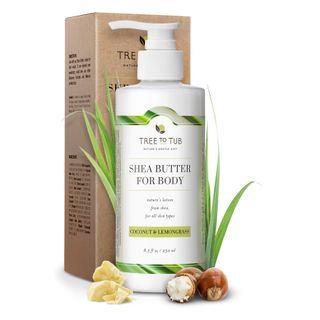
Tree To Tub Soothing Shea Butter Body Lotion For Sensitive Skin - Coconut Lemongrass
Works for
1 of 1 advertised claim delivered
Moisturizing13 ingredients credited for this claimGood support
“This everyday body lotion contains fewer, more effective ingredients.”
This product can help improve hydration of the skin with the two types of ingredients.
The first type is called “humectants”:
these ingredients help attract water.
When humectants are on the surface of the skin, they “pull in” the moisture from the outside environment, or from
within deeper layers of the skin. The following ingredients in this product do the job:
glycerin, aloe barbadensis extract.
This product also contains ingredients called “occlusives”. They help reduce the speed with which our skin loses moisture to the outside environment. These ingredients also help soften the upper layer of the skin, so it feels less tight and nicer to the touch. The following ingredients in this product do the job: caprylic/capric triglyceride, cocos nucifera fruit extract.
Can it cause trouble?
Irritancy3 strong irritants: Sodium anisate, Cymbopogon martini oil + 1 more — patch-test recommendedHigh risk
Comedogenic5 ingredients rated 2 or more on the 0–5 pore-clogging scale5 flagged
User reviews
Be the first — your take helps the next person decide.
Ingredients
Filter by role to see what each ingredient is doing.
Aloe barbadensis leaf~23–34%
- Irritation risk
- Low
Aloe barbadensis extract~4.9–7.3%
- Irritation risk
- Medium
Traditionally used to treat sunburns, dermatitis and inflammation, but evidence for its effectiveness is lacking. The extract can contain humectants that help attract water into the skin
More about Aloe barbadensis extractGlycerin~4.3–6.4%
- Irritation risk
- Low
One of the best moisturizing ingredients. Naturally present in skin. It attracts water to the upper layer of the skin working as a humectant
More about GlycerinCaprylic/capric triglyceride~4.1–6.2%
- Irritation risk
- Medium
A good mix of fatty acids that forms a protective layer on the skin. Improves the shelf life of products. Derived from coconut and glycerin
More about Caprylic/capric triglycerideCetearyl olivate~2.8–4.2%
Sorbitan olivate~2.1–3.1%
Coco-caprylate/caprate~1.7–2.6%
- Irritation risk
- Low
Helps to soften the upper layer of the skin without creating a greasy texture
More about Coco-caprylate/caprateCetearyl alcohol~1.5–2.2%
- Irritation risk
- Low
- Comedogenicity
- 2/5
A non-drying alcohol. Works as an emollient. Helps water and oil mix together and creates a nice product texture
More about Cetearyl alcohol1,2-hexanediol~0.9–1.3%
Sodium acrylates copolymer~1.1–1.7%
- Irritation risk
- Medium
Used to create a thicker product consistency
More about Sodium acrylates copolymerLecithin~0.95–1.4%
- Irritation risk
- Low
Used mostly for creating emulsions - helping oil and water mix together. Helps soften the upper layer of the skin
More about LecithinSodium levulinate~0.55–1.3%
Sodium anisate~0.5–1.2%
Butyrospermum parkii butter~0.55–1.3%
- Irritation risk
- Low
- Comedogenicity
- 3/5
A great moisturising ingredient that softens the skin and reduces water loss from its upper layer. It also can be helpful in protecting skin from free radicals
More about Butyrospermum parkii butterTheobroma cacao extract~0.45–1.1%
- Irritation risk
- Low
- Comedogenicity
- 3/5
Theobroma cacao seed butter~0.5–1.2%
- Irritation risk
- Low
- Comedogenicity
- 3/5
Helps soften the upper layer of the skin and can be helpful in restoring the skin barrier function. Might have some anti-oxidant effect
More about Theobroma cacao seed butterHydroxyacetophenone~0.45–1.05%
Avena sativa kernel extract~0.5–1.1%
- Irritation risk
- Low
An effective moisturizing and skin barrier repair ingredient. Helps calm down inflammation and has some anti-oxidant properties
More about Avena sativa kernel extractAvena sativa kernel flour~0.45–1.05%
- Irritation risk
- Low
A type of colloidal oatmeal. Can contain potent antioxidants and anti-inflammatory compounds. Is effective in supporting skin barrier
More about Avena sativa kernel flourChamomilla recutita extract~0.35–0.85%
- Irritation risk
- High
Plant extract that can have healing and anti-inflammatory properties. It is a potential allergen and can be irritating
More about Chamomilla recutita extractCocos nucifera fruit extract~0.45–1%
- Irritation risk
- Low
- Comedogenicity
- 3/5
An emollient. Found to be as effective as a moisturizer for dry skin as mineral oil. Could be comedogenic
More about Cocos nucifera fruit extractButylene glycol~0.3–0.7%
- Irritation risk
- Low
Used to create a nice product texture and help delivery of other ingredients. Might be somewhat helpful in attracting water to the upper layer of the skin
More about Butylene glycolCymbopogon martini oil~0.15–0.7%
- Irritation risk
- High
Aromatic plant oil used in cosmetics as a fragrance. A likely irritant
More about Cymbopogon martini oilLactic acid~0.15–0.7%
- Irritation risk
- Medium
An exfoliating and moisturizing alpha-hydroxy acid (AHA). Typically causes less irritation than other AHAs, for example, glycolic acid. At high concentrations (about 15%), lactic acid can help reduce lines and wrinkles. Recent studies show that lactic acid can support the "good" bacteria living on skin's surface (healthy skin microbiome)
More about Lactic acidCupressus funebris wood oil~0.15–0.6%
- Irritation risk
- Low
Lavandula angustifolia oil~0.1–0.5%
- Irritation risk
- High
An essential oil. Potential allergen and can be irritating. It has some anti-bacterial properties
More about Lavandula angustifolia oilIngredient list view
Aloe barbadensis leaf, Aloe barbadensis extract, Unknown, Glycerin, Caprylic/capric triglyceride, Cetearyl olivate, Sorbitan olivate, Coco-caprylate/caprate, Cetearyl alcohol, 1,2-hexanediol, Sodium acrylates copolymer, Lecithin, Sodium levulinate, Sodium anisate, Butyrospermum parkii butter, Theobroma cacao extract, Theobroma cacao seed butter, Hydroxyacetophenone, Avena sativa kernel extract, Avena sativa kernel flour, Unknown, Chamomilla recutita extract, Cocos nucifera fruit extract, Butylene glycol, Unknown, Cymbopogon martini oil, Lactic acid, Cupressus funebris wood oil, Lavandula angustifolia oil
Compare prices
Retailers ranked by price — lowest first.

Affiliate links · prices updated regularly
Worth comparing, line by line.
Match % combines shared ingredients, the first five ingredients, shared actives and hero ingredients, irritancy (lower counts in the alternative's favour), texture and body area. Only products in the same routine step are compared.
| Tree To TubSoothing Shea Butter Body Lotion For Sensitive Skin - Coconut LemongrassYOUR PRODUCT | LushBody Lotion: Dream Cream | |
|---|---|---|
| Match | — | 51% |
| Price | $18.74 | — |
| Shared key ingredients | — | 2 of 7 |
| Key difference | — | — |
| Irritancy | High | High |
| Drying alcohol | — | — |
| View product | Shop |


Sources cited in this review
Every concentration estimate and effectiveness label is anchored to one of these 7 studies and safety reviews.
- 1
- 2Safety Assessment of Alkyl Esters as Used in Cosmeticscir-safety.org
- 3
- 4
- 5
- 6Epidermal and dermal effects of topical lactic acidncbi.nlm.nih.gov

Affiliate links · As an Amazon Associate, WIMJ earns from qualifying purchases.