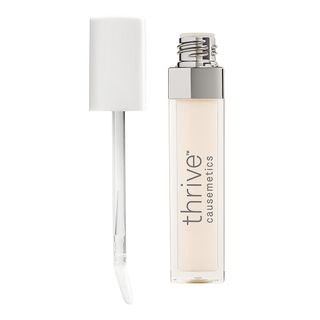
Thrive Causemetics Liquid Balm Lip Treatment™
Works for
1 of 2 advertised claims delivered
MoisturizingPanthenol, Ricinus communis seed oil + 12 moreStrong evidence
“What Else You Need To Know Our intensive lip treatment replenishes moisture with a protective veil of skin-nourishing vitamins + juicy hydration.”
This product can help improve hydration of the skin with the two types of ingredients.
The first type is called “humectants”:
these ingredients help attract water.
When humectants are on the surface of the skin, they “pull in” the moisture from the outside environment, or from
within deeper layers of the skin. The following ingredients in this product do the job:
panthenol.
This product also contains ingredients called “occlusives”. They help reduce the speed with which our skin loses moisture to the outside environment. These ingredients also help soften the upper layer of the skin, so it feels less tight and nicer to the touch. The following ingredients in this product do the job: caprylic/capric triglyceride, helianthus annuus seed oil.
The following ingredients in this product are especially good for supporting the skin barrier and helping with the hydration level: panthenol
Anti-agingTocopherolLimited evidence
“Formulated with plant actives that deliver powerful antioxidant protection + lip-reviving all-day hydration in just one swipe.Powered by nutrient-rich Lip Filler Technology™ to plump + smooth the look of fine lines for exceptionally soft, fuller lips.”
This product does not contain ingredients that are able to reduce fine lines and wrinkles or help with skin elasticity, but it can improve the look of the skin temporarily through moisturization. Well-moisturized skin might also be able to repair the sun damage better.
Can it cause trouble?
Irritancy13 strong irritants: Citrus aurantium dulcis peel oil, Citrus aurantifolia oil + 11 more — patch-test recommendedHigh risk
Comedogenic2 ingredients rated 2 or more on the 0–5 pore-clogging scale2 flagged

User reviews
Be the first — your take helps the next person decide.
Ingredients
Filter by role to see what each ingredient is doing.
Diisostearyl malate~22–33%
- Irritation risk
- Medium
Helps to soften the upper layer of the skin
More about Diisostearyl malateOctyldodecanol~4–5.9%
- Irritation risk
- Low
An emollient that helps to soften the skin and create a pleasant product texture and stabilize the formulation
More about OctyldodecanolDipentaerythrityl pentaisononanoate~4.5–6.7%
- Irritation risk
- Low
Hydrogenated dimer dilinoleyl/dimethylcarbonate copolymer~3.6–5.4%
- Irritation risk
- Low
Oleic/linoleic/linolenic polyglycerides~2.8–4.3%
- Irritation risk
- Low
Helps soften the upper layer of the skin
More about Oleic/linoleic/linolenic polyglyceridesEthylcellulose~2.1–3.1%
- Irritation risk
- Low
Hydrogenated dilinoleyl alcohol~1.7–2.6%
- Irritation risk
- Low
Isostearyl alcohol~1.4–2.2%
- Irritation risk
- Low
Helps soften the upper layer of the skin
More about Isostearyl alcoholSilica cetyl silylate~1.1–1.7%
- Irritation risk
- Low
Caprylic/capric triglyceride~1–1.6%
- Irritation risk
- Medium
A good mix of fatty acids that forms a protective layer on the skin. Improves the shelf life of products. Derived from coconut and glycerin
More about Caprylic/capric triglycerideHelianthus annuus seed oil~0.85–1.3%
- Irritation risk
- Low
A great emollient due to its high linoleic acid content. One of the most effective plant oils in helping skin hydration and repairing skin barrier function
More about Helianthus annuus seed oilGlyceryl caprylate~0.55–1.35%
- Irritation risk
- Low
An emollient that can also help water and oil mix together, as well as prevent bacteria growth in products
More about Glyceryl caprylateCrambe abyssinica seed oil~0.45–1.1%
- Irritation risk
- Medium
Helps soften the upper layer of the skin
More about Crambe abyssinica seed oilHomosalate~0.8–1.2%
- Irritation risk
- Medium
A weak sunscreen that offers some protection against the sun rays that cause sunburn (UVB), but does not offer meaningful protection against protect against the most aging sun rays (UVA). It loses its effectiveness quickly when exposed to sunlight. It is an organic, or so called "chemical" sunscreen. When used in low concentrations, helps to stabilize the product formulation
More about HomosalatePhytosteryl/octyldodecyl lauroyl glutamate~0.5–1.15%
- Irritation risk
- Low
A mix of amino acids and plant-based lipids. Helps to soften the upper layer of the skin and reduce water loss over time
More about Phytosteryl/octyldodecyl lauroyl glutamateDimethyl isosorbide~0.4–0.95%
- Irritation risk
- Low
Used to dissolve other ingredients in a product and can enhance their ability to penetrate the skin
More about Dimethyl isosorbideSesamum indicum seed extract~0.4–0.9%
- Irritation risk
- Low
Plant oil that due to its high content of linoleic acid can help support skin's barrier function improving its hydration
More about Sesamum indicum seed extractBrassica alba sprout extract~0.4–0.9%
- Irritation risk
- Low
Citrus aurantium dulcis peel oil~0.35–0.85%
- Irritation risk
- High
An essentil oil from orange peel. Potential allergen and can be irritating
More about Citrus aurantium dulcis peel oilTocopheryl acetate~0.35–0.8%
- Irritation risk
- Medium
A more stable but less bio-available form of vitamin E compared to Tocopherol. Might help moisturize and protect the skin from free radicals, but mostly used in low concentrations to stabilize other ingredients.
More about Tocopheryl acetatePanthenol~0.3–0.75%
- Irritation risk
- Low
Helps attract water to the upper layer of the skin and can help improve skin barrier function
More about PanthenolGlyceryl undecylenate~0.4–0.9%
- Irritation risk
- Medium
Helps oil and water mix together and helps preserve the product formulation
More about Glyceryl undecylenateRicinus communis seed oil~0.35–0.85%
- Irritation risk
- Medium
A plant oil that can help soften the skin. It might be helpful in calming down inflammation, but solid research is lacking. Is often used in lip products to create the needed product consistency
More about Ricinus communis seed oilTocopherol~0.3–0.7%
- Irritation risk
- Low
Pure form of vitamin E. Can help moisturise and protect the skin from free radicals. Often used to help stabilise other ingredients or the formula itself
More about TocopherolEthyl butyrate~0.2–0.75%
- Irritation risk
- Low
Citrus aurantifolia oil~0.3–0.75%
- Irritation risk
- High
Citrus aurantium dulcis peel extract~0.2–0.75%
Citrus paradisi peel oil~0.2–0.75%
Citrus reticulata peel oil~0.2–0.75%
- Irritation risk
- High
An essential oil used for fragrance. Can be an allergen and irritant
More about Citrus reticulata peel oilLinalool~0.2–0.75%
Limonene~0.2–0.75%
- Irritation risk
- High
A common frangrance that can easily irritate skin, especially if exposed to air, light or heat
More about LimoneneCi 15850~0.3–0.7%
Ci 45410~0.3–0.7%
Blue 1 lake~0.3–0.7%
Ci 42090~0.3–0.7%
Diisostearyl malate~0.35–0.85%
- Irritation risk
- Medium
Helps to soften the upper layer of the skin
More about Diisostearyl malateOctyldodecanol~0.35–0.8%
- Irritation risk
- Low
An emollient that helps to soften the skin and create a pleasant product texture and stabilize the formulation
More about OctyldodecanolDipentaerythrityl pentaisononanoate~0.35–0.85%
- Irritation risk
- Low
Hydrogenated dimer dilinoleyl/dimethylcarbonate copolymer~0.3–0.7%
- Irritation risk
- Low
Oleic/linoleic/linolenic polyglycerides~0.35–0.85%
- Irritation risk
- Low
Helps soften the upper layer of the skin
More about Oleic/linoleic/linolenic polyglyceridesEthylcellulose~0.35–0.8%
- Irritation risk
- Low
Hydrogenated dilinoleyl alcohol~0.35–0.85%
- Irritation risk
- Low
Isostearyl alcohol~0.35–0.85%
- Irritation risk
- Low
Helps soften the upper layer of the skin
More about Isostearyl alcoholSunflower seed oil glyceride~0.35–0.85%
Silica~0.4–0.95%
Ricinus communis seed oil~0.35–0.8%
- Irritation risk
- Medium
A plant oil that can help soften the skin. It might be helpful in calming down inflammation, but solid research is lacking. Is often used in lip products to create the needed product consistency
More about Ricinus communis seed oilGlyceryl caprylate~0.35–0.85%
- Irritation risk
- Low
An emollient that can also help water and oil mix together, as well as prevent bacteria growth in products
More about Glyceryl caprylateCrambe abyssinica seed oil~0.3–0.7%
- Irritation risk
- Medium
Helps soften the upper layer of the skin
More about Crambe abyssinica seed oilHomosalate~0.45–1%
- Irritation risk
- Medium
A weak sunscreen that offers some protection against the sun rays that cause sunburn (UVB), but does not offer meaningful protection against protect against the most aging sun rays (UVA). It loses its effectiveness quickly when exposed to sunlight. It is an organic, or so called "chemical" sunscreen. When used in low concentrations, helps to stabilize the product formulation
More about HomosalatePhytosteryl/octyldodecyl lauroyl glutamate~0.35–0.85%
- Irritation risk
- Low
A mix of amino acids and plant-based lipids. Helps to soften the upper layer of the skin and reduce water loss over time
More about Phytosteryl/octyldodecyl lauroyl glutamateTocopheryl acetate~0.3–0.75%
- Irritation risk
- Medium
A more stable but less bio-available form of vitamin E compared to Tocopherol. Might help moisturize and protect the skin from free radicals, but mostly used in low concentrations to stabilize other ingredients.
More about Tocopheryl acetatePanthenol~0.2–0.8%
- Irritation risk
- Low
Helps attract water to the upper layer of the skin and can help improve skin barrier function
More about PanthenolDimethyl isosorbide~0.3–0.7%
- Irritation risk
- Low
Used to dissolve other ingredients in a product and can enhance their ability to penetrate the skin
More about Dimethyl isosorbideVanillin~0.3–0.7%
- Irritation risk
- Low
Sesamum indicum seed extract~0.2–0.75%
- Irritation risk
- Low
Plant oil that due to its high content of linoleic acid can help support skin's barrier function improving its hydration
More about Sesamum indicum seed extractTriacetin~0.4–0.9%
Brassica alba sprout extract~0.3–0.7%
- Irritation risk
- Low
Piper nigrum seed oil~0.3–0.75%
- Irritation risk
- Low
Artemisia pallens flower oil~0.2–0.75%
- Irritation risk
- Low
Zingiber officinale root oil~0.15–0.65%
- Irritation risk
- High
An essential oil that is likely to be irritating and can cause photosensitivity
More about Zingiber officinale root oilElettaria cardamomum seed oil~0.2–0.75%
- Irritation risk
- Low
Eugenia caryophyllus leaf oil~0.2–0.7%
- Irritation risk
- High
An essential oil. Used as a fragrance. Can be irritating and sensitizing
More about Eugenia caryophyllus leaf oilTocopherol~0.3–0.7%
- Irritation risk
- Low
Pure form of vitamin E. Can help moisturise and protect the skin from free radicals. Often used to help stabilise other ingredients or the formula itself
More about TocopherolGlyceryl undecylenate~0.35–0.85%
- Irritation risk
- Medium
Helps oil and water mix together and helps preserve the product formulation
More about Glyceryl undecylenateCinnamal~0.2–0.75%
- Irritation risk
- High
Eugenol~0.2–0.75%
Limonene~0.2–0.75%
- Irritation risk
- High
A common frangrance that can easily irritate skin, especially if exposed to air, light or heat
More about LimoneneCi 19140~0.3–0.7%
Ci 15850~0.3–0.7%
Diisostearyl malate~0.35–0.85%
- Irritation risk
- Medium
Helps to soften the upper layer of the skin
More about Diisostearyl malateOctyldodecanol~0.35–0.8%
- Irritation risk
- Low
An emollient that helps to soften the skin and create a pleasant product texture and stabilize the formulation
More about OctyldodecanolDipentaerythrityl pentaisononanoate~0.35–0.85%
- Irritation risk
- Low
Hydrogenated dimer dilinoleyl/dimethylcarbonate copolymer~0.3–0.7%
- Irritation risk
- Low
Oleic/linoleic/linolenic polyglycerides~0.35–0.85%
- Irritation risk
- Low
Helps soften the upper layer of the skin
More about Oleic/linoleic/linolenic polyglyceridesEthylcellulose~0.35–0.8%
- Irritation risk
- Low
Hydrogenated dilinoleyl alcohol~0.35–0.85%
- Irritation risk
- Low
Isostearyl alcohol~0.35–0.85%
- Irritation risk
- Low
Helps soften the upper layer of the skin
More about Isostearyl alcoholSilica cetyl silylate~0.3–0.7%
- Irritation risk
- Low
Caprylic/capric triglyceride~0.4–0.9%
- Irritation risk
- Medium
A good mix of fatty acids that forms a protective layer on the skin. Improves the shelf life of products. Derived from coconut and glycerin
More about Caprylic/capric triglycerideHelianthus annuus seed oil~0.35–0.85%
- Irritation risk
- Low
A great emollient due to its high linoleic acid content. One of the most effective plant oils in helping skin hydration and repairing skin barrier function
More about Helianthus annuus seed oilGlyceryl caprylate~0.35–0.85%
- Irritation risk
- Low
An emollient that can also help water and oil mix together, as well as prevent bacteria growth in products
More about Glyceryl caprylateCrambe abyssinica seed oil~0.3–0.7%
- Irritation risk
- Medium
Helps soften the upper layer of the skin
More about Crambe abyssinica seed oilHomosalate~0.45–1%
- Irritation risk
- Medium
A weak sunscreen that offers some protection against the sun rays that cause sunburn (UVB), but does not offer meaningful protection against protect against the most aging sun rays (UVA). It loses its effectiveness quickly when exposed to sunlight. It is an organic, or so called "chemical" sunscreen. When used in low concentrations, helps to stabilize the product formulation
More about HomosalatePhytosteryl/octyldodecyl lauroyl glutamate~0.35–0.85%
- Irritation risk
- Low
A mix of amino acids and plant-based lipids. Helps to soften the upper layer of the skin and reduce water loss over time
More about Phytosteryl/octyldodecyl lauroyl glutamateTocopheryl acetate~0.3–0.75%
- Irritation risk
- Medium
A more stable but less bio-available form of vitamin E compared to Tocopherol. Might help moisturize and protect the skin from free radicals, but mostly used in low concentrations to stabilize other ingredients.
More about Tocopheryl acetatePanthenol~0.2–0.8%
- Irritation risk
- Low
Helps attract water to the upper layer of the skin and can help improve skin barrier function
More about PanthenolRicinus communis seed oil~0.35–0.8%
- Irritation risk
- Medium
A plant oil that can help soften the skin. It might be helpful in calming down inflammation, but solid research is lacking. Is often used in lip products to create the needed product consistency
More about Ricinus communis seed oilDimethyl isosorbide~0.3–0.7%
- Irritation risk
- Low
Used to dissolve other ingredients in a product and can enhance their ability to penetrate the skin
More about Dimethyl isosorbideAlcohol~0.3–0.7%
- Irritation risk
- High
Can be drying and contribute to skin irritation. Used in formulars to dissolve other ingredients, create a thinner product consistency or for its antibacterial properties
More about AlcoholSesamum indicum seed extract~0.2–0.75%
- Irritation risk
- Low
Plant oil that due to its high content of linoleic acid can help support skin's barrier function improving its hydration
More about Sesamum indicum seed extractVanillin~0.3–0.7%
- Irritation risk
- Low
Brassica alba sprout extract~0.3–0.7%
- Irritation risk
- Low
Citrus aurantium dulcis peel extract~0.2–0.75%
Tocopherol~0.3–0.7%
- Irritation risk
- Low
Pure form of vitamin E. Can help moisturise and protect the skin from free radicals. Often used to help stabilise other ingredients or the formula itself
More about TocopherolGlyceryl undecylenate~0.35–0.85%
- Irritation risk
- Medium
Helps oil and water mix together and helps preserve the product formulation
More about Glyceryl undecylenateCi 15850~0.3–0.7%
Ci 45410~0.3–0.7%
Blue 1 lake~0.3–0.7%
Ci 42090~0.3–0.7%
Diisostearyl malate~0.35–0.85%
- Irritation risk
- Medium
Helps to soften the upper layer of the skin
More about Diisostearyl malateOctyldodecanol~0.35–0.8%
- Irritation risk
- Low
An emollient that helps to soften the skin and create a pleasant product texture and stabilize the formulation
More about OctyldodecanolDipentaerythrityl pentaisononanoate~0.35–0.85%
- Irritation risk
- Low
Hydrogenated dimer dilinoleyl/dimethylcarbonate copolymer~0.3–0.7%
- Irritation risk
- Low
Oleic/linoleic/linolenic polyglycerides~0.35–0.85%
- Irritation risk
- Low
Helps soften the upper layer of the skin
More about Oleic/linoleic/linolenic polyglyceridesEthylcellulose~0.35–0.8%
- Irritation risk
- Low
Hydrogenated dilinoleyl alcohol~0.35–0.85%
- Irritation risk
- Low
Isostearyl alcohol~0.35–0.85%
- Irritation risk
- Low
Helps soften the upper layer of the skin
More about Isostearyl alcoholSilica cetyl silylate~0.3–0.7%
- Irritation risk
- Low
Caprylic/capric triglyceride~0.4–0.9%
- Irritation risk
- Medium
A good mix of fatty acids that forms a protective layer on the skin. Improves the shelf life of products. Derived from coconut and glycerin
More about Caprylic/capric triglycerideHelianthus annuus seed oil~0.35–0.85%
- Irritation risk
- Low
A great emollient due to its high linoleic acid content. One of the most effective plant oils in helping skin hydration and repairing skin barrier function
More about Helianthus annuus seed oilGlyceryl caprylate~0.35–0.85%
- Irritation risk
- Low
An emollient that can also help water and oil mix together, as well as prevent bacteria growth in products
More about Glyceryl caprylateCrambe abyssinica seed oil~0.3–0.7%
- Irritation risk
- Medium
Helps soften the upper layer of the skin
More about Crambe abyssinica seed oilHomosalate~0.45–1%
- Irritation risk
- Medium
A weak sunscreen that offers some protection against the sun rays that cause sunburn (UVB), but does not offer meaningful protection against protect against the most aging sun rays (UVA). It loses its effectiveness quickly when exposed to sunlight. It is an organic, or so called "chemical" sunscreen. When used in low concentrations, helps to stabilize the product formulation
More about HomosalatePhytosteryl/octyldodecyl lauroyl glutamate~0.35–0.85%
- Irritation risk
- Low
A mix of amino acids and plant-based lipids. Helps to soften the upper layer of the skin and reduce water loss over time
More about Phytosteryl/octyldodecyl lauroyl glutamateRicinus communis seed oil~0.35–0.8%
- Irritation risk
- Medium
A plant oil that can help soften the skin. It might be helpful in calming down inflammation, but solid research is lacking. Is often used in lip products to create the needed product consistency
More about Ricinus communis seed oilDimethyl isosorbide~0.3–0.7%
- Irritation risk
- Low
Used to dissolve other ingredients in a product and can enhance their ability to penetrate the skin
More about Dimethyl isosorbideSesamum indicum seed extract~0.2–0.75%
- Irritation risk
- Low
Plant oil that due to its high content of linoleic acid can help support skin's barrier function improving its hydration
More about Sesamum indicum seed extractBrassica alba sprout extract~0.3–0.7%
- Irritation risk
- Low
Mentha piperita oil~0.2–0.75%
Tocopheryl acetate~0.3–0.75%
- Irritation risk
- Medium
A more stable but less bio-available form of vitamin E compared to Tocopherol. Might help moisturize and protect the skin from free radicals, but mostly used in low concentrations to stabilize other ingredients.
More about Tocopheryl acetatePanthenol~0.2–0.8%
- Irritation risk
- Low
Helps attract water to the upper layer of the skin and can help improve skin barrier function
More about PanthenolVanillin~0.3–0.7%
- Irritation risk
- Low
Citrus aurantium dulcis peel extract~0.2–0.75%
Alcohol~0.3–0.7%
- Irritation risk
- High
Can be drying and contribute to skin irritation. Used in formulars to dissolve other ingredients, create a thinner product consistency or for its antibacterial properties
More about AlcoholGlyceryl undecylenate~0.35–0.85%
- Irritation risk
- Medium
Helps oil and water mix together and helps preserve the product formulation
More about Glyceryl undecylenateTocopherol~0.3–0.7%
- Irritation risk
- Low
Pure form of vitamin E. Can help moisturise and protect the skin from free radicals. Often used to help stabilise other ingredients or the formula itself
More about TocopherolLimonene~0.2–0.75%
- Irritation risk
- High
A common frangrance that can easily irritate skin, especially if exposed to air, light or heat
More about LimoneneDiisostearyl malate~0.35–0.85%
- Irritation risk
- Medium
Helps to soften the upper layer of the skin
More about Diisostearyl malateOctyldodecanol~0.35–0.8%
- Irritation risk
- Low
An emollient that helps to soften the skin and create a pleasant product texture and stabilize the formulation
More about OctyldodecanolDipentaerythrityl pentaisononanoate~0.35–0.85%
- Irritation risk
- Low
Hydrogenated dimer dilinoleyl/dimethylcarbonate copolymer~0.3–0.7%
- Irritation risk
- Low
Oleic/linoleic/linolenic polyglycerides~0.35–0.85%
- Irritation risk
- Low
Helps soften the upper layer of the skin
More about Oleic/linoleic/linolenic polyglyceridesEthylcellulose~0.35–0.8%
- Irritation risk
- Low
Hydrogenated dilinoleyl alcohol~0.35–0.85%
- Irritation risk
- Low
Isostearyl alcohol~0.35–0.85%
- Irritation risk
- Low
Helps soften the upper layer of the skin
More about Isostearyl alcoholSilica cetyl silylate~0.3–0.7%
- Irritation risk
- Low
Caprylic/capric triglyceride~0.4–0.9%
- Irritation risk
- Medium
A good mix of fatty acids that forms a protective layer on the skin. Improves the shelf life of products. Derived from coconut and glycerin
More about Caprylic/capric triglycerideHelianthus annuus seed oil~0.35–0.85%
- Irritation risk
- Low
A great emollient due to its high linoleic acid content. One of the most effective plant oils in helping skin hydration and repairing skin barrier function
More about Helianthus annuus seed oilGlyceryl caprylate~0.35–0.85%
- Irritation risk
- Low
An emollient that can also help water and oil mix together, as well as prevent bacteria growth in products
More about Glyceryl caprylateCrambe abyssinica seed oil~0.3–0.7%
- Irritation risk
- Medium
Helps soften the upper layer of the skin
More about Crambe abyssinica seed oilHomosalate~0.45–1%
- Irritation risk
- Medium
A weak sunscreen that offers some protection against the sun rays that cause sunburn (UVB), but does not offer meaningful protection against protect against the most aging sun rays (UVA). It loses its effectiveness quickly when exposed to sunlight. It is an organic, or so called "chemical" sunscreen. When used in low concentrations, helps to stabilize the product formulation
More about HomosalatePhytosteryl/octyldodecyl lauroyl glutamate~0.35–0.85%
- Irritation risk
- Low
A mix of amino acids and plant-based lipids. Helps to soften the upper layer of the skin and reduce water loss over time
More about Phytosteryl/octyldodecyl lauroyl glutamateRicinus communis seed oil~0.35–0.8%
- Irritation risk
- Medium
A plant oil that can help soften the skin. It might be helpful in calming down inflammation, but solid research is lacking. Is often used in lip products to create the needed product consistency
More about Ricinus communis seed oilDimethyl isosorbide~0.3–0.7%
- Irritation risk
- Low
Used to dissolve other ingredients in a product and can enhance their ability to penetrate the skin
More about Dimethyl isosorbideSesamum indicum seed extract~0.2–0.75%
- Irritation risk
- Low
Plant oil that due to its high content of linoleic acid can help support skin's barrier function improving its hydration
More about Sesamum indicum seed extractBrassica alba sprout extract~0.2–0.8%
- Irritation risk
- Low
Tocopheryl acetate~0.2–0.8%
- Irritation risk
- Medium
A more stable but less bio-available form of vitamin E compared to Tocopherol. Might help moisturize and protect the skin from free radicals, but mostly used in low concentrations to stabilize other ingredients.
More about Tocopheryl acetatePanthenol~0.2–0.75%
- Irritation risk
- Low
Helps attract water to the upper layer of the skin and can help improve skin barrier function
More about PanthenolZingiber officinale root oil~0.15–0.6%
- Irritation risk
- High
An essential oil that is likely to be irritating and can cause photosensitivity
More about Zingiber officinale root oilVanillin~0.15–0.7%
- Irritation risk
- Low
Citrus aurantium dulcis peel extract~0.15–0.65%
Eugenia caryophyllus leaf oil~0.15–0.55%
- Irritation risk
- High
An essential oil. Used as a fragrance. Can be irritating and sensitizing
More about Eugenia caryophyllus leaf oilIllicium verum fruit/seed oil~0.15–0.6%
- Irritation risk
- Low
Alcohol~0.1–0.5%
- Irritation risk
- High
Can be drying and contribute to skin irritation. Used in formulars to dissolve other ingredients, create a thinner product consistency or for its antibacterial properties
More about AlcoholGlyceryl undecylenate~0.2–0.75%
- Irritation risk
- Medium
Helps oil and water mix together and helps preserve the product formulation
More about Glyceryl undecylenateTocopherol~0.1–0.5%
- Irritation risk
- Low
Pure form of vitamin E. Can help moisturise and protect the skin from free radicals. Often used to help stabilise other ingredients or the formula itself
More about TocopherolEugenol~0.1–0.35%
Cinnamal~0.1–0.35%
- Irritation risk
- High
Ingredient list view
Diisostearyl malate, Octyldodecanol, Dipentaerythrityl pentaisononanoate, Hydrogenated dimer dilinoleyl/dimethylcarbonate copolymer, Oleic/linoleic/linolenic polyglycerides, Ethylcellulose, Hydrogenated dilinoleyl alcohol, Isostearyl alcohol, Silica cetyl silylate, Caprylic/capric triglyceride, Helianthus annuus seed oil, Glyceryl caprylate, Crambe abyssinica seed oil, Homosalate, Phytosteryl/octyldodecyl lauroyl glutamate, Dimethyl isosorbide, Sesamum indicum seed extract, Brassica alba sprout extract, Citrus aurantium dulcis peel oil, Tocopheryl acetate, Panthenol, Glyceryl undecylenate, Ricinus communis seed oil, Tocopherol, Ethyl butyrate, Citrus aurantifolia oil, Citrus aurantium dulcis peel extract, Citrus paradisi peel oil, Citrus reticulata peel oil, Linalool, Limonene, Ci 15850, Ci 45410, Blue 1 lake, Ci 42090, Diisostearyl malate, Octyldodecanol, Dipentaerythrityl pentaisononanoate, Hydrogenated dimer dilinoleyl/dimethylcarbonate copolymer, Oleic/linoleic/linolenic polyglycerides, Ethylcellulose, Hydrogenated dilinoleyl alcohol, Isostearyl alcohol, Unknown, Sunflower seed oil glyceride, Silica, Ricinus communis seed oil, Glyceryl caprylate, Crambe abyssinica seed oil, Homosalate, Phytosteryl/octyldodecyl lauroyl glutamate, Tocopheryl acetate, Panthenol, Dimethyl isosorbide, Vanillin, Sesamum indicum seed extract, Triacetin, Brassica alba sprout extract, Piper nigrum seed oil, Artemisia pallens flower oil, Zingiber officinale root oil, Elettaria cardamomum seed oil, Eugenia caryophyllus leaf oil, Tocopherol, Glyceryl undecylenate, Cinnamal, Eugenol, Limonene, Ci 19140, Ci 15850, Diisostearyl malate, Octyldodecanol, Dipentaerythrityl pentaisononanoate, Hydrogenated dimer dilinoleyl/dimethylcarbonate copolymer, Oleic/linoleic/linolenic polyglycerides, Ethylcellulose, Hydrogenated dilinoleyl alcohol, Isostearyl alcohol, Silica cetyl silylate, Caprylic/capric triglyceride, Helianthus annuus seed oil, Glyceryl caprylate, Crambe abyssinica seed oil, Homosalate, Phytosteryl/octyldodecyl lauroyl glutamate, Tocopheryl acetate, Panthenol, Ricinus communis seed oil, Dimethyl isosorbide, Alcohol, Sesamum indicum seed extract, Vanillin, Brassica alba sprout extract, Citrus aurantium dulcis peel extract, Tocopherol, Glyceryl undecylenate, Ci 15850, Ci 45410, Blue 1 lake, Ci 42090, Diisostearyl malate, Octyldodecanol, Dipentaerythrityl pentaisononanoate, Hydrogenated dimer dilinoleyl/dimethylcarbonate copolymer, Oleic/linoleic/linolenic polyglycerides, Ethylcellulose, Hydrogenated dilinoleyl alcohol, Isostearyl alcohol, Silica cetyl silylate, Caprylic/capric triglyceride, Helianthus annuus seed oil, Glyceryl caprylate, Crambe abyssinica seed oil, Homosalate, Phytosteryl/octyldodecyl lauroyl glutamate, Ricinus communis seed oil, Dimethyl isosorbide, Sesamum indicum seed extract, Brassica alba sprout extract, Mentha piperita oil, Tocopheryl acetate, Panthenol, Vanillin, Citrus aurantium dulcis peel extract, Alcohol, Glyceryl undecylenate, Tocopherol, Limonene, Diisostearyl malate, Octyldodecanol, Dipentaerythrityl pentaisononanoate, Hydrogenated dimer dilinoleyl/dimethylcarbonate copolymer, Oleic/linoleic/linolenic polyglycerides, Ethylcellulose, Hydrogenated dilinoleyl alcohol, Isostearyl alcohol, Silica cetyl silylate, Caprylic/capric triglyceride, Helianthus annuus seed oil, Glyceryl caprylate, Crambe abyssinica seed oil, Homosalate, Phytosteryl/octyldodecyl lauroyl glutamate, Ricinus communis seed oil, Dimethyl isosorbide, Sesamum indicum seed extract, Brassica alba sprout extract, Tocopheryl acetate, Panthenol, Zingiber officinale root oil, Vanillin, Citrus aurantium dulcis peel extract, Eugenia caryophyllus leaf oil, Illicium verum fruit/seed oil, Alcohol, Glyceryl undecylenate, Tocopherol, Eugenol, Cinnamal
Compare prices
Retailers ranked by price — lowest first.

Affiliate links · prices updated regularly
Worth comparing, line by line.
Match % combines shared ingredients, the first five ingredients, shared actives and hero ingredients, irritancy (lower counts in the alternative's favour), texture and body area. Only products in the same routine step are compared.
| Thrive CausemeticsLiquid Balm Lip Treatment™YOUR PRODUCT | Bigger than Beauty SkincareTEST- BTBS Pout Hero™ Liquid Lip Balm Lip Treatment | |
|---|---|---|
| Match | — | 63% |
| Price | $26.00 | — |
| Shared key ingredients | — | 8 of 8 |
| Key difference | — | — |
| Irritancy | High | High |
| Drying alcohol | Contains drying alcohol | — |
| View product | Shop |
Product summary
"Thrive Causemetics - Liquid Balm Lip Treatment™" is effective for: Moisturizing
Ingredient callouts
- An effective concentration of Panthenol (pro-vitamin B5) - about 0.20% - 0.80%. Panthenol helps strengthen the skin barrier, improve hydration and reduce inflammation in skin.
About the brand
According to Cruelty-Free Kitty "Thrive Causemetics" is cruelty free and so is its parent company.
Price
The product retails for 26.00$ in the United States.
For a detailed price comparison: click here.
Sources cited in this review
Every concentration estimate and effectiveness label is anchored to one of these 18 studies and safety reviews.
- 1
- 2
- 3Effect of topically applied lipids on surfactant-irritated skinonlinelibrary.wiley.com
- 4
- 5
- 6

Affiliate links · As an Amazon Associate, WIMJ earns from qualifying purchases.