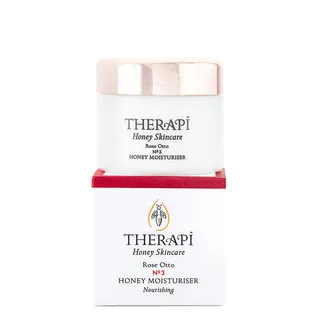
Therapi Honey Skincare Therapi Rose Otto Honey Moisturiser

Therapi Honey Skincare Therapi Rose Otto Honey Moisturiser

Efficacy62/100IrritancyHigh

Works for

Moisturizing
Prunus armeniaca kernel oil, Simmondsia chinensis seed oil + 11 more
Works
What the product description says
“A certified organic, deeply nourishing Rose Otto Honey moisturiser from Therapi.”
Source: Content

This product can help improve hydration of the skin with the two types of ingredients.

The first type is called “humectants”:
these ingredients help attract water. When humectants are on the surface of the skin, they “pull in” the moisture from the outside environment, or from within deeper layers of the skin. The following ingredients in this product do the job: glycerin, mel.

This product also contains ingredients called “occlusives”. They help reduce the speed with which our skin loses moisture to the outside environment. These ingredients also help soften the upper layer of the skin, so it feels less tight and nicer to the touch. The following ingredients in this product do the job: butyrospermum parkii butter, cera alba.

Prunus armeniaca kernel oilKey active· EmollientEffect: HighAn emollient that helps soften the skin~4–4.9%
Simmondsia chinensis seed oilKey active· Emollient, OcclusiveEffect: HighSoftens the upper layer of skin and helps restore the healthy skin barrier. Has shown to help calm down inflammation in skin. It is a stable oil, meaning that it retains its properties even when exposed to air.~3.1–3.8%
Cera albaKey active· Emollient, OcclusiveEffect: HighForms a protective barrier that holds water and keeps dry skin hydrated. Keeps an emulsion from separating into its oil and liquid components, and increases the thickness of a product. Can be an allergen~1.9–2.3%
Rosa canina fruit oilKey active· EmollientEffect: HighA great emollient. Contains vitamin E (tocopherol) which may give it some anti-oxidant properties. Can contain volatile compounds and can be irritating~1.9–2.3%
Butyrospermum parkii butterKey active· Emollient, OcclusiveEffect: HighA great moisturising ingredient that softens the skin and reduces water loss from its upper layer. It also can be helpful in protecting skin from free radicals~1.4–1.7%
MelKey active· Humectant, EmollientEffect: MediumHelps to soften the upper layer of the skin and attract water to it~1.1–1.4%
Cocos nucifera oilKey active· Emollient, OcclusiveEffect: HighAn emollient. Found to be as effective as a moisturizer for dry skin as mineral oil. Could be comedogenic~0.95–1.15%
GlycerinKey active· HumectantEffect: HighOne of the best moisturizing ingredients. Naturally present in skin. It attracts water to the upper layer of the skin working as a humectant~0.7–1.05%
Helianthus annuus seed oilKey active· Emollient, OcclusiveEffect: HighA great emollient due to its high linoleic acid content. One of the most effective plant oils in helping skin hydration and repairing skin barrier function~0.4–0.65%
Rosa damascena flower water· HumectantEffect: LowUsed to add a nice rose smell to the product. Might help attract water to the upper layer of the skin and have some anti-oxidant effect. Can be irritating~6.5–8%
Aloe barbadensis leaf juice powderEffect: LowTraditionally used to treat sunburns, dermatitis and inflammation, but evidence for its effectiveness is lacking. The extract can contain humectants that help attract water into the skin~0.5–0.7%
Glyceryl caprylate· EmollientEffect: LowAn emollient that can also help water and oil mix together, as well as prevent bacteria growth in products~0.3–0.55%
TocopherolEffect: Low, below effective dosePure form of vitamin E. Can help moisturise and protect the skin from free radicals. Often used to help stabilise other ingredients or the formula itself~0.35–0.6%
Anti-aging
Butyrospermum parkii butter, Tocopherol
Not delivered
What the product description says
“Organic Rosehip Oil – Rich in essential fatty acids and vitamins A and C, this lightweight oil helps to regenerate skin, improve elasticity, and reduce the appearance of fine lines.”
Source: Content

This product does not contain ingredients that are able to reduce fine lines and wrinkles or help with skin elasticity, but it can improve the look of the skin temporarily through moisturization. Well-moisturized skin might also be able to repair the sun damage better.This ingredient - butyrospermum parkii butter - could be helpful for preventing or repairing signs of aging in theory, but there is no evidence that it actually works.

Butyrospermum parkii butterEffect: LowA great moisturising ingredient that softens the skin and reduces water loss from its upper layer. It also can be helpful in protecting skin from free radicals~1.4–1.7%
TocopherolEffect: Low, below effective dosePure form of vitamin E. Can help moisturise and protect the skin from free radicals. Often used to help stabilise other ingredients or the formula itself~0.35–0.6%

Can it cause trouble?

Irritancy
13 strong irritants: Rosa damascena flower water, Rosa damascena extract + 11 more — patch-test recommended
High risk
We flagged 24 ingredients with irritancy potential. Severity depends on your sensitivity threshold; the table lists the worst offenders first.
IngredientFunctionIrritationEst. amount
Rosa damascena flower waterUsed to add a nice rose smell to the product. Might help attract water to the upper layer of the skin and have some anti-oxidant effect. Can be irritatingHigh~6.5–8%est.
Rosa damascena extractOil of a very fragrant pink rose used as fragrance in cosmetics. Extensive research has shown it has mixed benefits. In the pro column, inhaling this flower’s scent seems to have relaxing properties and the plant’s petals contain skin-soothing and antioxidant compounds that can benefit skin. On the flipside, the numerous chemicals that create this rose’s distinctive fragrance pose a risk of causing skin aggravation.High~0.55–0.8%est.
Citrus aurantium bergamia peel oil—High~0.45–0.7%est.
Pelargonium graveolens flower oilAn essential oil. Can be irritating. Can become an allergen with oxidationHigh~0.45–0.7%est.
Santalum spicata wood oil—High~0.35–0.65%est.
Sodium anisateUsed as a fragranceHigh~0.3–0.5%est.
CitralA fragrance with a lemon scent. A likely irritantHigh~0.15–0.25%est.
CitronellolA fragrance. Can be irritatingHigh~0.1–0.2%est.
EugenolA fragrance. Is a likely irritantHigh~0.1–0.15%est.
FarnesolAdded to create a nice product smell. Can be irritatingHigh~0.1–0.15%est.
GeraniolA fragrance. Can be irritatingHigh~0.05–0.1%est.
LimoneneA common frangrance that can easily irritate skin, especially if exposed to air, light or heatHigh~0.05%est.
LinaloolA fragrance. Can be irritatingHigh~0.01–0.05%est.
Prunus armeniaca kernel oilAn emollient that helps soften the skinMedium~4–4.9%est.
Simmondsia chinensis seed oilSoftens the upper layer of skin and helps restore the healthy skin barrier. Has shown to help calm down inflammation in skin. It is a stable oil, meaning that it retains its properties even when exposed to air.Medium~3.1–3.8%est.
Rosa canina fruit oilA great emollient. Contains vitamin E (tocopherol) which may give it some anti-oxidant properties. Can contain volatile compounds and can be irritatingMedium~1.9–2.3%est.
Cera albaForms a protective barrier that holds water and keeps dry skin hydrated. Keeps an emulsion from separating into its oil and liquid components, and increases the thickness of a product. Can be an allergenMedium~1.9–2.3%est.
Cetearyl glucosideHelps water and oil in the product mix well together and improves product textureMedium~0.6–0.9%est.
Aloe barbadensis leaf juice powderTraditionally used to treat sunburns, dermatitis and inflammation, but evidence for its effectiveness is lacking. The extract can contain humectants that help attract water into the skinMedium~0.5–0.7%est.
Amorphophallus konjac root powder—Medium~0.6–0.9%est.
Sodium levulinateA preservativeMedium~0.3–0.55%est.
Potassium cetyl phosphateHelps oil and water mix togetherMedium~0.35–0.6%est.
Citric acidCan work as an exfoliant but is typically used to adjust the product pHMedium~0.25–0.5%est.
Phytic acidAn alpha-hydroxy acid (AHA), but is mostly used to stabilize product formulations in cosmeticsMedium~0.25–0.5%est.
Comedogenic
2 ingredients rated 2 or more on the 0–5 pore-clogging scale
2 flagged
These ingredients have a comedogenic rating of 2 or more on a 0–5 scale; the table shows each one's rating. In leave-on products they can clog pores in acne-prone skin.
IngredientFunctionRatingEst. amount
Butyrospermum parkii butterA great moisturising ingredient that softens the skin and reduces water loss from its upper layer. It also can be helpful in protecting skin from free radicals3/5~1.4–1.7%est.
Cocos nucifera oilAn emollient. Found to be as effective as a moisturizer for dry skin as mineral oil. Could be comedogenic3/5~0.95–1.15%est.

User reviews

Would you recommend?
No community reviews yet.

Be the first — your take helps the next person decide.

Ingredients

Filter by role to see what each ingredient is doing.

Water~45–55%
Formula
Irritation risk
Low

Plain old water

More about Water
Rosa damascena flower water~6.5–8%
Irritant · high
Irritation risk
High
Works for
MoisturizingAnti-oxidation

Used to add a nice rose smell to the product. Might help attract water to the upper layer of the skin and have some anti-oxidant effect. Can be irritating

More about Rosa damascena flower water
Prunus armeniaca kernel oil~4–4.9%
Key activeIrritant · medium
Irritation risk
Medium
Works for
MoisturizingAnti-oxidation

An emollient that helps soften the skin

More about Prunus armeniaca kernel oil
Simmondsia chinensis seed oil~3.1–3.8%
Key activeIrritant · medium
Irritation risk
Medium
Works for
Moisturizing

Softens the upper layer of skin and helps restore the healthy skin barrier. Has shown to help calm down inflammation in skin. It is a stable oil, meaning that it retains its properties even when exposed to air.

More about Simmondsia chinensis seed oil
Polyglyceryl-3 rice branate~2.2–2.7%
Formula
Irritation risk
Low
Works for
Cleansing
More about Polyglyceryl-3 rice branate
Rosa canina fruit oil~1.9–2.3%
Key activeIrritant · medium
Irritation risk
Medium
Works for
MoisturizingAnti-oxidation

A great emollient. Contains vitamin E (tocopherol) which may give it some anti-oxidant properties. Can contain volatile compounds and can be irritating

More about Rosa canina fruit oil
Cera alba~1.9–2.3%
Key activeIrritant · medium
Irritation risk
Medium
Works for
CleansingMoisturizing

Forms a protective barrier that holds water and keeps dry skin hydrated. Keeps an emulsion from separating into its oil and liquid components, and increases the thickness of a product. Can be an allergen

More about Cera alba
Butyrospermum parkii butter~1.4–1.7%
Key activeComedogenic 3/5
Irritation risk
Low
Comedogenicity
3/5
Works for
MoisturizingAnti-oxidationAnti-aging

A great moisturising ingredient that softens the skin and reduces water loss from its upper layer. It also can be helpful in protecting skin from free radicals

More about Butyrospermum parkii butter
Mel~1.1–1.4%
Key active
Irritation risk
Low
Works for
Moisturizing

Helps to soften the upper layer of the skin and attract water to it

More about Mel
Cocos nucifera oil~0.95–1.15%
Key activeComedogenic 3/5
Irritation risk
Low
Comedogenicity
3/5
Works for
Moisturizing

An emollient. Found to be as effective as a moisturizer for dry skin as mineral oil. Could be comedogenic

More about Cocos nucifera oil
Glycerin~0.7–1.05%
Key active
Irritation risk
Low
Works for
Moisturizing

One of the best moisturizing ingredients. Naturally present in skin. It attracts water to the upper layer of the skin working as a humectant

More about Glycerin
Cetearyl glucoside~0.6–0.9%
Irritant · medium
Irritation risk
Medium
Works for
Cleansing

Helps water and oil in the product mix well together and improves product texture

More about Cetearyl glucoside
Rosa damascena extract~0.55–0.8%
Irritant · high
Irritation risk
High

Oil of a very fragrant pink rose used as fragrance in cosmetics. Extensive research has shown it has mixed benefits. In the pro column, inhaling this flower’s scent seems to have relaxing properties and the plant’s petals contain skin-soothing and antioxidant compounds that can benefit skin. On the flipside, the numerous chemicals that create this rose’s distinctive fragrance pose a risk of causing skin aggravation.

More about Rosa damascena extract
Aloe barbadensis leaf juice powder~0.5–0.7%
Irritant · medium
Irritation risk
Medium
Works for
Moisturizing

Traditionally used to treat sunburns, dermatitis and inflammation, but evidence for its effectiveness is lacking. The extract can contain humectants that help attract water into the skin

More about Aloe barbadensis leaf juice powder
Amorphophallus konjac root powder~0.6–0.9%
Irritant · medium
Citrus aurantium bergamia peel oil~0.45–0.7%
Irritant · high
Pelargonium graveolens flower oil~0.45–0.7%
Irritant · high
Irritation risk
High
Works for
Anti-oxidation

An essential oil. Can be irritating. Can become an allergen with oxidation

More about Pelargonium graveolens flower oil
Santalum spicata wood oil~0.35–0.65%
Irritant · high
Helianthus annuus seed oil~0.4–0.65%
Key active
Irritation risk
Low
Works for
Moisturizing

A great emollient due to its high linoleic acid content. One of the most effective plant oils in helping skin hydration and repairing skin barrier function

More about Helianthus annuus seed oil
Tocopherol~0.35–0.6%
Formula
Irritation risk
Low
Works for
Anti-oxidationMoisturizingAnti-inflammatoryAnti-aging

Pure form of vitamin E. Can help moisturise and protect the skin from free radicals. Often used to help stabilise other ingredients or the formula itself

More about Tocopherol
Sodium levulinate~0.3–0.55%
Irritant · medium
Irritation risk
Medium

A preservative

More about Sodium levulinate
Potassium cetyl phosphate~0.35–0.6%
Irritant · medium
Irritation risk
Medium
Works for
Cleansing

Helps oil and water mix together

More about Potassium cetyl phosphate
Sodium anisate~0.3–0.5%
Irritant · high
Irritation risk
High

Used as a fragrance

More about Sodium anisate
Citric acid~0.25–0.5%
Irritant · medium
Irritation risk
Medium

Can work as an exfoliant but is typically used to adjust the product pH

More about Citric acid
Phytic acid~0.25–0.5%
Irritant · medium
Irritation risk
Medium

An alpha-hydroxy acid (AHA), but is mostly used to stabilize product formulations in cosmetics

More about Phytic acid
Glyceryl caprylate~0.3–0.55%
Formula
Irritation risk
Low
Works for
CleansingMoisturizing

An emollient that can also help water and oil mix together, as well as prevent bacteria growth in products

More about Glyceryl caprylate
Citral~0.15–0.25%
Irritant · high
Irritation risk
High

A fragrance with a lemon scent. A likely irritant

More about Citral
Citronellol~0.1–0.2%
Irritant · high
Irritation risk
High

A fragrance. Can be irritating

More about Citronellol
Eugenol~0.1–0.15%
Irritant · high
Irritation risk
High

A fragrance. Is a likely irritant

More about Eugenol
Farnesol~0.1–0.15%
Irritant · high
Irritation risk
High

Added to create a nice product smell. Can be irritating

More about Farnesol
Geraniol~0.05–0.1%
Irritant · high
Irritation risk
High

A fragrance. Can be irritating

More about Geraniol
Limonene~0.05%
Irritant · high
Irritation risk
High

A common frangrance that can easily irritate skin, especially if exposed to air, light or heat

More about Limonene
Linalool~0.01–0.05%
Irritant · high
Irritation risk
High

A fragrance. Can be irritating

More about Linalool
Ingredient list view

Water, Rosa damascena flower water, Prunus armeniaca kernel oil, Simmondsia chinensis seed oil, Polyglyceryl-3 rice branate, Rosa canina fruit oil, Cera alba, Butyrospermum parkii butter, Mel, Cocos nucifera oil, Glycerin, Cetearyl glucoside, Rosa damascena extract, Aloe barbadensis leaf juice powder, Amorphophallus konjac root powder, Citrus aurantium bergamia peel oil, Pelargonium graveolens flower oil, Santalum spicata wood oil, Helianthus annuus seed oil, Tocopherol, Sodium levulinate, Potassium cetyl phosphate, Sodium anisate, Citric acid, Phytic acid, Glyceryl caprylate, Citral, Citronellol, Eugenol, Farnesol, Geraniol, Limonene, Linalool

Compare prices

Retailers ranked by price — lowest first.

🇬🇧 Content (UK)
$44.00
Buy

Affiliate links · As an Amazon Associate, WIMJ earns from qualifying purchases.

Worth comparing, line by line.

Match % combines shared ingredients, the first five ingredients, shared actives and hero ingredients, irritancy (lower counts in the alternative's favour), texture and body area. Only products in the same routine step are compared.

Side-by-side comparison of this product against its closest alternatives
Therapi Honey SkincareTherapi Rose Otto Honey MoisturiserYOUR PRODUCTAbsolutionLa Creme du Temps Firming Face CreamEstelle and ThildEstelle Thild BioCalm Nourishing Night CreamAnnemarie BorlindZZ Sensitive Night Cream
Match—40%40%38%
Price——$33.82$45.30
Shared key ingredients—7 of 95 of 93 of 9
Key difference—ArginineGluconolactoneAlpha-Glucan Oligosaccharide
Irritancy High High Low Medium
Drying alcohol——— Contains drying alcohol
View product Shop Shop Shop

More alternatives: Laboratoires de Biarritz HYDRA-PROTECT + Moisturizing Cream Face OrganicArtemis MED LIPID REPLENISHING FACE CREAM

Cheaper alternatives? See how this stacks up against similar formulas.
We compare ingredient profiles across our catalog — pick the closest match for your budget.
Open dupe finder
Therapi Honey Skincare Therapi Rose Otto Honey Moisturiser
Therapi Honey SkincareTherapi Rose Otto Honey Moisturiser

Affiliate links · As an Amazon Associate, WIMJ earns from qualifying purchases.

As an Amazon Associate, WIMJ earns from qualifying purchases.