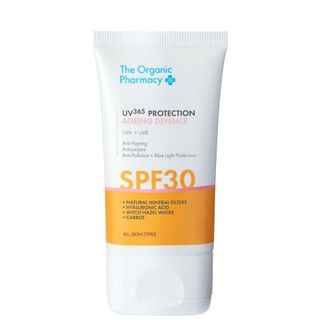
The Organic Pharmacy Suncare UV 365 Protection Ageing Defence SPF30
Works for
1 of 1 advertised claim delivered
Sun protectionSPF 30 · 2 UV filtersBroad spectrum
This product offers a good level of protection against both UVB and UVA rays.
It is a mineral sunscreen. In other words, it contains non-organic UV filters. It will probably not sting your eyes but might leave a white cast.
This product can be considered "reef safe" because it does not contain the UV filters (oxybenzone and octinoxate) that can be harmful to coral reefs when present in the water in high concentrations.
Anti-agingNot advertised by the brand · 1 ingredient credited for this claimStrong support
This product can help prevent early signs of skin aging because it offers a good level of broad spectrum sun protection. Sun damage is the main cause of premature skin aging, and protecting your skin from the sun is the best anti-aging strategy.
Evens skin toneNot advertised by the brand · No ingredient credited for this claimStrong support
This product offers broad spectrum sun protection. It means that it can prevent hyperpigmentation and help keep the skin tone even (sun damage is the main factor causing age spots, darkening of post-acne marks and other discolorations).
MoisturizingNot advertised by the brand · 14 ingredients credited for this claimGood support
This product can help improve hydration of the skin with the two types of ingredients.
The first type is called “humectants”:
these ingredients help attract water.
When humectants are on the surface of the skin, they “pull in” the moisture from the outside environment, or from
within deeper layers of the skin. The following ingredients in this product do the job:
glycerin, sodium hyaluronate.
This product also contains ingredients called “occlusives”. They help reduce the speed with which our skin loses moisture to the outside environment. These ingredients also help soften the upper layer of the skin, so it feels less tight and nicer to the touch. The following ingredients in this product do the job: caprylic/capric triglyceride, helianthus annuus seed oil.
Can it cause trouble?
Irritancy7 strong irritants: Hamamelis virginiana water, Calendula officinalis flower extract + 5 more — patch-test recommendedHigh risk
ComedogenicClean of flagged comedogenic ingredientsNone flagged
User reviews
Be the first — your take helps the next person decide.
Ingredients
Filter by role to see what each ingredient is doing.
Hamamelis virginiana water~23–34%
- Irritation risk
- High
A plant extract that can help calm down inflammation in skin. Can, however, itself be irritating
More about Hamamelis virginiana waterDiethylhexyl carbonate~5.1–7.6%
- Irritation risk
- Low
Helps soften the upper layer of the skin
More about Diethylhexyl carbonateHexyl laurate~5.1–7.7%
- Irritation risk
- Medium
Helps soften the upper layer of the skin and create a nice product consistency
More about Hexyl laurateC9-12 alkane~3.8–5.6%
Titanium dioxide~3.6–5.4%
- Irritation risk
- Low
Works as a UV filter when used in high concentrations. It is photostable and is effective mostly against the UVB light, with some protection in the UVA range. In small concentrations, used for its ability to improve the color of cosmetic products. Is usually well tolerated by the skin
More about Titanium dioxideTri (polyglyceryl-3/lauryl) hydrogenated trilinoleate~2.2–3.2%
- Irritation risk
- Low
Zinc oxide~2.4–3.5%
- Irritation risk
- Low
A broad spectrum sunblock (protects from both UVA and UVB rays). Is suitable for most sensitive skins. In small concentrations, can be used as a colorant
More about Zinc oxideCapryloyl glycerin/sebacic acid copolymer~1.5–2.3%
- Irritation risk
- Low
Helps soften the upper layer of the skin
More about Capryloyl glycerin/sebacic acid copolymerCaprylic/capric triglyceride~1.4–2.1%
- Irritation risk
- Medium
A good mix of fatty acids that forms a protective layer on the skin. Improves the shelf life of products. Derived from coconut and glycerin
More about Caprylic/capric triglycerideOleyl erucate~1–1.5%
- Irritation risk
- Low
Helps soften the upper layer of the skin and create a nice product texture
More about Oleyl erucatePolyhydroxystearic acid~0.6–1.35%
- Irritation risk
- Medium
Used to create a thicker product consistency and stabilize the formulation
More about Polyhydroxystearic acidSilica~0.95–1.4%
Glycerin~0.45–1.1%
- Irritation risk
- Low
One of the best moisturizing ingredients. Naturally present in skin. It attracts water to the upper layer of the skin working as a humectant
More about GlycerinPropanediol~0.4–1%
- Irritation risk
- Low
Acts as a solvent for other ingredients. Speeds up the absorption of other ingredients into the skin
More about PropanediolC13-15 alkane~0.4–0.9%
Hydrogenated castor oil~0.45–1.05%
- Irritation risk
- Medium
A plant oil that can help soften the skin. It might be helpful in calming down inflammation, but solid research is lacking. Is often used in lip products to create the needed product consistency
More about Hydrogenated castor oilMagnesium sulfate~0.4–0.9%
Helianthus annuus seed oil~0.4–0.9%
- Irritation risk
- Low
A great emollient due to its high linoleic acid content. One of the most effective plant oils in helping skin hydration and repairing skin barrier function
More about Helianthus annuus seed oilCalendula officinalis flower extract~0.2–0.8%
- Irritation risk
- High
A plant extract that has some anti-oxidant and anti-bacterial properties. Can be irritating
More about Calendula officinalis flower extractDaucus carota sativa root extract~0.3–0.7%
- Irritation risk
- Low
Carrot extract. Might have anti-oxidant properties and be used to add orange color
More about Daucus carota sativa root extractMedicago sativa seed extract~0.2–0.75%
- Irritation risk
- Low
Water~0.2–0.75%
Coco-caprylate/caprate~0.3–0.75%
- Irritation risk
- Low
Helps to soften the upper layer of the skin without creating a greasy texture
More about Coco-caprylate/caprateSodium hyaluronate~0.2–0.7%
- Irritation risk
- Low
One of the best moisturizing ingredients. Attracts water into the upper layer of the skin
More about Sodium hyaluronateTocopherol~0.2–0.7%
- Irritation risk
- Low
Pure form of vitamin E. Can help moisturise and protect the skin from free radicals. Often used to help stabilise other ingredients or the formula itself
More about TocopherolTocopheryl acetate~0.2–0.7%
- Irritation risk
- Medium
A more stable but less bio-available form of vitamin E compared to Tocopherol. Might help moisturize and protect the skin from free radicals, but mostly used in low concentrations to stabilize other ingredients.
More about Tocopheryl acetateBisabolol~0.15–0.65%
- Irritation risk
- Low
An active component of chamomile plant that historically has been used to calm down irritated skin. A recent study shows that bisabolol indeed can have some anti-inflammatory effect on skin, even though conclusive data is lacking. Bisabolol has a sweet floral scent and can be added to products for its aromatic properties
More about BisabololTetrasodium glutamate diacetate~0.2–0.7%
- Irritation risk
- Low
Helps stabilize the product formulation
More about Tetrasodium glutamate diacetateDehydroacetic acid~0.3–0.6%
1,2-hexanediol~0.2–0.7%
Stearic acid~0.35–0.85%
- Irritation risk
- Low
Helps oil and water mix together and works as an emollient
More about Stearic acidHydroxyacetophenone~0.2–0.7%
Diethylhexyl syringylidenemalonate~0.2–0.7%
- Irritation risk
- Medium
Used to stabilize the product formulation
More about Diethylhexyl syringylidenemalonateSodium hydroxide~0.2–0.75%
Cetyl alcohol~0.35–0.85%
- Irritation risk
- Low
A non-drying alcohol that works to soften the skin and stabilize product formulations helping oil and water mix together
More about Cetyl alcoholButylene glycol~0.2–0.75%
- Irritation risk
- Low
Used to create a nice product texture and help delivery of other ingredients. Might be somewhat helpful in attracting water to the upper layer of the skin
More about Butylene glycolOryzanol~0.2–0.75%
- Irritation risk
- Low
An anti-oxidant that helps stabilize product formulations. Might help neutralise free radicals in skin
More about OryzanolBenzyl alcohol~0.15–0.7%
- Irritation risk
- High
A preservative. Can be used to mask unpleasant smell. Can be irritating
More about Benzyl alcoholParfum~0.15–0.7%
- Irritation risk
- High
An aromatic blend of unspecified and possibly irritating ingredients
More about ParfumLimonene~0.15–0.7%
- Irritation risk
- High
A common frangrance that can easily irritate skin, especially if exposed to air, light or heat
More about LimoneneLinalool~0.15–0.65%
Hexyl cinnamal~0.15–0.65%
Geranyl acetate~0.15–0.55%
- Irritation risk
- Low
Citrus aurantium peel oil~0.15–0.55%
- Irritation risk
- Low
Terpineol~0.15–0.6%
- Irritation risk
- Low
Geraniol~0.15–0.55%
Rose ketones~0.1–0.45%
- Irritation risk
- Low
Benzaldehyde~0.1–0.45%
- Irritation risk
- Low
Ingredient list view
Hamamelis virginiana water, Diethylhexyl carbonate, Hexyl laurate, C9-12 alkane, Titanium dioxide, Tri (polyglyceryl-3/lauryl) hydrogenated trilinoleate, Zinc oxide, Capryloyl glycerin/sebacic acid copolymer, Caprylic/capric triglyceride, Oleyl erucate, Polyhydroxystearic acid, Silica, Glycerin, Propanediol, C13-15 alkane, Hydrogenated castor oil, Magnesium sulfate, Helianthus annuus seed oil, Calendula officinalis flower extract, Daucus carota sativa root extract, Medicago sativa seed extract, Water, Coco-caprylate/caprate, Sodium hyaluronate, Tocopherol, Tocopheryl acetate, Bisabolol, Tetrasodium glutamate diacetate, Dehydroacetic acid, 1,2-hexanediol, Stearic acid, Hydroxyacetophenone, Diethylhexyl syringylidenemalonate, Sodium hydroxide, Cetyl alcohol, Butylene glycol, Oryzanol, Benzyl alcohol, Parfum, Limonene, Linalool, Hexyl cinnamal, Geranyl acetate, Citrus aurantium peel oil, Terpineol, Geraniol, Rose ketones, Benzaldehyde
Compare prices
Retailers ranked by price — lowest first.

Affiliate links · prices updated regularly
Sources cited in this review
Every concentration estimate and effectiveness label is anchored to one of these 29 studies and safety reviews.
- 1A review of inorganic UV filters zinc oxide and titanium dioxideonlinelibrary.wiley.com
- 2
- 3
- 4
- 5
- 6

Affiliate links · As an Amazon Associate, WIMJ earns from qualifying purchases.