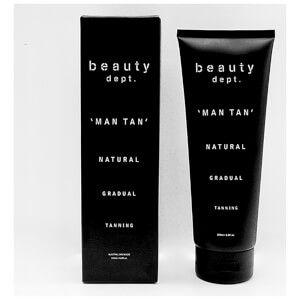
The Beauty Department Natural Gradual Tanning Lotion - Man Tan
Works for
1 of 1 advertised claim delivered
MoisturizingButyrospermum parkii butter, Cera alba + 7 moreGood evidence
“Formulated with a nourishing, hydrating blend of organic ingredients, the self tan smooths on effortlessly to infuse skin with a warm golden tone and provide antioxidant protection against external aggressors.”
This product can help improve hydration of the skin with the two types of ingredients.
The first type is called “humectants”:
these ingredients help attract water.
When humectants are on the surface of the skin, they “pull in” the moisture from the outside environment, or from
within deeper layers of the skin. The following ingredients in this product do the job:
glycerin.
This product also contains ingredients called “occlusives”. They help reduce the speed with which our skin loses moisture to the outside environment. These ingredients also help soften the upper layer of the skin, so it feels less tight and nicer to the touch. The following ingredients in this product do the job: butyrospermum parkii butter, cera alba.
ExfoliationNot advertised by the brand · Salicylic acidStrong evidence
This product can help exfoliate the skin. In other words, it helps break down the bonds between dead cells on the surface of the skin and speed up the skin turnover. Skin often appears softer and brighter after exfoliation, but overdoing it can result in disrupted skin barrier. The following ingredient is doing the exfoliating job in this product: salicylic acid.
Anti-blemishNot advertised by the brand · Salicylic acidStrong evidence
This product can help reduce breakouts and clogged pores because it contains the following ingredient: salicylic acid. This ingredient is used for treating acne and can have a noticeable effect.
Can it cause trouble?
Irritancy9 strong irritants: Citrus reticulata peel oil, Lavandula angustifolia oil + 7 more — patch-test recommendedHigh risk
Comedogenic4 ingredients rated 2 or more on the 0–5 pore-clogging scale4 flagged


User reviews
Be the first — your take helps the next person decide.
Ingredients
Filter by role to see what each ingredient is doing.
Water~40–60%
Cocos nucifera oil~4.8–7.3%
- Irritation risk
- Low
- Comedogenicity
- 3/5
An emollient. Found to be as effective as a moisturizer for dry skin as mineral oil. Could be comedogenic
More about Cocos nucifera oilMacadamia integrifolia seed oil~3.8–5.6%
- Irritation risk
- Low
A plant oil that helps soften the upper layer of the skin
More about Macadamia integrifolia seed oilDihydroxyacetone~2.8–4.3%
Cetearyl alcohol~2.1–3.2%
- Irritation risk
- Low
- Comedogenicity
- 2/5
A non-drying alcohol. Works as an emollient. Helps water and oil mix together and creates a nice product texture
More about Cetearyl alcoholGlycerin~1.8–2.8%
- Irritation risk
- Low
One of the best moisturizing ingredients. Naturally present in skin. It attracts water to the upper layer of the skin working as a humectant
More about GlycerinCetearyl glucoside~1.5–2.3%
- Irritation risk
- Medium
Helps water and oil in the product mix well together and improves product texture
More about Cetearyl glucosideCera alba~1.6–2.4%
- Irritation risk
- Medium
Forms a protective barrier that holds water and keeps dry skin hydrated. Keeps an emulsion from separating into its oil and liquid components, and increases the thickness of a product. Can be an allergen
More about Cera albaHelianthus annuus seed oil~1.2–1.8%
- Irritation risk
- Low
A great emollient due to its high linoleic acid content. One of the most effective plant oils in helping skin hydration and repairing skin barrier function
More about Helianthus annuus seed oilChondrus crispus~0.85–1.3%
- Irritation risk
- Low
- Comedogenicity
- 3/5
Red algae extract that helps attract water to the upper layer of the skin and create a nicer product consistency
More about Chondrus crispusButyrospermum parkii butter~0.55–1.35%
- Irritation risk
- Low
- Comedogenicity
- 3/5
A great moisturising ingredient that softens the skin and reduces water loss from its upper layer. It also can be helpful in protecting skin from free radicals
More about Butyrospermum parkii butterTocopherol~0.45–1.05%
- Irritation risk
- Low
Pure form of vitamin E. Can help moisturise and protect the skin from free radicals. Often used to help stabilise other ingredients or the formula itself
More about TocopherolCitrus reticulata peel oil~0.4–0.9%
- Irritation risk
- High
An essential oil used for fragrance. Can be an allergen and irritant
More about Citrus reticulata peel oilLavandula angustifolia oil~0.35–0.8%
- Irritation risk
- High
An essential oil. Potential allergen and can be irritating. It has some anti-bacterial properties
More about Lavandula angustifolia oilPogostemon cablin oil~0.35–0.8%
- Irritation risk
- Low
Rosmarinus officinalis leaf oil~0.35–0.75%
- Irritation risk
- High
A plant oil with high content of volatile compounds that can irritate the skin. Can be used as a fragrance. Has anti-bacterial properties and might help neutralize free radicals on the surface of the skin
More about Rosmarinus officinalis leaf oilXanthan gum~0.3–0.75%
- Irritation risk
- Low
Used to create a thicker product consistency
More about Xanthan gumErythrulose~0.2–0.75%
- Irritation risk
- Low
Benzyl alcohol~0.15–0.5%
- Irritation risk
- High
A preservative. Can be used to mask unpleasant smell. Can be irritating
More about Benzyl alcoholSalicylic acid~0.15–0.55%
- Irritation risk
- High
Used for skin exfoliation. It has an anti-inflammatory and anti-bacterial effect, helps to unclog pores, prevent blemishes and speed up healing of the existing ones. Sometimes referred to as a BHA (beta-hydroxy acid)
More about Salicylic acidSorbic acid~0.1–0.5%
Citronellol~0.1–0.45%
Limonene~0.1–0.4%
- Irritation risk
- High
A common frangrance that can easily irritate skin, especially if exposed to air, light or heat
More about LimoneneLinalool~0.1–0.35%
Citral~0.1–0.3%
Farnesol~0.05–0.25%
Geraniol~0.05–0.2%
Ingredient list view
Water, Cocos nucifera oil, Macadamia integrifolia seed oil, Dihydroxyacetone, Cetearyl alcohol, Glycerin, Cetearyl glucoside, Cera alba, Helianthus annuus seed oil, Chondrus crispus, Butyrospermum parkii butter, Tocopherol, Citrus reticulata peel oil, Lavandula angustifolia oil, Pogostemon cablin oil, Rosmarinus officinalis leaf oil, Unknown, Xanthan gum, Erythrulose, Benzyl alcohol, Salicylic acid, Sorbic acid, Citronellol, Limonene, Linalool, Citral, Farnesol, Geraniol
Compare prices
Retailers ranked by price — lowest first.
.png)
Affiliate links · prices updated regularly
Worth comparing, line by line.
Match % combines shared ingredients, the first five ingredients, shared actives and hero ingredients, irritancy (lower counts in the alternative's favour), texture and body area. Only products in the same routine step are compared.
| The Beauty DepartmentNatural Gradual Tanning Lotion - Man TanYOUR PRODUCT | The Organic PharmacyRose Body Lotion | SayaHand and Body Lotion | Vita LiberataFabulous Self Tanning Gradual Lotion | |
|---|---|---|---|---|
| Match | — | 89% | 88% | 87% |
| Price | $42.13 | $40.09−$2.04 | $58.00+$15.87 | $10.00−$32.13 |
| Shared key ingredients | — | 6 of 9 | 6 of 9 | 4 of 9 |
| Key difference | — | Glycine Soja Sterols | Carthamus Tinctorius Seed Oil | Panthenol |
| Irritancy | High | High | High | Low |
| Drying alcohol | — | — | — | — |
| View product | Shop | Shop | Shop |


Sources cited in this review
Every concentration estimate and effectiveness label is anchored to one of these 21 studies and safety reviews.
- 1
- 2
- 3
- 4
- 5
- 6Effect of topically applied lipids on surfactant-irritated skinonlinelibrary.wiley.com

Affiliate links · As an Amazon Associate, WIMJ earns from qualifying purchases.