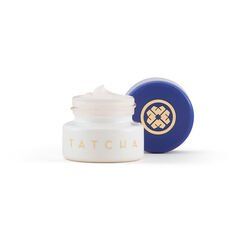
Tatcha Ageless Revitalizing Eye Cream - Anti-Aging | Tatcha
Works for
1 of 2 advertised claims delivered
Moisturizing12 ingredients credited for this claimGood support
“rich, velvety eye cream”
This product can help improve hydration of the skin with the two types of ingredients.
The first type is called “humectants”:
these ingredients help attract water.
When humectants are on the surface of the skin, they “pull in” the moisture from the outside environment, or from
within deeper layers of the skin. The following ingredients in this product do the job:
glycerin, inositol.
This product also contains ingredients called “occlusives”. They help reduce the speed with which our skin loses moisture to the outside environment. These ingredients also help soften the upper layer of the skin, so it feels less tight and nicer to the touch. The following ingredients in this product do the job: beeswax, chondrus crispus extract.
Anti-aging1 ingredient credited for this claimWeak support
“Anti-Aging”
Effective ingredients missing or their concentration is too low.
Can it cause trouble?
Irritancy1 strong irritant: AlcoholMedium risk
Comedogenic3 ingredients rated 2 or more on the 0–5 pore-clogging scale3 flagged
User reviews
Be the first — your take helps the next person decide.
Ingredients
Filter by role to see what each ingredient is doing.
Water~45–55%
Glycerin~5.4–6.6%
- Irritation risk
- Low
One of the best moisturizing ingredients. Naturally present in skin. It attracts water to the upper layer of the skin working as a humectant
More about GlycerinSqualane~4.7–5.7%
- Irritation risk
- Low
An oil naturally present in skin. Works as an emollient to soften the skin and form a protective layer on its surface without a greasy feeling.
More about SqualanePropanediol~3.1–3.8%
- Irritation risk
- Low
Acts as a solvent for other ingredients. Speeds up the absorption of other ingredients into the skin
More about PropanediolXylitol~2.3–2.9%
- Irritation risk
- Low
Helps attract water to the upper layer of the skin and repair the skin barrier function
More about XylitolGlyceryl stearate se~1.9–2.3%
- Irritation risk
- Low
- Comedogenicity
- 2/5
Used to stabilize the product formulations and works as an emollient
More about Glyceryl stearate seCyclopentasiloxane~1.6–1.9%
- Irritation risk
- Low
A silicone that helps improve the product texture and spreadability. Can absorb oil creating a short-term mattifying effect on the skin
More about CyclopentasiloxaneBehenyl alcohol~1.5–1.8%
- Irritation risk
- Low
Non-drying alcohol that helps water and oil mix together. Also serves as an emollient
More about Behenyl alcoholMyristyl myristate~1.3–1.5%
- Irritation risk
- Medium
- Comedogenicity
- 3/5
An emollient. Is not recommended for acne-prone skin as it can be comedogenic
More about Myristyl myristateSilica~1.1–1.3%
Beeswax~0.65–1%
- Irritation risk
- Low
Forms a protective barrier that holds water and keeps dry skin hydrated. Keeps an emulsion from separating into its oil and liquid components, and increases the thickness of a product. Can be an allergen
More about BeeswaxPaeonia albiflora root extract~0.45–0.7%
- Irritation risk
- Low
Camellia japonica seed oil~0.45–0.65%
- Irritation risk
- Low
A plant oil that helps to soften the upper layer of the skin and can help restore skin's barrier function. Might have an anti-oxidant effect
More about Camellia japonica seed oilCamellia sinensis leaf extract~0.35–0.65%
- Irritation risk
- Low
Can contain potent anti-oxidant compounds (abbreviated ECG, GCG, EGC, and EGCG) that might help protect the skin from free radicals. Can help calm down inflammation and has some anti-bacterial properties. Unfortunately, these antioxidants are unstable and lose their effectiveness very quickly in products. The concentration of the antioxidant compounds in the extract also tends to be low to be effective in topical formulation
More about Camellia sinensis leaf extractLonicera japonica leaf extract~0.3–0.55%
- Irritation risk
- Low
Coix lacryma-jobi ma-yuen seed extract~0.3–0.55%
- Irritation risk
- Low
Chondrus crispus extract~0.3–0.6%
- Irritation risk
- Low
- Comedogenicity
- 3/5
Red algae extract that helps attract water to the upper layer of the skin and create a nicer product consistency
More about Chondrus crispus extractInositol~0.25–0.5%
Sodium hyaluronate~0.25–0.45%
- Irritation risk
- Low
One of the best moisturizing ingredients. Attracts water into the upper layer of the skin
More about Sodium hyaluronateTocopheryl acetate~0.2–0.4%
- Irritation risk
- Medium
A more stable but less bio-available form of vitamin E compared to Tocopherol. Might help moisturize and protect the skin from free radicals, but mostly used in low concentrations to stabilize other ingredients.
More about Tocopheryl acetateCaprylyl/capryl glucoside~0.25–0.5%
- Irritation risk
- Medium
Helps oil and water mix together. Can be used as a cleansing agent
More about Caprylyl/capryl glucosideCaprylic/capric/myristic/stearic triglyceride~0.2–0.4%
- Irritation risk
- Low
Helps to soften the upper layer of the skin
More about Caprylic/capric/myristic/stearic triglycerideTetrasodium pyrophosphate~0.2–0.35%
Disodium edta~0.15–0.3%
Sodium acrylate/acryloyldimethyltaurate/dimethylacrylamide crosspolymer~0.2–0.35%
Sodium dilauramidoglutamide lysine~0.15–0.3%
- Irritation risk
- Low
Isostearic acid~0.25–0.45%
- Irritation risk
- Low
Used to create a nice product texture
More about Isostearic acidSorbitan isostearate~0.15–0.3%
- Irritation risk
- Low
Helps oil and water mix together
More about Sorbitan isostearateEthylhexylglycerin~0.15–0.25%
Aluminum hydroxide~0.15–0.3%
- Irritation risk
- Low
Is used to add opaque (non-transparent) appearance to formulations. Can be used to coat other ingredients for even dispersion. This is a different ingredient compared to the ones used in antipersperants (aluminium chloride and aluminium chlorohydrate)
More about Aluminum hydroxideStearyl alcohol~0.1–0.2%
- Irritation risk
- Low
An emollient that helps soften the skin
More about Stearyl alcoholAlcohol~0.05–0.1%
- Irritation risk
- High
Can be drying and contribute to skin irritation. Used in formulars to dissolve other ingredients, create a thinner product consistency or for its antibacterial properties
More about AlcoholPhenoxyethanol~0.05–0.1%
- Irritation risk
- Low
A preservative. It helps prevent bacterial growth in cosmetic products
More about PhenoxyethanolTitanium dioxide~0.01–0.05%
- Irritation risk
- Low
Works as a UV filter when used in high concentrations. It is photostable and is effective mostly against the UVB light, with some protection in the UVA range. In small concentrations, used for its ability to improve the color of cosmetic products. Is usually well tolerated by the skin
More about Titanium dioxideIron oxides~0.01–0.05%
- Irritation risk
- Low
An umbrella term for the following three colorants: CI 77491, CI 77492, CI 77499. They might be able to offer some protection against visible light, but the degree of the protection is not clear
More about Iron oxidesIngredient list view
Water, Glycerin, Squalane, Propanediol, Xylitol, Glyceryl stearate se, Cyclopentasiloxane, Behenyl alcohol, Myristyl myristate, Silica, Beeswax, Paeonia albiflora root extract, Camellia japonica seed oil, Camellia sinensis leaf extract, Lonicera japonica leaf extract, Coix lacryma-jobi ma-yuen seed extract, Chondrus crispus extract, Inositol, Sodium hyaluronate, Tocopheryl acetate, Caprylyl/capryl glucoside, Caprylic/capric/myristic/stearic triglyceride, Tetrasodium pyrophosphate, Disodium edta, Sodium acrylate/acryloyldimethyltaurate/dimethylacrylamide crosspolymer, Sodium dilauramidoglutamide lysine, Isostearic acid, Sorbitan isostearate, Ethylhexylglycerin, Aluminum hydroxide, Unknown, Stearyl alcohol, Alcohol, Phenoxyethanol, Titanium dioxide, Iron oxides
Compare prices
Retailers ranked by price — lowest first.

Sources cited in this review
Every concentration estimate and effectiveness label is anchored to one of these 5 studies and safety reviews.
- 1
- 2Hyaluronic acid: A key molecule in skin agingncbi.nlm.nih.gov
- 3
- 4
- 5

Affiliate links · As an Amazon Associate, WIMJ earns from qualifying purchases.