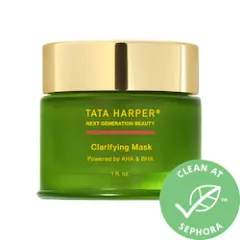
Works for:
based on ingredients and %- Exfoliation
- Moisturizing
- Evens skin tone
- Anti-aging
Doesn't work for:
based on ingredients and %- Anti-blemish
Can it cause trouble?
- Irritation risk: high
- Comedogenic risk ingredients: 0
Key actives


Product Summary
"Tata Harper - Clarifying AHA + BHA Mask" is effective for: Exfoliation, Evens skin tone and Anti-inflammatory
This product could be helpful for: Anti-aging and Moisturizing, but its actives are not the most effective or are not well-studied.
Ingredient callouts
- This product contains acids (lactic acid 2.60% - 3.90%). Their concentration is low, and they will not have a strong exfoliating effect. Instead, they work to support the skin natural acid mantle and to attract water (as humectants). Lactic acid is particularly good in attracting water to the upper layer of the skin and improving the skin barrier.
- Humectants (glycerin 0.40% - 0.95% and lactic acid 2.60% - 3.90%). These ingredients help attract water to the upper layer of the skin and improve the skin hydration.
About the brand
According to Cruelty-Free Kitty "Tata Harper" is cruelty free and so is its parent company.
Price
The product retails from 75.00$ up to 95.00$ in the United States.
For a detailed price comparison: click here.
Evens skin tone
What does the product description say?
clear-looking complexion
Source: Sephora
This product can help reduce hypepigmentation and even out the skin tone because it contains the following effective ingredients: lactic acid
Keep in mind that you would need to apply any topical skincare targetted at hypigmentation consistently for a couple of months to get a result. No topical skincare product can help get rid of hyperpigmentation (including post-acne marks and age spots) instantly.
An exfoliating and moisturizing alpha-hydroxy acid (AHA). Typically causes less irritation than other AHAs, for example, glycolic acid. At high concentrations (about 15%), lactic acid can help reduce lines and wrinkles. Recent studies show that lactic acid can support the "good" bacteria living on skin's surface (healthy skin microbiome)
Exfoliation
What does the product description say?
A blemish-targeting mask that clarifies, exfoliates, and soothes redness with AHAs and quartz micro-crystals for a smooth, clear-looking complexion.
Source: Sephora
This product can help exfoliate the skin. In other words, it helps break down the bonds between dead cells on the surface of the skin and speed up the skin turnover. Skin often appears softer and brighter after exfoliation, but overdoing it can result in disrupted skin barrier. The following ingredient is doing the exfoliating job in this product: lactic acid.
An exfoliating and moisturizing alpha-hydroxy acid (AHA). Typically causes less irritation than other AHAs, for example, glycolic acid. At high concentrations (about 15%), lactic acid can help reduce lines and wrinkles. Recent studies show that lactic acid can support the "good" bacteria living on skin's surface (healthy skin microbiome)
A plant extract that can help neutralize free radicals in skin. It contains a compound salicin that can theoretically be converted into salicylic acid that, in turn, helps reduce inflammation in skin, but the evidence of effectiveness in skin is lacking and the extract is usually not used in a concentration that would enable an exfoliating effect
Anti-aging
This product contains lactic acid. This ingredient might be able to help reduce and prevent fine lines and wrinkles, improve skin elasticity and firmness, but there is not enough evidence that it actually works.
An exfoliating and moisturizing alpha-hydroxy acid (AHA). Typically causes less irritation than other AHAs, for example, glycolic acid. At high concentrations (about 15%), lactic acid can help reduce lines and wrinkles. Recent studies show that lactic acid can support the "good" bacteria living on skin's surface (healthy skin microbiome)
Moisturizing
What does the product description say?
- African Wild Grape and Raw Honey: Hydrate and soothe to visibly calm irritation and minimize the look of redness.
Source: Sephora
This product can help improve hydration of the skin with the two types of ingredients.
The first type is called “humectants”:
these ingredients help attract water.
When humectants are on the surface of the skin, they “pull in” the moisture from the outside environment, or from
within deeper layers of the skin. The following ingredients in this product do the job:
glycerin, lactic acid.
This product also contains ingredients called “occlusives”. They help reduce the speed with which our skin loses moisture to the outside environment. These ingredients also help soften the upper layer of the skin, so it feels less tight and nicer to the touch. The following ingredients in this product do the job: borago officinalis seed oil, oenothera biennis oil.
Sugar extract that helps attract water to the upper layer of the skin
A plant oil that is effective in reducing irritation in skin, restore the barrier function and support its hydration
An exfoliating and moisturizing alpha-hydroxy acid (AHA). Typically causes less irritation than other AHAs, for example, glycolic acid. At high concentrations (about 15%), lactic acid can help reduce lines and wrinkles. Recent studies show that lactic acid can support the "good" bacteria living on skin's surface (healthy skin microbiome)
Helps soften the upper layer of the skin and can support skin barrier function
One of the best moisturizing ingredients. Naturally present in skin. It attracts water to the upper layer of the skin working as a humectant
Helps attract water to the upper layer of the skin
Helps attract water to the skin and might have some anti-bacterial properties. Can be an allergen
An emollient that helps soften the skin but is not effective for restoring its barrier function. Might be helpful to calm down inflammation
An emollient that can also help water and oil mix together, as well as prevent bacteria growth in products
Helps oil and water mix together and helps preserve the product formulation
Anti-blemish
What does the product description say?
A blemish-targeting mask that clarifies, exfoliates, and soothes redness with AHAs and quartz micro-crystals for a smooth, clear-looking complexion.
Source: Sephora
Effective ingredients missing or their concentration is too low.
A type of clay that consists mainly of aluminum silicate. Helps absorb oil and creates a thicker product consistency. Can be used to add a white color
Helps soften the upper layer of the skin and can support skin barrier function
A plant extract that can help neutralize free radicals in skin. It contains a compound salicin that can theoretically be converted into salicylic acid that, in turn, helps reduce inflammation in skin, but the evidence of effectiveness in skin is lacking and the extract is usually not used in a concentration that would enable an exfoliating effect
Helps stabilize the product formulation
How honest is this product?
| Promise | Can it deliver? |
|---|---|
| Exfoliation | |
| Moisturizing | |
| Anti-blemish |
Total Promises Fulfilled score: 58/100.
We receive a small commission for purchases made through these links at no cost for you. Thank you for your support! Learn more
Potential irritants
Comedogenic ingredients
No comedogenic ingredients detected
User reviews (0)
Averages from community submissions.
No reviews yet for this product.
Be the first to share your experience!
Tried this product?
Help capture what the ingredient list can't—texture, finish, pilling, scent, and more. Answer what you can, skip the rest.
Takes ~30 seconds.
Reviews are shown in aggregate. No personal details.
| Product | Similarity | Price | Irritancy |
|---|---|---|---|
 Tata Harper Clarifying AHA + BHA Mask | Current | ≈ $66.81 | |
Then I Met You Rose Resurfacing Facial Mask | 56% | $56.00 | |
celimax Skin Repair Bee Tox Therapy Mask | 55% | $4.60 | |
 Jan Marini Luminate Face Mask | 55% | ≈ $106.12 | |
 Beekman 1802 Milk Glaze 10% Lactic Acid Pore Purging Clay Mask | 54% | $38.00 | |
 Gallinée Care Mask | 53% | ≈ $29.60 |
Key Actives
An exfoliating and moisturizing alpha-hydroxy acid (AHA). Typically causes less irritation than other AHAs, for example, glycolic acid. At high concentrations (about 15%), lactic acid can help reduce lines and wrinkles. Recent studies show that lactic acid can support the "good" bacteria living on skin's surface (healthy skin microbiome)
Helps soften the upper layer of the skin and can support skin barrier function
A plant oil that is effective in reducing irritation in skin, restore the barrier function and support its hydration
A type of clay that consists mainly of aluminum silicate. Helps absorb oil and creates a thicker product consistency. Can be used to add a white color
One of the best moisturizing ingredients. Naturally present in skin. It attracts water to the upper layer of the skin working as a humectant
Sugar extract that helps attract water to the upper layer of the skin
Helps attract water to the upper layer of the skin
Potential irritants
A plant extract that can help neutralize free radicals in skin. It contains a compound salicin that can theoretically be converted into salicylic acid that, in turn, helps reduce inflammation in skin, but the evidence of effectiveness in skin is lacking and the extract is usually not used in a concentration that would enable an exfoliating effect
Can contain essential oil that can be irritating. Can help to soften the upper layer of the skin. Might be helpful in neutralizing free radicals
A plant extract that is used as a fragrance. Can be irritating and lead to photosensitivity
Used as a fragrance. Can be irritating and cause photosensitivity
A plant extract that has some anti-oxidant and anti-bacterial properties. Can be irritating
A plant extract that may contain a small amount of essential oils. Might be helpful in neutralizing free radicals in skin
A common frangrance that can easily irritate skin, especially if exposed to air, light or heat
An exfoliating and moisturizing alpha-hydroxy acid (AHA). Typically causes less irritation than other AHAs, for example, glycolic acid. At high concentrations (about 15%), lactic acid can help reduce lines and wrinkles. Recent studies show that lactic acid can support the "good" bacteria living on skin's surface (healthy skin microbiome)
Helps oil and water mix together and helps preserve the product formulation
Helps soften the upper layer of the skin and can support skin barrier function
A plant extract that contains small percentage of AHAs. Is unlikely to have any skin benefit due the small concentration of the active compounds
An emollient that helps soften the skin but is not effective for restoring its barrier function. Might be helpful to calm down inflammation
A plant extract that might help neutralize free radicals in skin
Helps to control the skin's pH level. Maintains the skin's natural film of amino-lactic acids and oils. Helps to preserve products
Comedogenic ingredients
We couldn't find any comedogenic ingredients in this product
All ingredients
Helps attract water to the skin and might have some anti-bacterial properties. Can be an allergen
A type of clay that consists mainly of aluminum silicate. Helps absorb oil and creates a thicker product consistency. Can be used to add a white color
An exfoliating and moisturizing alpha-hydroxy acid (AHA). Typically causes less irritation than other AHAs, for example, glycolic acid. At high concentrations (about 15%), lactic acid can help reduce lines and wrinkles. Recent studies show that lactic acid can support the "good" bacteria living on skin's surface (healthy skin microbiome)
A plant extract that can help neutralize free radicals in skin. It contains a compound salicin that can theoretically be converted into salicylic acid that, in turn, helps reduce inflammation in skin, but the evidence of effectiveness in skin is lacking and the extract is usually not used in a concentration that would enable an exfoliating effect
Helps oil and water mix together and helps preserve the product formulation
Can contain essential oil that can be irritating. Can help to soften the upper layer of the skin. Might be helpful in neutralizing free radicals
One of the best moisturizing ingredients. Naturally present in skin. It attracts water to the upper layer of the skin working as a humectant
Helps soften the upper layer of the skin and can support skin barrier function
Sugar extract that helps attract water to the upper layer of the skin
A plant extract that is used as a fragrance. Can be irritating and lead to photosensitivity
Used as a fragrance. Can be irritating and cause photosensitivity
A plant extract that contains small percentage of AHAs. Is unlikely to have any skin benefit due the small concentration of the active compounds
An emollient that helps soften the skin but is not effective for restoring its barrier function. Might be helpful to calm down inflammation
A plant oil that is effective in reducing irritation in skin, restore the barrier function and support its hydration
A plant extract that has some anti-oxidant and anti-bacterial properties. Can be irritating
A plant extract that might help neutralize free radicals in skin
A plant extract that may contain a small amount of essential oils. Might be helpful in neutralizing free radicals in skin
Helps attract water to the upper layer of the skin
An emollient that can also help water and oil mix together, as well as prevent bacteria growth in products
Helps to control the skin's pH level. Maintains the skin's natural film of amino-lactic acids and oils. Helps to preserve products
A common frangrance that can easily irritate skin, especially if exposed to air, light or heat
Ingredient list view
Honey, Kaolin, Cirsium flower/leaf/stem extract, Unknown, Lactic acid, Salix alba bark extract, Unknown, Maranta arundinacea root extract, Bentonite, Aroma, Glyceryl undecylenate, Pyrus malus seed oil, Water, Glycerin, Hydrated silica, Oenothera biennis oil, Santalum spicatum seed oil, Lannea microcarpa fruit extract, Tasmannia lanceolata fruit/leaf extract, Chlorella pyrenoidosa powder, Vaccinium myrtillus fruit/leaf extract, Gaultheria procumbens leaf extract, Saccharum officinarum extract, Citrus aurantium dulcis fruit extract, Citrus limon fruit extract, Acer saccharum extract, Olea europaea fruit oil, Borago officinalis seed oil, Arnica montana extract, Borago officinalis leaf extract, Calendula officinalis flower extract, Medicago sativa extract, Spiraea ulmaria extract, Sambucus nigra fruit extract, Alpha-glucan oligosaccharide, Glyceryl caprylate, Sodium citrate, Sodium phytate, Ci 77288, Linalool, Limonene, Geraniol, Citronellol, Citral, Eugenol, Methyl eugenol
- Epidermal and dermal effects of topical lactic acid
- Dual Effects of Alpha-Hydroxy Acids on the Skin
- Efficacy and Safety of White Willow Bark (Salix alba) Extract
- An evaluation of the effect of a topical product containing salicin on the visible signs of human skin aging
- Safety Assessment of Pyrus malus (Apple)-derived Ingredients as Used in Cosmetics
- Glycerol and the skin: holistic approach to its origin and functions
- Safety Assessment of Citrus Fruit-Derived Ingredients as Used in Cosmetics
- Photosensitivity in children: An approach to diagnosis and management
- Safety Assessment of Citrus-Derived Peel Oils as Used in Cosmetics
- Use of “natural” oils for moisturization: Review of olive, coconut, and sunflower seed oil
- Dermatology News - Commentary: Borage Seed Oil
- Undershirts coated with borage oil alleviate the symptoms of atopic dermatitis in children
- Topical application of Calendula officinalis (L.): Formulation and evaluation of hydrophilic cream with antioxidant activity
- The seamy side of natural medicines: contact sensitization to arnica (Arnica montana L.) and marigold (Calendula officinalis L.)
- Final report on the safety assessment of Calendula officinalis extract and Calendula officinalis
- Contact dermatitis as an adverse reaction to some topically used European herbal medicinal products – part 1: Achillea millefolium–Curcuma longa
- Antioxidant Activity and Cytotoxicity of Medicago sativa L. Seeds and Herb Extract on Skin Cells
- Assessment report on Sambucus nigra L., fructus
- SKIN PROTECTION AGAINST SOLAR UV RADIATION BY NATURAL PLANT PRODUCTS: EXTRACTS FROM ELDER FRUIT (SAMBUCUS NIGRA L.)
- Annex I: Clinical evidence regarding sensitisation to individual fragrance chemicals and to natural extracts