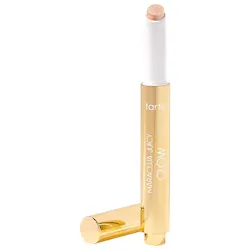
Tarte Maracuja Juicy Glow Highlighting Stick
Works for
1 of 1 advertised claim delivered
Moisturizing15 ingredients credited for this claimGood support
“Provides visibly firmer, brighter, and smoother skin and hydrates.”
This product can help soften the skin and reduce its moisture loss with emollients and occlusives: bis-diglyceryl polyacyladipate-2, caprylic/capric triglyceride.
Keep in mind that this product does not contain effective ingredients to attract water to the upper layer of the skin. This is why an additional product with humectants like glycerin or hyaluronic acid can be helpful (apply it before this product for the best results).
Can it cause trouble?
Irritancy1 strong irritant: Sorbitan sesquioleateMedium risk
Comedogenic2 ingredients rated 2 or more on the 0–5 pore-clogging scale2 flagged
User reviews
Be the first — your take helps the next person decide.
Ingredients
Filter by role to see what each ingredient is doing.
Octyldodecanol~26–31%
- Irritation risk
- Low
An emollient that helps to soften the skin and create a pleasant product texture and stabilize the formulation
More about OctyldodecanolSynthetic fluorphlogopite~9.2–11.3%
- Irritation risk
- Low
A mineral that is used as an optical filter (makes the skin looks nicer through light reflection) and to improve the texture of cosmetic products
More about Synthetic fluorphlogopiteTridecyl trimellitate~6.4–7.8%
- Irritation risk
- Medium
Used to create a thicker product consistency and soften the upper layer of the skin
More about Tridecyl trimellitateHydrogenated poly(c6-14 olefin)~5.3–6.5%
- Irritation risk
- Low
Helps soften the upper layer of the skin and create a nice product texture
More about Hydrogenated poly(c6-14 olefin)Synthetic wax~4.3–5.2%
- Irritation risk
- Low
Used to stabilize product formulations and thicken product consistency
More about Synthetic waxPhenyl trimethicone~3.4–4.1%
- Irritation risk
- Low
A type of silicone that can decrease loss of moisture from the skin surface. It helps create a nice product texture
More about Phenyl trimethiconeCaprylic/capric triglyceride~2.8–3.5%
- Irritation risk
- Medium
A good mix of fatty acids that forms a protective layer on the skin. Improves the shelf life of products. Derived from coconut and glycerin
More about Caprylic/capric triglycerideMicrocrystalline wax~2.2–2.6%
Cera microcristallina~2.2–2.7%
- Irritation risk
- Low
Helps to soften the upper layer of the skin, reduce water loss from its surface and create a thicker product consistency
More about Cera microcristallinaPhytosteryl/isostearyl/cetyl/stearyl/behenyl dimer dilinoleate~1.7–2.1%
- Irritation risk
- Low
Helps soften the upper layer of the skin and create a nice product consistency
More about Phytosteryl/isostearyl/cetyl/stearyl/behenyl dimer dilinoleateBis-diglyceryl polyacyladipate-2~1.5–1.9%
- Irritation risk
- Low
Helps soften the upper layer of the skin and reduce water loss from its surface
More about Bis-diglyceryl polyacyladipate-2Ceresin~1.4–1.7%
Polyglyceryl-6 polyricinoleate~1.3–1.5%
- Irritation risk
- Medium
Helps oil and water mix together
More about Polyglyceryl-6 polyricinoleateSorbitan olivate~1.2–1.5%
Sorbitan sesquioleate~1.2–1.4%
- Irritation risk
- High
Used to help oil and water mix together. Can be irritating
More about Sorbitan sesquioleateStearalkonium hectorite~1.1–1.4%
Propylene carbonate~1.1–1.3%
- Irritation risk
- Low
Is used to dissolve other ingredients and create nice product texture
More about Propylene carbonateTin oxide~1.1–1.3%
- Irritation risk
- Low
A colorant that can add a pearl-like appearance to the formulation
More about Tin oxideTocopherol~0.95–1.15%
- Irritation risk
- Low
Pure form of vitamin E. Can help moisturise and protect the skin from free radicals. Often used to help stabilise other ingredients or the formula itself
More about TocopherolPolyhydroxystearic acid~0.9–1.15%
- Irritation risk
- Medium
Used to create a thicker product consistency and stabilize the formulation
More about Polyhydroxystearic acidPassiflora edulis seed oil~0.95–1.15%
- Irritation risk
- High
A good emollient helping to soften the skin. Might have some anti-oxidant properties. Adds a fragrance to the product
More about Passiflora edulis seed oilPropylene glycol dicaprylate/dicaprate~0.9–1.1%
- Irritation risk
- Low
Dehydroacetic acid~0.3–0.6%
Aluminum hydroxide~0.75–1.15%
- Irritation risk
- Low
Is used to add opaque (non-transparent) appearance to formulations. Can be used to coat other ingredients for even dispersion. This is a different ingredient compared to the ones used in antipersperants (aluminium chloride and aluminium chlorohydrate)
More about Aluminum hydroxideEthylhexyl palmitate~0.75–1.1%
- Irritation risk
- Low
- Comedogenicity
- 3/5
An emollient that helps soften the skin and create a nice product texture
More about Ethylhexyl palmitateIsopropyl myristate~0.7–1.05%
- Irritation risk
- Low
- Comedogenicity
- 3/5
An emollient that helps soften the skin. Could be comedogenic
More about Isopropyl myristateIsostearic acid~0.55–0.85%
- Irritation risk
- Low
Used to create a nice product texture
More about Isostearic acidLecithin~0.55–0.8%
- Irritation risk
- Low
Used mostly for creating emulsions - helping oil and water mix together. Helps soften the upper layer of the skin
More about LecithinPolyglyceryl-3 polyricinoleate~0.35–0.6%
- Irritation risk
- Medium
Helps oil and water mix together
More about Polyglyceryl-3 polyricinoleateIron oxides~0.25–0.5%
- Irritation risk
- Low
An umbrella term for the following three colorants: CI 77491, CI 77492, CI 77499. They might be able to offer some protection against visible light, but the degree of the protection is not clear
More about Iron oxidesTitanium dioxide~0.3–0.55%
- Irritation risk
- Low
Works as a UV filter when used in high concentrations. It is photostable and is effective mostly against the UVB light, with some protection in the UVA range. In small concentrations, used for its ability to improve the color of cosmetic products. Is usually well tolerated by the skin
More about Titanium dioxideCi 77891~0.25–0.4%
- Irritation risk
- Low
Ingredient list view
Octyldodecanol, Synthetic fluorphlogopite, Tridecyl trimellitate, Hydrogenated poly(c6-14 olefin), Synthetic wax, Phenyl trimethicone, Caprylic/capric triglyceride, Microcrystalline wax, Cera microcristallina, Phytosteryl/isostearyl/cetyl/stearyl/behenyl dimer dilinoleate, Bis-diglyceryl polyacyladipate-2, Ceresin, Polyglyceryl-6 polyricinoleate, Sorbitan olivate, Sorbitan sesquioleate, Stearalkonium hectorite, Propylene carbonate, Tin oxide, Tocopherol, Polyhydroxystearic acid, Passiflora edulis seed oil, Propylene glycol dicaprylate/dicaprate, Dehydroacetic acid, Aluminum hydroxide, Ethylhexyl palmitate, Isopropyl myristate, Isostearic acid, Lecithin, Polyglyceryl-3 polyricinoleate, Iron oxides, Titanium dioxide, Ci 77891
Compare prices
Retailers ranked by price — lowest first.

Sources cited in this review
Every concentration estimate and effectiveness label is anchored to one of these 7 studies and safety reviews.
- 1
- 2
- 3Safety Assessment of Tin(IV) Oxide as Used in Cosmeticscir-safety.org
- 4Vitamin E in dermatologyncbi.nlm.nih.gov
- 5Vitamin E and Skin Healthlpi.oregonstate.edu
- 6

Affiliate links · As an Amazon Associate, WIMJ earns from qualifying purchases.