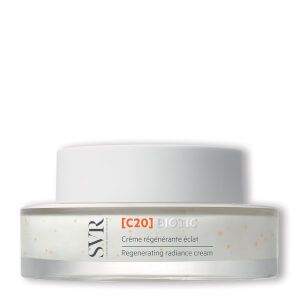
Works for
3 of 3 advertised claims delivered
Anti-aging3 ingredients credited for this claimModerate support
“The moisturiser also contains Hyaluronic Acid with a low molecular weight, which diminishes the look of wrinkles and fine lines by plumping and perfecting.”
This product contains ascorbyl tetraisopalmitate. This ingredient might be able to help reduce and prevent fine lines and wrinkles, improve skin elasticity and firmness, but there is not enough evidence that it actually works.
Moisturizing12 ingredients credited for this claimGood support
“The moisturiser also contains Hyaluronic Acid with a low molecular weight, which diminishes the look of wrinkles and fine lines by plumping and perfecting.”
This product contains good ingredients to attract water to the upper layer of the skin. These ingredients are called "humectants": lactobacillus ferment, mannitol.
When humectants are on the surface of the skin, they “pull in” the moisture from the outside environment, or from within deeper layers of the skin. If the air is dry, humectants can speed up the moisture loss from the skin. This is why it is a good idea to use another product on top of this one to help "seal in" the moisture (look for ingredients like dimethicone, squalane, oils and butters).
Evens skin tone2 ingredients credited for this claimModerate support
“As an outcome, wrinkles develop more quickly and become more visible with time with appearance of brown spots.”
The following ingredient (ingredients) in this product might be helpful, but there is no evidence to confirm that it actually works: 3-o-ethyl ascorbic acid, ascorbyl tetraisopalmitate.
Anti-oxidationNot advertised by the brand · 5 ingredients credited for this claimStrong support
This product contains antioxidants (ascorbyl tetraisopalmitate) that can help neutralize free radicals in skin. By doing so, they can lessen the damage the skin gets from the UV light (sun).
The following ingredients - 3-o-ethyl ascorbic acid also can have an antioxidant effect, but there is less evidence to confirm their effectiveness in skin.
Can it cause trouble?
Irritancy1 strong irritant: ParfumMedium risk
Comedogenic2 ingredients rated 2 or more on the 0–5 pore-clogging scale2 flagged
User reviews
Be the first — your take helps the next person decide.
Ingredients
Filter by role to see what each ingredient is doing.
Water~45–55%
Ascorbyl tetraisopalmitate~5.8–7.1%
- Irritation risk
- Medium
A vitamin C derivative. Studies show that is might be effective in reducing hyperpigmentation, but there are no studies confirming that it is effectively converted into the bioavailable form of Vitamin C in skin. It is not clear how this derivative compares in effectiveness to the topical application of bioavailable form of vitamin C (L-ascorbic acid)
More about Ascorbyl tetraisopalmitate3-o-ethyl ascorbic acid~4.6–5.6%
- Irritation risk
- High
A vitamin C derivative that is more stable but less potent than pure form of vitamin C. Can help neutralize free radicals and help reduce hyperpigmentation, but the required concentration is likely to be much higher than for the pure form of vitamin C, limiting the ingredient's effectiveness in products
More about 3-o-ethyl ascorbic acidCoco-caprylate/caprate~3.2–3.9%
- Irritation risk
- Low
Helps to soften the upper layer of the skin without creating a greasy texture
More about Coco-caprylate/caprateMyristyl alcohol~2.4–3%
- Irritation risk
- High
Helps to stabilize the product formulation while softening the upper layer of the skin. Can be irritating
More about Myristyl alcoholSilica~2.2–2.7%
Glyceryl stearate~1.7–2.1%
- Irritation risk
- Low
An emollient that softens the skin and forms a protective layer on its surface. Helps water and oil mix together
More about Glyceryl stearatePeg-100 stearate~1.6–2%
- Irritation risk
- Low
Helps oil and water mix togehter and creates a nice product texture
More about Peg-100 stearateSodium citrate~1.2–1.4%
- Irritation risk
- Medium
Helps to control the skin's pH level. Maintains the skin's natural film of amino-lactic acids and oils. Helps to preserve products
More about Sodium citrateLauroyl lysine~0.95–1.15%
- Irritation risk
- Low
Helps soften the upper layer of the skin and creates a nice product texture
More about Lauroyl lysineMyristyl glucoside~0.95–1.15%
- Irritation risk
- Low
Butyrospermum parkii butter~0.65–0.95%
- Irritation risk
- Low
- Comedogenicity
- 3/5
A great moisturising ingredient that softens the skin and reduces water loss from its upper layer. It also can be helpful in protecting skin from free radicals
More about Butyrospermum parkii butterMicrocrystalline cellulose~0.65–0.95%
Hydroxyethyl acrylate/sodium acryloyldimethyl taurate copolymer~0.5–0.7%
- Irritation risk
- Medium
A gelling agent that thickens the product consistency and leaves the skin with a velvety finish
More about Hydroxyethyl acrylate/sodium acryloyldimethyl taurate copolymerTocopheryl acetate~0.45–0.7%
- Irritation risk
- Medium
A more stable but less bio-available form of vitamin E compared to Tocopherol. Might help moisturize and protect the skin from free radicals, but mostly used in low concentrations to stabilize other ingredients.
More about Tocopheryl acetatePentylene glycol~0.5–0.7%
- Irritation risk
- Medium
Used to preserve products, dissolve other ingredients and create a nice product texture
More about Pentylene glycolMaltodextrin~0.4–0.6%
- Irritation risk
- Low
Used to stabilize the product formulation and can help absorb oil
More about MaltodextrinMannitol~0.35–0.65%
- Irritation risk
- Low
Helps to attract water to the upper layer of the skin
More about Mannitol1,2-hexanediol~0.3–0.55%
Caprylyl glycol~0.3–0.6%
- Irritation risk
- Medium
Helps preserve products and creates a nice product texture
More about Caprylyl glycolParfum~0.25–0.45%
- Irritation risk
- High
An aromatic blend of unspecified and possibly irritating ingredients
More about ParfumCitric acid~0.25–0.45%
- Irritation risk
- Medium
Can work as an exfoliant but is typically used to adjust the product pH
More about Citric acidLactobacillus ferment~0.25–0.45%
- Irritation risk
- Low
A fermentation product created by bacteria Lactobacillus. The fermented product has anti-bacterial properties and might be helpful in calming down inflammation, but studies are lacking. Helps attract water to the upper layer of the skin. Can be used as a preservative
More about Lactobacillus fermentSodium acetylated hyaluronate~0.2–0.4%
- Irritation risk
- Low
A type of hyaluronic acid that works as an excellent moisturizer by attracting water into the upper layer of the skin. Is typically feels less sticky on the skin compared to the usual hyaluronic acid
More about Sodium acetylated hyaluronateCellulose gum~0.2–0.4%
- Irritation risk
- Low
Used to create thicker product consistency and stabilize emulsions
More about Cellulose gumPolysorbate 60~0.2–0.4%
Sorbitan isostearate~0.15–0.3%
- Irritation risk
- Low
Helps oil and water mix together
More about Sorbitan isostearateHydroxypropyl methylcellulose~0.15–0.3%
- Irritation risk
- Medium
Used to create a thicker product consistency and stabilize the formulation
More about Hydroxypropyl methylcelluloseCi 77492~0.1–0.2%
Iron oxides~0.1–0.15%
- Irritation risk
- Low
An umbrella term for the following three colorants: CI 77491, CI 77492, CI 77499. They might be able to offer some protection against visible light, but the degree of the protection is not clear
More about Iron oxidesAlgin~0.05–0.1%
- Irritation risk
- Low
- Comedogenicity
- 3/5
Used to thicken product formulation. Can help attract water to the upper layer of the skin
More about AlginIngredient list view
Water, Ascorbyl tetraisopalmitate, 3-o-ethyl ascorbic acid, Coco-caprylate/caprate, Myristyl alcohol, Silica, Glyceryl stearate, Peg-100 stearate, Sodium citrate, Lauroyl lysine, Myristyl glucoside, Butyrospermum parkii butter, Microcrystalline cellulose, Hydroxyethyl acrylate/sodium acryloyldimethyl taurate copolymer, Tocopheryl acetate, Pentylene glycol, Maltodextrin, Mannitol, 1,2-hexanediol, Caprylyl glycol, Parfum, Citric acid, Lactobacillus ferment, Sodium acetylated hyaluronate, Cellulose gum, Polysorbate 60, Sorbitan isostearate, Hydroxypropyl methylcellulose, Ci 77492, Iron oxides, Algin
Compare prices
Retailers ranked by price — lowest first.


.png)
Sources cited in this review
Every concentration estimate and effectiveness label is anchored to one of these 14 studies and safety reviews.
- 1
- 2
- 3
- 4
- 5
- 6Safety Assessment of Alkyl Esters as Used in Cosmeticscir-safety.org

Affiliate links · As an Amazon Associate, WIMJ earns from qualifying purchases.