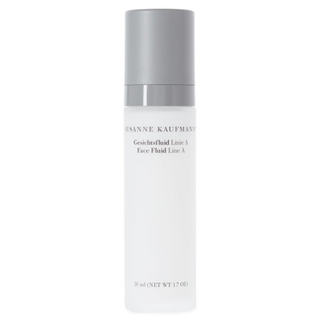
Susanne Kaufmann Face Fluid Line A
Works for
2 of 2 advertised claims delivered
Moisturizing24 ingredients credited for this claimStrong support
“Silk proteins provide a great deal of moisture and form a protective film.”
This product can help improve hydration of the skin with the two types of ingredients.
The first type is called “humectants”:
these ingredients help attract water.
When humectants are on the surface of the skin, they “pull in” the moisture from the outside environment, or from
within deeper layers of the skin. The following ingredients in this product do the job:
glycerin, saccharide isomerate.
This product also contains ingredients called “occlusives”. They help reduce the speed with which our skin loses moisture to the outside environment. These ingredients also help soften the upper layer of the skin, so it feels less tight and nicer to the touch. The following ingredients in this product do the job: butyrospermum parkii butter extract, caprylic/capric triglyceride.
The following ingredients in this product are especially good for supporting the skin barrier and helping with the hydration level: urea
Anti-aging4 ingredients credited for this claimModerate support
“The face fluid line A should be used as a gentle part of your daily skincare regime to protect your skin against the initial signs of aging, to provide an intense moisture boost, and to counteract damage caused by environmental factors.”
This product contains serine. This ingredient might be able to help reduce and prevent fine lines and wrinkles, improve skin elasticity and firmness, but there is not enough evidence that it actually works.
Can it cause trouble?
Irritancy7 strong irritants: Linalool, Benzyl salicylate + 5 more — patch-test recommendedHigh risk
Comedogenic1 ingredient rated 2 or more on the 0–5 pore-clogging scale1 flagged
User reviews
Be the first — your take helps the next person decide.
Ingredients
Filter by role to see what each ingredient is doing.
Water~45–55%
Pentylene glycol~5–6.1%
- Irritation risk
- Medium
Used to preserve products, dissolve other ingredients and create a nice product texture
More about Pentylene glycolCaprylic/capric triglyceride~4.2–5.1%
- Irritation risk
- Medium
A good mix of fatty acids that forms a protective layer on the skin. Improves the shelf life of products. Derived from coconut and glycerin
More about Caprylic/capric triglycerideGlycerin~3–3.7%
- Irritation risk
- Low
One of the best moisturizing ingredients. Naturally present in skin. It attracts water to the upper layer of the skin working as a humectant
More about GlycerinCetearyl ethylhexanoate~2.4–2.9%
- Irritation risk
- Low
An emollient that helps soften the skin
More about Cetearyl ethylhexanoateMethyl glucose sesquistearate~2–2.4%
- Irritation risk
- Medium
Helps water and oil mix together
More about Methyl glucose sesquistearateBrassica oleracea italica seed oil~1.7–2%
- Irritation risk
- Medium
A plant seed oil that consists mainly of erucic acid and used to help soften the upper layer of the skin. This fatty acid can enhance penetration of other ingredients into the skin but it is not a good moisturizer on its own
More about Brassica oleracea italica seed oilLimnanthes alba seed oil~1.5–1.8%
- Irritation risk
- Low
This oil's cmposition is closest to rapeseed oil. It is a very stable oil and serves as an emoillient
More about Limnanthes alba seed oilButyrospermum parkii butter extract~1.2–1.5%
- Irritation risk
- Low
- Comedogenicity
- 3/5
A great moisturising ingredient that softens the skin and reduces water loss from its upper layer. It also can be helpful in protecting skin from free radicals
More about Butyrospermum parkii butter extractGlyceryl stearate~1–1.2%
- Irritation risk
- Low
An emollient that softens the skin and forms a protective layer on its surface. Helps water and oil mix together
More about Glyceryl stearateStearyl alcohol~0.8–1.2%
- Irritation risk
- Low
An emollient that helps soften the skin
More about Stearyl alcoholSimmondsia chinensis seed oil~0.65–0.95%
- Irritation risk
- Medium
Softens the upper layer of skin and helps restore the healthy skin barrier. Has shown to help calm down inflammation in skin. It is a stable oil, meaning that it retains its properties even when exposed to air.
More about Simmondsia chinensis seed oilArgania spinosa kernel oil~0.55–0.85%
- Irritation risk
- Medium
An emollient that helps soften the upper layer of the skin. Might have some weak anti-oxidant properties
More about Argania spinosa kernel oilEctoin~0.5–0.75%
- Irritation risk
- Low
Softens the upper layer of the skin and can support skin barrier function
More about EctoinTocopheryl acetate~0.5–0.7%
- Irritation risk
- Medium
A more stable but less bio-available form of vitamin E compared to Tocopherol. Might help moisturize and protect the skin from free radicals, but mostly used in low concentrations to stabilize other ingredients.
More about Tocopheryl acetateHydrolyzed silk~0.45–0.7%
- Irritation risk
- Medium
Can help attract water to the upper layer of the skin
More about Hydrolyzed silkXanthan gum~0.45–0.7%
- Irritation risk
- Low
Used to create a thicker product consistency
More about Xanthan gumSqualane~0.45–0.7%
- Irritation risk
- Low
An oil naturally present in skin. Works as an emollient to soften the skin and form a protective layer on its surface without a greasy feeling.
More about SqualaneHordeum vulgare cera~0.4–0.6%
- Irritation risk
- Low
Spent grain wax~0.3–0.55%
- Irritation risk
- Low
Tocopherol~0.3–0.55%
- Irritation risk
- Low
Pure form of vitamin E. Can help moisturise and protect the skin from free radicals. Often used to help stabilise other ingredients or the formula itself
More about TocopherolEchium plantagineum seed oil~0.3–0.5%
- Irritation risk
- Medium
A plant oil that because of its high content of alpha-linolenic acid help support skin barrier function and moisturize the skin
More about Echium plantagineum seed oilMagnolia officinalis bark extract~0.25–0.45%
- Irritation risk
- Low
Helianthus annuus seed oil~0.3–0.55%
- Irritation risk
- Low
A great emollient due to its high linoleic acid content. One of the most effective plant oils in helping skin hydration and repairing skin barrier function
More about Helianthus annuus seed oilSolanum lycopersicum fruit extract~0.25–0.5%
- Irritation risk
- Low
Vigna aconitifolia seed extract~0.25–0.45%
- Irritation risk
- Low
Schisandra chinensis fruit extract~0.25–0.45%
- Irritation risk
- Medium
A berry extract that might help neutralize free radicals on the surface of the skin
More about Schisandra chinensis fruit extractLactic acid~0.25–0.45%
- Irritation risk
- Medium
An exfoliating and moisturizing alpha-hydroxy acid (AHA). Typically causes less irritation than other AHAs, for example, glycolic acid. At high concentrations (about 15%), lactic acid can help reduce lines and wrinkles. Recent studies show that lactic acid can support the "good" bacteria living on skin's surface (healthy skin microbiome)
More about Lactic acidSerine~0.25–0.45%
- Irritation risk
- Low
An amino-acid that helps to attract water to the upper layer of the skin. In combination with other amino-acids, might help to reduce fine lines and wrinkles
More about SerineUrea~0.25–0.5%
- Irritation risk
- Low
Naturally present in skin (urea makes up about 7% of natural moisturizing factors in skin). Attracts water to the upper layer of the skin. Also has a positive effect on the skin barrier beyond the humectant action. Can enhance penetration of other ingredients. Is an exfoliating ingredient when used in high concentrations
More about UreaCardiospermum halicacabum seed extract~0.25–0.45%
- Irritation risk
- Low
Sodium polyphosphate~0.25–0.5%
- Irritation risk
- Low
Sodium lactate~0.25–0.5%
- Irritation risk
- Medium
Helps attract water to the upper layer of the skin. Is often used to adjust the pH level of the product
More about Sodium lactateSorbitol~0.25–0.5%
- Irritation risk
- Low
Helps attract water to the upper layer of the skin and improves the product texture
More about SorbitolPropanediol~0.3–0.5%
- Irritation risk
- Low
Acts as a solvent for other ingredients. Speeds up the absorption of other ingredients into the skin
More about PropanediolOctyldodecanol~0.25–0.5%
- Irritation risk
- Low
An emollient that helps to soften the skin and create a pleasant product texture and stabilize the formulation
More about OctyldodecanolCitric acid~0.25–0.45%
- Irritation risk
- Medium
Can work as an exfoliant but is typically used to adjust the product pH
More about Citric acidSodium chloride~0.25–0.5%
- Irritation risk
- Low
Used to stabilize mixtures of oil and water, and create thicker, gel-like product textures
More about Sodium chlorideSodium citrate~0.25–0.4%
- Irritation risk
- Medium
Helps to control the skin's pH level. Maintains the skin's natural film of amino-lactic acids and oils. Helps to preserve products
More about Sodium citrateSaccharide isomerate~0.2–0.4%
- Irritation risk
- Low
Helps attract water to the upper layer of the skin
More about Saccharide isomerateMaltodextrin~0.2–0.4%
- Irritation risk
- Low
Used to stabilize the product formulation and can help absorb oil
More about MaltodextrinLinalool~0.15–0.3%
Benzyl salicylate~0.15–0.25%
Citral~0.1–0.2%
Citronellol~0.1–0.2%
Geraniol~0.1–0.2%
Limonene~0.1–0.2%
- Irritation risk
- High
A common frangrance that can easily irritate skin, especially if exposed to air, light or heat
More about LimoneneAllantoin~0.1–0.15%
- Irritation risk
- Low
Helps calm down inflammation in skin and can help reduce itching. Helps to repair the skin barrier and keep skin hydrated
More about AllantoinParfum~0.05–0.1%
- Irritation risk
- High
An aromatic blend of unspecified and possibly irritating ingredients
More about ParfumIngredient list view
Water, Pentylene glycol, Caprylic/capric triglyceride, Glycerin, Cetearyl ethylhexanoate, Methyl glucose sesquistearate, Brassica oleracea italica seed oil, Limnanthes alba seed oil, Butyrospermum parkii butter extract, Glyceryl stearate, Stearyl alcohol, Simmondsia chinensis seed oil, Argania spinosa kernel oil, Ectoin, Tocopheryl acetate, Hydrolyzed silk, Xanthan gum, Squalane, Hordeum vulgare cera, Spent grain wax, Tocopherol, Echium plantagineum seed oil, Magnolia officinalis bark extract, Helianthus annuus seed oil, Solanum lycopersicum fruit extract, Vigna aconitifolia seed extract, Schisandra chinensis fruit extract, Lactic acid, Serine, Urea, Cardiospermum halicacabum seed extract, Sodium polyphosphate, Sodium lactate, Sorbitol, Propanediol, Octyldodecanol, Citric acid, Sodium chloride, Sodium citrate, Saccharide isomerate, Maltodextrin, Linalool, Benzyl salicylate, Citral, Citronellol, Geraniol, Limonene, Allantoin, Parfum
Compare prices
Retailers ranked by price — lowest first.

Product summary
Judging from the ingredient list, "Susanne Kaufmann - Face Fluid Line A" works well for improving skin hydration To work well, any moisturizer needs to include a combination of water-binding and emollient ingredients. Susanne Kaufmann - Face Fluid Line A ticks this box. Urea, glycerin, saccharide isomerate, sodium lactate and hydrolyzed silk in this product (humectants) attract water molecules to the upper layer of the skin (the water comes from the outside air or from the deeper layers of the skin if the air is dry). Limnanthes alba seed oil, butyrospermum parkii butter extract, caprylic/capric triglyceride, helianthus annuus seed oil and squalane in this product help decrease the water evoporation from the skin, so that it stays hydrated for longer. These ingredients also soften the skin and take away the feeling of tightness and dryness.
Irritation risk
There are quite a few common irritants in this product, including ingredients without particular skin benefits. We would not recommend it for sensitive skin. We assess the overall irritancy of this moisturizer to be high. For a detailed overview of all potential irritants: click here
You can see the detailed formula review with the breakdown of all actives in the product and the full ingredient list with estimated concentrations in the tables below.
Price
The product retails for 141.00£ in the United Kingdom and from 140.00$ up to 197.00$ in the United States.
For a detailed price comparison: click here.
Sources cited in this review
Every concentration estimate and effectiveness label is anchored to one of these 17 studies and safety reviews.
- 1
- 2
- 3
- 4
- 5Vitamin E in dermatologyncbi.nlm.nih.gov
- 6Vitamin E and Skin Healthlpi.oregonstate.edu

Affiliate links · As an Amazon Associate, WIMJ earns from qualifying purchases.