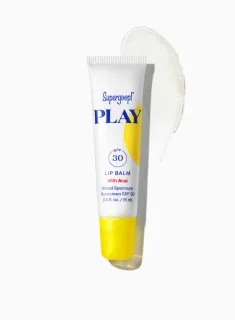
Supergoop! PLAY Lip Balm SPF 30 in Acai
Works for
2 of 2 advertised claims delivered
Sun protectionSPF 30 · 5 UV filtersBroad spectrum
This product offers a good level of protection against both UVB and UVA rays.
This sunscreen uses organic (so-called "chemical") sunscreen filters. Organic, or "chemical" filters usually provide reliable sun protection and rarely leave a white cast. Sunscreens with organic filters can sting eyes.
This product can be considered "reef safe" because it does not contain the UV filters (oxybenzone and octinoxate) that can be harmful to coral reefs when present in the water in high concentrations.
Moisturizing13 ingredients credited for this claimGood support
“A liquid lip balm that nourishes, soothes & moisturizes with shea butter, plus provides daily sun protection.”
This product can help soften the skin and reduce its moisture loss with emollients and occlusives: helianthus annuus seed oil, carthamus tinctorius seed oil.
Keep in mind that this product does not contain effective ingredients to attract water to the upper layer of the skin. This is why an additional product with humectants like glycerin or hyaluronic acid can be helpful (apply it before this product for the best results).
Anti-agingNot advertised by the brand · 2 ingredients credited for this claimStrong support
This product can help prevent early signs of skin aging because it offers a good level of broad spectrum sun protection. Sun damage is the main cause of premature skin aging, and protecting your skin from the sun is the best anti-aging strategy.
Can it cause trouble?
Irritancy4 strong irritants: Menthol, Mentha piperita oil + 2 more — patch-test recommendedHigh risk
Comedogenic2 ingredients rated 2 or more on the 0–5 pore-clogging scale2 flagged
User reviews
Be the first — your take helps the next person decide.
Ingredients
Filter by role to see what each ingredient is doing.
Butyl methoxydibenzoylmethane3%
- Irritation risk
- Medium
Avobenzone. An organic, or so-called "chemical" UV filter. Protects against both UVA and UVB rays. Needs to be combined with other filters in a formulation to be stable.
More about Butyl methoxydibenzoylmethaneHomosalate10%
- Irritation risk
- Medium
A weak sunscreen that offers some protection against the sun rays that cause sunburn (UVB), but does not offer meaningful protection against protect against the most aging sun rays (UVA). It loses its effectiveness quickly when exposed to sunlight. It is an organic, or so called "chemical" sunscreen. When used in low concentrations, helps to stabilize the product formulation
More about HomosalateOctocrylene10%
- Irritation risk
- Medium
A weak sunscreen that protects against the sun rays that cause sunburn (UVB) and is somewhat effective against the UVA rays. It is quite stable and can help stabilize other, more vulnerable, sunscreen ingredients like Avobenzone. It is an organic, or so called "chemical" sunscreen
More about OctocryleneEthylhexyl salicylate5%
- Irritation risk
- Low
Octisalate. A UV filter. It offers some protection against the sun rays that cause sunburn (UVB), but does not protect against the most aging sun rays (UVA). It loses its effectiveness quickly when exposed to sunlight. It is an organic, or so called "chemical" sunscreen
More about Ethylhexyl salicylateHydrogenated polyisobutene~22–33%
- Irritation risk
- Low
Used to improve the product consistency and soften the upper layer of the skin
More about Hydrogenated polyisobutenePolyisobutene~3.9–5.8%
Butyloctyl salicylate~4.5–6.8%
- Irritation risk
- Medium
A synthetic ester of salicylic acid that is used to help disperse pigments and boost effectiveness of sunscreen ingredients. It is able to absorb UV light (working as an organic, or chemical filter), but is not approved as a sunscreen ingredient on its own
More about Butyloctyl salicylateButyrospermum parkii nut extract~3.7–5.6%
- Irritation risk
- Low
C18-38 alkyl hydroxystearoyl stearate~2.8–4.3%
- Irritation risk
- Low
Ozokerite~2–2.9%
Cetyl alcohol~1.6–2.4%
- Irritation risk
- Low
A non-drying alcohol that works to soften the skin and stabilize product formulations helping oil and water mix together
More about Cetyl alcoholDiethylhexyl 2,6-naphthalate~1.3–2%
- Irritation risk
- Low
Glyceryl stearate~1.1–1.7%
- Irritation risk
- Low
An emollient that softens the skin and forms a protective layer on its surface. Helps water and oil mix together
More about Glyceryl stearatePolyglyceryl-10 decaoleate~0.95–1.4%
- Irritation risk
- Low
Helps soften the upper layer of the skin
More about Polyglyceryl-10 decaoleateCarthamus tinctorius seed oil~0.85–1.25%
- Irritation risk
- Low
An emollient that helps soften the skin and might help calm down inflammation
More about Carthamus tinctorius seed oilSesamum indicum seed oil~0.55–1.25%
- Irritation risk
- Low
A good moisturizing plant oil. Due to the high linoleic acid content, it helps soften the upper layer of the skin, reduce water loss and support skin barrier function
More about Sesamum indicum seed oilTrihydroxystearin~0.45–1.05%
- Irritation risk
- Low
Helps soften the upper layer of the skin and improve the product texture
More about TrihydroxystearinHelianthus annuus seed oil~0.45–1.1%
- Irritation risk
- Low
A great emollient due to its high linoleic acid content. One of the most effective plant oils in helping skin hydration and repairing skin barrier function
More about Helianthus annuus seed oilStevioside~0.4–0.95%
- Irritation risk
- Low
2-methylbutyric acid~0.35–0.85%
- Irritation risk
- Low
Barosma betulina leaf oil~0.35–0.85%
- Irritation risk
- Low
Benzaldehyde~0.35–0.75%
- Irritation risk
- Low
Dimethylhydroxy furanone~0.3–0.75%
- Irritation risk
- Low
Trans-2-hexenal~0.2–0.75%
- Irritation risk
- Low
Tocopherol~0.2–0.8%
- Irritation risk
- Low
Pure form of vitamin E. Can help moisturise and protect the skin from free radicals. Often used to help stabilise other ingredients or the formula itself
More about TocopherolGlycine soja oil~0.35–0.75%
- Irritation risk
- Medium
- Comedogenicity
- 2/5
A good emollient that helps soften the skin and helps repair its barrier function. It can clog pores if used in high concentrations.
More about Glycine soja oilEuterpe oleracea fruit extract~0.2–0.75%
- Irritation risk
- Medium
A plant extract that can have some anti-oxidant effect in skin
More about Euterpe oleracea fruit extractEthyl acetate~0.15–0.7%
- Irritation risk
- Low
Gamma-undecalactone~0.15–0.7%
- Irritation risk
- Low
Vanillin~0.2–0.75%
- Irritation risk
- Low
Hydrogenated polyisobutene~0.3–0.75%
- Irritation risk
- Low
Used to improve the product consistency and soften the upper layer of the skin
More about Hydrogenated polyisobutenePolyisobutene~0.35–0.75%
Butyloctyl salicylate~0.2–0.75%
- Irritation risk
- Medium
A synthetic ester of salicylic acid that is used to help disperse pigments and boost effectiveness of sunscreen ingredients. It is able to absorb UV light (working as an organic, or chemical filter), but is not approved as a sunscreen ingredient on its own
More about Butyloctyl salicylateButyrospermum parkii butter~0.35–0.8%
- Irritation risk
- Low
- Comedogenicity
- 3/5
A great moisturising ingredient that softens the skin and reduces water loss from its upper layer. It also can be helpful in protecting skin from free radicals
More about Butyrospermum parkii butterC18-38 alkyl hydroxystearoyl stearate~0.35–0.75%
- Irritation risk
- Low
Ozokerite~0.2–0.75%
Cetyl alcohol~0.35–0.8%
- Irritation risk
- Low
A non-drying alcohol that works to soften the skin and stabilize product formulations helping oil and water mix together
More about Cetyl alcoholDiethylhexyl 2,6-naphthalate~0.35–0.75%
- Irritation risk
- Low
Carthamus tinctorius seed oil~0.35–0.75%
- Irritation risk
- Low
An emollient that helps soften the skin and might help calm down inflammation
More about Carthamus tinctorius seed oilGlyceryl stearate~0.35–0.8%
- Irritation risk
- Low
An emollient that softens the skin and forms a protective layer on its surface. Helps water and oil mix together
More about Glyceryl stearatePolyglyceryl-10 decaoleate~0.2–0.75%
- Irritation risk
- Low
Helps soften the upper layer of the skin
More about Polyglyceryl-10 decaoleateTrihydroxystearin~0.2–0.7%
- Irritation risk
- Low
Helps soften the upper layer of the skin and improve the product texture
More about TrihydroxystearinOryza sativa bran extract~0.2–0.7%
Helianthus annuus seed oil~0.3–0.75%
- Irritation risk
- Low
A great emollient due to its high linoleic acid content. One of the most effective plant oils in helping skin hydration and repairing skin barrier function
More about Helianthus annuus seed oilMenthol~0.15–0.6%
- Irritation risk
- High
Dipotassium glycyrrhizate~0.15–0.65%
- Irritation risk
- Low
A salt derived from licorice. Works as an emollient to soften the upper layer of the skin and can help calm down inflammation. Might be helpful for skin lightening
More about Dipotassium glycyrrhizateHelianthus annuus extract~0.3–0.7%
- Irritation risk
- Low
Helps soften the upper layer of the skin
More about Helianthus annuus extractMentha piperita oil~0.1–0.45%
Rosmarinus officinalis leaf extract~0.15–0.5%
- Irritation risk
- High
Can be helpful in reducing inflammation in skin, including inflamed acne. It can be irritating
More about Rosmarinus officinalis leaf extractStevioside~0.15–0.55%
- Irritation risk
- Low
Tocopherol~0.1–0.45%
- Irritation risk
- Low
Pure form of vitamin E. Can help moisturise and protect the skin from free radicals. Often used to help stabilise other ingredients or the formula itself
More about TocopherolMentha viridis leaf oil~0.1–0.45%
Ingredient list view
Butyl methoxydibenzoylmethane, Homosalate, Octocrylene, Ethylhexyl salicylate, Hydrogenated polyisobutene, Polyisobutene, Butyloctyl salicylate, Butyrospermum parkii nut extract, C18-38 alkyl hydroxystearoyl stearate, Ozokerite, Cetyl alcohol, Diethylhexyl 2,6-naphthalate, Glyceryl stearate, Polyglyceryl-10 decaoleate, Carthamus tinctorius seed oil, Sesamum indicum seed oil, Trihydroxystearin, Helianthus annuus seed oil, Stevioside, 2-methylbutyric acid, Barosma betulina leaf oil, Benzaldehyde, Dimethylhydroxy furanone, Trans-2-hexenal, Tocopherol, Glycine soja oil, Euterpe oleracea fruit extract, Ethyl acetate, Gamma-undecalactone, Vanillin, Hydrogenated polyisobutene, Polyisobutene, Butyloctyl salicylate, Butyrospermum parkii butter, C18-38 alkyl hydroxystearoyl stearate, Ozokerite, Cetyl alcohol, Diethylhexyl 2,6-naphthalate, Carthamus tinctorius seed oil, Glyceryl stearate, Polyglyceryl-10 decaoleate, Trihydroxystearin, Oryza sativa bran extract, Helianthus annuus seed oil, Menthol, Dipotassium glycyrrhizate, Helianthus annuus extract, Mentha piperita oil, Rosmarinus officinalis leaf extract, Stevioside, Tocopherol, Mentha viridis leaf oil
Compare prices
Retailers ranked by price — lowest first.

Affiliate links · prices updated regularly
Sources cited in this review
Every concentration estimate and effectiveness label is anchored to one of these 19 studies and safety reviews.
- 1
- 2
- 3
- 4
- 5Triglyceride composition of Sesamum indicum seed oilonlinelibrary.wiley.com
- 6

Affiliate links · As an Amazon Associate, WIMJ earns from qualifying purchases.