Works for:
based on ingredients and %- Anti-oxidation
- Moisturizing
Doesn't work for:
based on ingredients and %- Anti-aging
- Evens skin tone
Can it cause trouble?
- Irritation risk: high
- Comedogenic risk ingredients: 0
Key actives


Product Summary
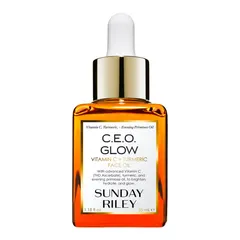
"SUNDAY RILEY - CEO Glow Vitamin C + Turmeric Face Oil" could be helpful for: Moisturizing, but its actives are not the most effective or are not well-studied.
What our users say
Based on 3 reviews 67% recommend this product- When it comes to comedogenicity, two out of three reviewers didn't notice clogged pores after using this sunscreen, but the third reviewer found that it clogged pores.
- When it comes to using this sunscreen under makeup, two out of three reviewers say that it works well under makeup, but the third user had an issue with pilling.
About the brand
According to Cruelty-Free Kitty "SUNDAY RILEY" is cruelty free and so is its parent company.
Price
The product retails for 84.19A$ in Australia, from 40.00$ up to 80.00$ in the United States, from 34.00£ up to 74.07£ in the United Kingdom and for 330.00HK$ in Hong Kong.
For a detailed price comparison: click here.
Anti-oxidation
This product contains antioxidants (rubus idaeus seed oil, vaccinium macrocarpon seed oil) that might be able to help neutralize free radicals in skin to lessen the damage it gets from the UV light (sun). There is not enough evidence to confirm their effectiveness in skin though.
A plant oil that can help neutralize free radicals, soften the upper layer of the skin, and support skin's barrier function
A plant oil that might be able to help neutralize free radicals in skin
A plant extract that might help neutralize free radicals in skin. It can be irritating
Helps soften the upper layer of the skin and can support skin barrier function
A plant extract that might have some anti-inflammatory and anti-oxidant properties but evidence is missing
An emollient. Can be helpful for restoring skin barrier function.
A plant extract that can contain an irritating essential oil. Might have some anti-oxidant effect, but evidence is lacking
Being a lipid soluble form of vitamin C, it is more stable than ascorbic acid, but still degrades quickly and needs to be stabilized in a formulation with another ingredient. It is claimed to penetrate skin better than pure vitamin C and have the the similar benefits, but solid studies of its effectiveness are lacking. Is likely to require a higher concentration in a product than pure vitamin C to be effective. It might be able to help reduce pore clogging.
Pure form of vitamin E. Can help moisturise and protect the skin from free radicals. Often used to help stabilise other ingredients or the formula itself
An active component of chamomile plant that historically has been used to calm down irritated skin. A recent study shows that bisabolol indeed can have some anti-inflammatory effect on skin, even though conclusive data is lacking. Bisabolol has a sweet floral scent and can be added to products for its aromatic properties
Can be helpful in reducing inflammation in skin, including inflamed acne. It can be irritating
Moisturizing
What does the product description say?
Plumps and firms the appearance of lines and wrinkles
Source: Ulta
This product can help soften the skin and reduce its moisture loss with emollients and occlusives: helianthus annuus seed oil, simmondsia chinensis seed oil.
Keep in mind that this product does not contain effective ingredients to attract water to the upper layer of the skin. This is why an additional product with humectants like glycerin or hyaluronic acid can be helpful (apply it before this product for the best results).
A great emollient due to its high linoleic acid content. One of the most effective plant oils in helping skin hydration and repairing skin barrier function
An emollient. Can be helpful for restoring skin barrier function.
Helps soften the upper layer of the skin and can support skin barrier function
A great emollient due to its high linoleic acid content. One of the most effective plant oils in helping skin hydration and repairing skin barrier function
Softens the upper layer of skin and helps restore the healthy skin barrier. Has shown to help calm down inflammation in skin. It is a stable oil, meaning that it retains its properties even when exposed to air.
A plant oil that can help neutralize free radicals, soften the upper layer of the skin, and support skin's barrier function
A type of lipid similar to ceramides naturally present in skin. Helps to soften the upper layer of the skin and supports the skin barrier function to keep it hydrated. Can help to prevent inflammation in skin
Helps soften the upper layer of the skin
Help soften the upper layer of the skin
Helps soften the upper layer of the skin
Helps soften the upper layer of the skin
A plant oil that helps soften the upper layer of the skin. Is unlikely to be helpful in restoring skin barrier function due to the low content of linoleic acid
Used to preserve products, dissolve other ingredients and create a nice product texture
An emollient that helps to soften the skin and create a pleasant product texture and stabilize the formulation
Pure form of vitamin E. Can help moisturise and protect the skin from free radicals. Often used to help stabilise other ingredients or the formula itself
Helps oil and water mix together and works as an emollient
Anti-aging
What does the product description say?
Plumps and firms the appearance of lines and wrinkles
Source: Ulta
This product does not contain ingredients that are able to reduce fine lines and wrinkles or help with skin elasticity, but it can improve the look of the skin temporarily through moisturization. Well-moisturized skin might also be able to repair the sun damage better.
This ingredient rubus idaeus seed oil might be able to help neutralize free radicals in skin and help it fight off some of the sun damage.
Being a lipid soluble form of vitamin C, it is more stable than ascorbic acid, but still degrades quickly and needs to be stabilized in a formulation with another ingredient. It is claimed to penetrate skin better than pure vitamin C and have the the similar benefits, but solid studies of its effectiveness are lacking. Is likely to require a higher concentration in a product than pure vitamin C to be effective. It might be able to help reduce pore clogging.
Pure form of vitamin E. Can help moisturise and protect the skin from free radicals. Often used to help stabilise other ingredients or the formula itself
Evens skin tone
What does the product description say?
Brightens the look of dark spots
Source: Ulta
Effective ingredients missing or their concentration is too low
Being a lipid soluble form of vitamin C, it is more stable than ascorbic acid, but still degrades quickly and needs to be stabilized in a formulation with another ingredient. It is claimed to penetrate skin better than pure vitamin C and have the the similar benefits, but solid studies of its effectiveness are lacking. Is likely to require a higher concentration in a product than pure vitamin C to be effective. It might be able to help reduce pore clogging.
How honest is this product?
| Promise | Can it deliver? |
|---|---|
| Anti-oxidation | |
| Moisturizing | |
| Anti-aging | |
| Evens skin tone |
Total Promises Fulfilled score: 50/100.
We receive a small commission for purchases made through these links at no cost for you. Thank you for your support! Learn more
Potential irritants
Comedogenic ingredients
No comedogenic ingredients detected
User reviews (3)
Averages from community submissions.
How well does it work for anti-aging?
How well does it work for evening out skin tone?
How well does it work for moisturization?
How would you describe the texture?
How much does it pill under makeup?
How much does this product clog pores?
How would you describe the smell?
Tried this product?
Help capture what the ingredient list can't—texture, finish, pilling, scent, and more. Answer what you can, skip the rest.
Takes ~30 seconds.
Reviews are shown in aggregate. No personal details.
| Product | Similarity | Price | Irritancy |
|---|---|---|---|
 SUNDAY RILEY CEO Glow Vitamin C + Turmeric Face Oil | Current | ≈ $35.05 | |
Utena Lumice Whitening Oil Serum | 51% | $14.00 | |
100% PURE Multi Vitamin Antioxidants PM Facial Oil | 50% | $62.00 |
Key Actives
Helps soften the upper layer of the skin and can support skin barrier function
Pure form of vitamin E. Can help moisturise and protect the skin from free radicals. Often used to help stabilise other ingredients or the formula itself
A plant oil that can help neutralize free radicals, soften the upper layer of the skin, and support skin's barrier function
Being a lipid soluble form of vitamin C, it is more stable than ascorbic acid, but still degrades quickly and needs to be stabilized in a formulation with another ingredient. It is claimed to penetrate skin better than pure vitamin C and have the the similar benefits, but solid studies of its effectiveness are lacking. Is likely to require a higher concentration in a product than pure vitamin C to be effective. It might be able to help reduce pore clogging.
An active component of chamomile plant that historically has been used to calm down irritated skin. A recent study shows that bisabolol indeed can have some anti-inflammatory effect on skin, even though conclusive data is lacking. Bisabolol has a sweet floral scent and can be added to products for its aromatic properties
A type of lipid similar to ceramides naturally present in skin. Helps to soften the upper layer of the skin and supports the skin barrier function to keep it hydrated. Can help to prevent inflammation in skin
A plant extract that has anti-bacterial properties. Can be used to preserve the product. Can be irritating
An emollient. Can be helpful for restoring skin barrier function.
A plant oil that might be able to help neutralize free radicals in skin
Softens the upper layer of skin and helps restore the healthy skin barrier. Has shown to help calm down inflammation in skin. It is a stable oil, meaning that it retains its properties even when exposed to air.
A great emollient due to its high linoleic acid content. One of the most effective plant oils in helping skin hydration and repairing skin barrier function
A great emollient due to its high linoleic acid content. One of the most effective plant oils in helping skin hydration and repairing skin barrier function
Potential irritants
A plant extract that can contain an active compound curcumin, that may have some anti-inflammatory properties when applied to the skin, but solid research is lacking and the typical concentration used in skincare products is too low. Can be an irritant
A plant extract that has anti-bacterial properties. Can be used to preserve the product. Can be irritating
A plant extract that might help neutralize free radicals in skin. It can be irritating
A plant extract that might have some anti-inflammatory and anti-oxidant properties but evidence is missing
A plant extract that can contain an irritating essential oil. Might have some anti-oxidant effect, but evidence is lacking
Can be helpful in reducing inflammation in skin, including inflamed acne. It can be irritating
A common frangrance that can easily irritate skin, especially if exposed to air, light or heat
A plant oil that might be able to help neutralize free radicals in skin
Softens the upper layer of skin and helps restore the healthy skin barrier. Has shown to help calm down inflammation in skin. It is a stable oil, meaning that it retains its properties even when exposed to air.
A plant oil that can help neutralize free radicals, soften the upper layer of the skin, and support skin's barrier function
Helps soften the upper layer of the skin and can support skin barrier function
Being a lipid soluble form of vitamin C, it is more stable than ascorbic acid, but still degrades quickly and needs to be stabilized in a formulation with another ingredient. It is claimed to penetrate skin better than pure vitamin C and have the the similar benefits, but solid studies of its effectiveness are lacking. Is likely to require a higher concentration in a product than pure vitamin C to be effective. It might be able to help reduce pore clogging.
A plant oil that helps soften the upper layer of the skin. Is unlikely to be helpful in restoring skin barrier function due to the low content of linoleic acid
Used to preserve products, dissolve other ingredients and create a nice product texture
An emollient. Can be helpful for restoring skin barrier function.
Comedogenic ingredients
We couldn't find any comedogenic ingredients in this product
All ingredients
A plant oil that might be able to help neutralize free radicals in skin
Softens the upper layer of skin and helps restore the healthy skin barrier. Has shown to help calm down inflammation in skin. It is a stable oil, meaning that it retains its properties even when exposed to air.
A plant oil that can help neutralize free radicals, soften the upper layer of the skin, and support skin's barrier function
Helps soften the upper layer of the skin and can support skin barrier function
An emollient that helps to soften the skin and create a pleasant product texture and stabilize the formulation
Being a lipid soluble form of vitamin C, it is more stable than ascorbic acid, but still degrades quickly and needs to be stabilized in a formulation with another ingredient. It is claimed to penetrate skin better than pure vitamin C and have the the similar benefits, but solid studies of its effectiveness are lacking. Is likely to require a higher concentration in a product than pure vitamin C to be effective. It might be able to help reduce pore clogging.
A plant extract that can contain an active compound curcumin, that may have some anti-inflammatory properties when applied to the skin, but solid research is lacking and the typical concentration used in skincare products is too low. Can be an irritant
A great emollient due to its high linoleic acid content. One of the most effective plant oils in helping skin hydration and repairing skin barrier function
A plant extract that has anti-bacterial properties. Can be used to preserve the product. Can be irritating
A plant extract that might help neutralize free radicals in skin. It can be irritating
A plant oil that helps soften the upper layer of the skin. Is unlikely to be helpful in restoring skin barrier function due to the low content of linoleic acid
Pure form of vitamin E. Can help moisturise and protect the skin from free radicals. Often used to help stabilise other ingredients or the formula itself
A great emollient due to its high linoleic acid content. One of the most effective plant oils in helping skin hydration and repairing skin barrier function
Used to preserve products, dissolve other ingredients and create a nice product texture
An emollient. Can be helpful for restoring skin barrier function.
An active component of chamomile plant that historically has been used to calm down irritated skin. A recent study shows that bisabolol indeed can have some anti-inflammatory effect on skin, even though conclusive data is lacking. Bisabolol has a sweet floral scent and can be added to products for its aromatic properties
A type of lipid similar to ceramides naturally present in skin. Helps to soften the upper layer of the skin and supports the skin barrier function to keep it hydrated. Can help to prevent inflammation in skin
Might help to reduce inflammation in skin, but solid research is lacking
A plant extract that might have some anti-inflammatory and anti-oxidant properties but evidence is missing
A plant extract that can contain an irritating essential oil. Might have some anti-oxidant effect, but evidence is lacking
Can be helpful in reducing inflammation in skin, including inflamed acne. It can be irritating
A common frangrance that can easily irritate skin, especially if exposed to air, light or heat
Ingredient list view
Rubus idaeus seed oil, Neopentyl glycol diethylhexanoate, Caprylyl caprylate/caprate, Simmondsia chinensis seed oil, Cucumis sativus seed oil, Punica granatum seed oil, Vaccinium macrocarpon seed oil, Oenothera biennis oil, Octyldodecanol, Tetrahexyldecyl ascorbate, Curcuma longa root extract, Helianthus annuus seed oil unsaponifiables, Citrus aurantium amara flower oil, Melia azadirachta leaf extract, Eclipta prostrata extract, Moringa oleifera seed oil, Tocopherol, Helianthus annuus seed oil, Pentylene glycol, 4-t-butylcyclohexanol, Ribes nigrum seed oil, Bisabolol, Cetylhydroxyproline palmitamide, Hexyldecanol, Hydroxyphenyl propamidobenzoic acid, Stearic acid, Brassica campestris sterols, Cardiospermum halicacabum flower/leaf/vine extract, Zingiber officinale root extract, Rosmarinus officinalis leaf extract, Linalool, Limonene, Geraniol, Farnesol, Citronellol, Citral
- Wound‐healing Properties of the Oils of Vitis vinifera and Vaccinium macrocarpon
- BERRY SEEDS: A SOURCE OF SPECIALTY OILS WITH HIGH CONTENT OF BIOACTIVES AND NUTRITIONAL VALUE
- Double-blind, half-face study comparing topical vitamin C and vehicle for rejuvenation of photodamage
- Application of tetra-isopalmitoyl ascorbic acid in cosmetic formulations: Stability studies and in vivo efficacy
- Vaughn, A. R., Branum, A., & Sivamani, R. K. (2016). Effects of Turmeric (Curcuma longa) on Skin Health: A Systematic Review of the Clinical Evidence. Phytotherapy Research, 30(8), 1243–1264. doi:10.1002/ptr.5640
- Biological Activities and Safety of Citrus spp. Essential Oils
- Melia azedarach
- Preliminary and Pharmacological Profile of Melia azedarach L.: An Overview
- Potent Antioxidative and UVB Protective Effect of Water Extract of Eclipta prostrata L.
- Moringa oleifera seed oil: Composition, nutritional aspects and health attributes
- Moringa oleifera Seeds and Oil: Characteristics and Uses for Human Health
- Vitamin E in dermatology
- Vitamin E and Skin Health
- Effect of Olive and Sunflower Seed Oil on the Adult Skin Barrier: Implications for Neonatal Skin Care
- Topically Applied Sunflower Seed Oil Prevents Invasive Bacterial Infections in Preterm Infants in Egypt
- Effect of topically applied lipids on surfactant-irritated skin
- Impact of topical oils on the skin barrier: possible implications for neonatal health in developing countries
- α-(-)-Bisabolol Reduces Pro-Inflammatory Cytokine Production and Ameliorates Skin Inflammation
- Evidence for the efficacy and safety of topical herbal drugs in dermatology: Part I: Anti-inflammatory agents
- Some phytochemical, pharmacological and toxicological properties of ginger (Zingiber officinale Roscoe): A review of recent research
- Allergic contact dermatitis induced by rosemary leaf extract in a cleansing gel
- Safety Assessment of Rosmarinus officinalis (Rosemary)-Derived Ingredients as Used in Cosmetics
- Rosmarinus officinalis Extract Suppresses Propionibacterium acnes–Induced Inflammatory Responses
- Annex I: Clinical evidence regarding sensitisation to individual fragrance chemicals and to natural extracts