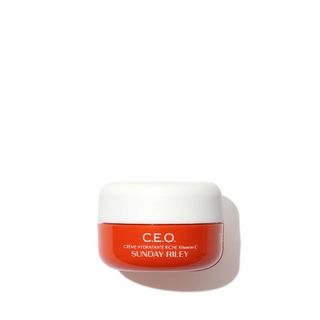
SUNDAY RILEY C.E.O. Vitamin C Rich Hydration Cream Format Voyage
Works for
1 of 1 advertised claim delivered
Moisturizing22 ingredients credited for this claimGood support
“C.E.O. Vitamin C Rich Hydration Cream Format Voyage”
This product can help improve hydration of the skin with the two types of ingredients.
The first type is called “humectants”:
these ingredients help attract water.
When humectants are on the surface of the skin, they “pull in” the moisture from the outside environment, or from
within deeper layers of the skin. The following ingredients in this product do the job:
glycerin, sodium hyaluronate.
This product also contains ingredients called “occlusives”. They help reduce the speed with which our skin loses moisture to the outside environment. These ingredients also help soften the upper layer of the skin, so it feels less tight and nicer to the touch. The following ingredients in this product do the job: squalane, jojoba esters.
Can it cause trouble?
Irritancy9 strong irritants: Citrus tangerina peel oil, Limonene + 7 more — patch-test recommendedHigh risk
Comedogenic2 ingredients rated 2 or more on the 0–5 pore-clogging scale2 flagged

User reviews
Be the first — your take helps the next person decide.
Ingredients
Filter by role to see what each ingredient is doing.
Water~45–55%
Squalane~5.7–7%
- Irritation risk
- Low
An oil naturally present in skin. Works as an emollient to soften the skin and form a protective layer on its surface without a greasy feeling.
More about SqualaneDicaprylyl carbonate~4.8–5.9%
- Irritation risk
- Low
Helps products spread more easily and works as an emollient to soften skin
More about Dicaprylyl carbonateTetrahexyldecyl ascorbate~3.3–4%
- Irritation risk
- Medium
Being a lipid soluble form of vitamin C, it is more stable than ascorbic acid, but still degrades quickly and needs to be stabilized in a formulation with another ingredient. It is claimed to penetrate skin better than pure vitamin C and have the the similar benefits, but solid studies of its effectiveness are lacking. Is likely to require a higher concentration in a product than pure vitamin C to be effective. It might be able to help reduce pore clogging.
More about Tetrahexyldecyl ascorbateC10-18 triglycerides~2.6–3.2%
- Irritation risk
- Low
Helps soften the skin and attract water to its upper layer. Helps create nice product texture
More about C10-18 triglyceridesPeg-8 beeswax~2.2–2.6%
- Irritation risk
- Medium
Helps water and oil mix together while softening the upper layer of the skin. Can be an allergen (beeswax)
More about Peg-8 beeswaxPolyglyceryl-6 distearate~1.8–2.2%
- Irritation risk
- Medium
Helps oil and water mix together while softening the upper layer of the skin
More about Polyglyceryl-6 distearateTapioca starch~1.5–1.8%
Hydrogenated vegetable oil~1.3–1.6%
- Irritation risk
- Low
- Comedogenicity
- 2/5
An oil from a mixture of different vegetables. Helps soften the upper layer of the skin
More about Hydrogenated vegetable oilPrunus amygdalus dulcis oil~1.1–1.3%
- Irritation risk
- Low
An emollient that softens the skin
More about Prunus amygdalus dulcis oilCitric acid~0.75–1.1%
- Irritation risk
- Medium
Can work as an exfoliant but is typically used to adjust the product pH
More about Citric acidPpg-12/smdi copolymer~0.75–1.1%
Glycerin~0.65–0.95%
- Irritation risk
- Low
One of the best moisturizing ingredients. Naturally present in skin. It attracts water to the upper layer of the skin working as a humectant
More about GlycerinCitrus tangerina peel oil~0.55–0.8%
- Irritation risk
- High
Essential oil that can be irritating. Can lead to photosensitivity
More about Citrus tangerina peel oilSodium acrylates copolymer~0.5–0.75%
- Irritation risk
- Medium
Used to create a thicker product consistency
More about Sodium acrylates copolymerBisabolol~0.5–0.7%
- Irritation risk
- Low
An active component of chamomile plant that historically has been used to calm down irritated skin. A recent study shows that bisabolol indeed can have some anti-inflammatory effect on skin, even though conclusive data is lacking. Bisabolol has a sweet floral scent and can be added to products for its aromatic properties
More about BisabololJojoba esters~0.55–0.85%
- Irritation risk
- Medium
An emollient made of jojoba oil. Helps soften the skin and support its barrier function
More about Jojoba estersTocopherol~0.5–0.75%
- Irritation risk
- Low
Pure form of vitamin E. Can help moisturise and protect the skin from free radicals. Often used to help stabilise other ingredients or the formula itself
More about TocopherolCaprylic/capric triglyceride~0.5–0.75%
- Irritation risk
- Medium
A good mix of fatty acids that forms a protective layer on the skin. Improves the shelf life of products. Derived from coconut and glycerin
More about Caprylic/capric triglycerideLimonene~0.35–0.65%
- Irritation risk
- High
A common frangrance that can easily irritate skin, especially if exposed to air, light or heat
More about LimonenePhenoxyethanol~0.4–0.65%
- Irritation risk
- Low
A preservative. It helps prevent bacterial growth in cosmetic products
More about PhenoxyethanolLecithin~0.45–0.65%
- Irritation risk
- Low
Used mostly for creating emulsions - helping oil and water mix together. Helps soften the upper layer of the skin
More about LecithinNylon-12~0.4–0.6%
Rosa centifolia flower wax~0.3–0.6%
- Irritation risk
- High
Is likely to contain an essential oil that can be irritating. Typically used for its fragrance and to create a thicker product consistency
More about Rosa centifolia flower waxRosa damascena flower wax~0.35–0.6%
- Irritation risk
- High
Is likely to contain rose essential oil that can be irritating. Typically used for its fragrance and to create a thicker product consistency
More about Rosa damascena flower waxSodium phytate~0.35–0.6%
Cetyl alcohol~0.4–0.65%
- Irritation risk
- Low
A non-drying alcohol that works to soften the skin and stabilize product formulations helping oil and water mix together
More about Cetyl alcoholPolyglyceryl-3 beeswax~0.4–0.6%
- Irritation risk
- Medium
Helps water and oil mix together. Could be an allergen (beeswax)
More about Polyglyceryl-3 beeswaxButylene glycol~0.3–0.6%
- Irritation risk
- Low
Used to create a nice product texture and help delivery of other ingredients. Might be somewhat helpful in attracting water to the upper layer of the skin
More about Butylene glycolCaprylyl glycol~0.35–0.65%
- Irritation risk
- Medium
Helps preserve products and creates a nice product texture
More about Caprylyl glycolAlcohol denat.~0.3–0.6%
- Irritation risk
- High
Produces temporary toning effect. Can help dissolve other ingredients or preserve products
More about Alcohol denat.Chlorphenesin~0.16–0.32%
Citrus australasica fruit extract~0.3–0.55%
- Irritation risk
- High
Polymethylsilsesquioxane~0.35–0.65%
- Irritation risk
- Low
A silicone that improves product texture and helps dissolve other ingredients. Can form a non-greasy film on the skin to prevent moisture loss
More about PolymethylsilsesquioxaneTerminalia ferdinandiana fruit extract~0.35–0.6%
- Irritation risk
- Medium
A plant extract that might have some anti-oxidant effect in skin, but evidence is lacking
More about Terminalia ferdinandiana fruit extractButyrospermum parkii butter extract~0.4–0.6%
- Irritation risk
- Low
- Comedogenicity
- 3/5
A great moisturising ingredient that softens the skin and reduces water loss from its upper layer. It also can be helpful in protecting skin from free radicals
More about Butyrospermum parkii butter extractCamellia sinensis leaf extract~0.35–0.6%
- Irritation risk
- Low
Can contain potent anti-oxidant compounds (abbreviated ECG, GCG, EGC, and EGCG) that might help protect the skin from free radicals. Can help calm down inflammation and has some anti-bacterial properties. Unfortunately, these antioxidants are unstable and lose their effectiveness very quickly in products. The concentration of the antioxidant compounds in the extract also tends to be low to be effective in topical formulation
More about Camellia sinensis leaf extractCitrus junos fruit extract~0.3–0.55%
- Irritation risk
- High
Contains essential oil. Can be irritating and lead to photosensitivity
More about Citrus junos fruit extractCurcuma longa root extract~0.25–0.5%
- Irritation risk
- High
A plant extract that can contain an active compound curcumin, that may have some anti-inflammatory properties when applied to the skin, but solid research is lacking and the typical concentration used in skincare products is too low. Can be an irritant
More about Curcuma longa root extractEuterpe oleracea fruit extract~0.25–0.5%
- Irritation risk
- Medium
A plant extract that can have some anti-oxidant effect in skin
More about Euterpe oleracea fruit extractLippia citriodora flower extract~0.25–0.4%
- Irritation risk
- High
Used as a fragrance. Contains an essential oil and can be irritating
More about Lippia citriodora flower extractOenothera biennis seed extract~0.25–0.45%
- Irritation risk
- Medium
A plant extract that might have some anti-oxidant properties but evidence is lacking
More about Oenothera biennis seed extractRosa canina fruit extract~0.2–0.35%
- Irritation risk
- Medium
A plant extract that might have some anti-oxidant properties, but evidence is lacking
More about Rosa canina fruit extractAlteromonas ferment extract~0.15–0.3%
- Irritation risk
- Low
A marine extract that helps attract water to the upper layer of the skin. It is claimed to have anti-inflammatory properties but research is lacking
More about Alteromonas ferment extractBenzyl alcohol~0.15–0.3%
- Irritation risk
- High
A preservative. Can be used to mask unpleasant smell. Can be irritating
More about Benzyl alcoholSodium hyaluronate~0.15–0.3%
- Irritation risk
- Low
One of the best moisturizing ingredients. Attracts water into the upper layer of the skin
More about Sodium hyaluronateLinalool~0.1–0.2%
Dehydroacetic acid~0.15–0.25%
Ingredient list view
Water, Squalane, Dicaprylyl carbonate, Tetrahexyldecyl ascorbate, C10-18 triglycerides, Peg-8 beeswax, Polyglyceryl-6 distearate, Tapioca starch, Hydrogenated vegetable oil, Prunus amygdalus dulcis oil, Citric acid, Ppg-12/smdi copolymer, Glycerin, Citrus tangerina peel oil, Sodium acrylates copolymer, Bisabolol, Jojoba esters, Tocopherol, Caprylic/capric triglyceride, Limonene, Phenoxyethanol, Lecithin, Nylon-12, Rosa centifolia flower wax, Rosa damascena flower wax, Sodium phytate, Cetyl alcohol, Polyglyceryl-3 beeswax, Butylene glycol, Caprylyl glycol, Alcohol denat., Chlorphenesin, Citrus australasica fruit extract, Polymethylsilsesquioxane, Terminalia ferdinandiana fruit extract, Butyrospermum parkii butter extract, Camellia sinensis leaf extract, Citrus junos fruit extract, Curcuma longa root extract, Euterpe oleracea fruit extract, Lippia citriodora flower extract, Oenothera biennis seed extract, Rosa canina fruit extract, Alteromonas ferment extract, Benzyl alcohol, Sodium hyaluronate, Linalool, Dehydroacetic acid
Compare prices
Retailers ranked by price — lowest first.

Affiliate links · prices updated regularly
Worth comparing, line by line.
Match % combines shared ingredients, the first five ingredients, shared actives and hero ingredients, irritancy (lower counts in the alternative's favour), texture and body area. Only products in the same routine step are compared.
| SUNDAY RILEYC.E.O. Vitamin C Rich Hydration Cream Format VoyageYOUR PRODUCT | Mario BadescuVitamin C Cream | RetrouvéVoyage Dynamic Nourishing Face Cream | OFRAVitamin C Cream | |
|---|---|---|---|---|
| Match | — | 58% | 56% | 56% |
| Price | $22.00 | $18.00−$4.00 | $255.00+$233.00 | — |
| Shared key ingredients | — | 4 of 12 | 5 of 12 | 4 of 12 |
| Key difference | — | Niacinamide | Niacinamide | Oxybenzone |
| Irritancy | High | Medium | Medium | Medium |
| Drying alcohol | Contains drying alcohol | — | — | — |
| View product | Shop | Shop | Shop |


Sources cited in this review
Every concentration estimate and effectiveness label is anchored to one of these 19 studies and safety reviews.
- 1
- 2
- 3
- 4
- 5Biological Activities and Safety of Citrus spp. Essential Oilsncbi.nlm.nih.gov
- 6

Affiliate links · As an Amazon Associate, WIMJ earns from qualifying purchases.