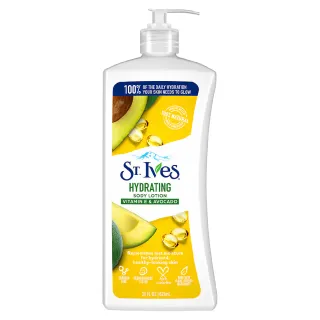
St. Ives Hydrating Body Lotion, Vitamin E and Avocado Vitamin E and Avocado
Works for
1 of 1 advertised claim delivered
MoisturizingGlycine soja oil, Cocos nucifera oil + 7 moreGood evidence
“Hydrating Body Lotion, Vitamin E and Avocado Vitamin E and Avocado”
This product can help improve hydration of the skin with the two types of ingredients.
The first type is called “humectants”:
these ingredients help attract water.
When humectants are on the surface of the skin, they “pull in” the moisture from the outside environment, or from
within deeper layers of the skin. The following ingredients in this product do the job:
glycerin, caprylyl glycol.
This product also contains ingredients called “occlusives”. They help reduce the speed with which our skin loses moisture to the outside environment. These ingredients also help soften the upper layer of the skin, so it feels less tight and nicer to the touch. The following ingredients in this product do the job: cocos nucifera oil, glycine soja oil.
Can it cause trouble?
Irritancy4 strong irritants: Parfum, Benzyl salicylate + 2 more — patch-test recommendedHigh risk
Comedogenic3 ingredients rated 2 or more on the 0–5 pore-clogging scale3 flagged
User reviews
Be the first — your take helps the next person decide.
Ingredients
Filter by role to see what each ingredient is doing.
Water~40–60%
Glycerin~3.9–5.8%
- Irritation risk
- Low
One of the best moisturizing ingredients. Naturally present in skin. It attracts water to the upper layer of the skin working as a humectant
More about GlycerinStearic acid~3.9–5.9%
- Irritation risk
- Low
Helps oil and water mix together and works as an emollient
More about Stearic acidGlycol stearate~2.6–3.9%
Isopropyl palmitate~2–3%
- Irritation risk
- Medium
- Comedogenicity
- 3/5
Helps soften the upper layer of the skin and create a thicker product consistency
More about Isopropyl palmitateGlycine soja oil~1.6–2.4%
- Irritation risk
- Medium
- Comedogenicity
- 2/5
A good emollient that helps soften the skin and helps repair its barrier function. It can clog pores if used in high concentrations.
More about Glycine soja oilGlyceryl stearate~1.4–2.1%
- Irritation risk
- Low
An emollient that softens the skin and forms a protective layer on its surface. Helps water and oil mix together
More about Glyceryl stearateTriethanolamine~1.2–1.9%
- Irritation risk
- Medium
Used to adjust pH of the product and can help improve the product's smell
More about TriethanolamineCocos nucifera oil~1.1–1.6%
- Irritation risk
- Low
- Comedogenicity
- 3/5
An emollient. Found to be as effective as a moisturizer for dry skin as mineral oil. Could be comedogenic
More about Cocos nucifera oilCetyl alcohol~0.95–1.4%
- Irritation risk
- Low
A non-drying alcohol that works to soften the skin and stabilize product formulations helping oil and water mix together
More about Cetyl alcoholCaprylyl glycol~0.55–1.25%
- Irritation risk
- Medium
Helps preserve products and creates a nice product texture
More about Caprylyl glycolPhenoxyethanol~0.4–1%
- Irritation risk
- Low
A preservative. It helps prevent bacterial growth in cosmetic products
More about PhenoxyethanolCarbomer~0.4–0.9%
- Irritation risk
- Low
Helps create a thicker or gel-like product texture. It is not a surfactant but can be used in gentle cleansing formulations
More about CarbomerParfum~0.35–0.8%
- Irritation risk
- High
An aromatic blend of unspecified and possibly irritating ingredients
More about ParfumHydroxyethylcellulose~0.2–0.8%
- Irritation risk
- Low
Used to thicken product formulations and create gel-like textures
More about HydroxyethylcelluloseStearamide amp~0.15–0.65%
- Irritation risk
- Low
Disodium edta~0.15–0.55%
Bht~0.1–0.5%
Tocopheryl acetate~0.1–0.4%
- Irritation risk
- Medium
A more stable but less bio-available form of vitamin E compared to Tocopherol. Might help moisturize and protect the skin from free radicals, but mostly used in low concentrations to stabilize other ingredients.
More about Tocopheryl acetatePersea gratissima oil~0.1–0.45%
- Irritation risk
- Medium
An emollient that helps soften the skin and could be helpful in repairing its barrier function
More about Persea gratissima oilBenzyl alcohol~0.05–0.25%
- Irritation risk
- High
A preservative. Can be used to mask unpleasant smell. Can be irritating
More about Benzyl alcoholBenzyl salicylate~0.05–0.2%
Limonene~0.05–0.15%
- Irritation risk
- High
A common frangrance that can easily irritate skin, especially if exposed to air, light or heat
More about LimoneneLinalool~0.05–0.1%
Ingredient list view
Water, Glycerin, Stearic acid, Glycol stearate, Isopropyl palmitate, Glycine soja oil, Glyceryl stearate, Triethanolamine, Cocos nucifera oil, Cetyl alcohol, Caprylyl glycol, Phenoxyethanol, Carbomer, Parfum, Hydroxyethylcellulose, Stearamide amp, Disodium edta, Bht, Tocopheryl acetate, Persea gratissima oil, Benzyl alcohol, Benzyl salicylate, Limonene, Linalool
Compare prices
Retailers ranked by price — lowest first.

Sources cited in this review
Every concentration estimate and effectiveness label is anchored to one of these 2 studies and safety reviews.
- 1
- 2Final Report on the Safety Assessment of Isopropyl Isostearatejournals.sagepub.com

Affiliate links · As an Amazon Associate, WIMJ earns from qualifying purchases.