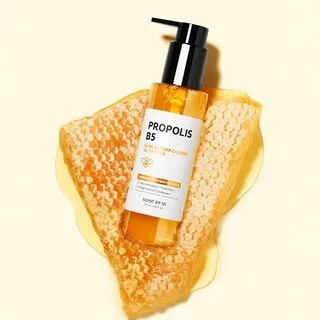
Some By Mi Propolis B5 Glow Barrier Calming Oil To Foam
Works for
CleansingCoco-betaine, Potassium cocoate + 15 moreCleanses gently
“Formulated with Pro-Panthenol™ (a blend of propolis and B5 panthenol) and Truecica™, this oil-to-foam cleanser gets rid of makeup residue and impurities on skin while providing skin-soothing properties.”
This product works by removing dirt and oil from the surface of the skin. It uses a combination of mild cleansing agents (babassuamidopropyl betaine, coco-betaine, coco-glucoside, glyceryl caprylate, glyceryl laurate, hexylene glycol, hydrogenated lecithin, polyglyceryl-4 caprate, potassium cocoate, potassium cocoyl glycinate, potassium cocoyl hydrolyzed oat protein, potassium myristate, potassium stearate, quillaja saponaria bark extract, sodium cocoyl apple amino acids, sodium cocoyl glycinate, sodium surfactin) and should be able to cleanse the skin gently. Still keep in mind that any cleansing can disrupt the skin barrier, and most people do not need to cleanse their skin more than once per day.
Even though this formulation is mild, the following cleansing agents could trigger an irritation or allergy for some people: coco-betaine, coco-glucoside
ExfoliationSalix alba bark extractNot delivered
“It enriched with oatmeal, coconut and apple extract to gently exfoliate dead skin cells for smooth and revitalized skin.”
This product does not contain effective exfoliating ingredients. It might be able to deliver physical exfoliation, that is scrub off some of the dead cells on the surface of the skin. We do not recommend physical exfoliation, because it is not uniform (some bits of skin can get exfoliated too much while others not at all). It can also traumatize the skin and aggrevate acne and other skin conditions.
Can it cause trouble?
Irritancy5 strong irritants: Melaleuca alternifolia leaf extract, Cinnamomum cassia bark extract + 3 more — patch-test recommendedHigh risk
ComedogenicClean of flagged comedogenic ingredientsNone flagged

User reviews
Be the first — your take helps the next person decide.
Ingredients
Filter by role to see what each ingredient is doing.
Water~45–55%
Propolis extract11.4%
- Irritation risk
- High
A complex substance produced by honey bees. Can have anti-bacterial and some anti-oxidant effect. Is an allergen and can be irritating
More about Propolis extractCoco-betaine~7.2–8.9%
- Irritation risk
- High
Helps oil and water mix together and works as a cleansing agent. Can be allergenic
More about Coco-betaineGlycerin~3.8–4.6%
- Irritation risk
- Low
One of the best moisturizing ingredients. Naturally present in skin. It attracts water to the upper layer of the skin working as a humectant
More about GlycerinHoney extract~2.9–3.6%
- Irritation risk
- Medium
Helps attract water to the upper layer of the skin
More about Honey extractPotassium cocoate~2.2–2.7%
- Irritation risk
- Medium
Helps oil and water mix together and works as a cleansing agent
More about Potassium cocoateCanola oil~1.9–2.3%
- Irritation risk
- Medium
A plant oil that can help soften the upper layer of the skin
More about Canola oilPotassium cocoyl glycinate~1.6–1.9%
Acrylates copolymer~1.4–1.7%
- Irritation risk
- Medium
Used to stabilize product formulation, help create an even product layer over skin (for example, in sunscreen) and create a thicker product consistency
More about Acrylates copolymerPropanediol~1.1–1.4%
- Irritation risk
- Low
Acts as a solvent for other ingredients. Speeds up the absorption of other ingredients into the skin
More about PropanediolPolyglyceryl-4 caprate~0.9–1.1%
Sodium chloride~0.7–1.1%
- Irritation risk
- Low
Used to stabilize mixtures of oil and water, and create thicker, gel-like product textures
More about Sodium chloride1,2-hexanediol~0.5–0.75%
Panthenol~0.5–0.75%
- Irritation risk
- Low
Helps attract water to the upper layer of the skin and can help improve skin barrier function
More about PanthenolHoney~0.45–0.65%
- Irritation risk
- Low
Helps attract water to the skin and might have some anti-bacterial properties. Can be an allergen
More about HoneyRoyal jelly extract~0.4–0.65%
- Irritation risk
- Medium
A compound secreted by bees. Might be able to attract water to the top layer of the skin. Avoid if sensitive to honey and bee products
More about Royal jelly extractCeramide np~0.45–0.7%
- Irritation risk
- Low
A type of lipid similar to ceramides naturally present in skin. Helps to soften the upper layer of the skin and supports the skin barrier function to keep it hydrated. Can help to prevent inflammation in skin
More about Ceramide npVitis vinifera seed oil~0.45–0.65%
- Irritation risk
- Medium
A great emollient that can also have anti-oxidant properties
More about Vitis vinifera seed oilMelaleuca alternifolia leaf extract~0.35–0.6%
- Irritation risk
- High
An essential oil that can be irritating. Has some anti-bacterial properties
More about Melaleuca alternifolia leaf extractArtemisia capillaris extract~0.35–0.65%
- Irritation risk
- Low
Centella asiatica extract~0.45–0.65%
- Irritation risk
- Medium
A plant extract that has been shown to be able to reduce inflammation in skin, support restoration of skin barrier function, as well as support collagen production. Contains active compounds called centelloids: asiaticoside, madecasosside, asiatic acid and madecassic acid. Might be helpful in preventing stretch marks. It can be itself be irritating though.
More about Centella asiatica extractCentella asiatica oil~0.35–0.6%
- Irritation risk
- Low
Asiatic acid~0.3–0.5%
- Irritation risk
- Medium
An active compound of Centella Asiatica plant extract. In combination with other active compounds of Centella Asiatica extract (asiaticoside, madecasosside and madecassic acid) asiatic acid has been shown to be helpful in wound-healing, restoring skin barrier function and supporting collagen production in skin. It can, however, itself be irritating
More about Asiatic acidAsiaticoside~0.25–0.45%
- Irritation risk
- Medium
An active compound of Centella Asiatica plant extract. In combination with other active compounds of Centella Asiatica extract (madecasosside, asiatic acid and madecassic acid), asiaticoside has been shown to be helpful in wound-healing, restoring skin barrier function and supporting collagen production in skin. It can, however, itself be irritating
More about AsiaticosideMadecassic acid~0.25–0.5%
- Irritation risk
- Medium
An active compound of Centella Asiatica plant extract. In combination with other active compounds of Centella Asiatica extract (asiaticoside, madecasosside and asiatic acid), madecassic acid has been shown to be helpful in wound-healing, restoring skin barrier function and supporting collagen production in skin. It can, however, itself be irritating
More about Madecassic acidMadecassoside~0.25–0.5%
- Irritation risk
- Medium
An antioxidant that is typically derived from plant Centella Asiatica. It can help neutralize free radicals in skin and support skin barrier function. It could, however, itself be irritating. It is often unstable in formulations
More about MadecassosideRibes nigrum seed oil~0.3–0.55%
- Irritation risk
- Medium
An emollient. Can be helpful for restoring skin barrier function.
More about Ribes nigrum seed oilSaponaria officinalis leaf extract~0.35–0.6%
- Irritation risk
- Low
Quillaja saponaria bark extract~0.45–0.65%
- Irritation risk
- Medium
Helps water and oil mix together
More about Quillaja saponaria bark extractSapindus mukorossi fruit extract~0.25–0.5%
- Irritation risk
- High
Olea europaea leaf extract~0.25–0.45%
- Irritation risk
- Medium
A plant extract that might have some anti-oxidant and anti-inflammatory properties but evidence for effectiveness in skin is missing
More about Olea europaea leaf extractOenothera biennis oil~0.3–0.55%
- Irritation risk
- Medium
Helps soften the upper layer of the skin and can support skin barrier function
More about Oenothera biennis oilSimmondsia chinensis seed oil~0.3–0.6%
- Irritation risk
- Medium
Softens the upper layer of skin and helps restore the healthy skin barrier. Has shown to help calm down inflammation in skin. It is a stable oil, meaning that it retains its properties even when exposed to air.
More about Simmondsia chinensis seed oilLactobacillus/soybean ferment extract~0.25–0.5%
- Irritation risk
- Low
A fermentation product created by bacteria Lactobacillus out of soybean. The fermented product helps to attract water to the upper layer of the skin and has anti-bacterial properties. It might be helpful in calming down inflammation and could be helpful in evening out skin tone, but studies are lacking
More about Lactobacillus/soybean ferment extractPortulaca oleracea extract~0.25–0.5%
- Irritation risk
- Medium
A plant extract that has some anti-oxidant activity, but solid research is lacking. Can help attract water to the upper layer of the skin
More about Portulaca oleracea extractCinnamomum cassia bark extract~0.3–0.55%
Scutellaria baicalensis root extract~0.25–0.5%
- Irritation risk
- High
A plant extract that might contain a compound baicalin that could be helpful in neutralizing free radicals and reducing inflammation in skin. The baicalin concentration in skincare products is often too low for an effective action. Can be used for its fragrant properties
More about Scutellaria baicalensis root extractOriganum vulgare leaf extract~0.25–0.5%
- Irritation risk
- High
A plant extract. Can have an anti-oxidant effect, but can also contain irritants
More about Origanum vulgare leaf extractChamaecyparis obtusa leaf extract~0.25–0.5%
Salix alba bark extract~0.25–0.5%
- Irritation risk
- High
A plant extract that can help neutralize free radicals in skin. It contains a compound salicin that can theoretically be converted into salicylic acid that, in turn, helps reduce inflammation in skin, but the evidence of effectiveness in skin is lacking and the extract is usually not used in a concentration that would enable an exfoliating effect
More about Salix alba bark extractGlycolipids~0.25–0.5%
- Irritation risk
- Low
Phytosphingosine~0.3–0.6%
- Irritation risk
- Low
A type of lipid that is naturally present in skin. It might help in repairing skin barrier function and has anti-bacterial effect
More about PhytosphingosineSodium cocoyl glycinate~0.3–0.6%
- Irritation risk
- Medium
Helps oil and water mix together
More about Sodium cocoyl glycinateSodium cocoyl apple amino acids~0.25–0.5%
Potassium cocoyl hydrolyzed oat protein~0.25–0.5%
Babassuamidopropyl betaine~0.9–1.1%
Coco-glucoside~0.4–0.6%
- Irritation risk
- High
Used as a cleansing agent (surfactant) in cleansers. Helps water and oil mix together in lotions. Can be irritating
More about Coco-glucosidePotassium stearate~0.4–0.6%
Potassium myristate~0.3–0.55%
Tromethamine~0.25–0.5%
Sodium surfactin~0.4–0.6%
Glyceryl laurate~0.3–0.6%
- Irritation risk
- Medium
Helps water and oil mix together and has an anti-microbial effect helping to preserve product formulations
More about Glyceryl laurateHydrogenated lecithin~0.3–0.55%
- Irritation risk
- Low
Helps to retain moisture by creating a protective barrier on the skin. Rich in fatty acids. Improves product texture and helps with the penetration of other ingredients.
More about Hydrogenated lecithinErythritol~0.25–0.5%
- Irritation risk
- Low
Helps to attract water to the upper layer of the skin
More about ErythritolCaprylic/capric triglyceride~0.3–0.6%
- Irritation risk
- Medium
A good mix of fatty acids that forms a protective layer on the skin. Improves the shelf life of products. Derived from coconut and glycerin
More about Caprylic/capric triglycerideButylene glycol~0.25–0.5%
- Irritation risk
- Low
Used to create a nice product texture and help delivery of other ingredients. Might be somewhat helpful in attracting water to the upper layer of the skin
More about Butylene glycolDipropylene glycol~0.25–0.45%
- Irritation risk
- Low
Helps to dissolve other ingredients in a formulation. Slows down the rate of product drying
More about Dipropylene glycolC12-15 alkyl benzoate~0.3–0.5%
- Irritation risk
- Low
Enhances the product texture and makes it more spreadable. Helps reduce water loss from the outer layer of skin. Extands the shelf life by preventing bacteria growth
More about C12-15 alkyl benzoateCaprylyl glycol~0.3–0.55%
- Irritation risk
- Medium
Helps preserve products and creates a nice product texture
More about Caprylyl glycolHexylene glycol~0.25–0.45%
- Irritation risk
- Medium
Helps create a more spreadable product texture
More about Hexylene glycolEthylhexylglycerin~0.2–0.4%
Glyceryl caprylate~0.25–0.5%
- Irritation risk
- Low
An emollient that can also help water and oil mix together, as well as prevent bacteria growth in products
More about Glyceryl caprylateSodium benzoate~0.15–0.3%
Pentylene glycol~0.2–0.4%
- Irritation risk
- Medium
Used to preserve products, dissolve other ingredients and create a nice product texture
More about Pentylene glycolCi 17200~0.15–0.25%
Ci 19140~0.15–0.25%
Tetrasodium glutamate diacetate~0.15–0.25%
- Irritation risk
- Low
Helps stabilize the product formulation
More about Tetrasodium glutamate diacetateDisodium edta~0.05–0.1%
Parfum~0.05–0.15%
- Irritation risk
- High
An aromatic blend of unspecified and possibly irritating ingredients
More about ParfumIngredient list view
Water, Propolis extract, Coco-betaine, Glycerin, Honey extract, Potassium cocoate, Canola oil, Potassium cocoyl glycinate, Acrylates copolymer, Propanediol, Polyglyceryl-4 caprate, Sodium chloride, 1,2-hexanediol, Panthenol, Honey, Royal jelly extract, Ceramide np, Vitis vinifera seed oil, Melaleuca alternifolia leaf extract, Artemisia capillaris extract, Centella asiatica extract, Centella asiatica oil, Asiatic acid, Asiaticoside, Madecassic acid, Madecassoside, Ribes nigrum seed oil, Saponaria officinalis leaf extract, Quillaja saponaria bark extract, Sapindus mukorossi fruit extract, Olea europaea leaf extract, Oenothera biennis oil, Simmondsia chinensis seed oil, Lactobacillus/soybean ferment extract, Portulaca oleracea extract, Cinnamomum cassia bark extract, Scutellaria baicalensis root extract, Origanum vulgare leaf extract, Chamaecyparis obtusa leaf extract, Salix alba bark extract, Glycolipids, Phytosphingosine, Sodium cocoyl glycinate, Sodium cocoyl apple amino acids, Potassium cocoyl hydrolyzed oat protein, Babassuamidopropyl betaine, Coco-glucoside, Potassium stearate, Potassium myristate, Tromethamine, Sodium surfactin, Glyceryl laurate, Hydrogenated lecithin, Erythritol, Caprylic/capric triglyceride, Butylene glycol, Dipropylene glycol, C12-15 alkyl benzoate, Caprylyl glycol, Hexylene glycol, Ethylhexylglycerin, Glyceryl caprylate, Sodium benzoate, Pentylene glycol, Ci 17200, Ci 19140, Tetrasodium glutamate diacetate, Disodium edta, Parfum
Compare prices
Retailers ranked by price — lowest first.

Affiliate links
Worth comparing, line by line.
Match % combines shared ingredients, the first five ingredients, shared actives and hero ingredients, irritancy (lower counts in the alternative's favour), texture and body area. Only products in the same routine step are compared.
| Some By MiPropolis B5 Glow Barrier Calming Oil To FoamYOUR PRODUCT | the Torriden StoreBalanceful Cica Cleansing Gel | LeadersCalming Biotics Gel Cleanser | MAXCLINICCica Biome Oil Foam | |
|---|---|---|---|---|
| Match | — | 53% | 49% | 46% |
| Price | — | $3.99 | $22.00 | $9.70 |
| Shared key ingredients | — | 14 of 32 | 8 of 32 | 26 of 32 |
| Key difference | — | Capryloyl Salicylic Acid | Capryloyl Salicylic Acid | Niacinamide |
| Irritancy | High | Medium | Medium | High |
| Drying alcohol | — | — | Contains drying alcohol | — |
| View product | Shop | Shop | Shop |


More alternatives: SCINIC Cica Blemish Clear Bubble FoamSKIN 1004. brightening foam
Sources cited in this review
Every concentration estimate and effectiveness label is anchored to one of these 35 studies and safety reviews.
- 1
- 2
- 3Canola Oilsciencedirect.com
- 4
- 5
- 6

Affiliate links · As an Amazon Associate, WIMJ earns from qualifying purchases.