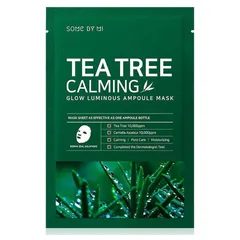
Some By Mi Buy Some By Mi Tea Tree Calming Glow Luminous Ampoule Mask in Australia - Korean Skincare Online
Works for:
based on ingredients and %- Moisturizing
- Anti-oxidation
- Anti-aging
Can it cause trouble?
- Irritation risk: high
- Comedogenic risk ingredients: 1
Key actives
Product Summary
"Some By Mi - Buy Some By Mi Tea Tree Calming Glow Luminous Ampoule Mask in Australia - Korean Skincare Online" could be helpful for: Moisturizing and Anti-aging, but its actives are not the most effective or are not well-studied.
Ingredient callouts
- Humectants (sodium hyaluronate crosspolymer 0.10% - 0.20%, sodium hyaluronate 0.20% - 0.40%, alanine 0.20% - 0.40%, glycine 0.20% - 0.40%, trehalose 0.20% - 0.35%, hyaluronic acid 0.20% - 0.35%, hydrolyzed hyaluronic acid 0.15% - 0.30%, glyceryl acrylate/acrylic acid copolymer 0.15% - 0.30%, sodium hyaluronate 0.15% - 0.30%, sodium acetylated hyaluronate 0.15% - 0.30%, glutamic acid 0.15% - 0.30%, hydrolyzed hyaluronic acid 0.15% - 0.30%, xylitylglucoside 0.15% - 0.30%, histidine 0.15% - 0.30%, aspartic acid 0.20% - 0.35%, anhydroxylitol 0.30% - 0.55%, arginine 1.80% - 2.30% and glycerin 2.30% - 2.90%). These ingredients help attract water to the upper layer of the skin and improve the skin hydration.
Price
The product retails for 2.40A$ in Australia.
For a detailed price comparison: click here.
Works for
Anti-aging
This product contains aspartic acid, lysine, serine, threonine. These ingredients might be able to help reduce and prevent fine lines and wrinkles, improve skin elasticity and firmness, but there is not enough evidence that it actually works.
An amino-acid that helps to attract water to the upper layer of the skin. In combination with other amino-acids, might help to reduce fine lines and wrinkles
An amino-acid that helps to attract water to the upper layer of the skin. In combination with other amino-acids, might help to reduce fine lines and wrinkles
An amino-acid that helps to attract water to the upper layer of the skin. In combination with other amino-acids, might help to reduce fine lines and wrinkles
An amino-acid that helps increase skin hydration and might help to slightly improve skin firmness, potentially reducing lines and wrinkles
One of the best moisturizing ingredients. Attracts water into the upper layer of the skin. Naturally present in skin. Typically has large molecule size unless advertised otherwise on the product label. Helps support skin's barrier function and may help to reduce inflammation
A plant extract that has been shown to be able to reduce inflammation in skin, support restoration of skin barrier function, as well as support collagen production. Contains active compounds called centelloids: asiaticoside, madecasosside, asiatic acid and madecassic acid. Might be helpful in preventing stretch marks. It can be itself be irritating though.
Can contain potent anti-oxidant compounds (abbreviated ECG, GCG, EGC, and EGCG) that might help protect the skin from free radicals. Can help calm down inflammation and has some anti-bacterial properties. Unfortunately, these antioxidants are unstable and lose their effectiveness very quickly in products. The concentration of the antioxidant compounds in the extract also tends to be low to be effective in topical formulation
Anti-oxidation
This product contains antioxidants (cysteine, punica granatum extract) that might be able to help neutralize free radicals in skin to lessen the damage it gets from the UV light (sun). There is not enough evidence to confirm their effectiveness in skin though.
Might help neutralize free radicals in skin and might be helpful against hyperpigmentation
A plant extract that can help neutralize free radicals in skin and even out the skin tone, but is typically used in products in a concentration that is too low to be effective
A plant extract that might contain a compound baicalin that could be helpful in neutralizing free radicals and reducing inflammation in skin. The baicalin concentration in skincare products is often too low for an effective action. Can be used for its fragrant properties
A plant extract that can help lighten the skin and calm down inflammation. Might be helpful in neutralizing free radicals
A plant extract that has some anti-oxidant activity, but solid research is lacking. Can help attract water to the upper layer of the skin
A plant extract that might have antioxidant properties
A plant extract. Can have an anti-oxidant effect, but can also contain irritants
A plant extract that has some anti-oxidant and anti-bacterial properties. Can be irritating
An essential oil. Can be irritating. Can become an allergen with oxidation
A plant extract that can contain an irritating essential oil. Might have some anti-oxidant effect, but evidence is lacking
A plant extract that has been shown to be able to reduce inflammation in skin, support restoration of skin barrier function, as well as support collagen production. Contains active compounds called centelloids: asiaticoside, madecasosside, asiatic acid and madecassic acid. Might be helpful in preventing stretch marks. It can be itself be irritating though.
Can contain potent anti-oxidant compounds (abbreviated ECG, GCG, EGC, and EGCG) that might help protect the skin from free radicals. Can help calm down inflammation and has some anti-bacterial properties. Unfortunately, these antioxidants are unstable and lose their effectiveness very quickly in products. The concentration of the antioxidant compounds in the extract also tends to be low to be effective in topical formulation
A plant extract that can help neutralize free radicals in skin. It contains a compound salicin that can theoretically be converted into salicylic acid that, in turn, helps reduce inflammation in skin, but the evidence of effectiveness in skin is lacking and the extract is usually not used in a concentration that would enable an exfoliating effect
A great emollient. Contains vitamin E (tocopherol) which may give it some anti-oxidant properties. Can contain volatile compounds and can be irritating
Moisturizing
What does the product description say?
DESRIPTION Some By Mi Tea Tree Calming Glow Luminous Ampoule Mask moistures skin with naturally derived extracts and effective ingredients.
Source: Lila Beauty
This product can help improve hydration of the skin with the two types of ingredients.
The first type is called “humectants”:
these ingredients help attract water.
When humectants are on the surface of the skin, they “pull in” the moisture from the outside environment, or from
within deeper layers of the skin. The following ingredients in this product do the job:
alanine, anhydroxylitol.
This product also contains ingredients called “occlusives”. They help reduce the speed with which our skin loses moisture to the outside environment. These ingredients also help soften the upper layer of the skin, so it feels less tight and nicer to the touch. The following ingredients in this product do the job: arginine, pentylene glycol.
An amino acid that can help attract water to the upper layer of the skin and support skin's barrier function
Helps attract water to the upper layer of the skin and repair the skin barrier function
An amino-acid that helps to attract water to the upper layer of the skin and might help to lighten the skin, but solid evidence is lacking
Helps attract water to the upper layer of the skin and repair the skin barrir function
An amino acid that is naturally present in skin and helps keep it hydrated. When used together with AHAs, it can reduce their irritating effect on the skin
An amino-acid that helps increase skin hydration and might help to slightly improve skin firmness, potentially reducing lines and wrinkles
Might help neutralize free radicals in skin and might be helpful against hyperpigmentation
An amino-acid that helps attract water to the upper layer of the skin
One of the best moisturizing ingredients. Naturally present in skin. It attracts water to the upper layer of the skin working as a humectant
Helps attract water to the upper layer of the skin and provide a longer-lasting hydration. Can create a thicker product consistency
Helps to attract water to the upper layer of the skin and can help restore the skin barrier function
One of the best moisturizing ingredients. Attracts water into the upper layer of the skin. Naturally present in skin. Typically has large molecule size unless advertised otherwise on the product label. Helps support skin's barrier function and may help to reduce inflammation
One of the best moisturizing ingredients. Attracts water into the upper layer of the skin. A version of it is naturally present in skin
Attracts water into the upper layer of the skin
Seaweed extract that might help to attract water to the upper layer of the skin and have some anti-oxidant properties
An amino-acid that helps to attract water to the upper layer of the skin. In combination with other amino-acids, might help to reduce fine lines and wrinkles
An amino-acid that helps to attract water to the upper layer of the skin. In combination with other amino-acids, might help to reduce fine lines and wrinkles
A type of hyaluronic acid that works as an excellent moisturizer by attracting water into the upper layer of the skin. Is typically feels less sticky on the skin compared to the usual hyaluronic acid
One of the best moisturizing ingredients. Attracts water into the upper layer of the skin
Attracts water into the upper layer of the skin
An amino-acid that helps to attract water to the upper layer of the skin. In combination with other amino-acids, might help to reduce fine lines and wrinkles
A sugar that attracts water to the upper layer of the skin
A fermentation product created by bacteria Lactobacillus out of soybean. The fermented product helps to attract water to the upper layer of the skin and has anti-bacterial properties. It might be helpful in calming down inflammation and could be helpful in evening out skin tone, but studies are lacking
Helps attract water to the upper layer of the skin. Could be helpful in restoring the skin barrier function
A plant extract that has some anti-oxidant activity, but solid research is lacking. Can help attract water to the upper layer of the skin
Used to preserve products, dissolve other ingredients and create a nice product texture
A plant extract that might contain a compound baicalin that could be helpful in neutralizing free radicals and reducing inflammation in skin. The baicalin concentration in skincare products is often too low for an effective action. Can be used for its fragrant properties
Used to create a nice product texture and help delivery of other ingredients. Might be somewhat helpful in attracting water to the upper layer of the skin
A plant extract that has been shown to be able to reduce inflammation in skin, support restoration of skin barrier function, as well as support collagen production. Contains active compounds called centelloids: asiaticoside, madecasosside, asiatic acid and madecassic acid. Might be helpful in preventing stretch marks. It can be itself be irritating though.
A salt derived from licorice. Works as an emollient to soften the upper layer of the skin and can help calm down inflammation. Might be helpful for skin lightening
Helps attract water to the upper layer of the skin and can help improve skin barrier function
A great emollient. Contains vitamin E (tocopherol) which may give it some anti-oxidant properties. Can contain volatile compounds and can be irritating
Helps calm down inflammation in skin and can help reduce itching. Helps to repair the skin barrier and keep skin hydrated
Traditionally used to treat sunburns, dermatitis and inflammation, but evidence for its effectiveness is lacking. The extract can contain humectants that help attract water into the skin
Can contain potent anti-oxidant compounds (abbreviated ECG, GCG, EGC, and EGCG) that might help protect the skin from free radicals. Can help calm down inflammation and has some anti-bacterial properties. Unfortunately, these antioxidants are unstable and lose their effectiveness very quickly in products. The concentration of the antioxidant compounds in the extract also tends to be low to be effective in topical formulation
How honest is this product?
| Promise | Can it deliver? |
|---|---|
| Moisturizing |
Total Promises Fulfilled score: 75/100.
We receive a small commission for purchases made through these links at no cost for you. Thank you for your support! Learn more
Affiliate link · supports WIMJ at no cost to you
Potential irritants
Comedogenic ingredients
User reviews (0)
Averages from community submissions.
No reviews yet for this product.
Be the first to share your experience!
Tried this product?
Help capture what the ingredient list can't—texture, finish, pilling, scent, and more. Answer what you can, skip the rest.
Takes ~30 seconds.
Reviews are shown in aggregate. No personal details.
| Product | Similarity | Price | Irritancy |
|---|---|---|---|
 Some By Mi Buy Some By Mi Tea Tree Calming Glow Luminous Ampoule Mask in Australia - Korean Skincare Online | Current | $2.40 | |
 Baciel Hydra Barrier Cica Essence Toner | 62% | $19.80 | |
Dr.G HYDRA AQUA BOOSTING TONER | 59% | - | |
 Farm Stay Cica Farm Blemish Clear Ampoule | 58% | $19.90 | |
 MEDIHEAL D.N.A Hydrating Protein Sheet Mask | 57% | $9.95 | |
 Be Minimalist Polyhydroxy Acid 03% Toner | 57% | $5.99 |
Key Actives
A plant extract that has been shown to be able to reduce inflammation in skin, support restoration of skin barrier function, as well as support collagen production. Contains active compounds called centelloids: asiaticoside, madecasosside, asiatic acid and madecassic acid. Might be helpful in preventing stretch marks. It can be itself be irritating though.
Helps calm down inflammation in skin and can help reduce itching. Helps to repair the skin barrier and keep skin hydrated
Can contain potent anti-oxidant compounds (abbreviated ECG, GCG, EGC, and EGCG) that might help protect the skin from free radicals. Can help calm down inflammation and has some anti-bacterial properties. Unfortunately, these antioxidants are unstable and lose their effectiveness very quickly in products. The concentration of the antioxidant compounds in the extract also tends to be low to be effective in topical formulation
A salt derived from licorice. Works as an emollient to soften the upper layer of the skin and can help calm down inflammation. Might be helpful for skin lightening
Helps attract water to the upper layer of the skin and can help improve skin barrier function
Might help neutralize free radicals in skin and might be helpful against hyperpigmentation
One of the best moisturizing ingredients. Attracts water into the upper layer of the skin. Naturally present in skin. Typically has large molecule size unless advertised otherwise on the product label. Helps support skin's barrier function and may help to reduce inflammation
An amino-acid that helps increase skin hydration and might help to slightly improve skin firmness, potentially reducing lines and wrinkles
An amino-acid that helps to attract water to the upper layer of the skin. In combination with other amino-acids, might help to reduce fine lines and wrinkles
A plant extract that can help neutralize free radicals in skin and even out the skin tone, but is typically used in products in a concentration that is too low to be effective
An amino-acid that helps to attract water to the upper layer of the skin. In combination with other amino-acids, might help to reduce fine lines and wrinkles
An amino-acid that helps to attract water to the upper layer of the skin. In combination with other amino-acids, might help to reduce fine lines and wrinkles
An amino-acid that helps to attract water to the upper layer of the skin and might help to lighten the skin, but solid evidence is lacking
One of the best moisturizing ingredients. Naturally present in skin. It attracts water to the upper layer of the skin working as a humectant
An amino acid that is naturally present in skin and helps keep it hydrated. When used together with AHAs, it can reduce their irritating effect on the skin
Helps attract water to the upper layer of the skin and repair the skin barrir function
Seaweed extract that might help to attract water to the upper layer of the skin and have some anti-oxidant properties
Helps attract water to the upper layer of the skin and repair the skin barrier function
One of the best moisturizing ingredients. Attracts water into the upper layer of the skin. A version of it is naturally present in skin
An amino-acid that helps attract water to the upper layer of the skin
A type of hyaluronic acid that works as an excellent moisturizer by attracting water into the upper layer of the skin. Is typically feels less sticky on the skin compared to the usual hyaluronic acid
One of the best moisturizing ingredients. Attracts water into the upper layer of the skin
Helps attract water to the upper layer of the skin and provide a longer-lasting hydration. Can create a thicker product consistency
One of the best moisturizing ingredients. Attracts water into the upper layer of the skin. A version of it is naturally present in skin
A sugar that attracts water to the upper layer of the skin
Helps to attract water to the upper layer of the skin and can help restore the skin barrier function
An amino acid that can help attract water to the upper layer of the skin and support skin's barrier function
Attracts water into the upper layer of the skin
One of the best moisturizing ingredients. Attracts water into the upper layer of the skin
Attracts water into the upper layer of the skin
Potential irritants
A plant extract that has some anti-oxidant and anti-bacterial properties. Can be irritating
A plant extract that might contain a compound baicalin that could be helpful in neutralizing free radicals and reducing inflammation in skin. The baicalin concentration in skincare products is often too low for an effective action. Can be used for its fragrant properties
A plant extract. Can have an anti-oxidant effect, but can also contain irritants
A plant extract that might have antioxidant properties
A plant oil with a high content of volatile compounds that can irritate the skin and lead to allergic reactions. Can lead to photosensitivity
A common frangrance that can easily irritate skin, especially if exposed to air, light or heat
A plant extract that can contain an irritating essential oil. Might have some anti-oxidant effect, but evidence is lacking
A plant extract that can help neutralize free radicals in skin. It contains a compound salicin that can theoretically be converted into salicylic acid that, in turn, helps reduce inflammation in skin, but the evidence of effectiveness in skin is lacking and the extract is usually not used in a concentration that would enable an exfoliating effect
An essentil oil from orange peel. Potential allergen and can be irritating
An essential oil that can be irritating. Has some anti-bacterial properties
An essential oil. Can be irritating. Can become an allergen with oxidation
Used to preserve products, dissolve other ingredients and create a nice product texture
A plant extract that can help neutralize free radicals in skin and even out the skin tone, but is typically used in products in a concentration that is too low to be effective
Helps attract water to the upper layer of the skin and provide a longer-lasting hydration. Can create a thicker product consistency
A great emollient. Contains vitamin E (tocopherol) which may give it some anti-oxidant properties. Can contain volatile compounds and can be irritating
A plant extract that has been shown to be able to reduce inflammation in skin, support restoration of skin barrier function, as well as support collagen production. Contains active compounds called centelloids: asiaticoside, madecasosside, asiatic acid and madecassic acid. Might be helpful in preventing stretch marks. It can be itself be irritating though.
A plant extract that can help lighten the skin and calm down inflammation. Might be helpful in neutralizing free radicals
Traditionally used to treat sunburns, dermatitis and inflammation, but evidence for its effectiveness is lacking. The extract can contain humectants that help attract water into the skin
Attracts water into the upper layer of the skin
A plant extract that has some anti-oxidant activity, but solid research is lacking. Can help attract water to the upper layer of the skin
Comedogenic ingredients
Seaweed extract that might help to attract water to the upper layer of the skin and have some anti-oxidant properties
All ingredients
Used to create a nice product texture and help delivery of other ingredients. Might be somewhat helpful in attracting water to the upper layer of the skin
Used to thicken product formulations and create gel-like textures
One of the best moisturizing ingredients. Naturally present in skin. It attracts water to the upper layer of the skin working as a humectant
An amino acid that is naturally present in skin and helps keep it hydrated. When used together with AHAs, it can reduce their irritating effect on the skin
Helps create a thicker or gel-like product texture. It is not a surfactant but can be used in gentle cleansing formulations
A salt derived from licorice. Works as an emollient to soften the upper layer of the skin and can help calm down inflammation. Might be helpful for skin lightening
A plant extract that has some anti-oxidant and anti-bacterial properties. Can be irritating
Helps calm down inflammation in skin and can help reduce itching. Helps to repair the skin barrier and keep skin hydrated
Helps attract water to the upper layer of the skin and repair the skin barrir function
Seaweed extract that might help to attract water to the upper layer of the skin and have some anti-oxidant properties
Used to preserve products, dissolve other ingredients and create a nice product texture
Helps attract water to the upper layer of the skin and can help improve skin barrier function
An amino-acid that helps increase skin hydration and might help to slightly improve skin firmness, potentially reducing lines and wrinkles
Helps attract water to the upper layer of the skin. Could be helpful in restoring the skin barrier function
A plant extract that might contain a compound baicalin that could be helpful in neutralizing free radicals and reducing inflammation in skin. The baicalin concentration in skincare products is often too low for an effective action. Can be used for its fragrant properties
Helps attract water to the upper layer of the skin and repair the skin barrier function
A plant extract. Can have an anti-oxidant effect, but can also contain irritants
A plant extract that might have antioxidant properties
An amino-acid that helps to attract water to the upper layer of the skin. In combination with other amino-acids, might help to reduce fine lines and wrinkles
A plant oil with a high content of volatile compounds that can irritate the skin and lead to allergic reactions. Can lead to photosensitivity
A plant extract that can help neutralize free radicals in skin and even out the skin tone, but is typically used in products in a concentration that is too low to be effective
One of the best moisturizing ingredients. Attracts water into the upper layer of the skin. A version of it is naturally present in skin
A fermentation product created by bacteria Lactobacillus out of soybean. The fermented product helps to attract water to the upper layer of the skin and has anti-bacterial properties. It might be helpful in calming down inflammation and could be helpful in evening out skin tone, but studies are lacking
An amino-acid that helps attract water to the upper layer of the skin
An amino-acid that helps to attract water to the upper layer of the skin. In combination with other amino-acids, might help to reduce fine lines and wrinkles
A type of hyaluronic acid that works as an excellent moisturizer by attracting water into the upper layer of the skin. Is typically feels less sticky on the skin compared to the usual hyaluronic acid
A common frangrance that can easily irritate skin, especially if exposed to air, light or heat
One of the best moisturizing ingredients. Attracts water into the upper layer of the skin
Helps attract water to the upper layer of the skin and provide a longer-lasting hydration. Can create a thicker product consistency
Helps to dissolve other ingredients in a formulation. Slows down the rate of product drying
A plant extract that can contain an irritating essential oil. Might have some anti-oxidant effect, but evidence is lacking
One of the best moisturizing ingredients. Attracts water into the upper layer of the skin. A version of it is naturally present in skin
A great emollient. Contains vitamin E (tocopherol) which may give it some anti-oxidant properties. Can contain volatile compounds and can be irritating
Might help neutralize free radicals in skin and might be helpful against hyperpigmentation
One of the best moisturizing ingredients. Attracts water into the upper layer of the skin. Naturally present in skin. Typically has large molecule size unless advertised otherwise on the product label. Helps support skin's barrier function and may help to reduce inflammation
An amino-acid that helps to attract water to the upper layer of the skin. In combination with other amino-acids, might help to reduce fine lines and wrinkles
A plant extract that has been shown to be able to reduce inflammation in skin, support restoration of skin barrier function, as well as support collagen production. Contains active compounds called centelloids: asiaticoside, madecasosside, asiatic acid and madecassic acid. Might be helpful in preventing stretch marks. It can be itself be irritating though.
Helps to attract water to the upper layer of the skin and can help restore the skin barrier function
A plant extract that can help lighten the skin and calm down inflammation. Might be helpful in neutralizing free radicals
Can contain potent anti-oxidant compounds (abbreviated ECG, GCG, EGC, and EGCG) that might help protect the skin from free radicals. Can help calm down inflammation and has some anti-bacterial properties. Unfortunately, these antioxidants are unstable and lose their effectiveness very quickly in products. The concentration of the antioxidant compounds in the extract also tends to be low to be effective in topical formulation
Does not have known skin benefits. Might help create an optical illusion of smoother skin
A plant extract that can help neutralize free radicals in skin. It contains a compound salicin that can theoretically be converted into salicylic acid that, in turn, helps reduce inflammation in skin, but the evidence of effectiveness in skin is lacking and the extract is usually not used in a concentration that would enable an exfoliating effect
An amino acid that can help attract water to the upper layer of the skin and support skin's barrier function
Attracts water into the upper layer of the skin
An essentil oil from orange peel. Potential allergen and can be irritating
An amino-acid that helps to attract water to the upper layer of the skin and might help to lighten the skin, but solid evidence is lacking
Oxygen molecules that are abundant in normal air. In cosmetic formulas typically comes as a perfluorohexane oxygen emulsion. There is no evidence for benefits of the oxygen emulsion in topical creams, lotions or serums. There is a study available confirming a positive impact of oxygen therapy for skin wound healing, but it used an emulsion stored under high pressure using special equipment
Traditionally used to treat sunburns, dermatitis and inflammation, but evidence for its effectiveness is lacking. The extract can contain humectants that help attract water into the skin
An essential oil that can be irritating. Has some anti-bacterial properties
One of the best moisturizing ingredients. Attracts water into the upper layer of the skin
Helps attract water to the upper layer of the skin and repair the skin barrier function
An essential oil. Can be irritating. Can become an allergen with oxidation
Attracts water into the upper layer of the skin
A plant extract that has some anti-oxidant activity, but solid research is lacking. Can help attract water to the upper layer of the skin
Ingredient list view
Water, Butylene glycol, 1,2-hexanediol, Hydroxyethylcellulose, Glycerin, Arginine, Carbomer, Disodium edta, Polyglyceryl-10 laurate, Polyglyceryl-10 myristate, Dipotassium glycyrrhizate, Chamaecyparis obtusa leaf extract, Glycereth-26, Calendula officinalis flower extract, Allantoin, Anhydroxylitol, Laminaria japonica extract, Pentylene glycol, Panthenol, Aspartic acid, Glucose, Scutellaria baicalensis root extract, Histidine, Xylitylglucoside, Hexylene glycol, Tyrosine, Dioscorea japonica root extract, Origanum vulgare leaf extract, Coptis chinensis root extract, Threonine, Ethylhexylglycerin, Methionine, Xanthan gum, Cinnamomum cassia bark extract, Citrus aurantium bergamia fruit oil, Punica granatum extract, Hydrolyzed hyaluronic acid, Lactobacillus/soybean ferment extract, Glutamic acid, Citronellol, Pearl extract, Methylpropanediol, Lysine, Linalool, Sodium acetylated hyaluronate, Artemisia princeps leaf extract, Limonene, Sodium hyaluronate, Glyceryl acrylate/acrylic acid copolymer, Dipropylene glycol, Zingiber officinale root extract, Hydrolyzed hyaluronic acid, Rosa canina fruit oil, Cysteine, Hyaluronic acid, Trehalose, Serine, Proline, Centella asiatica extract, Leucine, Glycine, Boswellia serrata resin extract, Glycyrrhiza glabra root extract, Camellia sinensis leaf extract, Diamond powder, Salix alba bark extract, Geraniol, Isoleucine, Hydrolyzed sodium hyaluronate, Citrus aurantium dulcis peel oil, Alanine, Oxygen, Aloe barbadensis leaf extract, Phenylalanine, Melaleuca alternifolia leaf extract, Unknown, Pvm/ma copolymer, Sodium hyaluronate, Xylitol, Hydroxyacetophenone, Valine, Pelargonium graveolens flower oil, Sodium hyaluronate crosspolymer, Portulaca oleracea extract
- The influence of alkane chain length on the skin irritation potential of 1,2-alkanediols
- Glycerol and the skin: holistic approach to its origin and functions
- In Vitro Assessment of Skin Irritation Potential of Surfactant-based Formulations by Using a 3-D Skin Reconstructed Tissue Model and Cytokine Response
- Ameliorating effect of dipotassium glycyrrhizinate on an IL-4- and IL-13-induced atopic dermatitis-like skin-equivalent model
- Final report on the safety assessment of Glycyrrhetinic Acid, Potassium Glycyrrhetinate, Disodium Succinoyl Glycyrrhetinate, Glyceryl Glycyrrhetinate, Glycyrrhetinyl Stearate, Stearyl Glycyrrhetinate, Glycyrrhizic Acid, Ammonium Glycyrrhizate, Dipotassium Glycyrrhizate, Disodium Glycyrrhizate, Trisodium Glycyrrhizate, Methyl Glycyrrhizate, and Potassium Glycyrrhizinate.
- Safety Assessment of Glycerin Ethoxylates as Used in Cosmetics
- Topical application of Calendula officinalis (L.): Formulation and evaluation of hydrophilic cream with antioxidant activity
- The seamy side of natural medicines: contact sensitization to arnica (Arnica montana L.) and marigold (Calendula officinalis L.)
- Final report on the safety assessment of Calendula officinalis extract and Calendula officinalis
- Contact dermatitis as an adverse reaction to some topically used European herbal medicinal products – part 1: Achillea millefolium–Curcuma longa
- Profile of wound healing process induced by allantoin
- Skin moisturizing effects of panthenol-based formulations
- Safety Assessment of Panthenol, Pantothenic Acid, and Derivatives as Used in Cosmetics
- Acetyl aspartic acid, a novel active ingredient, demonstrates potential to improve signs of skin ageing: from consumer need to clinical proof
- In vivo topical application of acetyl aspartic acid increases fibrillin-1 and collagen IV deposition leading to a significant improvement of skin firmness
- Topical Glucose Induces Claudin-1 and Filaggrin Expression in a Mouse Model of Atopic Dermatitis and in Keratinocyte Culture, Exerting Anti-inflammatory Effects by Repairing Skin Barrier Function
- Scutellaria baicalensis, the golden herb from the garden of Chinese medicinal plants
- Flavonoids in Treating Psoriasis
- Improvement of skin barrier dysfunction by Scutellaria baicalensis GEOGI extracts through lactic acid fermentation
- Safety Assessment of Scutellaria baicalensis-Derived Ingredients as Used in Cosmetics
- Histidine and/or Histidine Derivative for the Treatment of Inflammatory Skin Diseases
- Safety Assessment of α-Amino Acids as Used in Cosmetics
- Topical palmitoyl pentapeptide provides improvement in photoaged human facial skin
- Safety Assessment of Citrus-Derived Peel Oils as Used in Cosmetics
- Oxidized citrus oil (R-limonene): A frequent skin sensitizer in Europe
- Air oxidation increases skin irritation from fragrance terpenes
- Extract of Punica granatum inhibits skin photoaging induced by UVB irradiation
- Topical microemulsion containing Punica granatum extract: its control over skin erythema and melanin in healthy Asian subjects
- Safety Assessment of Punica granatum -Derived Ingredients as Used in Cosmetics
- Efficacy of a New Topical Nano-hyaluronic Acid in Humans
- Physiochemical properties and application of hyaluronic acid: a systematic review
- Acetylated Hyaluronic Acid: Enhanced Bioavailability and Biological Studies
- Hyaluronic acid: A key molecule in skin aging
- Hyaluronan (Hyaluronic Acid): a natural moisturizer for skin care
- Some phytochemical, pharmacological and toxicological properties of ginger (Zingiber officinale Roscoe): A review of recent research
- The Potential Uses of N-acetylcysteine in Dermatology: A Review
- Anti-Inflammatory Effect of Titrated Extract of Centella asiatica in Phthalic Anhydride-Induced Allergic Dermatitis Animal Model
- Centella asiatica in cosmetology
- Triterpene Composition and Bioactivities of Centella asiatica
- Asiaticoside induction for cell-cycle progression, proliferation and collagen synthesis in human dermal fibroblasts
- Assessment report on Centella asiatica (L.) Urban, herba
- Contact dermatitis due to Madecassol
- The Effects of a Standardized Extract of Centella asiatica on Postlaser Resurfacing Wound Healing on the Face: A Split-Face, Double-Blind, Randomized, Placebo-Controlled Trial
- Effect of Topical Application of Glycine and Proline on Recalcitrant Leg Ulcers of Prolidase Deficiency
- Functional glycine receptor in cultured human keratinocytes
- Efficacy and Safety of White Willow Bark (Salix alba) Extract
- An evaluation of the effect of a topical product containing salicin on the visible signs of human skin aging
- Annex I: Clinical evidence regarding sensitisation to individual fragrance chemicals and to natural extracts
- Local rhamnosoft, ceramides and L‐isoleucine in atopic eczema: a randomized, placebo controlled trial
- Combination of amino acids reduces pigmentation in B16F0 melanoma cells
- Topical Oxygen Emulsion A Novel Wound Therapy
- Fragrance Compound Geraniol Forms Contact Allergens on Air Exposure. Identification and Quantification of Oxidation Products and Effect on Skin Sensitization
- Portulaca oleracea (purslane)