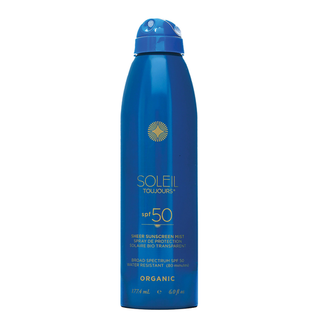
Soleil Toujours Organic Sheer Sunscreen Mist SPF 50
Works for
2 of 2 advertised claims delivered
Sun protectionSPF 50 · 3 UV filtersBroad spectrum
This product offers a good level of protection against both UVB and UVA rays.
This sunscreen uses organic (so-called "chemical") sunscreen filters. Organic, or "chemical" filters usually provide reliable sun protection and rarely leave a white cast. Sunscreens with organic filters can sting eyes.
This product can be considered "reef safe" because it does not contain the UV filters (oxybenzone and octinoxate) that can be harmful to coral reefs when present in the water in high concentrations.
Anti-agingHyaluronic acid, Aloe barbadensis leaf juice + 3 moreStrong evidence
“Soleil Toujours Organic Sheer Sunscreen Mist SPF 50 Organic Sheer Sunscreen Mist SPF 50 by Soleil Toujours provides superior, skin-safe protection from the sun, while also imparting advanced anti-ageing benefits.”
This product can help prevent early signs of skin aging because it offers a good level of broad spectrum sun protection. Sun damage is the main cause of premature skin aging, and protecting your skin from the sun is the best anti-aging strategy.
Anti-oxidationNot advertised by the brand · Camellia oleifera leaf extract, Bisabolol + 5 moreStrong evidence
This product contains antioxidants (camellia oleifera leaf extract) that can help neutralize free radicals in skin. By doing so, they can lessen the damage the skin gets from the UV light (sun).
Evens skin toneNot advertised by the brand · Tetrahexyldecyl ascorbateStrong evidence
This product offers broad spectrum sun protection. It means that it can prevent hyperpigmentation and help keep the skin tone even (sun damage is the main factor causing age spots, darkening of post-acne marks and other discolorations).
MoisturizingNot advertised by the brand · Caprylic/capric triglyceride, Glycerin + 5 moreGood evidence
This product can help improve hydration of the skin with the two types of ingredients.
The first type is called “humectants”:
these ingredients help attract water.
When humectants are on the surface of the skin, they “pull in” the moisture from the outside environment, or from
within deeper layers of the skin. The following ingredients in this product do the job:
glycerin, hyaluronic acid.
This product also contains ingredients called “occlusives”. They help reduce the speed with which our skin loses moisture to the outside environment. These ingredients also help soften the upper layer of the skin, so it feels less tight and nicer to the touch. The following ingredients in this product do the job: caprylic/capric triglyceride.
Can it cause trouble?
Irritancy7 strong irritants: Citrus aurantifolia peel oil, Citrus aurantium bergamia fruit extract + 5 more — patch-test recommendedHigh risk
Comedogenic1 ingredient rated 2 or more on the 0–5 pore-clogging scale1 flagged
User reviews
Be the first — your take helps the next person decide.
Ingredients
Filter by role to see what each ingredient is doing.
Butyl methoxydibenzoylmethane3%
- Irritation risk
- Medium
Avobenzone. An organic, or so-called "chemical" UV filter. Protects against both UVA and UVB rays. Needs to be combined with other filters in a formulation to be stable.
More about Butyl methoxydibenzoylmethaneHomosalate10%
- Irritation risk
- Medium
A weak sunscreen that offers some protection against the sun rays that cause sunburn (UVB), but does not offer meaningful protection against protect against the most aging sun rays (UVA). It loses its effectiveness quickly when exposed to sunlight. It is an organic, or so called "chemical" sunscreen. When used in low concentrations, helps to stabilize the product formulation
More about HomosalateEthylhexyl salicylate5%
- Irritation risk
- Low
Octisalate. A UV filter. It offers some protection against the sun rays that cause sunburn (UVB), but does not protect against the most aging sun rays (UVA). It loses its effectiveness quickly when exposed to sunlight. It is an organic, or so called "chemical" sunscreen
More about Ethylhexyl salicylateCucumis sativus extract~22–33%
- Irritation risk
- Medium
Aloe barbadensis leaf juice~4.9–7.4%
- Irritation risk
- Medium
Traditionally used to treat sunburns, dermatitis and inflammation, but evidence for its effectiveness is lacking. The extract can contain humectants that help attract water into the skin
More about Aloe barbadensis leaf juiceArtemisia pallens flower oil~4.3–6.5%
- Irritation risk
- Low
Ascorbyl palmitate~3.5–5.2%
- Irritation risk
- Medium
Being a lipid soluble form of vitamin C, it is more stable and can penetrate the skin better than L-Ascorbic acid. It is effective in protecting the skin from free radicals, as well as evening the skin tone, but is less effective in stimulating collagen production compared to L-Ascorbic acid.
More about Ascorbyl palmitateBisabolol~2.6–3.9%
- Irritation risk
- Low
An active component of chamomile plant that historically has been used to calm down irritated skin. A recent study shows that bisabolol indeed can have some anti-inflammatory effect on skin, even though conclusive data is lacking. Bisabolol has a sweet floral scent and can be added to products for its aromatic properties
More about BisabololCamellia oleifera leaf extract~1.9–2.9%
- Irritation risk
- Low
A plant extract that can help neutralize free radicals and reduce inflammation, even though it is not usually used in sufficient concentration in cosmetics
More about Camellia oleifera leaf extractCaprylic/capric triglyceride~1.7–2.6%
- Irritation risk
- Medium
A good mix of fatty acids that forms a protective layer on the skin. Improves the shelf life of products. Derived from coconut and glycerin
More about Caprylic/capric triglycerideCitrus aurantifolia peel oil~1.3–1.9%
- Irritation risk
- High
Citrus aurantium bergamia fruit extract~1.1–1.6%
- Irritation risk
- High
Citrus limon peel oil~0.6–1.35%
Rosa damascena flower oil~0.5–1.15%
- Irritation risk
- High
Used as a fragrance. Can be irritating
More about Rosa damascena flower oilCitrus aurantium dulcis peel oil~0.4–0.9%
- Irritation risk
- High
An essentil oil from orange peel. Potential allergen and can be irritating
More about Citrus aurantium dulcis peel oilEthyl acetate~0.2–0.75%
- Irritation risk
- Low
Ethyl acetoacetate~0.15–0.65%
- Irritation risk
- Low
Gamma-undecalactone~0.15–0.55%
- Irritation risk
- Low
Ferula galbaniflua resin oil~0.15–0.55%
- Irritation risk
- Low
Glycerin~0.15–0.7%
- Irritation risk
- Low
One of the best moisturizing ingredients. Naturally present in skin. It attracts water to the upper layer of the skin working as a humectant
More about GlycerinHeliotropine~0.15–0.6%
- Irritation risk
- Low
Hyaluronic acid~0.15–0.6%
- Irritation risk
- Low
One of the best moisturizing ingredients. Attracts water into the upper layer of the skin. Naturally present in skin. Typically has large molecule size unless advertised otherwise on the product label. Helps support skin's barrier function and may help to reduce inflammation
More about Hyaluronic acidIsoamyl acetate~0.15–0.55%
- Irritation risk
- Low
Isobutyl acetate~0.1–0.45%
- Irritation risk
- Low
Jasminum sambac flower extract~0.1–0.45%
- Irritation risk
- Low
Opoponax oil~0.1–0.45%
- Irritation risk
- Low
Polyester-8~0.2–0.75%
- Irritation risk
- Medium
Used to stabilize product formulations and individual ingredients (for example, sunscreens). Can be an allergen
More about Polyester-8Porphyra umbilicalis extract~0.15–0.6%
- Irritation risk
- Low
- Comedogenicity
- 3/5
An algae extract that can help attract water to the upper layer of the skin. Might have an anti-oxidant effect in skin but evidence is lacking
More about Porphyra umbilicalis extractSalvia sclarea oil~0.1–0.5%
- Irritation risk
- High
Sd alcohol 40-b~0.1–0.5%
- Irritation risk
- High
Can be drying and contribute to skin irritation. Used in formulars to dissolve other ingredients, create a thinner product consistency or for its antibacterial properties
More about Sd alcohol 40-bTetrahexyldecyl ascorbate~0.1–0.5%
- Irritation risk
- Medium
Being a lipid soluble form of vitamin C, it is more stable than ascorbic acid, but still degrades quickly and needs to be stabilized in a formulation with another ingredient. It is claimed to penetrate skin better than pure vitamin C and have the the similar benefits, but solid studies of its effectiveness are lacking. Is likely to require a higher concentration in a product than pure vitamin C to be effective. It might be able to help reduce pore clogging.
More about Tetrahexyldecyl ascorbateTocopherol~0.1–0.45%
- Irritation risk
- Low
Pure form of vitamin E. Can help moisturise and protect the skin from free radicals. Often used to help stabilise other ingredients or the formula itself
More about TocopherolTocopheryl acetate~0.1–0.4%
- Irritation risk
- Medium
A more stable but less bio-available form of vitamin E compared to Tocopherol. Might help moisturize and protect the skin from free radicals, but mostly used in low concentrations to stabilize other ingredients.
More about Tocopheryl acetateVa/butyl maleate/isobornyl acrylate copolymer~0.15–0.55%
- Irritation risk
- Low
Water~0.1–0.3%
Ingredient list view
Butyl methoxydibenzoylmethane, Homosalate, Ethylhexyl salicylate, Cucumis sativus extract, Aloe barbadensis leaf juice, Artemisia pallens flower oil, Ascorbyl palmitate, Bisabolol, Camellia oleifera leaf extract, Caprylic/capric triglyceride, Citrus aurantifolia peel oil, Citrus aurantium bergamia fruit extract, Citrus limon peel oil, Rosa damascena flower oil, Citrus aurantium dulcis peel oil, Ethyl acetate, Ethyl acetoacetate, Gamma-undecalactone, Ferula galbaniflua resin oil, Glycerin, Heliotropine, Hyaluronic acid, Isoamyl acetate, Isobutyl acetate, Jasminum sambac flower extract, Unknown, Opoponax oil, Polyester-8, Porphyra umbilicalis extract, Salvia sclarea oil, Sd alcohol 40-b, Tetrahexyldecyl ascorbate, Tocopherol, Tocopheryl acetate, Va/butyl maleate/isobornyl acrylate copolymer, Water
Compare prices
Retailers ranked by price — lowest first.
Product summary
We assess that "Soleil Toujours - Organic Sheer Sunscreen Mist SPF 50" can provide reliable sun protection based on the ingredient list. It can protect from both UVA and UVB rays. This is great news because not all sunscreens with SPF ratings give UVA protection. (UVA rays do not cause sunburn, but still damage our skin and lead to early aging).
Because it includes good moisturizing ingredients, it can also work as a hydrating day cream. This product prevents early signs of aging by protecting against sun damage (all broad spectrum sunscreens do that).
Sunscreen filters
This sunscreen uses so-called "chemical", or organic UV filters (organic simply means that their molecules contain atoms of carbon). These filters typically give good sun protection and rarely leave a white cast, but they can be irritating for sensitive skin. The UV filters in this sunscreen are: avobenzone 3.00% (declared), octisalate 5.00% (declared) and homosalate 10.00% (declared).
Irritation risk
This sunscreen contains a bunch of common irritants, including ingredients that do not provide any known benefit for the skin. It might not be the best choice if your skin is sensitive. We assess the overall irritancy of this product to be high. For a detailed overview of all potential irritants: click here
You can see the detailed formula review with the breakdown of all actives in the product and the full ingredient list with estimated concentrations in the tables below.
Sources cited in this review
Every concentration estimate and effectiveness label is anchored to one of these 13 studies and safety reviews.
- 1
- 2
- 3
- 4
- 5Efficacy of a New Topical Nano-hyaluronic Acid in Humansncbi.nlm.nih.gov
- 6Physiochemical properties and application of hyaluronic acid: a systematic reviewonlinelibrary.wiley.com

Affiliate links · As an Amazon Associate, WIMJ earns from qualifying purchases.