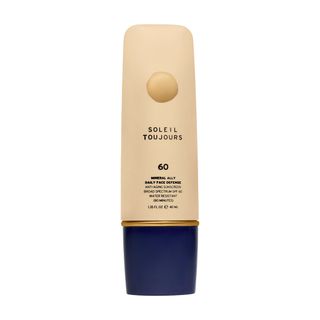
Soleil Toujours Mineral Ally Daily Face Defense SPF 60
Works for
1 of 1 advertised claim delivered
Sun protectionSPF 60 · 2 UV filtersBroad spectrum
This product offers a good level of protection against both UVB and UVA rays.
This sunscreen uses organic (so-called "chemical") sunscreen filters. Organic, or "chemical" filters usually provide reliable sun protection and rarely leave a white cast. Sunscreens with organic filters can sting eyes.
This product can be considered "reef safe" because it does not contain the UV filters (oxybenzone and octinoxate) that can be harmful to coral reefs when present in the water in high concentrations.
Anti-agingNot advertised by the brand · 3 ingredients credited for this claimStrong support
This product can help prevent early signs of skin aging because it offers a good level of broad spectrum sun protection. Sun damage is the main cause of premature skin aging, and protecting your skin from the sun is the best anti-aging strategy.
Evens skin toneNot advertised by the brand · 1 ingredient credited for this claimStrong support
This product offers broad spectrum sun protection. It means that it can prevent hyperpigmentation and help keep the skin tone even (sun damage is the main factor causing age spots, darkening of post-acne marks and other discolorations).
MoisturizingNot advertised by the brand · 12 ingredients credited for this claimGood support
This product can help soften the skin and reduce its moisture loss with emollients and occlusives: caprylic/capric triglyceride, carthamus tinctorius seed oil.
Keep in mind that this product does not contain effective ingredients to attract water to the upper layer of the skin. This is why an additional product with humectants like glycerin or hyaluronic acid can be helpful (apply it before this product for the best results).
Can it cause trouble?
Irritancy26 strong irritants: Artemisia vulgaris extract, Citrus aurantium dulcis peel oil expressed + 24 more — patch-test recommendedHigh risk
Comedogenic2 ingredients rated 2 or more on the 0–5 pore-clogging scale2 flagged
User reviews
Be the first — your take helps the next person decide.
Ingredients
Filter by role to see what each ingredient is doing.
Zinc oxide24%
- Irritation risk
- Low
A broad spectrum sunblock (protects from both UVA and UVB rays). Is suitable for most sensitive skins. In small concentrations, can be used as a colorant
More about Zinc oxideCaprylic/capric triglyceride~23–35%
- Irritation risk
- Medium
A good mix of fatty acids that forms a protective layer on the skin. Improves the shelf life of products. Derived from coconut and glycerin
More about Caprylic/capric triglycerideButyloctyl salicylate~5.3–8%
- Irritation risk
- Medium
A synthetic ester of salicylic acid that is used to help disperse pigments and boost effectiveness of sunscreen ingredients. It is able to absorb UV light (working as an organic, or chemical filter), but is not approved as a sunscreen ingredient on its own
More about Butyloctyl salicylateC13-15 alkane~4–6%
Stearalkonium hectorite~2.8–4.2%
Propylene carbonate~2.1–3.2%
- Irritation risk
- Low
Is used to dissolve other ingredients and create nice product texture
More about Propylene carbonateEuphorbia cerifera wax~2.1–3.2%
- Irritation risk
- Low
Helianthus annuus seed wax~1.5–2.3%
- Irritation risk
- Low
Helps soften the upper layer of the skin and support skin's barrier function while creating a thicker product consistency
More about Helianthus annuus seed waxQuaternium-90 bentonite~1.2–1.9%
- Irritation risk
- Low
Butyrospermum parkii nut extract~1.1–1.6%
- Irritation risk
- Low
Coconut alkanes~0.85–1.3%
- Irritation risk
- Medium
- Comedogenicity
- 2/5
An emollient that helps soften the skin
More about Coconut alkanesCarthamus tinctorius seed oil~0.5–1.15%
- Irritation risk
- Low
An emollient that helps soften the skin and might help calm down inflammation
More about Carthamus tinctorius seed oilPolyhydroxystearic acid~0.4–0.95%
- Irritation risk
- Medium
Used to create a thicker product consistency and stabilize the formulation
More about Polyhydroxystearic acidPolyglyceryl-3 polyricinoleate~0.35–0.85%
- Irritation risk
- Medium
Helps oil and water mix together
More about Polyglyceryl-3 polyricinoleateIsostearic acid~0.4–0.9%
- Irritation risk
- Low
Used to create a nice product texture
More about Isostearic acidLecithin~0.3–0.7%
- Irritation risk
- Low
Used mostly for creating emulsions - helping oil and water mix together. Helps soften the upper layer of the skin
More about LecithinPhenoxyethanol~0.2–0.75%
- Irritation risk
- Low
A preservative. It helps prevent bacterial growth in cosmetic products
More about PhenoxyethanolTriethyl citrate~0.15–0.65%
Caprylyl glycol~0.2–0.7%
- Irritation risk
- Medium
Helps preserve products and creates a nice product texture
More about Caprylyl glycolAloe barbadensis leaf extract~0.15–0.7%
- Irritation risk
- Medium
Traditionally used to treat sunburns, dermatitis and inflammation, but evidence for its effectiveness is lacking. The extract can contain humectants that help attract water into the skin
More about Aloe barbadensis leaf extractEthylhexylglycerin~0.15–0.55%
Hexylene glycol~0.1–0.5%
- Irritation risk
- Medium
Helps create a more spreadable product texture
More about Hexylene glycolWater~0.1–0.5%
Coco-caprylate/caprate~0.15–0.5%
- Irritation risk
- Low
Helps to soften the upper layer of the skin without creating a greasy texture
More about Coco-caprylate/caprateCurcuma longa rhizome oil~0.15–0.5%
- Irritation risk
- Low
Tetrahexyldecyl ascorbate~0.15–0.55%
- Irritation risk
- Medium
Being a lipid soluble form of vitamin C, it is more stable than ascorbic acid, but still degrades quickly and needs to be stabilized in a formulation with another ingredient. It is claimed to penetrate skin better than pure vitamin C and have the the similar benefits, but solid studies of its effectiveness are lacking. Is likely to require a higher concentration in a product than pure vitamin C to be effective. It might be able to help reduce pore clogging.
More about Tetrahexyldecyl ascorbateTocopherol~0.15–0.55%
- Irritation risk
- Low
Pure form of vitamin E. Can help moisturise and protect the skin from free radicals. Often used to help stabilise other ingredients or the formula itself
More about TocopherolLaminaria digitata extract~0.15–0.55%
- Irritation risk
- Low
- Comedogenicity
- 3/5
Seaweed extract that helps the skin to attract water and make it more smooth for touch. Also shows promise of anti-aging properties, but good research is lacking at the moment
More about Laminaria digitata extractArtemisia vulgaris extract~0.1–0.5%
- Irritation risk
- High
A plant extract that might have some anti-inflammatory and anti-oxidant properties. It can be irritating
More about Artemisia vulgaris extractBisabolol~0.1–0.4%
- Irritation risk
- Low
An active component of chamomile plant that historically has been used to calm down irritated skin. A recent study shows that bisabolol indeed can have some anti-inflammatory effect on skin, even though conclusive data is lacking. Bisabolol has a sweet floral scent and can be added to products for its aromatic properties
More about BisabololCitrus aurantium dulcis peel oil expressed~0.1–0.45%
- Irritation risk
- High
Citrus aurantifolia oil~0.15–0.6%
- Irritation risk
- High
Citrus grandis peel oil~0.1–0.45%
- Irritation risk
- High
A plant oil with high content of volatile compounds that, especially when exposed to air, can cause allergic reactions and irritate the skin
More about Citrus grandis peel oilEucalyptus globulus leaf oil~0.1–0.45%
- Irritation risk
- High
An essential oil that can be very irritating. Has some anti-bacterial properties
More about Eucalyptus globulus leaf oilCitrus aurantium bergamia fruit oil~0.15–0.5%
- Irritation risk
- High
A plant oil with a high content of volatile compounds that can irritate the skin and lead to allergic reactions. Can lead to photosensitivity
More about Citrus aurantium bergamia fruit oilIsoamyl salicylate~0.15–0.5%
- Irritation risk
- Low
Mentha piperita oil~0.1–0.45%
Citrus nobilis peel oil~0.1–0.5%
- Irritation risk
- High
A plant oil with high content of volatile compounds that, especially when exposed to air, can cause allergic reactions and irritate the skin
More about Citrus nobilis peel oilLinalyl acetate~0.15–0.55%
- Irritation risk
- Low
Citrus limon peel oil~0.15–0.5%
Triethyl citrate~0.1–0.5%
Phenethyl alcohol~0.15–0.6%
Beta-ionone~0.15–0.5%
- Irritation risk
- Low
Citrus reticulata leaf oil~0.1–0.45%
- Irritation risk
- High
Ethyl acetoacetate~0.15–0.5%
- Irritation risk
- Low
Gamma-decalactone~0.15–0.5%
- Irritation risk
- Low
Hexenyl acetate~0.15–0.5%
- Irritation risk
- Low
Allyl caproate~0.15–0.6%
- Irritation risk
- Low
Vanillin~0.15–0.55%
- Irritation risk
- Low
Dimethyl heptenal~0.15–0.55%
- Irritation risk
- Low
Pogostemon cablin leaf oil~0.15–0.6%
3-hexenol~0.1–0.45%
- Irritation risk
- Low
Salvia sclarea oil~0.15–0.5%
- Irritation risk
- High
Santalum spicata wood oil~0.1–0.5%
- Irritation risk
- High
Isojasmone~0.15–0.5%
- Irritation risk
- Low
Lavandula angustifolia oil~0.15–0.55%
- Irritation risk
- High
An essential oil. Potential allergen and can be irritating. It has some anti-bacterial properties
More about Lavandula angustifolia oilJuniperus virginiana oil~0.15–0.55%
- Irritation risk
- Medium
Cedarwood oil. Used as a fragrance. Can be irritating
More about Juniperus virginiana oilMaltol~0.15–0.5%
- Irritation risk
- Low
Abies sibirica needle oil~0.1–0.5%
- Irritation risk
- Low
Ferula galbaniflua resin oil~0.1–0.45%
- Irritation risk
- Low
Mentha viridis leaf oil~0.15–0.6%
Pelargonium graveolens flower oil~0.15–0.65%
- Irritation risk
- High
An essential oil. Can be irritating. Can become an allergen with oxidation
More about Pelargonium graveolens flower oilMyristica fragrans kernel oil~0.15–0.55%
Rosa damascena flower oil~0.15–0.55%
- Irritation risk
- High
Used as a fragrance. Can be irritating
More about Rosa damascena flower oilThymus vulgaris flower/leaf oil~0.15–0.5%
- Irritation risk
- High
Commiphora myrrha oil~0.15–0.5%
Linalool~0.1–0.45%
Geraniol~0.1–0.4%
Citronellol~0.1–0.4%
Benzyl acetate~0.1–0.3%
- Irritation risk
- Low
Nerol~0.05–0.3%
- Irritation risk
- Low
Benzyl alcohol~0.1–0.3%
- Irritation risk
- High
A preservative. Can be used to mask unpleasant smell. Can be irritating
More about Benzyl alcoholEugenol~0.05–0.3%
Citral~0.05–0.2%
Limonene~0.05–0.15%
- Irritation risk
- High
A common frangrance that can easily irritate skin, especially if exposed to air, light or heat
More about LimoneneIngredient list view
Zinc oxide, Caprylic/capric triglyceride, Butyloctyl salicylate, C13-15 alkane, Stearalkonium hectorite, Propylene carbonate, Euphorbia cerifera wax, Helianthus annuus seed wax, Quaternium-90 bentonite, Butyrospermum parkii nut extract, Coconut alkanes, Carthamus tinctorius seed oil, Polyhydroxystearic acid, Polyglyceryl-3 polyricinoleate, Isostearic acid, Lecithin, Phenoxyethanol, Triethyl citrate, Caprylyl glycol, Aloe barbadensis leaf extract, Ethylhexylglycerin, Hexylene glycol, Water, Coco-caprylate/caprate, Curcuma longa rhizome oil, Tetrahexyldecyl ascorbate, Tocopherol, Laminaria digitata extract, Artemisia vulgaris extract, Bisabolol, Citrus aurantium dulcis peel oil expressed, Citrus aurantifolia oil, Citrus grandis peel oil, Eucalyptus globulus leaf oil, Citrus aurantium bergamia fruit oil, Isoamyl salicylate, Mentha piperita oil, Citrus nobilis peel oil, Linalyl acetate, Citrus limon peel oil, Triethyl citrate, Phenethyl alcohol, Beta-ionone, Citrus reticulata leaf oil, Ethyl acetoacetate, Gamma-decalactone, Hexenyl acetate, Allyl caproate, Vanillin, Dimethyl heptenal, Pogostemon cablin leaf oil, 3-hexenol, Salvia sclarea oil, Santalum spicata wood oil, Isojasmone, Lavandula angustifolia oil, Juniperus virginiana oil, Maltol, Abies sibirica needle oil, Ferula galbaniflua resin oil, Mentha viridis leaf oil, Pelargonium graveolens flower oil, Myristica fragrans kernel oil, Rosa damascena flower oil, Thymus vulgaris flower/leaf oil, Commiphora myrrha oil, Linalool, Geraniol, Citronellol, Benzyl acetate, Nerol, Benzyl alcohol, Eugenol, Citral, Limonene
Compare prices
Retailers ranked by price — lowest first.

Affiliate links · prices updated regularly
Product summary
We believe that "Soleil Toujours - Mineral Ally Daily Face Defense SPF 60" can provide reliable sun protection based on the ingredients listed. We love that it can protect from both UVA and UVB rays (not all sunscreens with SPF ratings give UVA protection. UVA rays do not cause sunburn, but still damage our skin and lead to early aging).
It contains good moisturizing ingredients and can double as a hydrating day cream. This product prevents early signs of aging by protecting against sun damage (all broad spectrum sunscreens do that).
Sunscreen filters
This sunscreen uses a mixture of both mineral and organic (so-called "chemical") UV filters. Here are the organic filters this product uses: butyloctyl salicylate. As for the mineral filters, this sunscreen uses zinc oxide.
Irritation risk
This sunscreen contains a bunch of common irritants, including ingredients that do not provide any known benefit for the skin. It might not be the best choice if your skin is sensitive. We assess the overall irritancy of this sunscreen to be high. For a detailed overview of all potential irritants: click here
You can see the detailed formula review with the breakdown of all actives in the product and the full ingredient list with estimated concentrations in the tables below.
Price
The product retails for 58.00$ in the United States.
For a detailed price comparison: click here.
Sources cited in this review
Every concentration estimate and effectiveness label is anchored to one of these 21 studies and safety reviews.
- 1A review of inorganic UV filters zinc oxide and titanium dioxideonlinelibrary.wiley.com
- 2
- 3
- 4
- 5
- 6

Affiliate links · As an Amazon Associate, WIMJ earns from qualifying purchases.