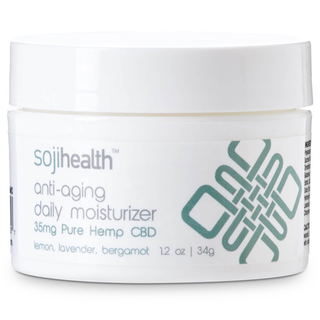
Soji Health Revitalizing Daily Moisturizer Pure Hemp CBD Lemon Lavender & Bergamot 35mg
Works for
1 of 1 advertised claim delivered
Moisturizing13 ingredients credited for this claimGood support
“Health Revitalizing Daily Moisturizer Pure Hemp CBD Lemon Lavender & Bergamot 35mg”
This product can help improve hydration of the skin with the two types of ingredients.
The first type is called “humectants”:
these ingredients help attract water.
When humectants are on the surface of the skin, they “pull in” the moisture from the outside environment, or from
within deeper layers of the skin. The following ingredients in this product do the job:
glycerin, hydrolyzed soy protein.
This product also contains ingredients called “occlusives”. They help reduce the speed with which our skin loses moisture to the outside environment. These ingredients also help soften the upper layer of the skin, so it feels less tight and nicer to the touch. The following ingredients in this product do the job: dimethicone, dimethiconol.
Can it cause trouble?
Irritancy5 strong irritants: Citrus aurantium dulcis fruit extract, Citrus limon fruit extract + 3 more — patch-test recommendedHigh risk
Comedogenic2 ingredients rated 2 or more on the 0–5 pore-clogging scale2 flagged
User reviews
Be the first — your take helps the next person decide.
Ingredients
Filter by role to see what each ingredient is doing.
Water~45–55%
Glycerin~4.7–5.7%
- Irritation risk
- Low
One of the best moisturizing ingredients. Naturally present in skin. It attracts water to the upper layer of the skin working as a humectant
More about GlycerinDimethicone~4.1–5%
- Irritation risk
- Low
A silicone that helps to reduce water loss from the surface of the skin. Can temporarily "fill in" lines and wrinkles, absorb oil, and create a nice product finish
More about DimethiconeOctyldodecanol~3–3.7%
- Irritation risk
- Low
An emollient that helps to soften the skin and create a pleasant product texture and stabilize the formulation
More about OctyldodecanolCetyl alcohol~2.3–2.8%
- Irritation risk
- Low
A non-drying alcohol that works to soften the skin and stabilize product formulations helping oil and water mix together
More about Cetyl alcoholStearic acid~2–2.5%
- Irritation risk
- Low
Helps oil and water mix together and works as an emollient
More about Stearic acidHydrogenated polyisobutene~1.7–2%
- Irritation risk
- Low
Used to improve the product consistency and soften the upper layer of the skin
More about Hydrogenated polyisobuteneTheobroma cacao seed butter~1.4–1.8%
- Irritation risk
- Low
- Comedogenicity
- 3/5
Helps soften the upper layer of the skin and can be helpful in restoring the skin barrier function. Might have some anti-oxidant effect
More about Theobroma cacao seed butterPoly c10-30 alkyl acrylate~1.2–1.4%
- Irritation risk
- Low
Polymethyl methacrylate~1–1.2%
- Irritation risk
- Low
Is used to enhance product texture and can help to optically mask skin imperfections
More about Polymethyl methacrylateSucrose stearate~0.7–1.05%
Sodium polyacrylate~0.65–0.95%
- Irritation risk
- Low
Used to create a gel-like product texture, as well as to stabilize emulsions
More about Sodium polyacrylateMyristic acid~0.55–0.8%
- Irritation risk
- Medium
- Comedogenicity
- 3/5
Helps oil and water mix together. Could be comedogenic
More about Myristic acidOrbignya oleifera seed oil~0.5–0.75%
- Irritation risk
- Low
A plant oil that can help soften the upper layer of the skin. Might be helpful in calming down inflammation in skin
More about Orbignya oleifera seed oilCyclopentasiloxane~0.45–0.7%
- Irritation risk
- Low
A silicone that helps improve the product texture and spreadability. Can absorb oil creating a short-term mattifying effect on the skin
More about CyclopentasiloxaneDimethiconol~0.45–0.7%
- Irritation risk
- Low
A silicone that makes products more spreadable and keeps skin smooth. Helps to add gloss to skin and may visually fill in fine lines/wrinkles for short time
More about DimethiconolTocopheryl acetate~0.4–0.6%
- Irritation risk
- Medium
A more stable but less bio-available form of vitamin E compared to Tocopherol. Might help moisturize and protect the skin from free radicals, but mostly used in low concentrations to stabilize other ingredients.
More about Tocopheryl acetateCaffeine~0.3–0.6%
- Irritation risk
- Medium
Might be helpful in neutralizing free radicals. Can have a dehydration effect that might somewhat decrease the look of puffy eyes
More about CaffeineAscorbyl glucoside~0.3–0.55%
- Irritation risk
- Medium
A vitamin C derivative that is more stable but less potent than pure form of vitamin C. Has a potential to boost collagen production, nutralise free radicals and reduce hyperpigmentation, but the required concentration is likely to be much higher than for the pure form of vitamin C, limiting the ingredient's effectiveness in products
More about Ascorbyl glucosideHydrolyzed soy protein~0.3–0.5%
- Irritation risk
- Low
Helps attract water to the upper layer of the skin. Might have some anti-aging, anti-oxidant, and skin lightening properties, but solid evidence is missing
More about Hydrolyzed soy proteinDisodium cocoyl glutamate~0.35–0.6%
- Irritation risk
- Medium
Helps water and oil mix together and works as a cleansing agent
More about Disodium cocoyl glutamateCannabis sativa seed/stem oil~0.25–0.45%
- Irritation risk
- Low
Linum usitatissimum seed oil~0.2–0.35%
Vaccinium myrtillus fruit extract~0.2–0.4%
- Irritation risk
- Medium
A plant extract that might help neutralize free radicals in skin, but research on its efficacy in skin is lacking
More about Vaccinium myrtillus fruit extractSaccharum officinarum extract~0.25–0.4%
- Irritation risk
- Low
Sugar extract that helps attract water to the upper layer of the skin
More about Saccharum officinarum extractAcer saccharum extract~0.2–0.4%
- Irritation risk
- Medium
A plant extract that contains small percentage of AHAs. Is unlikely to have any skin benefit due the small concentration of the active compounds
More about Acer saccharum extractCitrus aurantium dulcis fruit extract~0.2–0.4%
- Irritation risk
- High
A plant extract that is used as a fragrance. Can be irritating and lead to photosensitivity
More about Citrus aurantium dulcis fruit extractCitrus limon fruit extract~0.2–0.4%
- Irritation risk
- High
Used as a fragrance. Can be irritating and cause photosensitivity
More about Citrus limon fruit extractPentaerythrityl tetra-di-t-butyl hydroxyhydrocinnamate~0.2–0.4%
- Irritation risk
- Low
Used to increase stability of product formulations
More about Pentaerythrityl tetra-di-t-butyl hydroxyhydrocinnamateCitrus aurantium bergamia fruit oil~0.15–0.3%
- Irritation risk
- High
A plant oil with a high content of volatile compounds that can irritate the skin and lead to allergic reactions. Can lead to photosensitivity
More about Citrus aurantium bergamia fruit oilCitrus limon peel oil~0.15–0.3%
Lavandula angustifolia flower oil~0.15–0.3%
- Irritation risk
- High
A fragrant plant oil, can be irritating
More about Lavandula angustifolia flower oilAcrylates/c10-30 alkyl acrylate crosspolymer~0.15–0.3%
- Irritation risk
- Medium
Maintains the texture of skincare products. Allows the product to spread evenly. Helps oil and water mix together
More about Acrylates/c10-30 alkyl acrylate crosspolymerXanthan gum~0.15–0.25%
- Irritation risk
- Low
Used to create a thicker product consistency
More about Xanthan gumChlorphenesin~0.1–0.2%
Sodium hydroxide~0.1–0.2%
Phenoxyethanol~0.1–0.2%
- Irritation risk
- Low
A preservative. It helps prevent bacterial growth in cosmetic products
More about PhenoxyethanolEthylhexylglycerin~0.05–0.1%
Ingredient list view
Water, Glycerin, Dimethicone, Octyldodecanol, Cetyl alcohol, Stearic acid, Hydrogenated polyisobutene, Theobroma cacao seed butter, Poly c10-30 alkyl acrylate, Polymethyl methacrylate, Sucrose stearate, Sodium polyacrylate, Myristic acid, Orbignya oleifera seed oil, Cyclopentasiloxane, Dimethiconol, Tocopheryl acetate, Caffeine, Ascorbyl glucoside, Hydrolyzed soy protein, Disodium cocoyl glutamate, Cannabis sativa seed/stem oil, Linum usitatissimum seed oil, Vaccinium myrtillus fruit extract, Saccharum officinarum extract, Acer saccharum extract, Citrus aurantium dulcis fruit extract, Citrus limon fruit extract, Pentaerythrityl tetra-di-t-butyl hydroxyhydrocinnamate, Citrus aurantium bergamia fruit oil, Citrus limon peel oil, Lavandula angustifolia flower oil, Acrylates/c10-30 alkyl acrylate crosspolymer, Xanthan gum, Chlorphenesin, Sodium hydroxide, Phenoxyethanol, Ethylhexylglycerin
Compare prices
Retailers ranked by price — lowest first.

Affiliate links · prices updated regularly
Sources cited in this review
Every concentration estimate and effectiveness label is anchored to one of these 20 studies and safety reviews.
- 1
- 2
- 3Final Report on the Safety Assessment of Dimethicone Copolyoljournals.sagepub.com
- 4
- 5
- 6

Affiliate links · As an Amazon Associate, WIMJ earns from qualifying purchases.