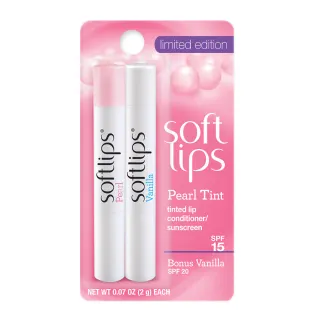
Softlips Pearl Tint SPF 15 & Vanilla SPF 20 Vanilla
Works for
0 of 1 advertised claim delivered
Sun protectionSPF 15 · 4 UV filters · Partial spectrumWeak protectionSPF under 30
This product does not offer good protection against UVA rays.
MoisturizingNot advertised by the brand · 16 ingredients credited for this claimStrong support
This product can help soften the skin and reduce its moisture loss with emollients and occlusives: bis-diglyceryl polyacyladipate-2, copernicia cerifera wax.
Keep in mind that this product does not contain effective ingredients to attract water to the upper layer of the skin. This is why an additional product with humectants like glycerin or hyaluronic acid can be helpful (apply it before this product for the best results).
The following ingredients in this product are especially good for supporting the skin barrier and helping with the hydration level: paraffinum liquidum
Can it cause trouble?
Irritancy3 strong irritants: Benzophenone-3, Parfum + 1 more — patch-test recommendedHigh risk
Comedogenic4 ingredients rated 2 or more on the 0–5 pore-clogging scale4 flagged
User reviews
Be the first — your take helps the next person decide.
Ingredients
Filter by role to see what each ingredient is doing.
Dimethicone2%
- Irritation risk
- Low
A silicone that helps to reduce water loss from the surface of the skin. Can temporarily "fill in" lines and wrinkles, absorb oil, and create a nice product finish
More about DimethiconeBenzophenone-33%
- Irritation risk
- High
Same as oxybenzone. Protects in the UVB and short UVA range. In small concentrations, used to stabilize product formulation. Can be irritating. Is shown to be harmful to coral reefs - consider avoiding bathing in coral reef areas when wearing a product with this ingredient. It can penetrate the skin and get absorbed into bloodstream faster than other popular filters available in the US. The study that produced this finding did not address any potential health effects of the absorption
More about Benzophenone-3Ethylhexyl methoxycinnamate7.5%
- Irritation risk
- High
Octinoxate. When used in higher concentrations, works as a sunscreen protecting the skin from UVB rays. When used in lower concentration, helps to preserve the product formulation. Is shown to be harmful to coral reefs - consider avoiding bathing in coral reef areas when wearing a product with this ingredient. It can be irritating
More about Ethylhexyl methoxycinnamateEthylhexyl salicylate5%
- Irritation risk
- Low
Octisalate. A UV filter. It offers some protection against the sun rays that cause sunburn (UVB), but does not protect against the most aging sun rays (UVA). It loses its effectiveness quickly when exposed to sunlight. It is an organic, or so called "chemical" sunscreen
More about Ethylhexyl salicylateLanolin oil~22–33%
- Irritation risk
- Low
Sebum of wool-bearing animals (most commonly sheep). Helps soften the upper layer of the skin and reduce the skin water loss. In rare cases could be an allergen. Not suitable for vegans
More about Lanolin oilHydrogenated polyisobutene~4.5–6.7%
- Irritation risk
- Low
Used to improve the product consistency and soften the upper layer of the skin
More about Hydrogenated polyisobuteneOzokerite~4.5–6.7%
Oleyl alcohol~3.6–5.4%
Vp/hexadecene copolymer~2.7–4%
- Irritation risk
- Low
Creates a nice product texture and can support water-resistance of sunscreens
More about Vp/hexadecene copolymerLimnanthes alba seed oil~2.1–3.1%
- Irritation risk
- Low
This oil's cmposition is closest to rapeseed oil. It is a very stable oil and serves as an emoillient
More about Limnanthes alba seed oilBis-diglyceryl polyacyladipate-2~1.8–2.7%
- Irritation risk
- Low
Helps soften the upper layer of the skin and reduce water loss from its surface
More about Bis-diglyceryl polyacyladipate-2Paraffinum liquidum~1.4–2.2%
- Irritation risk
- Low
Mineral oil. One of the most effective and well studied occlusive and emollient moisturizing ingredients. Helps reduce moisture loss in skin and repair skin barrier function
More about Paraffinum liquidumCopernicia cerifera wax~1.2–1.9%
- Irritation risk
- Low
Helps to soften the upper layer of the skin and create a nice product consistency
More about Copernicia cerifera waxRicinus communis seed oil~0.85–1.3%
- Irritation risk
- Medium
A plant oil that can help soften the skin. It might be helpful in calming down inflammation, but solid research is lacking. Is often used in lip products to create the needed product consistency
More about Ricinus communis seed oilCetyl lactate~0.55–1.3%
- Irritation risk
- Low
Polyethylene~0.85–1.25%
Paraffin~0.35–0.85%
- Irritation risk
- Low
Prevents water loss from the skin surface and thickens the product consistency
More about ParaffinAmmonium glycyrrhizate~0.35–0.85%
- Irritation risk
- Low
Bht~0.35–0.8%
Ci 77163~0.35–0.8%
Butylparaben~0.2–0.4%
Parfum~0.2–0.75%
- Irritation risk
- High
An aromatic blend of unspecified and possibly irritating ingredients
More about ParfumIsobutylparaben~0.2–0.75%
Isopropylparaben~0.2–0.4%
- Irritation risk
- Low
Menthol~0.15–0.6%
- Irritation risk
- High
Tocopheryl acetate~0.15–0.65%
- Irritation risk
- Medium
A more stable but less bio-available form of vitamin E compared to Tocopherol. Might help moisturize and protect the skin from free radicals, but mostly used in low concentrations to stabilize other ingredients.
More about Tocopheryl acetateTocopherol~0.15–0.6%
- Irritation risk
- Low
Pure form of vitamin E. Can help moisturise and protect the skin from free radicals. Often used to help stabilise other ingredients or the formula itself
More about TocopherolCi 75470~0.15–0.6%
Mica~0.2–0.7%
- Irritation risk
- Low
Creates an illusion of smoother and more radiant skin tone. Adds shimmer to the skin by reflecting light
More about MicaTitanium dioxide~0.3–0.7%
- Irritation risk
- Low
Works as a UV filter when used in high concentrations. It is photostable and is effective mostly against the UVB light, with some protection in the UVA range. In small concentrations, used for its ability to improve the color of cosmetic products. Is usually well tolerated by the skin
More about Titanium dioxideOzokerite~0.15–0.7%
Squalane~0.2–0.8%
- Irritation risk
- Low
An oil naturally present in skin. Works as an emollient to soften the skin and form a protective layer on its surface without a greasy feeling.
More about SqualaneEthylhexyl palmitate~0.2–0.8%
- Irritation risk
- Low
- Comedogenicity
- 3/5
An emollient that helps soften the skin and create a nice product texture
More about Ethylhexyl palmitatePetrolatum~0.2–0.8%
- Irritation risk
- Low
One of the most effective and the most studied occlusive ingredients that creates a protective layer on top of the skin preventing moisture loss
More about PetrolatumMyristyl myristate~0.3–0.75%
- Irritation risk
- Medium
- Comedogenicity
- 3/5
An emollient. Is not recommended for acne-prone skin as it can be comedogenic
More about Myristyl myristateMyristyl lactate~0.3–0.7%
- Irritation risk
- Low
- Comedogenicity
- 3/5
Parfum~0.15–0.55%
- Irritation risk
- High
An aromatic blend of unspecified and possibly irritating ingredients
More about ParfumCetyl alcohol~0.3–0.75%
- Irritation risk
- Low
A non-drying alcohol that works to soften the skin and stabilize product formulations helping oil and water mix together
More about Cetyl alcoholMyristyl laurate~0.15–0.5%
Myristyl alcohol~0.15–0.7%
- Irritation risk
- High
Helps to stabilize the product formulation while softening the upper layer of the skin. Can be irritating
More about Myristyl alcoholBht~0.1–0.35%
Menthol~0.1–0.5%
- Irritation risk
- High
Tocopheryl acetate~0.1–0.35%
- Irritation risk
- Medium
A more stable but less bio-available form of vitamin E compared to Tocopherol. Might help moisturize and protect the skin from free radicals, but mostly used in low concentrations to stabilize other ingredients.
More about Tocopheryl acetateTocopherol~0.1–0.3%
- Irritation risk
- Low
Pure form of vitamin E. Can help moisturise and protect the skin from free radicals. Often used to help stabilise other ingredients or the formula itself
More about TocopherolIngredient list view
Dimethicone, Benzophenone-3, Ethylhexyl methoxycinnamate, Ethylhexyl salicylate, Lanolin oil, Hydrogenated polyisobutene, Ozokerite, Oleyl alcohol, Vp/hexadecene copolymer, Limnanthes alba seed oil, Bis-diglyceryl polyacyladipate-2, Paraffinum liquidum, Copernicia cerifera wax, Ricinus communis seed oil, Cetyl lactate, Polyethylene, Paraffin, Ammonium glycyrrhizate, Bht, Ci 77163, Butylparaben, Parfum, Isobutylparaben, Isopropylparaben, Menthol, Tocopheryl acetate, Tocopherol, Ci 75470, Mica, Titanium dioxide, Ozokerite, Squalane, Ethylhexyl palmitate, Petrolatum, Myristyl myristate, Myristyl lactate, Parfum, Cetyl alcohol, Myristyl laurate, Myristyl alcohol, Bht, Menthol, Tocopheryl acetate, Tocopherol
Compare prices
Retailers ranked by price — lowest first.

Affiliate links · prices updated regularly
Product summary
We do not recommend "Softlips - Pearl Tint SPF 15 & Vanilla SPF 20 Vanilla" because it does not provide good UVA protection. UVA sun rays don't burn the skin, but they still lead to photoaging and hyperpigmentation.
Its formula is also hydrating, so you might not need an additional moistruizer during the day.
Sunscreen filters
This sunscreen uses so-called "chemical", or organic UV filters (organic simply means that their molecules contain atoms of carbon). These filters typically give good sun protection and rarely leave a white cast, but they can be irritating for sensitive skin. The UV filters in this sunscreen are: oxybenzone 3.00% (declared), octinoxate 7.50% (declared) and octisalate 5.00% (declared).
Irritation risk
This sunscreen contains a bunch of common irritants, including ingredients that do not provide any known benefit for the skin. It might not be the best choice if your skin is sensitive. We assess the overall irritancy of it to be high. For a detailed overview of all potential irritants: click here
You can see the detailed formula review with the breakdown of all actives in the product and the full ingredient list with estimated concentrations in the tables below.
Price
The product retails from 3.69$ up to 9.62$ in the United States.
For a detailed price comparison: click here.
Sources cited in this review
Every concentration estimate and effectiveness label is anchored to one of these 17 studies and safety reviews.
- 1
- 2Final Report on the Safety Assessment of Dimethicone Copolyoljournals.sagepub.com
- 3
- 4
- 5On Photostability of Oxybenzonecore.ac.uk
- 6

Affiliate links · As an Amazon Associate, WIMJ earns from qualifying purchases.