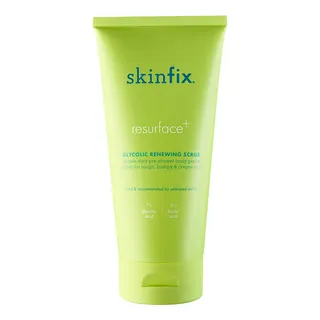
Skinfix Resurface+ Glycolic Renewing Scrub

Skinfix Resurface+ Glycolic Renewing Scrub

Efficacy87/100IrritancyHigh

Works for

Evens skin tone
Glycolic acid, Lactobacillus/punica granatum fruit ferment extract + 1 more
Works well
What the product description says
“- Lactic Acid (AHA) 5%: Visibly decreases discoloration smooths texture, and brightens skin.”
Source: Sephora

This product can help reduce hypepigmentation and even out the skin tone because it contains the following effective ingredients: glycolic acid

Keep in mind that you would need to apply any topical skincare targetted at hypigmentation consistently for a couple of months to get a result. No topical skincare product can help get rid of hyperpigmentation (including post-acne marks and age spots) instantly.

Glycolic acidKey activeEffect: HighAn alpha-hydroxy acid (AHA) that helps to remove the dead skin cells on the surface of the skin reveling a more even, smoother complexation. It is also able to stimulate collagen production with long-term use. Could help to reduce pore congestion. It can be irritating to the skin. Apply sunscreen daily if using products with glycolic acid~1.7–2.1%
Lactobacillus/punica granatum fruit ferment extractEffect: LowAn enzyme-based exfoliant~0.25–0.5%
Lactic acidUnder-dosedAn exfoliating and moisturizing alpha-hydroxy acid (AHA). Typically causes less irritation than other AHAs, for example, glycolic acid. At high concentrations (about 15%), lactic acid can help reduce lines and wrinkles. Recent studies show that lactic acid can support the "good" bacteria living on skin's surface (healthy skin microbiome)~1.4–1.7%
Exfoliation
Glycolic acid, Lactobacillus/punica granatum fruit ferment extract + 3 more
Works well
What the product description says
“Resurface+ Glycolic Renewing Scrub”
Source: Skinfix

This product can help exfoliate the skin. In other words, it helps break down the bonds between dead cells on the surface of the skin and speed up the skin turnover. Skin often appears softer and brighter after exfoliation, but overdoing it can result in disrupted skin barrier. The following ingredient is doing the exfoliating job in this product: glycolic acid.

Glycolic acidKey activeEffect: HighAn alpha-hydroxy acid (AHA) that helps to remove the dead skin cells on the surface of the skin reveling a more even, smoother complexation. It is also able to stimulate collagen production with long-term use. Could help to reduce pore congestion. It can be irritating to the skin. Apply sunscreen daily if using products with glycolic acid~1.7–2.1%
Lactobacillus/punica granatum fruit ferment extractEffect: LowAn enzyme-based exfoliant~0.25–0.5%
Salix nigra bark extractEffect: LowA plant extract that might contain salicylic acid~0.25–0.5%
AllantoinEffect: Low, below effective doseHelps calm down inflammation in skin and can help reduce itching. Helps to repair the skin barrier and keep skin hydrated~0.25–0.45%
Lactic acidUnder-dosedAn exfoliating and moisturizing alpha-hydroxy acid (AHA). Typically causes less irritation than other AHAs, for example, glycolic acid. At high concentrations (about 15%), lactic acid can help reduce lines and wrinkles. Recent studies show that lactic acid can support the "good" bacteria living on skin's surface (healthy skin microbiome)~1.4–1.7%
Moisturizing
Panthenol, Hydrogenated castor oil + 16 more
Works well
What the product description says
“Use to cleanse all over the body for moisturising nourishment with a silky, soft feel.”
Source: Sephora AU

This product can help improve hydration of the skin with the two types of ingredients.

The first type is called “humectants”:
these ingredients help attract water. When humectants are on the surface of the skin, they “pull in” the moisture from the outside environment, or from within deeper layers of the skin. The following ingredients in this product do the job: betaine, glycerin.

This product also contains ingredients called “occlusives”. They help reduce the speed with which our skin loses moisture to the outside environment. These ingredients also help soften the upper layer of the skin, so it feels less tight and nicer to the touch. The following ingredients in this product do the job: caprylic/capric triglyceride, cocos nucifera oil.

The following ingredients in this product are especially good for supporting the skin barrier and helping with the hydration level: panthenol

PanthenolHero· HumectantEffect: HighHelps attract water to the upper layer of the skin and can help improve skin barrier function~0.45–0.65%
Hydrogenated castor oilKey active· EmollientEffect: MediumA plant oil that can help soften the skin. It might be helpful in calming down inflammation, but solid research is lacking. Is often used in lip products to create the needed product consistency~4.7–5.7%
GlycerinKey active· HumectantEffect: HighOne of the best moisturizing ingredients. Naturally present in skin. It attracts water to the upper layer of the skin working as a humectant~4.1–5%
Vitis vinifera seed oilKey active· EmollientEffect: HighA great emollient that can also have anti-oxidant properties~3.2–3.9%
Cocos nucifera oilKey active· Emollient, OcclusiveEffect: HighAn emollient. Found to be as effective as a moisturizer for dry skin as mineral oil. Could be comedogenic~2.5–3%
Caprylic/capric triglycerideKey active· Emollient, OcclusiveEffect: HighA good mix of fatty acids that forms a protective layer on the skin. Improves the shelf life of products. Derived from coconut and glycerin~2.1–2.6%
Cetearyl alcoholKey active· EmollientEffect: MediumA non-drying alcohol. Works as an emollient. Helps water and oil mix together and creates a nice product texture~1.3–1.6%
BetaineKey active· HumectantEffect: HighHelps attract water to the upper layer of the skin and improves the product texture~0.45–0.7%
Helianthus annuus extractKey active· EmollientEffect: HighHelps soften the upper layer of the skin~0.4–0.6%
Prunus amygdalus dulcis oilKey active· EmollientEffect: MediumAn emollient that softens the skin~0.3–0.6%
Saccharum officinarum extractKey activeEffect: HighSugar extract that helps attract water to the upper layer of the skin~0.25–0.45%
GlucoseKey active· HumectantEffect: MediumHelps attract water to the upper layer of the skin. Could be helpful in restoring the skin barrier function~0.25–0.5%
Caprylyl glycol· Humectant, EmollientEffect: LowHelps preserve products and creates a nice product texture~0.2–0.4%
Aloe barbadensis leaf juiceEffect: Low, below effective doseTraditionally used to treat sunburns, dermatitis and inflammation, but evidence for its effectiveness is lacking. The extract can contain humectants that help attract water into the skin~0.25–0.5%
TocopherolEffect: Low, below effective dosePure form of vitamin E. Can help moisturise and protect the skin from free radicals. Often used to help stabilise other ingredients or the formula itself~0.25–0.5%
Lactic acidUnder-dosedAn exfoliating and moisturizing alpha-hydroxy acid (AHA). Typically causes less irritation than other AHAs, for example, glycolic acid. At high concentrations (about 15%), lactic acid can help reduce lines and wrinkles. Recent studies show that lactic acid can support the "good" bacteria living on skin's surface (healthy skin microbiome)~1.4–1.7%
Simmondsia chinensis seed oilUnder-dosedSoftens the upper layer of skin and helps restore the healthy skin barrier. Has shown to help calm down inflammation in skin. It is a stable oil, meaning that it retains its properties even when exposed to air.~0.35–0.65%
AllantoinUnder-dosedHelps calm down inflammation in skin and can help reduce itching. Helps to repair the skin barrier and keep skin hydrated~0.25–0.45%
Anti-blemish
Glycolic acid, Allantoin + 2 more
Not delivered
What the product description says
“Willow Bark Extract (BHA): Unclogs congested pores for healthy- and clear-looking skin.”
Source: Sephora AU

This product contains ingredients (glycolic acid) that could help reduce blemishes and clogged pores in theory, but there is not enough evidence that they actually work.

Glycolic acidEffect: MediumAn alpha-hydroxy acid (AHA) that helps to remove the dead skin cells on the surface of the skin reveling a more even, smoother complexation. It is also able to stimulate collagen production with long-term use. Could help to reduce pore congestion. It can be irritating to the skin. Apply sunscreen daily if using products with glycolic acid~1.7–2.1%
AllantoinEffect: Low, below effective doseHelps calm down inflammation in skin and can help reduce itching. Helps to repair the skin barrier and keep skin hydrated~0.25–0.45%
Aloe barbadensis leaf juiceEffect: Low, below effective doseTraditionally used to treat sunburns, dermatitis and inflammation, but evidence for its effectiveness is lacking. The extract can contain humectants that help attract water into the skin~0.25–0.5%
Rosmarinus officinalis leaf extractUnder-dosedCan be helpful in reducing inflammation in skin, including inflamed acne. It can be irritating~0.25–0.45%
Anti-aging
Side benefit · Glycolic acid, Prunus amygdalus dulcis oil + 3 more
Works well

This product can help reduce and prevent fine lines and wrinkles, improve skin elasticity and firmness because it contains glycolic acid.

Keep in mind that it typically takes at least 6 weeks to notice any results because the changes that are needed to improve fine lines and elasticity happen in the deeper layers of the skin. No topical anti-aging product can “erase” wrinkles or fully reverse signs of aging.

Glycolic acidKey activeEffect: HighAn alpha-hydroxy acid (AHA) that helps to remove the dead skin cells on the surface of the skin reveling a more even, smoother complexation. It is also able to stimulate collagen production with long-term use. Could help to reduce pore congestion. It can be irritating to the skin. Apply sunscreen daily if using products with glycolic acid~1.7–2.1%
Prunus amygdalus dulcis oilEffect: LowAn emollient that softens the skin~0.3–0.6%
TocopherolEffect: Low, below effective dosePure form of vitamin E. Can help moisturise and protect the skin from free radicals. Often used to help stabilise other ingredients or the formula itself~0.25–0.5%
Aloe barbadensis leaf juiceEffect: Low, below effective doseTraditionally used to treat sunburns, dermatitis and inflammation, but evidence for its effectiveness is lacking. The extract can contain humectants that help attract water into the skin~0.25–0.5%
Lactic acidUnder-dosedAn exfoliating and moisturizing alpha-hydroxy acid (AHA). Typically causes less irritation than other AHAs, for example, glycolic acid. At high concentrations (about 15%), lactic acid can help reduce lines and wrinkles. Recent studies show that lactic acid can support the "good" bacteria living on skin's surface (healthy skin microbiome)~1.4–1.7%

Can it cause trouble?

Irritancy
4 strong irritants: Rosmarinus officinalis leaf extract, Citrus aurantium dulcis fruit extract + 2 more — patch-test recommended
High risk
We flagged 22 ingredients with irritancy potential. Severity depends on your sensitivity threshold; the table lists the worst offenders first.
IngredientFunctionIrritationEst. amount
Glycolic acidAn alpha-hydroxy acid (AHA) that helps to remove the dead skin cells on the surface of the skin reveling a more even, smoother complexation. It is also able to stimulate collagen production with long-term use. Could help to reduce pore congestion. It can be irritating to the skin. Apply sunscreen daily if using products with glycolic acidHigh~1.7–2.1%est.
Lactobacillus/punica granatum fruit ferment extractAn enzyme-based exfoliantHigh~0.25–0.5%est.
Rosmarinus officinalis leaf extractCan be helpful in reducing inflammation in skin, including inflamed acne. It can be irritatingHigh~0.25–0.45%est.
Citrus aurantium dulcis fruit extractA plant extract that is used as a fragrance. Can be irritating and lead to photosensitivityHigh~0.25–0.45%est.
Citrus limon fruit extractUsed as a fragrance. Can be irritating and cause photosensitivityHigh~0.25–0.45%est.
Microcitrus australasica fruit extractMost likely used for its fragrance. Can be irritating and lead to photosensitivityHigh~0.2–0.4%est.
Hydrogenated castor oilA plant oil that can help soften the skin. It might be helpful in calming down inflammation, but solid research is lacking. Is often used in lip products to create the needed product consistencyMedium~4.7–5.7%est.
Vitis vinifera seed oilA great emollient that can also have anti-oxidant propertiesMedium~3.2–3.9%est.
Caprylic/capric triglycerideA good mix of fatty acids that forms a protective layer on the skin. Improves the shelf life of products. Derived from coconut and glycerinMedium~2.1–2.6%est.
Lactic acidAn exfoliating and moisturizing alpha-hydroxy acid (AHA). Typically causes less irritation than other AHAs, for example, glycolic acid. At high concentrations (about 15%), lactic acid can help reduce lines and wrinkles. Recent studies show that lactic acid can support the "good" bacteria living on skin's surface (healthy skin microbiome)Medium~1.4–1.7%est.
Cetearyl glucosideHelps water and oil in the product mix well together and improves product textureMedium~0.5–0.8%est.
ChlorphenesinA preservativeMedium~0.16–0.32%est.
Simmondsia chinensis seed oilSoftens the upper layer of skin and helps restore the healthy skin barrier. Has shown to help calm down inflammation in skin. It is a stable oil, meaning that it retains its properties even when exposed to air.Medium~0.35–0.65%est.
Aloe barbadensis leaf juiceTraditionally used to treat sunburns, dermatitis and inflammation, but evidence for its effectiveness is lacking. The extract can contain humectants that help attract water into the skinMedium~0.25–0.5%est.
Vaccinium myrtillus fruit extractA plant extract that might help neutralize free radicals in skin, but research on its efficacy in skin is lackingMedium~0.25–0.45%est.
Salix nigra bark extractA plant extract that might contain salicylic acidMedium~0.25–0.5%est.
Leuconostoc/radish root ferment filtrateA preservative that comes from radishes fermented by a bacteria. New research suggests that the preservation properties in the ingredient come from an ammonium salt that is not present naturally in radish root but used in its cultivation. Is problematic because the exact amount of the preservative agents is difficult to determineMedium~0.25–0.45%est.
Acer saccharum extractA plant extract that contains small percentage of AHAs. Is unlikely to have any skin benefit due the small concentration of the active compoundsMedium~0.2–0.4%est.
Caprylyl glycolHelps preserve products and creates a nice product textureMedium~0.2–0.4%est.
Trisodium ethylenediamine disuccinateUsed to improve stability of the formulationMedium~0.15–0.25%est.
Potassium sorbateA preservativeMedium~0.15–0.3%est.
Citric acidCan work as an exfoliant but is typically used to adjust the product pHMedium~0.15–0.25%est.
Comedogenic
2 ingredients rated 2 or more on the 0–5 pore-clogging scale
2 flagged
These ingredients have a comedogenic rating of 2 or more on a 0–5 scale; the table shows each one's rating. In leave-on products they can clog pores in acne-prone skin.
IngredientFunctionRatingEst. amount
Cocos nucifera oilAn emollient. Found to be as effective as a moisturizer for dry skin as mineral oil. Could be comedogenic3/5~2.5–3%est.
Cetearyl alcoholA non-drying alcohol. Works as an emollient. Helps water and oil mix together and creates a nice product texture2/5~1.3–1.6%est.
Did this help you decide?

User reviews

Would you recommend?
No community reviews yet.

Be the first — your take helps the next person decide.

Ingredients

Filter by role to see what each ingredient is doing.

Water~45–55%
Formula
Irritation risk
Low

Plain old water

More about Water
Hydrogenated castor oil~4.7–5.7%
Key activeIrritant · medium
Irritation risk
Medium
Works for
CleansingMoisturizingAnti-inflammatory

A plant oil that can help soften the skin. It might be helpful in calming down inflammation, but solid research is lacking. Is often used in lip products to create the needed product consistency

More about Hydrogenated castor oil
Glycerin~4.1–5%
Key active
Irritation risk
Low
Works for
Moisturizing

One of the best moisturizing ingredients. Naturally present in skin. It attracts water to the upper layer of the skin working as a humectant

More about Glycerin
Vitis vinifera seed oil~3.2–3.9%
Key activeIrritant · medium
Irritation risk
Medium
Works for
MoisturizingAnti-oxidation

A great emollient that can also have anti-oxidant properties

More about Vitis vinifera seed oil
Cocos nucifera oil~2.5–3%
Key activeComedogenic 3/5
Irritation risk
Low
Comedogenicity
3/5
Works for
Moisturizing

An emollient. Found to be as effective as a moisturizer for dry skin as mineral oil. Could be comedogenic

More about Cocos nucifera oil
Caprylic/capric triglyceride~2.1–2.6%
Key activeIrritant · medium
Irritation risk
Medium
Works for
Moisturizing

A good mix of fatty acids that forms a protective layer on the skin. Improves the shelf life of products. Derived from coconut and glycerin

More about Caprylic/capric triglyceride
Glycolic acid~1.7–2.1%
Key activeIrritant · high
Irritation risk
High
Works for
ExfoliationEvens skin toneAnti-agingAnti-blemish

An alpha-hydroxy acid (AHA) that helps to remove the dead skin cells on the surface of the skin reveling a more even, smoother complexation. It is also able to stimulate collagen production with long-term use. Could help to reduce pore congestion. It can be irritating to the skin. Apply sunscreen daily if using products with glycolic acid

More about Glycolic acid
Lactic acid~1.4–1.7%
Under-dosedIrritant · medium
Irritation risk
Medium
Works for
ExfoliationEvens skin toneMoisturizingAnti-aging

An exfoliating and moisturizing alpha-hydroxy acid (AHA). Typically causes less irritation than other AHAs, for example, glycolic acid. At high concentrations (about 15%), lactic acid can help reduce lines and wrinkles. Recent studies show that lactic acid can support the "good" bacteria living on skin's surface (healthy skin microbiome)

More about Lactic acid
Cetearyl alcohol~1.3–1.6%
Key activeComedogenic 2/5
Irritation risk
Low
Comedogenicity
2/5
Works for
CleansingMoisturizing

A non-drying alcohol. Works as an emollient. Helps water and oil mix together and creates a nice product texture

More about Cetearyl alcohol
Stearyl alcohol~1–1.3%
Formula
Irritation risk
Low
Works for
Cleansing

An emollient that helps soften the skin

More about Stearyl alcohol
Sodium hydroxide~0.65–1%
Formula
Irritation risk
Low

Used to adjust the product's pH

More about Sodium hydroxide
Propanediol~0.6–0.9%
Formula
Irritation risk
Low

Acts as a solvent for other ingredients. Speeds up the absorption of other ingredients into the skin

More about Propanediol
Cetearyl glucoside~0.5–0.8%
Irritant · medium
Irritation risk
Medium
Works for
Cleansing

Helps water and oil in the product mix well together and improves product texture

More about Cetearyl glucoside
Betaine~0.45–0.7%
Key active
Irritation risk
Low
Works for
Moisturizing

Helps attract water to the upper layer of the skin and improves the product texture

More about Betaine
Oryza sativa bran extract~0.4–0.65%
Formula
Irritation risk
Low

Used to thicken the product consistency

More about Oryza sativa bran extract
Panthenol~0.45–0.65%
Hero · Moisturizing
Irritation risk
Low
Works for
Reduces rednessMoisturizingReduces irritation

Helps attract water to the upper layer of the skin and can help improve skin barrier function

More about Panthenol
Chlorphenesin~0.16–0.32%
Irritant · medium
Irritation risk
Medium

A preservative

More about Chlorphenesin
Helianthus annuus extract~0.4–0.6%
Key active
Irritation risk
Low
Works for
Moisturizing

Helps soften the upper layer of the skin

More about Helianthus annuus extract
Bisabolol~0.3–0.5%
Formula
Irritation risk
Low
Works for
Reduces irritationAnti-inflammatoryAnti-oxidation

An active component of chamomile plant that historically has been used to calm down irritated skin. A recent study shows that bisabolol indeed can have some anti-inflammatory effect on skin, even though conclusive data is lacking. Bisabolol has a sweet floral scent and can be added to products for its aromatic properties

More about Bisabolol
Simmondsia chinensis seed oil~0.35–0.65%
Under-dosedIrritant · medium
Irritation risk
Medium
Works for
Moisturizing

Softens the upper layer of skin and helps restore the healthy skin barrier. Has shown to help calm down inflammation in skin. It is a stable oil, meaning that it retains its properties even when exposed to air.

More about Simmondsia chinensis seed oil
Prunus amygdalus dulcis oil~0.3–0.6%
Key active
Irritation risk
Low
Works for
MoisturizingAnti-oxidationAnti-aging

An emollient that softens the skin

More about Prunus amygdalus dulcis oil
Bambusa arundinacea stem extract~0.25–0.5%
Formula
Lactobacillus/punica granatum fruit ferment extract~0.25–0.5%
Irritant · high
Irritation risk
High
Works for
ExfoliationEvens skin tone

An enzyme-based exfoliant

More about Lactobacillus/punica granatum fruit ferment extract
Lactobacillus/pumpkin fruit ferment filtrate~0.25–0.5%
Formula
Aloe barbadensis leaf juice~0.25–0.5%
Irritant · medium
Irritation risk
Medium
Works for
MoisturizingReduces rednessReduces irritationAntibacterialAnti-inflammatoryAnti-blemishAnti-aging

Traditionally used to treat sunburns, dermatitis and inflammation, but evidence for its effectiveness is lacking. The extract can contain humectants that help attract water into the skin

More about Aloe barbadensis leaf juice
Allantoin~0.25–0.45%
Under-dosed
Irritation risk
Low
Works for
MoisturizingAnti-inflammatoryReduces irritationReduces rednessAnti-blemishExfoliation

Helps calm down inflammation in skin and can help reduce itching. Helps to repair the skin barrier and keep skin hydrated

More about Allantoin
Tocopherol~0.25–0.5%
Formula
Irritation risk
Low
Works for
Anti-oxidationAnti-agingAnti-inflammatoryMoisturizing

Pure form of vitamin E. Can help moisturise and protect the skin from free radicals. Often used to help stabilise other ingredients or the formula itself

More about Tocopherol
Rosmarinus officinalis leaf extract~0.25–0.45%
Under-dosedIrritant · high
Irritation risk
High
Works for
Anti-blemishAntibacterialAnti-oxidation

Can be helpful in reducing inflammation in skin, including inflamed acne. It can be irritating

More about Rosmarinus officinalis leaf extract
Vaccinium myrtillus fruit extract~0.25–0.45%
Irritant · medium
Irritation risk
Medium
Works for
Anti-oxidation

A plant extract that might help neutralize free radicals in skin, but research on its efficacy in skin is lacking

More about Vaccinium myrtillus fruit extract
Salix nigra bark extract~0.25–0.5%
Irritant · medium
Irritation risk
Medium
Works for
Exfoliation

A plant extract that might contain salicylic acid

More about Salix nigra bark extract
Glucose~0.25–0.5%
Key active
Irritation risk
Low
Works for
Moisturizing

Helps attract water to the upper layer of the skin. Could be helpful in restoring the skin barrier function

More about Glucose
Saccharum officinarum extract~0.25–0.5%
Key active
Irritation risk
Low
Works for
Moisturizing

Sugar extract that helps attract water to the upper layer of the skin

More about Saccharum officinarum extract
Saccharum officinarum extract~0.25–0.45%
Key active
Irritation risk
Low
Works for
Moisturizing

Sugar extract that helps attract water to the upper layer of the skin

More about Saccharum officinarum extract
Citrus aurantium dulcis fruit extract~0.25–0.45%
Irritant · high
Irritation risk
High

A plant extract that is used as a fragrance. Can be irritating and lead to photosensitivity

More about Citrus aurantium dulcis fruit extract
Citrus limon fruit extract~0.25–0.45%
Irritant · high
Irritation risk
High

Used as a fragrance. Can be irritating and cause photosensitivity

More about Citrus limon fruit extract
Leuconostoc/radish root ferment filtrate~0.25–0.45%
Irritant · medium
Irritation risk
Medium

A preservative that comes from radishes fermented by a bacteria. New research suggests that the preservation properties in the ingredient come from an ammonium salt that is not present naturally in radish root but used in its cultivation. Is problematic because the exact amount of the preservative agents is difficult to determine

More about Leuconostoc/radish root ferment filtrate
Microcitrus australasica fruit extract~0.2–0.4%
Irritant · high
Irritation risk
High

Most likely used for its fragrance. Can be irritating and lead to photosensitivity

More about Microcitrus australasica fruit extract
Acer saccharum extract~0.2–0.4%
Irritant · medium
Irritation risk
Medium

A plant extract that contains small percentage of AHAs. Is unlikely to have any skin benefit due the small concentration of the active compounds

More about Acer saccharum extract
Xanthan gum~0.2–0.4%
Formula
Irritation risk
Low
Works for
Cleansing

Used to create a thicker product consistency

More about Xanthan gum
Caprylyl glycol~0.2–0.4%
Irritant · medium
Irritation risk
Medium
Works for
Moisturizing

Helps preserve products and creates a nice product texture

More about Caprylyl glycol
Trisodium ethylenediamine disuccinate~0.15–0.25%
Irritant · medium
Irritation risk
Medium

Used to improve stability of the formulation

More about Trisodium ethylenediamine disuccinate
Potassium sorbate~0.15–0.3%
Irritant · medium
Irritation risk
Medium

A preservative

More about Potassium sorbate
Citric acid~0.15–0.25%
Irritant · medium
Irritation risk
Medium

Can work as an exfoliant but is typically used to adjust the product pH

More about Citric acid
Phenoxyethanol~0.15–0.25%
Formula
Irritation risk
Low

A preservative. It helps prevent bacterial growth in cosmetic products

More about Phenoxyethanol
Ingredient list view

Water, Hydrogenated castor oil, Glycerin, Vitis vinifera seed oil, Cocos nucifera oil, Caprylic/capric triglyceride, Glycolic acid, Lactic acid, Cetearyl alcohol, Stearyl alcohol, Sodium hydroxide, Propanediol, Cetearyl glucoside, Betaine, Oryza sativa bran extract, Panthenol, Chlorphenesin, Helianthus annuus extract, Bisabolol, Simmondsia chinensis seed oil, Prunus amygdalus dulcis oil, Bambusa arundinacea stem extract, Lactobacillus/punica granatum fruit ferment extract, Lactobacillus/pumpkin fruit ferment filtrate, Aloe barbadensis leaf juice, Allantoin, Tocopherol, Rosmarinus officinalis leaf extract, Vaccinium myrtillus fruit extract, Salix nigra bark extract, Glucose, Saccharum officinarum extract, Saccharum officinarum extract, Citrus aurantium dulcis fruit extract, Citrus limon fruit extract, Leuconostoc/radish root ferment filtrate, Microcitrus australasica fruit extract, Acer saccharum extract, Xanthan gum, Caprylyl glycol, Trisodium ethylenediamine disuccinate, Potassium sorbate, Citric acid, Phenoxyethanol

Compare prices

Retailers ranked by price — lowest first.

Amazon USPrice as of 11/24 09:00 GMT
$24.00
Buy
Skinfix
$33.00
Buy
Sephora
$33.00
Buy

Affiliate links · As an Amazon Associate, WIMJ earns from qualifying purchases.

Worth comparing, line by line.

Match % combines shared ingredients, the first five ingredients, shared actives and hero ingredients, irritancy (lower counts in the alternative's favour), texture and body area. Only products in the same routine step are compared.

Side-by-side comparison of this product against its closest alternatives
SkinfixResurface+ Glycolic Renewing ScrubYOUR PRODUCTFollainRESURFACING BODY SCRUB: Purify + PolishVersed SkinBuff It OutKopari BeautyKP Body Bumps Be Gone With 10% AHA Clarifying Body Scrub
Match—52%47%45%
Price$24.00—$14.99−$9.01$12.00−$12.00
Shared key ingredients—7 of 154 of 155 of 15
Key difference—Salicylic AcidArginineOatmeal Extract
Irritancy High Medium Low Low
Drying alcohol————
View product Shop Shop Shop

More alternatives: By BEAUTY BAY Body Exfoliating Buff with 10% AHA and Sea SaltOARS + ALPS Superfoliant Body Scrub

Cheaper alternatives? See how this stacks up against similar formulas.
We compare ingredient profiles across our catalog — pick the closest match for your budget.
Open dupe finder

Sources cited in this review

Every concentration estimate and effectiveness label is anchored to one of these 26 studies and safety reviews.

  1. 1
  2. 2
  3. 3
  4. 4
  5. 5
  6. 6
Skinfix Resurface+ Glycolic Renewing Scrub
SkinfixResurface+ Glycolic Renewing Scrub

Affiliate links · As an Amazon Associate, WIMJ earns from qualifying purchases.

As an Amazon Associate, WIMJ earns from qualifying purchases.