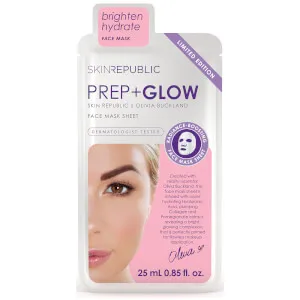
Skin Republic Prep + Glow with Olivia Buckland

Skin Republic Prep + Glow with Olivia Buckland

Efficacy100/100IrritancyHigh

Works for

Moisturizing
Urea, Lactic acid + 8 more
Works well
What the product description says
“Enriched with a potent blend of Hyaluronic Acid, Collagen and Pomegranate Extract, the sheet mask helps to pump skin full of hydration in order to smooth and tone the contours of the face.”
Source: Mankind

This product can help improve hydration of the skin with the two types of ingredients.

The first type is called “humectants”:
these ingredients help attract water. When humectants are on the surface of the skin, they “pull in” the moisture from the outside environment, or from within deeper layers of the skin. The following ingredients in this product do the job: arginine, betaine.

This product also contains ingredients called “occlusives”. They help reduce the speed with which our skin loses moisture to the outside environment. These ingredients also help soften the upper layer of the skin, so it feels less tight and nicer to the touch. The following ingredients in this product do the job: arginine, caprylyl glycol.

The following ingredients in this product are especially good for supporting the skin barrier and helping with the hydration level: urea

UreaHero· HumectantEffect: HighNaturally present in skin (urea makes up about 7% of natural moisturizing factors in skin). Attracts water to the upper layer of the skin. Also has a positive effect on the skin barrier beyond the humectant action. Can enhance penetration of other ingredients. Is an exfoliating ingredient when used in high concentrations~0.2–0.4%
Lactic acidKey active· HumectantEffect: HighAn exfoliating and moisturizing alpha-hydroxy acid (AHA). Typically causes less irritation than other AHAs, for example, glycolic acid. At high concentrations (about 15%), lactic acid can help reduce lines and wrinkles. Recent studies show that lactic acid can support the "good" bacteria living on skin's surface (healthy skin microbiome)~4.1–5%
GlycerinKey active· HumectantEffect: HighOne of the best moisturizing ingredients. Naturally present in skin. It attracts water to the upper layer of the skin working as a humectant~2.3–2.8%
ArginineKey active· Humectant, OcclusiveEffect: HighAn amino acid that is naturally present in skin and helps keep it hydrated. When used together with AHAs, it can reduce their irritating effect on the skin~1.6–1.9%
BetaineKey active· HumectantEffect: HighHelps attract water to the upper layer of the skin and improves the product texture~0.35–0.65%
Butylene glycol· HumectantEffect: LowUsed to create a nice product texture and help delivery of other ingredients. Might be somewhat helpful in attracting water to the upper layer of the skin~1.3–1.6%
Caprylyl glycol· Humectant, EmollientEffect: LowHelps preserve products and creates a nice product texture~0.5–0.75%
Portulaca oleracea extract· HumectantEffect: LowA plant extract that has some anti-oxidant activity, but solid research is lacking. Can help attract water to the upper layer of the skin~0.25–0.45%
Scutellaria baicalensis root extract· HumectantEffect: LowA plant extract that might contain a compound baicalin that could be helpful in neutralizing free radicals and reducing inflammation in skin. The baicalin concentration in skincare products is often too low for an effective action. Can be used for its fragrant properties~0.2–0.35%
Camellia sinensis leaf extractEffect: Low, below effective doseCan contain potent anti-oxidant compounds (abbreviated ECG, GCG, EGC, and EGCG) that might help protect the skin from free radicals. Can help calm down inflammation and has some anti-bacterial properties. Unfortunately, these antioxidants are unstable and lose their effectiveness very quickly in products. The concentration of the antioxidant compounds in the extract also tends to be low to be effective in topical formulation~0.35–0.6%
Anti-oxidation
Side benefit · Ginkgo biloba leaf extract, Malpighia punicifolia fruit extract + 11 more
Works well

This product contains antioxidants (camellia oleifera leaf extract) that can help neutralize free radicals in skin. By doing so, they can lessen the damage the skin gets from the UV light (sun).

The following ingredients - ginkgo biloba leaf extract, malpighia punicifolia fruit extract also can have an antioxidant effect, but there is less evidence to confirm their effectiveness in skin.

Ginkgo biloba leaf extractKey activeEffect: MediumA plant extract that might help neutralize free radicals and reduce inflammation in skin. It can be irritating~0.3–0.55%
Malpighia punicifolia fruit extractKey activeEffect: MediumA fruit extract that might help neutralize free radicals. The concentrations typically used in cosmetics are too small to have an effect~0.25–0.45%
Camellia oleifera leaf extractKey activeEffect: HighA plant extract that can help neutralize free radicals and reduce inflammation, even though it is not usually used in sufficient concentration in cosmetics~0.2–0.35%
Origanum vulgare leaf extractEffect: LowA plant extract. Can have an anti-oxidant effect, but can also contain irritants~0.25–0.45%
Actinidia chinensis fruit extractEffect: LowA plant extract that might have some anti-oxidant properties, but evidence of effectiveness in skin is lacking~0.25–0.5%
Portulaca oleracea extractEffect: LowA plant extract that has some anti-oxidant activity, but solid research is lacking. Can help attract water to the upper layer of the skin~0.25–0.45%
Lonicera japonica flower extractEffect: LowA plant extract that might help neutralize free radicals in skin. Can contain volalite oils and be irritating~0.25–0.5%
Scutellaria baicalensis root extractEffect: LowA plant extract that might contain a compound baicalin that could be helpful in neutralizing free radicals and reducing inflammation in skin. The baicalin concentration in skincare products is often too low for an effective action. Can be used for its fragrant properties~0.2–0.35%
Coffea arabica seed extractEffect: LowMight be helpful in neutralizing free radicals in skin~0.2–0.35%
Olea europaea leaf extractEffect: LowA plant extract that might have some anti-oxidant and anti-inflammatory properties but evidence for effectiveness in skin is missing~0.2–0.4%
Rosmarinus officinalis leaf extractEffect: Low, below effective doseCan be helpful in reducing inflammation in skin, including inflamed acne. It can be irritating~0.2–0.4%
Tocopheryl acetateEffect: Low, below effective doseA more stable but less bio-available form of vitamin E compared to Tocopherol. Might help moisturize and protect the skin from free radicals, but mostly used in low concentrations to stabilize other ingredients.~0.2–0.4%
Camellia sinensis leaf extractUnder-dosedCan contain potent anti-oxidant compounds (abbreviated ECG, GCG, EGC, and EGCG) that might help protect the skin from free radicals. Can help calm down inflammation and has some anti-bacterial properties. Unfortunately, these antioxidants are unstable and lose their effectiveness very quickly in products. The concentration of the antioxidant compounds in the extract also tends to be low to be effective in topical formulation~0.35–0.6%
Anti-aging
Side benefit · Lactic acid, Glycolic acid + 2 more
Works well

This product can help reduce and prevent fine lines and wrinkles, improve skin elasticity and firmness because it contains glycolic acid.

These ingredients in the product can also be helpful, even though there is less evidence for their effectiveness: lactic acid.

Keep in mind that it typically takes at least 6 weeks to notice any results because the changes that are needed to improve fine lines and elasticity happen in the deeper layers of the skin. No topical anti-aging product can “erase” wrinkles or fully reverse signs of aging.

Lactic acidKey activeEffect: MediumAn exfoliating and moisturizing alpha-hydroxy acid (AHA). Typically causes less irritation than other AHAs, for example, glycolic acid. At high concentrations (about 15%), lactic acid can help reduce lines and wrinkles. Recent studies show that lactic acid can support the "good" bacteria living on skin's surface (healthy skin microbiome)~4.1–5%
Glycolic acidKey activeEffect: HighAn alpha-hydroxy acid (AHA) that helps to remove the dead skin cells on the surface of the skin reveling a more even, smoother complexation. It is also able to stimulate collagen production with long-term use. Could help to reduce pore congestion. It can be irritating to the skin. Apply sunscreen daily if using products with glycolic acid~3–3.7%
Camellia sinensis leaf extractEffect: Low, below effective doseCan contain potent anti-oxidant compounds (abbreviated ECG, GCG, EGC, and EGCG) that might help protect the skin from free radicals. Can help calm down inflammation and has some anti-bacterial properties. Unfortunately, these antioxidants are unstable and lose their effectiveness very quickly in products. The concentration of the antioxidant compounds in the extract also tends to be low to be effective in topical formulation~0.35–0.6%
Prunus persica leaf extractEffect: Low, below effective doseMight be helpful in supporting collagen and ellastin production but solid research is lacking. Could be irritating~0.25–0.5%
Evens skin tone
Side benefit · Lactic acid, Glycolic acid + 2 more
Works well

This product can help reduce hypepigmentation and even out the skin tone because it contains the following effective ingredients: glycolic acid, lactic acid, salicylic acid

Keep in mind that you would need to apply any topical skincare targetted at hypigmentation consistently for a couple of months to get a result. No topical skincare product can help get rid of hyperpigmentation (including post-acne marks and age spots) instantly.

Lactic acidKey activeEffect: HighAn exfoliating and moisturizing alpha-hydroxy acid (AHA). Typically causes less irritation than other AHAs, for example, glycolic acid. At high concentrations (about 15%), lactic acid can help reduce lines and wrinkles. Recent studies show that lactic acid can support the "good" bacteria living on skin's surface (healthy skin microbiome)~4.1–5%
Glycolic acidKey activeEffect: HighAn alpha-hydroxy acid (AHA) that helps to remove the dead skin cells on the surface of the skin reveling a more even, smoother complexation. It is also able to stimulate collagen production with long-term use. Could help to reduce pore congestion. It can be irritating to the skin. Apply sunscreen daily if using products with glycolic acid~3–3.7%
Salicylic acidEffect: LowUsed for skin exfoliation. It has an anti-inflammatory and anti-bacterial effect, helps to unclog pores, prevent blemishes and speed up healing of the existing ones. Sometimes referred to as a BHA (beta-hydroxy acid)~0.6–0.9%
Camellia sinensis leaf extractEffect: Low, below effective doseCan contain potent anti-oxidant compounds (abbreviated ECG, GCG, EGC, and EGCG) that might help protect the skin from free radicals. Can help calm down inflammation and has some anti-bacterial properties. Unfortunately, these antioxidants are unstable and lose their effectiveness very quickly in products. The concentration of the antioxidant compounds in the extract also tends to be low to be effective in topical formulation~0.35–0.6%
Exfoliation
Side benefit · Lactic acid, Glycolic acid + 2 more
Works well

This product can help exfoliate the skin. In other words, it helps break down the bonds between dead cells on the surface of the skin and speed up the skin turnover. Skin often appears softer and brighter after exfoliation, but overdoing it can result in disrupted skin barrier. The following ingredient is doing the exfoliating job in this product: glycolic acid, lactic acid, salicylic acid.

Lactic acidKey activeEffect: HighAn exfoliating and moisturizing alpha-hydroxy acid (AHA). Typically causes less irritation than other AHAs, for example, glycolic acid. At high concentrations (about 15%), lactic acid can help reduce lines and wrinkles. Recent studies show that lactic acid can support the "good" bacteria living on skin's surface (healthy skin microbiome)~4.1–5%
Glycolic acidKey activeEffect: HighAn alpha-hydroxy acid (AHA) that helps to remove the dead skin cells on the surface of the skin reveling a more even, smoother complexation. It is also able to stimulate collagen production with long-term use. Could help to reduce pore congestion. It can be irritating to the skin. Apply sunscreen daily if using products with glycolic acid~3–3.7%
Salicylic acidKey activeEffect: HighUsed for skin exfoliation. It has an anti-inflammatory and anti-bacterial effect, helps to unclog pores, prevent blemishes and speed up healing of the existing ones. Sometimes referred to as a BHA (beta-hydroxy acid)~0.6–0.9%
UreaKey activeEffect: MediumNaturally present in skin (urea makes up about 7% of natural moisturizing factors in skin). Attracts water to the upper layer of the skin. Also has a positive effect on the skin barrier beyond the humectant action. Can enhance penetration of other ingredients. Is an exfoliating ingredient when used in high concentrations~0.2–0.4%
Anti-blemish
Side benefit · Salicylic acid, Glycolic acid + 3 more
Works well

This product can help reduce breakouts and clogged pores because it contains the following ingredient: salicylic acid. This ingredient is used for treating acne and can have a noticeable effect.

The following ingredient (ingredients) in this product might be helpful, but there is no evidence to confirm that it actually works: glycolic acid

Salicylic acidHeroEffect: HighUsed for skin exfoliation. It has an anti-inflammatory and anti-bacterial effect, helps to unclog pores, prevent blemishes and speed up healing of the existing ones. Sometimes referred to as a BHA (beta-hydroxy acid)~0.6–0.9%
Glycolic acidKey activeEffect: MediumAn alpha-hydroxy acid (AHA) that helps to remove the dead skin cells on the surface of the skin reveling a more even, smoother complexation. It is also able to stimulate collagen production with long-term use. Could help to reduce pore congestion. It can be irritating to the skin. Apply sunscreen daily if using products with glycolic acid~3–3.7%
Ginkgo biloba leaf extractEffect: LowA plant extract that might help neutralize free radicals and reduce inflammation in skin. It can be irritating~0.3–0.55%
Camellia sinensis leaf extractEffect: Low, below effective doseCan contain potent anti-oxidant compounds (abbreviated ECG, GCG, EGC, and EGCG) that might help protect the skin from free radicals. Can help calm down inflammation and has some anti-bacterial properties. Unfortunately, these antioxidants are unstable and lose their effectiveness very quickly in products. The concentration of the antioxidant compounds in the extract also tends to be low to be effective in topical formulation~0.35–0.6%
Rosmarinus officinalis leaf extractUnder-dosedCan be helpful in reducing inflammation in skin, including inflamed acne. It can be irritating~0.2–0.4%

Can it cause trouble?

Irritancy
19 strong irritants: Alcohol denat., Illicium verum fruit extract + 17 more — patch-test recommended
High risk
We flagged 36 ingredients with irritancy potential. Severity depends on your sensitivity threshold; the table lists the worst offenders first.
IngredientFunctionIrritationEst. amount
Alcohol denat.Produces temporary toning effect. Can help dissolve other ingredients or preserve productsHigh~7.3–9%est.
Glycolic acidAn alpha-hydroxy acid (AHA) that helps to remove the dead skin cells on the surface of the skin reveling a more even, smoother complexation. It is also able to stimulate collagen production with long-term use. Could help to reduce pore congestion. It can be irritating to the skin. Apply sunscreen daily if using products with glycolic acidHigh~3–3.7%est.
Salicylic acidUsed for skin exfoliation. It has an anti-inflammatory and anti-bacterial effect, helps to unclog pores, prevent blemishes and speed up healing of the existing ones. Sometimes referred to as a BHA (beta-hydroxy acid)High~0.6–0.9%est.
Illicium verum fruit extractAnise fruit extract. Used as a fragrance. Can be irritatingHigh~0.4–0.6%est.
Ginkgo biloba leaf extractA plant extract that might help neutralize free radicals and reduce inflammation in skin. It can be irritatingHigh~0.3–0.55%est.
Lonicera japonica flower extractA plant extract that might help neutralize free radicals in skin. Can contain volalite oils and be irritatingHigh~0.25–0.5%est.
Prunus persica leaf extractMight be helpful in supporting collagen and ellastin production but solid research is lacking. Could be irritatingHigh~0.25–0.5%est.
Scutellaria baicalensis root extractA plant extract that might contain a compound baicalin that could be helpful in neutralizing free radicals and reducing inflammation in skin. The baicalin concentration in skincare products is often too low for an effective action. Can be used for its fragrant propertiesHigh~0.2–0.35%est.
Lavandula angustifolia extractUsed for fragrance and contains volatile compounds that can irritate the skinHigh~0.25–0.4%est.
Actinidia chinensis fruit extractA plant extract that might have some anti-oxidant properties, but evidence of effectiveness in skin is lackingHigh~0.25–0.5%est.
Rosmarinus officinalis leaf extractCan be helpful in reducing inflammation in skin, including inflamed acne. It can be irritatingHigh~0.2–0.4%est.
Salvia officinalis leaf extractSage leaf extract. It can be irritatingHigh~0.3–0.5%est.
Sophora angustifolia root extract—High~0.25–0.4%est.
Rosmarinus officinalis extract—High~0.2–0.4%est.
Eucalyptus globulus leaf extractUsed as a fragrance. Can be irritatingHigh~0.2–0.35%est.
Melaleuca alternifolia leaf extractAn essential oil that can be irritating. Has some anti-bacterial propertiesHigh~0.2–0.4%est.
Melissa officinalis leaf extractA plant extract that is added for its fragrance. Can be irritatingHigh~0.25–0.45%est.
Mentha piperita leaf extractUsed as a fragrance and can be irritatingHigh~0.25–0.45%est.
Mentha spicata flower/leaf/stem extractUsed as a fragrance and can be irritatingHigh~0.25–0.45%est.
Origanum vulgare leaf extractA plant extract. Can have an anti-oxidant effect, but can also contain irritantsHigh~0.25–0.45%est.
Thymus vulgaris flower/leaf extractPlant extract that has some anti-bacterial properties. Can be used as a fragrance. Can be irritatingHigh~0.2–0.4%est.
LinaloolA fragrance. Can be irritatingHigh~0.15–0.3%est.
Hexyl cinnamalA fragrance with jasmine smell. A likely irritantHigh~0.15–0.25%est.
LimoneneA common frangrance that can easily irritate skin, especially if exposed to air, light or heatHigh~0.15–0.3%est.
Butylphenyl methylpropionalA fragrance. Can trigger allergic reactions and be irritatingHigh~0.15–0.25%est.
CitronellolA fragrance. Can be irritatingHigh~0.1–0.15%est.
ParfumAn aromatic blend of unspecified and possibly irritating ingredientsHigh~0.1–0.15%est.
Lactic acidAn exfoliating and moisturizing alpha-hydroxy acid (AHA). Typically causes less irritation than other AHAs, for example, glycolic acid. At high concentrations (about 15%), lactic acid can help reduce lines and wrinkles. Recent studies show that lactic acid can support the "good" bacteria living on skin's surface (healthy skin microbiome)Medium~4.1–5%est.
Peg-60 hydrogenated castor oilHelps oil and water mix togetherMedium~1.1–1.3%est.
1,2-hexanediolA preservativeMedium~0.5–0.75%est.
Caprylyl glycolHelps preserve products and creates a nice product textureMedium~0.5–0.75%est.
Disodium edtaStabilizes the product formulationMedium~0.3–0.6%est.
Tocopheryl acetateA more stable but less bio-available form of vitamin E compared to Tocopherol. Might help moisturize and protect the skin from free radicals, but mostly used in low concentrations to stabilize other ingredients.Medium~0.2–0.4%est.
Portulaca oleracea extractA plant extract that has some anti-oxidant activity, but solid research is lacking. Can help attract water to the upper layer of the skinMedium~0.25–0.45%est.
Olea europaea leaf extractA plant extract that might have some anti-oxidant and anti-inflammatory properties but evidence for effectiveness in skin is missingMedium~0.2–0.4%est.
EthylhexylglycerinA preservativeMedium~0.25–0.45%est.
Comedogenic
1 ingredient rated 2 or more on the 0–5 pore-clogging scale
1 flagged
These ingredients have a comedogenic rating of 2 or more on a 0–5 scale; the table shows each one's rating. In leave-on products they can clog pores in acne-prone skin.
IngredientFunctionRatingEst. amount
Theobroma cacao extract—3/5~0.2–0.35%est.

User reviews

Would you recommend?
No community reviews yet.

Be the first — your take helps the next person decide.

Ingredients

Filter by role to see what each ingredient is doing.

Water~45–55%
Formula
Irritation risk
Low

Plain old water

More about Water
Alcohol denat.~7.3–9%
Irritant · high
Irritation risk
High

Produces temporary toning effect. Can help dissolve other ingredients or preserve products

More about Alcohol denat.
Lactic acid~4.1–5%
Key activeIrritant · medium
Irritation risk
Medium
Works for
MoisturizingExfoliationEvens skin toneAnti-aging

An exfoliating and moisturizing alpha-hydroxy acid (AHA). Typically causes less irritation than other AHAs, for example, glycolic acid. At high concentrations (about 15%), lactic acid can help reduce lines and wrinkles. Recent studies show that lactic acid can support the "good" bacteria living on skin's surface (healthy skin microbiome)

More about Lactic acid
Glycolic acid~3–3.7%
Key activeIrritant · high
Irritation risk
High
Works for
ExfoliationEvens skin toneAnti-agingAnti-blemish

An alpha-hydroxy acid (AHA) that helps to remove the dead skin cells on the surface of the skin reveling a more even, smoother complexation. It is also able to stimulate collagen production with long-term use. Could help to reduce pore congestion. It can be irritating to the skin. Apply sunscreen daily if using products with glycolic acid

More about Glycolic acid
Glycerin~2.3–2.8%
Key active
Irritation risk
Low
Works for
Moisturizing

One of the best moisturizing ingredients. Naturally present in skin. It attracts water to the upper layer of the skin working as a humectant

More about Glycerin
Hydroxyethylcellulose~1.9–2.3%
Formula
Irritation risk
Low

Used to thicken product formulations and create gel-like textures

More about Hydroxyethylcellulose
Arginine~1.6–1.9%
Key active
Irritation risk
Low
Works for
Moisturizing

An amino acid that is naturally present in skin and helps keep it hydrated. When used together with AHAs, it can reduce their irritating effect on the skin

More about Arginine
Butylene glycol~1.3–1.6%
Formula
Irritation risk
Low
Works for
Moisturizing

Used to create a nice product texture and help delivery of other ingredients. Might be somewhat helpful in attracting water to the upper layer of the skin

More about Butylene glycol
Peg-60 hydrogenated castor oil~1.1–1.3%
Irritant · medium
Irritation risk
Medium
Works for
Cleansing

Helps oil and water mix together

More about Peg-60 hydrogenated castor oil
Salicylic acid~0.6–0.9%
Hero · Anti-blemishIrritant · high
Irritation risk
High
Works for
Anti-blemishAnti-inflammatoryExfoliationAntibacterialEvens skin tone

Used for skin exfoliation. It has an anti-inflammatory and anti-bacterial effect, helps to unclog pores, prevent blemishes and speed up healing of the existing ones. Sometimes referred to as a BHA (beta-hydroxy acid)

More about Salicylic acid
1,2-hexanediol~0.5–0.75%
Irritant · medium
Irritation risk
Medium

A preservative

More about 1,2-hexanediol
Caprylyl glycol~0.5–0.75%
Irritant · medium
Irritation risk
Medium
Works for
Moisturizing

Helps preserve products and creates a nice product texture

More about Caprylyl glycol
Illicium verum fruit extract~0.4–0.6%
Irritant · high
Irritation risk
High

Anise fruit extract. Used as a fragrance. Can be irritating

More about Illicium verum fruit extract
Betaine~0.35–0.65%
Key active
Irritation risk
Low
Works for
Moisturizing

Helps attract water to the upper layer of the skin and improves the product texture

More about Betaine
Disodium edta~0.3–0.6%
Irritant · medium
Irritation risk
Medium

Stabilizes the product formulation

More about Disodium edta
Camellia sinensis leaf extract~0.35–0.6%
Under-dosed
Irritation risk
Low
Works for
Anti-oxidationAntibacterialAnti-agingEvens skin toneMoisturizingAnti-blemish

Can contain potent anti-oxidant compounds (abbreviated ECG, GCG, EGC, and EGCG) that might help protect the skin from free radicals. Can help calm down inflammation and has some anti-bacterial properties. Unfortunately, these antioxidants are unstable and lose their effectiveness very quickly in products. The concentration of the antioxidant compounds in the extract also tends to be low to be effective in topical formulation

More about Camellia sinensis leaf extract
Ginkgo biloba leaf extract~0.3–0.55%
Key activeIrritant · high
Irritation risk
High
Works for
Anti-oxidationAnti-inflammatoryAntibacterialAnti-blemish

A plant extract that might help neutralize free radicals and reduce inflammation in skin. It can be irritating

More about Ginkgo biloba leaf extract
Lonicera japonica flower extract~0.25–0.5%
Irritant · high
Irritation risk
High
Works for
Anti-oxidation

A plant extract that might help neutralize free radicals in skin. Can contain volalite oils and be irritating

More about Lonicera japonica flower extract
Paeonia albiflora root extract~0.25–0.45%
Formula
Prunus persica leaf extract~0.25–0.5%
Irritant · high
Irritation risk
High
Works for
Anti-aging

Might be helpful in supporting collagen and ellastin production but solid research is lacking. Could be irritating

More about Prunus persica leaf extract
Scutellaria baicalensis root extract~0.2–0.35%
Irritant · high
Irritation risk
High
Works for
MoisturizingAntibacterialAnti-inflammatoryReduces irritationAnti-oxidation

A plant extract that might contain a compound baicalin that could be helpful in neutralizing free radicals and reducing inflammation in skin. The baicalin concentration in skincare products is often too low for an effective action. Can be used for its fragrant properties

More about Scutellaria baicalensis root extract
Tocopheryl acetate~0.2–0.4%
Irritant · medium
Irritation risk
Medium
Works for
Anti-oxidation

A more stable but less bio-available form of vitamin E compared to Tocopherol. Might help moisturize and protect the skin from free radicals, but mostly used in low concentrations to stabilize other ingredients.

More about Tocopheryl acetate
Urea~0.2–0.4%
Hero · Moisturizing
Irritation risk
Low
Works for
MoisturizingExfoliation

Naturally present in skin (urea makes up about 7% of natural moisturizing factors in skin). Attracts water to the upper layer of the skin. Also has a positive effect on the skin barrier beyond the humectant action. Can enhance penetration of other ingredients. Is an exfoliating ingredient when used in high concentrations

More about Urea
Camellia oleifera leaf extract~0.2–0.35%
Key active
Irritation risk
Low
Works for
Anti-oxidationAnti-inflammatory

A plant extract that can help neutralize free radicals and reduce inflammation, even though it is not usually used in sufficient concentration in cosmetics

More about Camellia oleifera leaf extract
Coffea arabica seed extract~0.2–0.35%
Formula
Irritation risk
Low
Works for
Anti-oxidation

Might be helpful in neutralizing free radicals in skin

More about Coffea arabica seed extract
Diospyros kaki leaf extract~0.2–0.35%
Formula
Theobroma cacao extract~0.2–0.35%
Comedogenic 3/5
Irritation risk
Low
Comedogenicity
3/5
More about Theobroma cacao extract
Wine extract~0.25–0.45%
Formula
Irritation risk
Low
More about Wine extract
Rhus semialata extract~0.2–0.4%
Formula
Sophora flavescens root extract~0.25–0.45%
Formula
Lavandula angustifolia extract~0.25–0.4%
Irritant · high
Irritation risk
High

Used for fragrance and contains volatile compounds that can irritate the skin

More about Lavandula angustifolia extract
Portulaca oleracea extract~0.25–0.45%
Irritant · medium
Irritation risk
Medium
Works for
MoisturizingAnti-oxidation

A plant extract that has some anti-oxidant activity, but solid research is lacking. Can help attract water to the upper layer of the skin

More about Portulaca oleracea extract
Malpighia punicifolia fruit extract~0.25–0.45%
Key active
Irritation risk
Low
Works for
Anti-oxidation

A fruit extract that might help neutralize free radicals. The concentrations typically used in cosmetics are too small to have an effect

More about Malpighia punicifolia fruit extract
Actinidia chinensis fruit extract~0.25–0.5%
Irritant · high
Irritation risk
High
Works for
Anti-oxidation

A plant extract that might have some anti-oxidant properties, but evidence of effectiveness in skin is lacking

More about Actinidia chinensis fruit extract
Musa sapientum fruit extract~0.25–0.4%
Formula
Olea europaea leaf extract~0.2–0.4%
Irritant · medium
Irritation risk
Medium
Works for
Anti-oxidation

A plant extract that might have some anti-oxidant and anti-inflammatory properties but evidence for effectiveness in skin is missing

More about Olea europaea leaf extract
Rosmarinus officinalis leaf extract~0.2–0.4%
Under-dosedIrritant · high
Irritation risk
High
Works for
Anti-blemishAnti-oxidationAntibacterial

Can be helpful in reducing inflammation in skin, including inflamed acne. It can be irritating

More about Rosmarinus officinalis leaf extract
Salvia officinalis leaf extract~0.3–0.5%
Irritant · high
Irritation risk
High

Sage leaf extract. It can be irritating

More about Salvia officinalis leaf extract
Ethylhexylglycerin~0.25–0.45%
Irritant · medium
Irritation risk
Medium

A preservative

More about Ethylhexylglycerin
Sophora angustifolia root extract~0.25–0.4%
Irritant · high
Rosmarinus officinalis extract~0.2–0.4%
Irritant · high
Eucalyptus globulus leaf extract~0.2–0.35%
Irritant · high
Irritation risk
High

Used as a fragrance. Can be irritating

More about Eucalyptus globulus leaf extract
Melaleuca alternifolia leaf extract~0.2–0.4%
Irritant · high
Irritation risk
High

An essential oil that can be irritating. Has some anti-bacterial properties

More about Melaleuca alternifolia leaf extract
Melissa officinalis leaf extract~0.25–0.45%
Irritant · high
Irritation risk
High

A plant extract that is added for its fragrance. Can be irritating

More about Melissa officinalis leaf extract
Mentha piperita leaf extract~0.25–0.45%
Irritant · high
Irritation risk
High

Used as a fragrance and can be irritating

More about Mentha piperita leaf extract
Mentha spicata flower/leaf/stem extract~0.25–0.45%
Irritant · high
Irritation risk
High

Used as a fragrance and can be irritating

More about Mentha spicata flower/leaf/stem extract
Origanum vulgare leaf extract~0.25–0.45%
Irritant · high
Irritation risk
High
Works for
Anti-oxidation

A plant extract. Can have an anti-oxidant effect, but can also contain irritants

More about Origanum vulgare leaf extract
Pelargonium graveolens extract~0.25–0.45%
Formula
Thymus vulgaris flower/leaf extract~0.2–0.4%
Irritant · high
Irritation risk
High
Works for
Antibacterial

Plant extract that has some anti-bacterial properties. Can be used as a fragrance. Can be irritating

More about Thymus vulgaris flower/leaf extract
Phenoxyethanol~0.2–0.35%
Formula
Irritation risk
Low

A preservative. It helps prevent bacterial growth in cosmetic products

More about Phenoxyethanol
Linalool~0.15–0.3%
Irritant · high
Irritation risk
High

A fragrance. Can be irritating

More about Linalool
Hexyl cinnamal~0.15–0.25%
Irritant · high
Irritation risk
High

A fragrance with jasmine smell. A likely irritant

More about Hexyl cinnamal
Limonene~0.15–0.3%
Irritant · high
Irritation risk
High

A common frangrance that can easily irritate skin, especially if exposed to air, light or heat

More about Limonene
Butylphenyl methylpropional~0.15–0.25%
Irritant · high
Irritation risk
High

A fragrance. Can trigger allergic reactions and be irritating

More about Butylphenyl methylpropional
Citronellol~0.1–0.15%
Irritant · high
Irritation risk
High

A fragrance. Can be irritating

More about Citronellol
Parfum~0.1–0.15%
Irritant · high
Irritation risk
High

An aromatic blend of unspecified and possibly irritating ingredients

More about Parfum
Ingredient list view

Water, Alcohol denat., Lactic acid, Glycolic acid, Glycerin, Hydroxyethylcellulose, Arginine, Butylene glycol, Peg-60 hydrogenated castor oil, Salicylic acid, 1,2-hexanediol, Caprylyl glycol, Illicium verum fruit extract, Betaine, Disodium edta, Camellia sinensis leaf extract, Ginkgo biloba leaf extract, Lonicera japonica flower extract, Paeonia albiflora root extract, Prunus persica leaf extract, Scutellaria baicalensis root extract, Tocopheryl acetate, Urea, Camellia oleifera leaf extract, Coffea arabica seed extract, Diospyros kaki leaf extract, Theobroma cacao extract, Wine extract, Rhus semialata extract, Sophora flavescens root extract, Lavandula angustifolia extract, Portulaca oleracea extract, Malpighia punicifolia fruit extract, Actinidia chinensis fruit extract, Musa sapientum fruit extract, Olea europaea leaf extract, Rosmarinus officinalis leaf extract, Salvia officinalis leaf extract, Ethylhexylglycerin, Sophora angustifolia root extract, Rosmarinus officinalis extract, Eucalyptus globulus leaf extract, Melaleuca alternifolia leaf extract, Melissa officinalis leaf extract, Mentha piperita leaf extract, Mentha spicata flower/leaf/stem extract, Origanum vulgare leaf extract, Pelargonium graveolens extract, Thymus vulgaris flower/leaf extract, Phenoxyethanol, Linalool, Hexyl cinnamal, Limonene, Butylphenyl methylpropional, Citronellol, Parfum

Compare prices

Retailers ranked by price — lowest first.

🇬🇧 Lookfantastic (UK)25 ml
≈ $5.26
Buy
🇬🇧 Mankind (UK)25 ml
≈ $5.26
Buy

Affiliate links · As an Amazon Associate, WIMJ earns from qualifying purchases.

Worth comparing, line by line.

Match % combines shared ingredients, the first five ingredients, shared actives and hero ingredients, irritancy (lower counts in the alternative's favour), texture and body area. Only products in the same routine step are compared.

Side-by-side comparison of this product against its closest alternatives
Skin RepublicPrep + Glow with Olivia BucklandYOUR PRODUCTIROHAExfoliating Lavender Foot Mask SocksIroha NatureGlycolic and Lactic Acid Peeling Foot MaskFunctionalabTriple Action Peel Exfoliating Pads 10%
Match—82%82%82%
Price—$20.85$13.73$61.72
Shared key ingredients—9 of 129 of 126 of 12
Key difference———Niacinamide
Irritancy High High High High
Drying alcohol Contains drying alcohol Contains drying alcohol Contains drying alcohol Contains drying alcohol
View product Shop Shop Shop

More alternatives: Barefaced Toning Pads IIClinique Clarifying Do-Over Peel

Cheaper alternatives? See how this stacks up against similar formulas.
We compare ingredient profiles across our catalog — pick the closest match for your budget.
Open dupe finder

Product summary

"Skin Republic - Prep + Glow with Olivia Buckland" is effective for: Anti-inflammatory, Moisturizing, Anti-aging, Evens skin tone, Exfoliation and Anti-blemish

Ingredient callouts

  • Exfoliating acids (lactic acid 4.10% - 5.00% and glycolic acid 3.00% - 3.70%). In this concentration, they will have a noticeable exfoliating effect. They can also have an anti-aging effect and stimulate collagen production in a long-run. Lactic Acid can also help to attract water to the upper layer (works as a humectant).
  • Salicylic acid (0.60% - 0.90%). This is an oil-soluble exfoliating acid. Because of this property, it can work inside pores and help reduce the congestion. It has an anti-inflammatory effect and is used to treat acne. Because it is a quite strong exfoliator, be careful with using this product too often: it could result in over-exfoliation.
  • Humectants (urea 0.20% - 0.40%, glycerin 2.30% - 2.80%, betaine 0.35% - 0.65%, arginine 1.60% - 1.90% and lactic acid 4.10% - 5.00%). These ingredients help attract water to the upper layer of the skin and improve the skin hydration.

Price

The product retails for 3.19$ in the United States and for 3.99£ in the United Kingdom.

For a detailed price comparison: click here.

Sources cited in this review

Every concentration estimate and effectiveness label is anchored to one of these 28 studies and safety reviews.

  1. 1
  2. 2
  3. 3
  4. 4
  5. 5
  6. 6
Skin Republic Prep + Glow with Olivia Buckland
Skin RepublicPrep + Glow with Olivia Buckland

Affiliate links · As an Amazon Associate, WIMJ earns from qualifying purchases.

As an Amazon Associate, WIMJ earns from qualifying purchases.