Works for
1 of 1 advertised claim delivered
MoisturizingButyrospermum parkii butter, Cocos nucifera fruit extract + 11 moreGood evidence
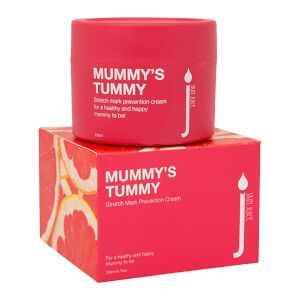
“Quench pregnant bellies' moisture cravings with this natural, indulgent stretch mark prevention cream that will soothe the irritation and itchiness associated with stretching skin.”
This product can help improve hydration of the skin with the two types of ingredients.
The first type is called “humectants”:
these ingredients help attract water.
When humectants are on the surface of the skin, they “pull in” the moisture from the outside environment, or from
within deeper layers of the skin. The following ingredients in this product do the job:
glycerin.
This product also contains ingredients called “occlusives”. They help reduce the speed with which our skin loses moisture to the outside environment. These ingredients also help soften the upper layer of the skin, so it feels less tight and nicer to the touch. The following ingredients in this product do the job: butyrospermum parkii butter, cocos nucifera fruit extract.
Anti-oxidationNot advertised by the brand · Rubus idaeus seed oil, Camellia sinensis leaf extract + 7 moreModerate evidence
This product contains antioxidants (camellia sinensis leaf extract, rubus idaeus seed oil, vaccinium macrocarpon seed oil) that might be able to help neutralize free radicals in skin to lessen the damage it gets from the UV light (sun). There is not enough evidence to confirm their effectiveness in skin though.
Can it cause trouble?
Irritancy3 strong irritants: Citrus reticulata peel oil, Citrus paradisi peel oil + 1 more — patch-test recommendedHigh risk
Comedogenic4 ingredients rated 2 or more on the 0–5 pore-clogging scale4 flagged
User reviews
Be the first — your take helps the next person decide.
Ingredients
Filter by role to see what each ingredient is doing.
Cocos nucifera fruit extract~22–33%
- Irritation risk
- Low
- Comedogenicity
- 3/5
An emollient. Found to be as effective as a moisturizer for dry skin as mineral oil. Could be comedogenic
More about Cocos nucifera fruit extractPrunus amygdalus dulcis oil~4.2–6.4%
- Irritation risk
- Low
An emollient that softens the skin
More about Prunus amygdalus dulcis oilGlyceryl stearate se~3.2–4.8%
- Irritation risk
- Low
- Comedogenicity
- 2/5
Used to stabilize the product formulations and works as an emollient
More about Glyceryl stearate seGlycerin~3.3–5%
- Irritation risk
- Low
One of the best moisturizing ingredients. Naturally present in skin. It attracts water to the upper layer of the skin working as a humectant
More about GlycerinCetearyl alcohol~2.8–4.2%
- Irritation risk
- Low
- Comedogenicity
- 2/5
A non-drying alcohol. Works as an emollient. Helps water and oil mix together and creates a nice product texture
More about Cetearyl alcoholPrunus armeniaca kernel oil~2.2–3.2%
- Irritation risk
- Medium
An emollient that helps soften the skin
More about Prunus armeniaca kernel oilPentylene glycol~1.7–2.6%
- Irritation risk
- Medium
Used to preserve products, dissolve other ingredients and create a nice product texture
More about Pentylene glycolButyrospermum parkii butter~1.6–2.4%
- Irritation risk
- Low
- Comedogenicity
- 3/5
A great moisturising ingredient that softens the skin and reduces water loss from its upper layer. It also can be helpful in protecting skin from free radicals
More about Butyrospermum parkii butterRosa canina fruit oil~1.1–1.7%
- Irritation risk
- Medium
A great emollient. Contains vitamin E (tocopherol) which may give it some anti-oxidant properties. Can contain volatile compounds and can be irritating
More about Rosa canina fruit oilXanthan gum~0.9–1.35%
- Irritation risk
- Low
Used to create a thicker product consistency
More about Xanthan gumCamellia sinensis leaf extract~0.6–1.35%
- Irritation risk
- Low
Can contain potent anti-oxidant compounds (abbreviated ECG, GCG, EGC, and EGCG) that might help protect the skin from free radicals. Can help calm down inflammation and has some anti-bacterial properties. Unfortunately, these antioxidants are unstable and lose their effectiveness very quickly in products. The concentration of the antioxidant compounds in the extract also tends to be low to be effective in topical formulation
More about Camellia sinensis leaf extractTerminalia ferdinandiana fruit extract~0.5–1.2%
- Irritation risk
- Medium
A plant extract that might have some anti-oxidant effect in skin, but evidence is lacking
More about Terminalia ferdinandiana fruit extractCitrus reticulata peel oil~0.4–1%
- Irritation risk
- High
An essential oil used for fragrance. Can be an allergen and irritant
More about Citrus reticulata peel oilCitrus paradisi peel oil~0.35–0.85%
Punica granatum seed oil~0.4–0.95%
- Irritation risk
- Low
Helps soften the upper layer of the skin
More about Punica granatum seed oilRubus idaeus seed oil~0.35–0.85%
- Irritation risk
- Medium
A plant oil that might be able to help neutralize free radicals in skin
More about Rubus idaeus seed oilVaccinium macrocarpon seed oil~0.35–0.8%
- Irritation risk
- Medium
A plant oil that can help neutralize free radicals, soften the upper layer of the skin, and support skin's barrier function
More about Vaccinium macrocarpon seed oilTocopherol~0.1–0.4%
- Irritation risk
- Low
Pure form of vitamin E. Can help moisturise and protect the skin from free radicals. Often used to help stabilise other ingredients or the formula itself
More about TocopherolParfum~0.05–0.3%
- Irritation risk
- High
An aromatic blend of unspecified and possibly irritating ingredients
More about ParfumIngredient list view
Cocos nucifera fruit extract, Prunus amygdalus dulcis oil, Glyceryl stearate se, Glycerin, Cetearyl alcohol, Prunus armeniaca kernel oil, Pentylene glycol, Butyrospermum parkii butter, Rosa canina fruit oil, Xanthan gum, Camellia sinensis leaf extract, Terminalia ferdinandiana fruit extract, Citrus reticulata peel oil, Citrus paradisi peel oil, Punica granatum seed oil, Rubus idaeus seed oil, Vaccinium macrocarpon seed oil, Unknown, Unknown, Tocopherol, Parfum
Compare prices
Retailers ranked by price — lowest first.
.png)
Affiliate links · prices updated regularly
Sources cited in this review
Every concentration estimate and effectiveness label is anchored to one of these 7 studies and safety reviews.
- 1
- 2
- 3
- 4Wound‐healing Properties of the Oils of Vitis vinifera and Vaccinium macrocarpononlinelibrary.wiley.com
- 5
- 6Vitamin E in dermatologyncbi.nlm.nih.gov

Affiliate links · As an Amazon Associate, WIMJ earns from qualifying purchases.