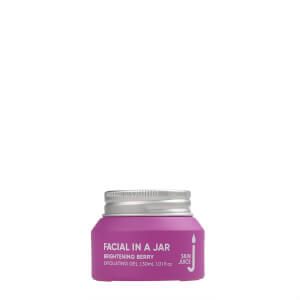
Skin Juice Facial in a Jar Brightening Berry
Works for
3 of 3 advertised claims delivered
Exfoliation4 ingredients credited for this claimStrong support
“Brightening Berry is a facial treat bursting with exfoliating plum and berry fruit acids and juicy nutrients to help brighten, boost and hydrate the skin.”
This product can help exfoliate the skin. In other words, it helps break down the bonds between dead cells on the surface of the skin and speed up the skin turnover. Skin often appears softer and brighter after exfoliation, but overdoing it can result in disrupted skin barrier. The following ingredient is doing the exfoliating job in this product: lactic acid, mandelic acid.
Anti-aging3 ingredients credited for this claimModerate support
“The ceramides used in this formula are known as sphingolipids.Pro-vitamin B5 helps support the formation of key skin barrier components like ceramides and fatty acids, which further helps keep moisture locked in, keeping the skin moisturised for longer.Vegan.Test Results Provides instant plumping hydration that lasts all day* Gives instantly smoother-feeling skin* Promotes supple skin with improved elasticity* Minimises the look of fine dry lines* *Testing on 32 people, 2 times per day for 4 weeks”
This product contains lactic acid. This ingredient might be able to help reduce and prevent fine lines and wrinkles, improve skin elasticity and firmness, but there is not enough evidence that it actually works.
Moisturizing10 ingredients credited for this claimGood support
“This is the natural colour of this new raw material.The Ordinary’s Hyaluronic Acid 2% + B5 provides instant plumping hydration to give softer, smoother, healthy-looking skin.”
This product can help improve hydration of the skin with the two types of ingredients.
The first type is called “humectants”:
these ingredients help attract water.
When humectants are on the surface of the skin, they “pull in” the moisture from the outside environment, or from
within deeper layers of the skin. The following ingredients in this product do the job:
glycerin, lactic acid.
This product also contains ingredients called “occlusives”. They help reduce the speed with which our skin loses moisture to the outside environment. These ingredients also help soften the upper layer of the skin, so it feels less tight and nicer to the touch. The following ingredients in this product do the job: caprylic/capric triglyceride, chondrus crispus extract.
Evens skin toneNot advertised by the brand · 4 ingredients credited for this claimStrong support
This product can help reduce hypepigmentation and even out the skin tone because it contains the following effective ingredients: lactic acid, mandelic acid
Keep in mind that you would need to apply any topical skincare targetted at hypigmentation consistently for a couple of months to get a result. No topical skincare product can help get rid of hyperpigmentation (including post-acne marks and age spots) instantly.
Anti-oxidationNot advertised by the brand · 4 ingredients credited for this claimModerate support
This product contains antioxidants (camellia sinensis leaf extract) that might be able to help neutralize free radicals in skin to lessen the damage it gets from the UV light (sun). There is not enough evidence to confirm their effectiveness in skin though.
Can it cause trouble?
Irritancy1 strong irritant: ParfumMedium risk
Comedogenic1 ingredient rated 2 or more on the 0–5 pore-clogging scale1 flagged


User reviews
Be the first — your take helps the next person decide.
Ingredients
Filter by role to see what each ingredient is doing.
Water~40–60%
Lactic acid~4.4–6.6%
- Irritation risk
- Medium
An exfoliating and moisturizing alpha-hydroxy acid (AHA). Typically causes less irritation than other AHAs, for example, glycolic acid. At high concentrations (about 15%), lactic acid can help reduce lines and wrinkles. Recent studies show that lactic acid can support the "good" bacteria living on skin's surface (healthy skin microbiome)
More about Lactic acidCaprylic/capric triglyceride~3.7–5.6%
- Irritation risk
- Medium
A good mix of fatty acids that forms a protective layer on the skin. Improves the shelf life of products. Derived from coconut and glycerin
More about Caprylic/capric triglycerideAcacia senegal gum~2.9–4.3%
- Irritation risk
- Medium
Helps mask the small of other ingredients and improve the product texture
More about Acacia senegal gumMannitol~2.1–3.1%
- Irritation risk
- Low
Helps to attract water to the upper layer of the skin
More about MannitolSaccharide isomerate~1.7–2.6%
- Irritation risk
- Low
Helps attract water to the upper layer of the skin
More about Saccharide isomerateGlyceryl stearate citrate~1.5–2.2%
- Irritation risk
- Low
Helps oil and water mix together while softening the upper layer of the skin
More about Glyceryl stearate citratePotassium cetyl phosphate~1.3–2%
- Irritation risk
- Medium
Helps oil and water mix together
More about Potassium cetyl phosphateVaccinium macrocarpon fruit extract~1–1.6%
- Irritation risk
- High
A berry extract. Might have some anti-oxidant properties
More about Vaccinium macrocarpon fruit extractCamellia sinensis leaf extract~0.85–1.25%
- Irritation risk
- Low
Can contain potent anti-oxidant compounds (abbreviated ECG, GCG, EGC, and EGCG) that might help protect the skin from free radicals. Can help calm down inflammation and has some anti-bacterial properties. Unfortunately, these antioxidants are unstable and lose their effectiveness very quickly in products. The concentration of the antioxidant compounds in the extract also tends to be low to be effective in topical formulation
More about Camellia sinensis leaf extractMandelic acid~0.5–1.1%
- Irritation risk
- High
Helps shed the upper layer of dead cells from the surface of the skin revealing smoother, brighter skin. It can help to reduce hyperpigmentation. It has anti-bacterial properties, and might help to reduce blemishes, as well as fine lines and wrinkles. It is considered to be gentler than glycolic acid
More about Mandelic acidVaccinium angustifolium fruit extract~0.2–0.75%
- Irritation risk
- Medium
A plant extract tha can have anti-oxidant properties, but evidence of effectiveness in skin is lacking
More about Vaccinium angustifolium fruit extractTasmannia lanceolata fruit extract~0.35–0.8%
- Irritation risk
- High
Sodium hyaluronate~0.3–0.75%
- Irritation risk
- Low
One of the best moisturizing ingredients. Attracts water into the upper layer of the skin
More about Sodium hyaluronateTin~0.3–0.7%
Chondrus crispus extract~0.3–0.75%
- Irritation risk
- Low
- Comedogenicity
- 3/5
Red algae extract that helps attract water to the upper layer of the skin and create a nicer product consistency
More about Chondrus crispus extractPapain~0.2–0.75%
- Irritation risk
- High
An enzyme extracted from papaya fruit. Can have an exfoliating effect on the skin. Can be irritating
More about PapainMalic acid~0.15–0.7%
Glycerin~0.15–0.65%
- Irritation risk
- Low
One of the best moisturizing ingredients. Naturally present in skin. It attracts water to the upper layer of the skin working as a humectant
More about GlycerinTocopherol~0.15–0.6%
- Irritation risk
- Low
Pure form of vitamin E. Can help moisturise and protect the skin from free radicals. Often used to help stabilise other ingredients or the formula itself
More about TocopherolCitric acid~0.1–0.5%
- Irritation risk
- Medium
Can work as an exfoliant but is typically used to adjust the product pH
More about Citric acidSodium citrate~0.1–0.45%
- Irritation risk
- Medium
Helps to control the skin's pH level. Maintains the skin's natural film of amino-lactic acids and oils. Helps to preserve products
More about Sodium citrateSorbic acid~0.1–0.4%
Salicylic acid~0.1–0.35%
- Irritation risk
- High
Used for skin exfoliation. It has an anti-inflammatory and anti-bacterial effect, helps to unclog pores, prevent blemishes and speed up healing of the existing ones. Sometimes referred to as a BHA (beta-hydroxy acid)
More about Salicylic acidHydrogenated lecithin~0.1–0.4%
- Irritation risk
- Low
Helps to retain moisture by creating a protective barrier on the skin. Rich in fatty acids. Improves product texture and helps with the penetration of other ingredients.
More about Hydrogenated lecithinPolyglyceryl-3 stearate~0.1–0.35%
- Irritation risk
- Low
Helps oil and water mix together
More about Polyglyceryl-3 stearateXanthan gum~0.05–0.25%
- Irritation risk
- Low
Used to create a thicker product consistency
More about Xanthan gumBromelain~0.05–0.25%
- Irritation risk
- Low
Benzyl alcohol~0.05–0.15%
- Irritation risk
- High
A preservative. Can be used to mask unpleasant smell. Can be irritating
More about Benzyl alcoholParfum~0.05–0.1%
- Irritation risk
- High
An aromatic blend of unspecified and possibly irritating ingredients
More about ParfumIngredient list view
Water, Lactic acid, Caprylic/capric triglyceride, Acacia senegal gum, Mannitol, Saccharide isomerate, Glyceryl stearate citrate, Potassium cetyl phosphate, Vaccinium macrocarpon fruit extract, Camellia sinensis leaf extract, Mandelic acid, Vaccinium angustifolium fruit extract, Tasmannia lanceolata fruit extract, Sodium hyaluronate, Unknown, Tin, Chondrus crispus extract, Papain, Malic acid, Glycerin, Tocopherol, Citric acid, Sodium citrate, Sorbic acid, Salicylic acid, Hydrogenated lecithin, Polyglyceryl-3 stearate, Xanthan gum, Bromelain, Benzyl alcohol, Parfum
Compare prices
Retailers ranked by price — lowest first.

Affiliate links · prices updated regularly
Worth comparing, line by line.
Match % combines shared ingredients, the first five ingredients, shared actives and hero ingredients, irritancy (lower counts in the alternative's favour), texture and body area. Only products in the same routine step are compared.
| Skin JuiceFacial in a Jar Brightening BerryYOUR PRODUCT | Jan MariniMarini Multi-Acid Exfoliating Pads | Paula's choiceSkin Perfecting 25% AHA and 2% BHA Exfoliant Peel | Dermalogicaliquid peel | |
|---|---|---|---|---|
| Match | — | 86% | 85% | 82% |
| Price | $21.02 | $95.00+$73.98 | $49.00+$27.98 | $85.93+$64.91 |
| Shared key ingredients | — | 7 of 10 | 5 of 10 | 4 of 10 |
| Key difference | — | Glycolic Acid | Glycolic Acid | Azelaic Acid |
| Irritancy | Medium | Low | Low | Low |
| Drying alcohol | — | — | — | — |
| View product | Shop | Shop | Shop |


Sources cited in this review
Every concentration estimate and effectiveness label is anchored to one of these 14 studies and safety reviews.
- 1Epidermal and dermal effects of topical lactic acidncbi.nlm.nih.gov
- 2Dual Effects of Alpha-Hydroxy Acids on the Skinpdfs.semanticscholar.org
- 3
- 4
- 5
- 6Hyaluronic acid: A key molecule in skin agingncbi.nlm.nih.gov

Affiliate links · As an Amazon Associate, WIMJ earns from qualifying purchases.