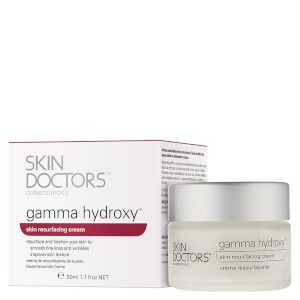
Works for
4 of 5 advertised claims delivered
Anti-aging3 ingredients credited for this claimStrong support
“This new generation, one step skin resurfacing cream that gradually removes the dead, lifeless top layer of skin to reveal the younger looking skin beneath.”
This product can help reduce and prevent fine lines and wrinkles, improve skin elasticity and firmness because it contains glycolic acid.
Keep in mind that it typically takes at least 6 weeks to notice any results because the changes that are needed to improve fine lines and elasticity happen in the deeper layers of the skin. No topical anti-aging product can “erase” wrinkles or fully reverse signs of aging.
Exfoliation3 ingredients credited for this claimStrong support
“This new generation, one step skin resurfacing cream that gradually removes the dead, lifeless top layer of skin to reveal the younger looking skin beneath.”
This product can help exfoliate the skin. In other words, it helps break down the bonds between dead cells on the surface of the skin and speed up the skin turnover. Skin often appears softer and brighter after exfoliation, but overdoing it can result in disrupted skin barrier. The following ingredient is doing the exfoliating job in this product: glycolic acid.
Evens skin tone4 ingredients credited for this claimStrong support
“Gradually removes lifeless top layer of skinDeveloped to help treat the appearance of acne-scarringReduces pigmentation trouble areas”
This product can help reduce hypepigmentation and even out the skin tone because it contains the following effective ingredients: glycolic acid
Keep in mind that you would need to apply any topical skincare targetted at hypigmentation consistently for a couple of months to get a result. No topical skincare product can help get rid of hyperpigmentation (including post-acne marks and age spots) instantly.
Moisturizing8 ingredients credited for this claimGood support
“Gamma Hydroxy is a luxurious cream enriched with fruit acids to regenerate skin renewal, refine the skin’s texture and give the skin a new found radiance.”
This product can help improve hydration of the skin with the two types of ingredients.
The first type is called “humectants”:
these ingredients help attract water.
When humectants are on the surface of the skin, they “pull in” the moisture from the outside environment, or from
within deeper layers of the skin. The following ingredients in this product do the job:
glycerin, sodium hyaluronate.
This product also contains ingredients called “occlusives”. They help reduce the speed with which our skin loses moisture to the outside environment. These ingredients also help soften the upper layer of the skin, so it feels less tight and nicer to the touch. The following ingredients in this product do the job: phenyl trimethicone, cetyl alcohol.
Anti-blemish2 ingredients credited for this claimLimited support
“For oily skin, the inclusion of salicylic acid can improve blemishes by reducing the appearance of blackheads and white heads, whilst decongesting clogged pores penetrate the surface of the skin to deliver fantastic resurfacing benefits; reducing pore size and improving skin texture and colour, to reveal younger, healthier skin.”
This product contains ingredients (glycolic acid) that could help reduce blemishes and clogged pores in theory, but there is not enough evidence that they actually work.
Can it cause trouble?
Irritancy5 strong irritants: Benzophenone-3, Parfum + 3 more — patch-test recommendedHigh risk
Comedogenic1 ingredient rated 2 or more on the 0–5 pore-clogging scale1 flagged


User reviews
Be the first — your take helps the next person decide.
Ingredients
Filter by role to see what each ingredient is doing.
Water~45–55%
Ethylhexyl methoxycinnamate~6.3–7.7%
- Irritation risk
- High
Octinoxate. When used in higher concentrations, works as a sunscreen protecting the skin from UVB rays. When used in lower concentration, helps to preserve the product formulation. Is shown to be harmful to coral reefs - consider avoiding bathing in coral reef areas when wearing a product with this ingredient. It can be irritating
More about Ethylhexyl methoxycinnamateGlycolic acid~4.4–5.4%
- Irritation risk
- High
An alpha-hydroxy acid (AHA) that helps to remove the dead skin cells on the surface of the skin reveling a more even, smoother complexation. It is also able to stimulate collagen production with long-term use. Could help to reduce pore congestion. It can be irritating to the skin. Apply sunscreen daily if using products with glycolic acid
More about Glycolic acidBenzophenone-3~3.6–4.4%
- Irritation risk
- High
Same as oxybenzone. Protects in the UVB and short UVA range. In small concentrations, used to stabilize product formulation. Can be irritating. Is shown to be harmful to coral reefs - consider avoiding bathing in coral reef areas when wearing a product with this ingredient. It can penetrate the skin and get absorbed into bloodstream faster than other popular filters available in the US. The study that produced this finding did not address any potential health effects of the absorption
More about Benzophenone-3Propylene glycol~2.3–2.9%
- Irritation risk
- High
Helps oil and water mix together and can enhance the penetration of other ingredients into the skin. It can be irritating
More about Propylene glycolCyclopentasiloxane~2–2.5%
- Irritation risk
- Low
A silicone that helps improve the product texture and spreadability. Can absorb oil creating a short-term mattifying effect on the skin
More about CyclopentasiloxaneCetyl alcohol~1.7–2.1%
- Irritation risk
- Low
A non-drying alcohol that works to soften the skin and stabilize product formulations helping oil and water mix together
More about Cetyl alcoholStearyl alcohol~1.5–1.9%
- Irritation risk
- Low
An emollient that helps soften the skin
More about Stearyl alcoholCyclohexasiloxane~1.2–1.5%
- Irritation risk
- Low
A silicone that serves as an emollient. Helps create a nice non-greasy feels
More about CyclohexasiloxaneButyl methoxydibenzoylmethane~1.4–1.7%
- Irritation risk
- Medium
Avobenzone. An organic, or so-called "chemical" UV filter. Protects against both UVA and UVB rays. Needs to be combined with other filters in a formulation to be stable.
More about Butyl methoxydibenzoylmethaneGlycerin~0.75–1.1%
- Irritation risk
- Low
One of the best moisturizing ingredients. Naturally present in skin. It attracts water to the upper layer of the skin working as a humectant
More about GlycerinLactic acid~0.55–0.85%
- Irritation risk
- Medium
An exfoliating and moisturizing alpha-hydroxy acid (AHA). Typically causes less irritation than other AHAs, for example, glycolic acid. At high concentrations (about 15%), lactic acid can help reduce lines and wrinkles. Recent studies show that lactic acid can support the "good" bacteria living on skin's surface (healthy skin microbiome)
More about Lactic acidGlyceryl stearate~0.55–0.85%
- Irritation risk
- Low
An emollient that softens the skin and forms a protective layer on its surface. Helps water and oil mix together
More about Glyceryl stearatePeg-100 stearate~0.55–0.85%
- Irritation risk
- Low
Helps oil and water mix togehter and creates a nice product texture
More about Peg-100 stearateCeteareth-20~0.55–0.8%
- Irritation risk
- Medium
- Comedogenicity
- 2/5
Helps oil and water mix together. Has some emollient properties
More about Ceteareth-20Phenyl trimethicone~0.45–0.7%
- Irritation risk
- Low
A type of silicone that can decrease loss of moisture from the skin surface. It helps create a nice product texture
More about Phenyl trimethiconeSalicylic acid~0.4–0.6%
- Irritation risk
- High
Used for skin exfoliation. It has an anti-inflammatory and anti-bacterial effect, helps to unclog pores, prevent blemishes and speed up healing of the existing ones. Sometimes referred to as a BHA (beta-hydroxy acid)
More about Salicylic acidPhenoxyethanol~0.4–0.6%
- Irritation risk
- Low
A preservative. It helps prevent bacterial growth in cosmetic products
More about PhenoxyethanolSodium hydroxide~0.3–0.6%
Arctostaphylos uva ursi leaf extract~0.3–0.5%
- Irritation risk
- Low
Magnesium ascorbyl phosphate~0.3–0.5%
- Irritation risk
- Medium
A derivative of vitamin C that is more stable, but less bioavailable than the pure form of vitamin C. It does not penetrate the skin well, but has been shown to convert to pure vitamin C once in skin. It can be helpful in stimulating collagen production and lightening the skin tone, but the required concentration is likely to be very high
More about Magnesium ascorbyl phosphateXanthan gum~0.25–0.5%
- Irritation risk
- Low
Used to create a thicker product consistency
More about Xanthan gumSodium hyaluronate~0.25–0.45%
- Irritation risk
- Low
One of the best moisturizing ingredients. Attracts water into the upper layer of the skin
More about Sodium hyaluronateParfum~0.2–0.4%
- Irritation risk
- High
An aromatic blend of unspecified and possibly irritating ingredients
More about ParfumDisodium edta~0.2–0.4%
Sodium metabisulfite~0.1–0.2%
Sodium benzoate~0.2–0.35%
Methylparaben~0.15–0.3%
Propylparaben~0.1–0.2%
Ethylparaben~0.1–0.2%
Bht~0.1–0.2%
Hexyl cinnamal~0.1–0.15%
Citronellol~0.05–0.15%
Linalool~0.05–0.1%
Ingredient list view
Water, Ethylhexyl methoxycinnamate, Glycolic acid, Benzophenone-3, Propylene glycol, Cyclopentasiloxane, Cetyl alcohol, Stearyl alcohol, Cyclohexasiloxane, Butyl methoxydibenzoylmethane, Glycerin, Lactic acid, Glyceryl stearate, Peg-100 stearate, Ceteareth-20, Phenyl trimethicone, Salicylic acid, Phenoxyethanol, Sodium hydroxide, Arctostaphylos uva ursi leaf extract, Magnesium ascorbyl phosphate, Xanthan gum, Sodium hyaluronate, Parfum, Disodium edta, Sodium metabisulfite, Sodium benzoate, Methylparaben, Propylparaben, Ethylparaben, Bht, Hexyl cinnamal, Citronellol, Linalool
Compare prices
Retailers ranked by price — lowest first.
Affiliate links · prices updated regularly · As an Amazon Associate, WIMJ earns from qualifying purchases.
Worth comparing, line by line.
Match % combines shared ingredients, the first five ingredients, shared actives and hero ingredients, irritancy (lower counts in the alternative's favour), texture and body area. Only products in the same routine step are compared.
| Skin DoctorsRadiance & RenewYOUR PRODUCT | CeraVeBlemish Control Gel Moisturiser with 2% Salicylic Acid & Niacinamide for Blemish-Prone Skin | Beauty DropsAHA 30% + BHA 2% Peeling | Paula's choiceSkin Perfecting 25% AHA and 2% BHA Exfoliant Peel | |
|---|---|---|---|---|
| Match | — | 85% | 85% | 85% |
| Price | $41.99 | $16.54−$25.45 | — | $49.00+$7.01 |
| Shared key ingredients | — | 5 of 10 | 5 of 10 | 5 of 10 |
| Key difference | — | Niacinamide | Panthenol | Glycyrrhetinic Acid |
| Irritancy | High | Low | Medium | Low |
| Drying alcohol | — | — | — | — |
| View product | Shop | Shop | Shop |


Sources cited in this review
Every concentration estimate and effectiveness label is anchored to one of these 21 studies and safety reviews.
- 1
- 2Glycolic acid peel therapy – a current reviewncbi.nlm.nih.gov
- 3
- 4
- 5
- 6On Photostability of Oxybenzonecore.ac.uk

Affiliate links · As an Amazon Associate, WIMJ earns from qualifying purchases.