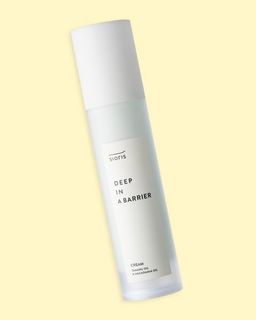
Sioris Deep In A Barrier Cream
Works for
2 of 4 advertised claims delivered
Moisturizing20 ingredients credited for this claimGood support
“Deep In A Barrier Cream”
This product can help improve hydration of the skin with the two types of ingredients.
The first type is called “humectants”:
these ingredients help attract water.
When humectants are on the surface of the skin, they “pull in” the moisture from the outside environment, or from
within deeper layers of the skin. The following ingredients in this product do the job:
glycerin, sodium hyaluronate.
This product also contains ingredients called “occlusives”. They help reduce the speed with which our skin loses moisture to the outside environment. These ingredients also help soften the upper layer of the skin, so it feels less tight and nicer to the touch. The following ingredients in this product do the job: helianthus annuus seed oil, cetearyl alcohol.
Anti-aging5 ingredients credited for this claimModerate support
“The Deep In A Barrier Cream is a nourishing cream infused with Tamanu Oil that supports the natural production of collagen and elastin for firmer, more youthful-looking skin.”
This product contains centella asiatica extract. This ingredient might be able to help reduce and prevent fine lines and wrinkles, improve skin elasticity and firmness, but there is not enough evidence that it actually works.
Evens skin tone2 ingredients credited for this claimLimited support
“Tamanu Oil is also known for its wound healing and skin regenerating properties, making it great for fading acne scars.”
This product contains ingredients (glycyrrhiza glabra root extract) that could help reduce hyperpigmentation (for example, post-acne marks or age spots) in theory, but there is not enough evidence that they actually work.
Anti-blemish4 ingredients credited for this claimWeak support
“Macadamia seed oil hydrates without clogging pores as it mimics the skin's natural sebum, leaving your skin moisturized, soft, and supple.”
Effective ingredients missing or their concentration is too low.
Anti-oxidationNot advertised by the brand · 8 ingredients credited for this claimModerate support
This product contains antioxidants (centella asiatica extract) that might be able to help neutralize free radicals in skin to lessen the damage it gets from the UV light (sun). There is not enough evidence to confirm their effectiveness in skin though.
Can it cause trouble?
Irritancy3 strong irritants: Citrus junos fruit water, Rosmarinus officinalis leaf extract + 1 more — patch-test recommendedHigh risk
Comedogenic4 ingredients rated 2 or more on the 0–5 pore-clogging scale4 flagged
User reviews
Ingredients
Filter by role to see what each ingredient is doing.
Calophyllum inophyllum seed oil~23–34%
- Irritation risk
- Low
Macadamia ternifolia seed oil~4.2–6.2%
- Irritation risk
- Medium
Plant oil from nuts that helps soften the upper layer of the skin. Contains a high concentration of oleic acid that can weaken skin's barrier function and increase water-loss while enhancing penetration of other ingredients
More about Macadamia ternifolia seed oilAloe barbadensis leaf juice~4.4–6.6%
- Irritation risk
- Medium
Traditionally used to treat sunburns, dermatitis and inflammation, but evidence for its effectiveness is lacking. The extract can contain humectants that help attract water into the skin
More about Aloe barbadensis leaf juiceCentella asiatica extract~3.9–5.8%
- Irritation risk
- Medium
A plant extract that has been shown to be able to reduce inflammation in skin, support restoration of skin barrier function, as well as support collagen production. Contains active compounds called centelloids: asiaticoside, madecasosside, asiatic acid and madecassic acid. Might be helpful in preventing stretch marks. It can be itself be irritating though.
More about Centella asiatica extractChamomilla recutita flower extract~2.8–4.2%
- Irritation risk
- High
Plant extract that can have healing and anti-inflammatory properties. It is a potential allergen and can be irritating
More about Chamomilla recutita flower extractCitrus junos fruit water34%
- Irritation risk
- High
Water~2.1–3.2%
Propanediol~1.7–2.6%
- Irritation risk
- Low
Acts as a solvent for other ingredients. Speeds up the absorption of other ingredients into the skin
More about PropanediolCalophyllum inophyllum seed oil~1.4–2.1%
- Irritation risk
- Low
Macadamia ternifolia seed oil~1.3–2%
- Irritation risk
- Medium
Plant oil from nuts that helps soften the upper layer of the skin. Contains a high concentration of oleic acid that can weaken skin's barrier function and increase water-loss while enhancing penetration of other ingredients
More about Macadamia ternifolia seed oilAloe barbadensis leaf juice~1.1–1.6%
- Irritation risk
- Medium
Traditionally used to treat sunburns, dermatitis and inflammation, but evidence for its effectiveness is lacking. The extract can contain humectants that help attract water into the skin
More about Aloe barbadensis leaf juiceIsoamyl laurate~1–1.5%
- Irritation risk
- Medium
Helps stabilize emulsions and create a nice product texture
More about Isoamyl laurateGlycerin~0.85–1.25%
- Irritation risk
- Low
One of the best moisturizing ingredients. Naturally present in skin. It attracts water to the upper layer of the skin working as a humectant
More about GlycerinCetearyl alcohol~0.9–1.35%
- Irritation risk
- Low
- Comedogenicity
- 2/5
A non-drying alcohol. Works as an emollient. Helps water and oil mix together and creates a nice product texture
More about Cetearyl alcoholButyrospermum parkii butter~0.8–1.2%
- Irritation risk
- Low
- Comedogenicity
- 3/5
A great moisturising ingredient that softens the skin and reduces water loss from its upper layer. It also can be helpful in protecting skin from free radicals
More about Butyrospermum parkii butterPentylene glycol~0.55–1.35%
- Irritation risk
- Medium
Used to preserve products, dissolve other ingredients and create a nice product texture
More about Pentylene glycolGlyceryl stearate se~0.5–1.2%
- Irritation risk
- Low
- Comedogenicity
- 2/5
Used to stabilize the product formulations and works as an emollient
More about Glyceryl stearate seTocopherol~0.5–1.1%
- Irritation risk
- Low
Pure form of vitamin E. Can help moisturise and protect the skin from free radicals. Often used to help stabilise other ingredients or the formula itself
More about TocopherolSodium hyaluronate~0.45–1.1%
- Irritation risk
- Low
One of the best moisturizing ingredients. Attracts water into the upper layer of the skin
More about Sodium hyaluronateOlea europaea fruit oil~0.5–1.15%
- Irritation risk
- Medium
An emollient that helps soften the skin but is not effective for restoring its barrier function. Might be helpful to calm down inflammation
More about Olea europaea fruit oilHelianthus annuus seed oil~0.5–1.1%
- Irritation risk
- Low
A great emollient due to its high linoleic acid content. One of the most effective plant oils in helping skin hydration and repairing skin barrier function
More about Helianthus annuus seed oilCentella asiatica/chamomilla recutita flower/leaf)/extract~0.4–1%
- Irritation risk
- Low
Polygonum cuspidatum root extract~0.4–0.95%
- Irritation risk
- Medium
A plant extract that can contain resveratrol, an antioxidant that can help neutralize free radicals in skin. The effectiveness depends on the extract quality and concentration in the product
More about Polygonum cuspidatum root extractScutellaria baicalensis root extract~0.3–0.75%
- Irritation risk
- High
A plant extract that might contain a compound baicalin that could be helpful in neutralizing free radicals and reducing inflammation in skin. The baicalin concentration in skincare products is often too low for an effective action. Can be used for its fragrant properties
More about Scutellaria baicalensis root extractCamellia sinensis leaf extract~0.4–0.9%
- Irritation risk
- Low
Can contain potent anti-oxidant compounds (abbreviated ECG, GCG, EGC, and EGCG) that might help protect the skin from free radicals. Can help calm down inflammation and has some anti-bacterial properties. Unfortunately, these antioxidants are unstable and lose their effectiveness very quickly in products. The concentration of the antioxidant compounds in the extract also tends to be low to be effective in topical formulation
More about Camellia sinensis leaf extractGlycyrrhiza glabra root extract~0.35–0.85%
- Irritation risk
- Medium
A plant extract that can help lighten the skin and calm down inflammation. Might be helpful in neutralizing free radicals
More about Glycyrrhiza glabra root extractRosmarinus officinalis leaf extract~0.35–0.85%
- Irritation risk
- High
Can be helpful in reducing inflammation in skin, including inflamed acne. It can be irritating
More about Rosmarinus officinalis leaf extractHydrogenated olive oil~0.4–0.9%
- Irritation risk
- Low
Olea europaea oil unsaponifiables~0.4–0.9%
- Irritation risk
- Low
Help soften the upper layer of the skin
More about Olea europaea oil unsaponifiablesHydrogenated vegetable oil~0.45–1%
- Irritation risk
- Low
- Comedogenicity
- 2/5
An oil from a mixture of different vegetables. Helps soften the upper layer of the skin
More about Hydrogenated vegetable oilSodium levulinate~0.35–0.85%
Cetearyl olivate~0.35–0.85%
Sorbitan olivate~0.35–0.85%
Cetearyl glucoside~0.35–0.85%
- Irritation risk
- Medium
Helps water and oil in the product mix well together and improves product texture
More about Cetearyl glucosideStearic acid~0.55–1.25%
- Irritation risk
- Low
Helps oil and water mix together and works as an emollient
More about Stearic acidPalmitic acid~0.35–0.8%
- Irritation risk
- Low
An emollient that is naturally present in skin and helps soften it
More about Palmitic acidCetyl alcohol~0.35–0.85%
- Irritation risk
- Low
A non-drying alcohol that works to soften the skin and stabilize product formulations helping oil and water mix together
More about Cetyl alcoholStearyl alcohol~0.3–0.75%
- Irritation risk
- Low
An emollient that helps soften the skin
More about Stearyl alcoholGlyceryl caprylate~0.2–0.75%
- Irritation risk
- Low
An emollient that can also help water and oil mix together, as well as prevent bacteria growth in products
More about Glyceryl caprylateSodium anisate~0.15–0.5%
Xanthan gum~0.15–0.5%
- Irritation risk
- Low
Used to create a thicker product consistency
More about Xanthan gumCitric acid~0.1–0.35%
- Irritation risk
- Medium
Can work as an exfoliant but is typically used to adjust the product pH
More about Citric acidIngredient list view
Calophyllum inophyllum seed oil, Macadamia ternifolia seed oil, Aloe barbadensis leaf juice, Centella asiatica extract, Chamomilla recutita flower extract, Citrus junos fruit water, Water, Propanediol, Calophyllum inophyllum seed oil, Macadamia ternifolia seed oil, Aloe barbadensis leaf juice, Isoamyl laurate, Glycerin, Cetearyl alcohol, Butyrospermum parkii butter, Pentylene glycol, Glyceryl stearate se, Tocopherol, Sodium hyaluronate, Olea europaea fruit oil, Helianthus annuus seed oil, Centella asiatica/chamomilla recutita flower/leaf)/extract, Polygonum cuspidatum root extract, Scutellaria baicalensis root extract, Camellia sinensis leaf extract, Glycyrrhiza glabra root extract, Rosmarinus officinalis leaf extract, Hydrogenated olive oil, Olea europaea oil unsaponifiables, Hydrogenated vegetable oil, Sodium levulinate, Cetearyl olivate, Sorbitan olivate, Cetearyl glucoside, Stearic acid, Palmitic acid, Cetyl alcohol, Stearyl alcohol, Glyceryl caprylate, Sodium anisate, Xanthan gum, Citric acid
Compare prices
Retailers ranked by price — lowest first.

Sources cited in this review
Every concentration estimate and effectiveness label is anchored to one of these 27 studies and safety reviews.
- 1
- 2
- 3Centella asiatica in cosmetologyncbi.nlm.nih.gov
- 4
- 5
- 6

Affiliate links · As an Amazon Associate, WIMJ earns from qualifying purchases.