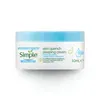
Simple Water Boost Skin Quench Sleep Moisturiser Cream
Works for
1 of 1 advertised claim delivered
Moisturizing13 ingredients credited for this claimGood support
“Water Boost Skin Quench Sleep Moisturiser Cream”
This product can help improve hydration of the skin with the two types of ingredients.
The first type is called “humectants”:
these ingredients help attract water.
When humectants are on the surface of the skin, they “pull in” the moisture from the outside environment, or from
within deeper layers of the skin. The following ingredients in this product do the job:
glycerin, saccharide isomerate.
This product also contains ingredients called “occlusives”. They help reduce the speed with which our skin loses moisture to the outside environment. These ingredients also help soften the upper layer of the skin, so it feels less tight and nicer to the touch. The following ingredients in this product do the job: caprylic/capric triglyceride, dimethicone.
Can it cause trouble?
Irritancy1 strong irritant: Benzophenone-4Medium risk
Comedogenic1 ingredient rated 2 or more on the 0–5 pore-clogging scale1 flagged
User reviews
Be the first — your take helps the next person decide.
Ingredients
Filter by role to see what each ingredient is doing.
Water~45–55%
Dimethicone~5.9–7.2%
- Irritation risk
- Low
A silicone that helps to reduce water loss from the surface of the skin. Can temporarily "fill in" lines and wrinkles, absorb oil, and create a nice product finish
More about DimethiconeGlycerin~3.8–4.6%
- Irritation risk
- Low
One of the best moisturizing ingredients. Naturally present in skin. It attracts water to the upper layer of the skin working as a humectant
More about GlycerinButylene glycol~3–3.7%
- Irritation risk
- Low
Used to create a nice product texture and help delivery of other ingredients. Might be somewhat helpful in attracting water to the upper layer of the skin
More about Butylene glycolAmmonium acryloyldimethyltaurate/vp copolymer~2.4–2.9%
- Irritation risk
- Low
Increases thickness of a product. Texture enhancer for oil-in-water emulsions
More about Ammonium acryloyldimethyltaurate/vp copolymerIsohexadecane~2.1–2.5%
- Irritation risk
- Low
Improves the texture of the product and helps soften the skin. Helps oil and water mix together and can be used as a cleansing agent
More about IsohexadecaneDimethicone/vinyl dimethicone crosspolymer~1.7–2%
- Irritation risk
- Low
Used to stabilize product formulations and create a nice product texture
More about Dimethicone/vinyl dimethicone crosspolymerCaprylic/capric triglyceride~1.6–1.9%
- Irritation risk
- Medium
A good mix of fatty acids that forms a protective layer on the skin. Improves the shelf life of products. Derived from coconut and glycerin
More about Caprylic/capric triglycerideSaccharide isomerate~1.2–1.4%
- Irritation risk
- Low
Helps attract water to the upper layer of the skin
More about Saccharide isomeratePhenoxyethanol~0.5–1%
- Irritation risk
- Low
A preservative. It helps prevent bacterial growth in cosmetic products
More about PhenoxyethanolCaprylyl glycol~0.7–1.05%
- Irritation risk
- Medium
Helps preserve products and creates a nice product texture
More about Caprylyl glycolTocopheryl acetate~0.55–0.8%
- Irritation risk
- Medium
A more stable but less bio-available form of vitamin E compared to Tocopherol. Might help moisturize and protect the skin from free radicals, but mostly used in low concentrations to stabilize other ingredients.
More about Tocopheryl acetateAmmonium acryloyldimethyltaurate/beheneth-25 methacrylate crosspolymer~0.45–0.7%
- Irritation risk
- Medium
Used to stabilize product formulations
More about Ammonium acryloyldimethyltaurate/beheneth-25 methacrylate crosspolymerCetearyl alcohol~0.5–0.75%
- Irritation risk
- Low
- Comedogenicity
- 2/5
A non-drying alcohol. Works as an emollient. Helps water and oil mix together and creates a nice product texture
More about Cetearyl alcoholBenzophenone-4~0.55–0.8%
- Irritation risk
- High
Sulisobenzone. A UV filter. Is typically used to improve the product stability under exposure to UV light. It is effective against both UVA and UVB rays. It can be used is larger concentrations as a sun protection ingredient for the skin, but can be irritating
More about Benzophenone-4Linoleamidopropyl pg-dimonium chloride phosphate~0.35–0.6%
- Irritation risk
- Low
Propylene glycol~0.3–0.55%
- Irritation risk
- High
Helps oil and water mix together and can enhance the penetration of other ingredients into the skin. It can be irritating
More about Propylene glycolStearic acid~0.45–0.65%
- Irritation risk
- Low
Helps oil and water mix together and works as an emollient
More about Stearic acidDimethiconol~0.3–0.55%
- Irritation risk
- Low
A silicone that makes products more spreadable and keeps skin smooth. Helps to add gloss to skin and may visually fill in fine lines/wrinkles for short time
More about DimethiconolCetearyl glucoside~0.25–0.45%
- Irritation risk
- Medium
Helps water and oil in the product mix well together and improves product texture
More about Cetearyl glucosideBht~0.2–0.35%
Disodium edta~0.2–0.35%
Sodium pca~0.15–0.3%
- Irritation risk
- Low
Naturally present in skin and helps to attract water to its upper layer
More about Sodium pcaC12-14 pareth-12~0.2–0.35%
Citric acid~0.15–0.3%
- Irritation risk
- Medium
Can work as an exfoliant but is typically used to adjust the product pH
More about Citric acidSodium citrate~0.15–0.3%
- Irritation risk
- Medium
Helps to control the skin's pH level. Maintains the skin's natural film of amino-lactic acids and oils. Helps to preserve products
More about Sodium citrateT-butyl alcohol~0.15–0.25%
- Irritation risk
- Medium
Used to dissolve other ingredients and to improve smell of products. It could be irritating
More about T-butyl alcoholChlorphenesin~0.1–0.2%
Glucose~0.15–0.25%
- Irritation risk
- Low
Helps attract water to the upper layer of the skin. Could be helpful in restoring the skin barrier function
More about GlucosePotassium chloride~0.15–0.25%
- Irritation risk
- Low
Sodium chloride~0.1–0.2%
- Irritation risk
- Low
Used to stabilize mixtures of oil and water, and create thicker, gel-like product textures
More about Sodium chlorideSodium benzoate~0.1–0.2%
Lactic acid~0.05–0.1%
- Irritation risk
- Medium
An exfoliating and moisturizing alpha-hydroxy acid (AHA). Typically causes less irritation than other AHAs, for example, glycolic acid. At high concentrations (about 15%), lactic acid can help reduce lines and wrinkles. Recent studies show that lactic acid can support the "good" bacteria living on skin's surface (healthy skin microbiome)
More about Lactic acidIngredient list view
Water, Dimethicone, Glycerin, Butylene glycol, Ammonium acryloyldimethyltaurate/vp copolymer, Isohexadecane, Dimethicone/vinyl dimethicone crosspolymer, Caprylic/capric triglyceride, Saccharide isomerate, Phenoxyethanol, Caprylyl glycol, Tocopheryl acetate, Ammonium acryloyldimethyltaurate/beheneth-25 methacrylate crosspolymer, Cetearyl alcohol, Benzophenone-4, Linoleamidopropyl pg-dimonium chloride phosphate, Propylene glycol, Stearic acid, Dimethiconol, Cetearyl glucoside, Bht, Disodium edta, Sodium pca, C12-14 pareth-12, Citric acid, Sodium citrate, T-butyl alcohol, Chlorphenesin, Glucose, Potassium chloride, Sodium chloride, Sodium benzoate, Lactic acid
Compare prices
Retailers ranked by price — lowest first.

.png)
Sources cited in this review
Every concentration estimate and effectiveness label is anchored to one of these 12 studies and safety reviews.
- 1
- 2Final Report on the Safety Assessment of Dimethicone Copolyoljournals.sagepub.com
- 3
- 4
- 5Benzophenone 4: An emerging allergen in cosmetics and toiletries?pubmed.ncbi.nlm.nih.gov
- 6Surfactants and experimental irritant contact dermatitisncbi.nlm.nih.gov

Affiliate links · As an Amazon Associate, WIMJ earns from qualifying purchases.