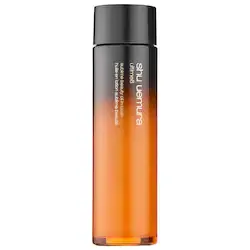
Shu Uemura Sublime Beauty Oil in Lotion
Works for
2 of 3 advertised claims delivered
Anti-aging4 ingredients credited for this claimStrong support
“Loss of firmness and elasticity .”
This product can help reduce and prevent fine lines and wrinkles, improve skin elasticity and firmness because it contains adenosine.
These ingredients in the product can also be helpful, even though there is less evidence for their effectiveness: tetradecyl aminobutyroylvalylaminobutyric urea trifluoroacetate.
Keep in mind that it typically takes at least 6 weeks to notice any results because the changes that are needed to improve fine lines and elasticity happen in the deeper layers of the skin. No topical anti-aging product can “erase” wrinkles or fully reverse signs of aging.
Moisturizing12 ingredients credited for this claimGood support
“An oil infused into a fresh toner that leaves skin feeling deeply hydrated, visibly plumper, and nourished.”
This product can help improve hydration of the skin with the two types of ingredients.
The first type is called “humectants”:
these ingredients help attract water.
When humectants are on the surface of the skin, they “pull in” the moisture from the outside environment, or from
within deeper layers of the skin. The following ingredients in this product do the job:
glycerin.
This product also contains ingredients called “occlusives”. They help reduce the speed with which our skin loses moisture to the outside environment. These ingredients also help soften the upper layer of the skin, so it feels less tight and nicer to the touch. The following ingredients in this product do the job: squalane, carthamus tinctorius seed oil.
Evens skin toneNo ingredient credited for this claimNo support
“Dullness and uneven texture If you want to know more.”
Effective ingredients missing or their concentration is too low
Can it cause trouble?
Irritancy5 strong irritants: Alcohol denat., Linalool + 3 more — patch-test recommendedHigh risk
Comedogenic2 ingredients rated 2 or more on the 0–5 pore-clogging scale2 flagged
User reviews
Be the first — your take helps the next person decide.
Ingredients
Filter by role to see what each ingredient is doing.
Water~40–60%
Glycerin~4.8–7.2%
- Irritation risk
- Low
One of the best moisturizing ingredients. Naturally present in skin. It attracts water to the upper layer of the skin working as a humectant
More about GlycerinAlcohol denat.~4–6%
- Irritation risk
- High
Produces temporary toning effect. Can help dissolve other ingredients or preserve products
More about Alcohol denat.Diphenylsiloxy phenyl trimethicone~2.8–4.2%
- Irritation risk
- Low
Help improve the product's texture
More about Diphenylsiloxy phenyl trimethiconeTrimethyl pentaphenyl trisiloxane~2.2–3.3%
- Irritation risk
- Low
Calcium chloride~1.8–2.6%
- Irritation risk
- Medium
Helps create a thicker product consistency. Might be irritating
More about Calcium chloridePhenoxyethanol~0.5–1%
- Irritation risk
- Low
A preservative. It helps prevent bacterial growth in cosmetic products
More about PhenoxyethanolChlorphenesin~0.16–0.32%
Hydroxypropyl tetrahydropyrantriol~1.1–1.6%
- Irritation risk
- High
A sugar-derived compound that helps to attract water to the upper layer of the skin and might be able to stimulate synthesis of skin's own moisturizing factors, but solid research is lacking. It could be irritating
More about Hydroxypropyl tetrahydropyrantriolPropylene glycol~0.85–1.3%
- Irritation risk
- High
Helps oil and water mix together and can enhance the penetration of other ingredients into the skin. It can be irritating
More about Propylene glycolGellan gum~0.55–1.25%
Xanthan gum~0.4–0.95%
- Irritation risk
- Low
Used to create a thicker product consistency
More about Xanthan gumAdenosine~0.35–0.8%
- Irritation risk
- Low
Might help improve cell turnover and reduce inflammation in skin. One study shows that the ingredients might be able to help reduce dynamic wrinkles (for example, in the corners of the eyes or on the forehead)
More about AdenosineLinalool~0.3–0.7%
Ethylcellulose~0.3–0.75%
- Irritation risk
- Low
Geraniol~0.2–0.75%
Squalane~0.35–0.75%
- Irritation risk
- Low
An oil naturally present in skin. Works as an emollient to soften the skin and form a protective layer on its surface without a greasy feeling.
More about SqualaneGlycine soja oil~0.2–0.7%
- Irritation risk
- Medium
- Comedogenicity
- 2/5
A good emollient that helps soften the skin and helps repair its barrier function. It can clog pores if used in high concentrations.
More about Glycine soja oilSimmondsia chinensis seed oil~0.15–0.7%
- Irritation risk
- Medium
Softens the upper layer of skin and helps restore the healthy skin barrier. Has shown to help calm down inflammation in skin. It is a stable oil, meaning that it retains its properties even when exposed to air.
More about Simmondsia chinensis seed oilCarthamus tinctorius seed oil~0.15–0.6%
- Irritation risk
- Low
An emollient that helps soften the skin and might help calm down inflammation
More about Carthamus tinctorius seed oilButyrospermum parkii butter~0.15–0.6%
- Irritation risk
- Low
- Comedogenicity
- 3/5
A great moisturising ingredient that softens the skin and reduces water loss from its upper layer. It also can be helpful in protecting skin from free radicals
More about Butyrospermum parkii butterCamellia oleifera seed oil~0.15–0.55%
- Irritation risk
- Medium
An emollient that does not leave a greasy finish
More about Camellia oleifera seed oilLavandula hybrida oil~0.1–0.4%
- Irritation risk
- High
Plant extract that can be irritating and is a known allergen
More about Lavandula hybrida oilTocopherol~0.1–0.35%
- Irritation risk
- Low
Pure form of vitamin E. Can help moisturise and protect the skin from free radicals. Often used to help stabilise other ingredients or the formula itself
More about TocopherolTetradecyl aminobutyroylvalylaminobutyric urea trifluoroacetate~0.05–0.3%
- Irritation risk
- Low
A peptide. It helps attract water to the upper layer of the skin, support skin's barrier function and might have some slight anti-aging effect through stimulating skin's own production of hyaluronic acid
More about Tetradecyl aminobutyroylvalylaminobutyric urea trifluoroacetateMagnesium chloride~0.05–0.25%
Citric acid~0.05–0.1%
- Irritation risk
- Medium
Can work as an exfoliant but is typically used to adjust the product pH
More about Citric acidParfum~0.01–0.1%
- Irritation risk
- High
An aromatic blend of unspecified and possibly irritating ingredients
More about ParfumIngredient list view
Water, Glycerin, Alcohol denat., Diphenylsiloxy phenyl trimethicone, Trimethyl pentaphenyl trisiloxane, Calcium chloride, Phenoxyethanol, Chlorphenesin, Hydroxypropyl tetrahydropyrantriol, Propylene glycol, Gellan gum, Xanthan gum, Adenosine, Linalool, Ethylcellulose, Geraniol, Unknown, Squalane, Glycine soja oil, Simmondsia chinensis seed oil, Carthamus tinctorius seed oil, Butyrospermum parkii butter, Camellia oleifera seed oil, Lavandula hybrida oil, Tocopherol, Tetradecyl aminobutyroylvalylaminobutyric urea trifluoroacetate, Magnesium chloride, Citric acid, Parfum
Compare prices
Retailers ranked by price — lowest first.
Affiliate links · prices updated regularly · As an Amazon Associate, WIMJ earns from qualifying purchases.
Sources cited in this review
Every concentration estimate and effectiveness label is anchored to one of these 11 studies and safety reviews.
- 1
- 2
- 3
- 4
- 5Surfactants and experimental irritant contact dermatitisncbi.nlm.nih.gov
- 6Propylene Glycolpubmed.ncbi.nlm.nih.gov

Affiliate links · As an Amazon Associate, WIMJ earns from qualifying purchases.