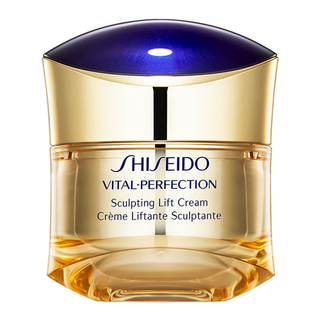
Shiseido Vital-perfection Sculpting Lift Cream
Works for
2 of 3 advertised claims delivered
Evens skin tone2 ingredients credited for this claimStrong support
“A multi-functional cream that firms facial contours, improves laugh lines, and even reduces dark spots.”
This product can help reduce hypepigmentation and even out the skin tone because it contains the following effective ingredients: potassium methoxysalicylate
Keep in mind that you would need to apply any topical skincare targetted at hypigmentation consistently for a couple of months to get a result. No topical skincare product can help get rid of hyperpigmentation (including post-acne marks and age spots) instantly.
Moisturizing14 ingredients credited for this claimGood support
“Vital Perfection Sculpting Lift Cream helps firm the skin while enhancing its resilience and brightness with a veil of 24-hour hydration.”
This product can help improve hydration of the skin with the two types of ingredients.
The first type is called “humectants”:
these ingredients help attract water.
When humectants are on the surface of the skin, they “pull in” the moisture from the outside environment, or from
within deeper layers of the skin. The following ingredients in this product do the job:
glycerin, sodium acetylated hyaluronate.
This product also contains ingredients called “occlusives”. They help reduce the speed with which our skin loses moisture to the outside environment. These ingredients also help soften the upper layer of the skin, so it feels less tight and nicer to the touch. The following ingredients in this product do the job: squalane, phytosteryl macadamiate.
Anti-aging2 ingredients credited for this claimWeak support
“Sculpt a more youthful look with this skin-lifting and tightening cream.”
Effective ingredients missing or their concentration is too low.
Can it cause trouble?
Irritancy3 strong irritants: Parfum, Alcohol + 1 more — patch-test recommendedHigh risk
ComedogenicClean of flagged comedogenic ingredientsNone flagged
User reviews
Be the first — your take helps the next person decide.
Ingredients
Filter by role to see what each ingredient is doing.
Water~45–55%
Hydrogenated polydecene~5.6–6.8%
- Irritation risk
- Low
Helps to soften the upper layer of the skin and create a nice product texture
More about Hydrogenated polydeceneGlycerin~4–4.9%
- Irritation risk
- Low
One of the best moisturizing ingredients. Naturally present in skin. It attracts water to the upper layer of the skin working as a humectant
More about GlycerinButylene glycol~3.1–3.7%
- Irritation risk
- Low
Used to create a nice product texture and help delivery of other ingredients. Might be somewhat helpful in attracting water to the upper layer of the skin
More about Butylene glycolIsododecane~2.4–2.9%
- Irritation risk
- Low
An emollient that helps soften the skin and can decrease moisture loss. Helps create a nice product texture
More about IsododecaneCetyl ethylhexanoate~2–2.4%
- Irritation risk
- Medium
An emollient that helps soften the skin and creates a thicker product texture
More about Cetyl ethylhexanoateMicrocrystalline wax~1.7–2.1%
Disteardimonium hectorite~1.5–1.8%
- Irritation risk
- Low
A type of clay that is used to thicken the product consistency
More about Disteardimonium hectoritePeg-150~1.2–1.5%
- Irritation risk
- Low
Peg-9 polydimethylsiloxyethyl dimethicone~0.95–1.2%
- Irritation risk
- Medium
A type of silicone that helps water and oil mix together
More about Peg-9 polydimethylsiloxyethyl dimethiconeSorbitol~0.7–1.05%
- Irritation risk
- Low
Helps attract water to the upper layer of the skin and improves the product texture
More about SorbitolPotassium methoxysalicylate~0.6–0.9%
- Irritation risk
- Medium
Can help reduce hyperpigmentation
More about Potassium methoxysalicylateSqualane~0.6–0.85%
- Irritation risk
- Low
An oil naturally present in skin. Works as an emollient to soften the skin and form a protective layer on its surface without a greasy feeling.
More about SqualanePetrolatum~0.5–0.8%
- Irritation risk
- Low
One of the most effective and the most studied occlusive ingredients that creates a protective layer on top of the skin preventing moisture loss
More about PetrolatumIsostearic acid~0.55–0.8%
- Irritation risk
- Low
Used to create a nice product texture
More about Isostearic acidPeg-400~0.45–0.65%
- Irritation risk
- Low
Peg-8 diisostearate~0.45–0.7%
- Irritation risk
- Medium
Helps water and oil mix together
More about Peg-8 diisostearatePhenoxyethanol~0.4–0.6%
- Irritation risk
- Low
A preservative. It helps prevent bacterial growth in cosmetic products
More about PhenoxyethanolDextrin palmitate~0.35–0.6%
- Irritation risk
- Medium
Helps water and oil mix together
More about Dextrin palmitateMethylparaben~0.15–0.3%
Parfum~0.25–0.5%
- Irritation risk
- High
An aromatic blend of unspecified and possibly irritating ingredients
More about ParfumTocopheryl acetate~0.3–0.5%
- Irritation risk
- Medium
A more stable but less bio-available form of vitamin E compared to Tocopherol. Might help moisturize and protect the skin from free radicals, but mostly used in low concentrations to stabilize other ingredients.
More about Tocopheryl acetatePeg/ppg-14/7 dimethyl ether~0.3–0.55%
- Irritation risk
- Low
An emollient that helps soften the skin. It also forms a protective on its surface to reduce water loss
More about Peg/ppg-14/7 dimethyl etherTrisodium edta~0.25–0.45%
Ethylparaben~0.2–0.4%
Phytosteryl macadamiate~0.3–0.55%
- Irritation risk
- Low
Helps soften the upper layer of the skin
More about Phytosteryl macadamiateSodium citrate~0.25–0.45%
- Irritation risk
- Medium
Helps to control the skin's pH level. Maintains the skin's natural film of amino-lactic acids and oils. Helps to preserve products
More about Sodium citrateAlcohol~0.25–0.5%
- Irritation risk
- High
Can be drying and contribute to skin irritation. Used in formulars to dissolve other ingredients, create a thinner product consistency or for its antibacterial properties
More about AlcoholLactobacillus/royal jelly ferment filtrate~0.25–0.45%
- Irritation risk
- Low
Citric acid~0.25–0.45%
- Irritation risk
- Medium
Can work as an exfoliant but is typically used to adjust the product pH
More about Citric acidSodium metaphosphate~0.25–0.5%
Angelica acutiloba root extract~0.25–0.45%
- Irritation risk
- Low
Olea europaea leaf extract~0.2–0.4%
- Irritation risk
- Medium
A plant extract that might have some anti-oxidant and anti-inflammatory properties but evidence for effectiveness in skin is missing
More about Olea europaea leaf extractSanguisorba officinalis root extract~0.3–0.55%
- Irritation risk
- Low
Camellia sinensis leaf extract~0.25–0.5%
- Irritation risk
- Low
Can contain potent anti-oxidant compounds (abbreviated ECG, GCG, EGC, and EGCG) that might help protect the skin from free radicals. Can help calm down inflammation and has some anti-bacterial properties. Unfortunately, these antioxidants are unstable and lose their effectiveness very quickly in products. The concentration of the antioxidant compounds in the extract also tends to be low to be effective in topical formulation
More about Camellia sinensis leaf extractSodium acetylated hyaluronate~0.25–0.45%
- Irritation risk
- Low
A type of hyaluronic acid that works as an excellent moisturizer by attracting water into the upper layer of the skin. Is typically feels less sticky on the skin compared to the usual hyaluronic acid
More about Sodium acetylated hyaluronateRubus suavissimus leaf extract~0.25–0.45%
- Irritation risk
- Low
Tocopherol~0.25–0.45%
- Irritation risk
- Low
Pure form of vitamin E. Can help moisturise and protect the skin from free radicals. Often used to help stabilise other ingredients or the formula itself
More about TocopherolCinnamomum cassia bark extract~0.25–0.45%
Bupleurum falcatum root extract~0.2–0.4%
- Irritation risk
- High
A plant extract that might help to attract water to the upper layer of the skin, but it is not well studied. It can be irritating
More about Bupleurum falcatum root extractIron oxides~0.15–0.3%
- Irritation risk
- Low
An umbrella term for the following three colorants: CI 77491, CI 77492, CI 77499. They might be able to offer some protection against visible light, but the degree of the protection is not clear
More about Iron oxidesLauryl betaine~0.25–0.45%
Sodium benzoate~0.15–0.25%
Ingredient list view
Water, Hydrogenated polydecene, Glycerin, Butylene glycol, Isododecane, Cetyl ethylhexanoate, Microcrystalline wax, Disteardimonium hectorite, Peg-150, Peg-9 polydimethylsiloxyethyl dimethicone, Sorbitol, Potassium methoxysalicylate, Squalane, Petrolatum, Isostearic acid, Peg-400, Peg-8 diisostearate, Phenoxyethanol, Dextrin palmitate, Methylparaben, Parfum, Tocopheryl acetate, Peg/ppg-14/7 dimethyl ether, Trisodium edta, Ethylparaben, Phytosteryl macadamiate, Sodium citrate, Alcohol, Lactobacillus/royal jelly ferment filtrate, Citric acid, Sodium metaphosphate, Angelica acutiloba root extract, Olea europaea leaf extract, Sanguisorba officinalis root extract, Camellia sinensis leaf extract, Sodium acetylated hyaluronate, Rubus suavissimus leaf extract, Tocopherol, Cinnamomum cassia bark extract, Bupleurum falcatum root extract, Iron oxides, Unknown, Lauryl betaine, Sodium benzoate
Compare prices
Retailers ranked by price — lowest first.
Affiliate links · prices updated regularly · As an Amazon Associate, WIMJ earns from qualifying purchases.
Sources cited in this review
Every concentration estimate and effectiveness label is anchored to one of these 11 studies and safety reviews.
- 1Safety Assessment of Polyene Group as Used in Cosmeticscir-safety.org
- 2
- 3
- 4
- 5
- 6Safety Assessment of Phytosterols as Used in Cosmeticscir-safety.org

Affiliate links · As an Amazon Associate, WIMJ earns from qualifying purchases.