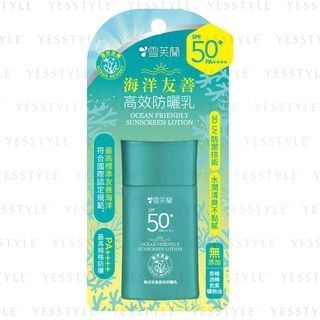
Shen Hsiang Tang Cellina Ocean Friendly Sunscreen Lotion SPF 50+ PA++++
Works for
1 of 1 advertised claim delivered
Sun protectionSPF 50 · 5 UV filtersBroad spectrum
This product offers a good level of protection against both UVB and UVA rays.
This sunscreen uses organic (so-called "chemical") sunscreen filters. Organic, or "chemical" filters usually provide reliable sun protection and rarely leave a white cast. Sunscreens with organic filters can sting eyes.
This product can be considered "reef safe" because it does not contain the UV filters (oxybenzone and octinoxate) that can be harmful to coral reefs when present in the water in high concentrations.
Anti-agingNot advertised by the brand · No ingredient credited for this claimStrong support
This product can help prevent early signs of skin aging because it offers a good level of broad spectrum sun protection. Sun damage is the main cause of premature skin aging, and protecting your skin from the sun is the best anti-aging strategy.
Evens skin toneNot advertised by the brand · 1 ingredient credited for this claimStrong support
This product offers broad spectrum sun protection. It means that it can prevent hyperpigmentation and help keep the skin tone even (sun damage is the main factor causing age spots, darkening of post-acne marks and other discolorations).
MoisturizingNot advertised by the brand · 17 ingredients credited for this claimGood support
This product can help improve hydration of the skin with the two types of ingredients.
The first type is called “humectants”:
these ingredients help attract water.
When humectants are on the surface of the skin, they “pull in” the moisture from the outside environment, or from
within deeper layers of the skin. The following ingredients in this product do the job:
glycerin, sodium hyaluronate.
This product also contains ingredients called “occlusives”. They help reduce the speed with which our skin loses moisture to the outside environment. These ingredients also help soften the upper layer of the skin, so it feels less tight and nicer to the touch. The following ingredients in this product do the job: squalane, glycosphingolipids.
Can it cause trouble?
Irritancy14 flagged ingredientsLow risk
ComedogenicClean of flagged comedogenic ingredientsNone flagged
User reviews
Be the first — your take helps the next person decide.
Ingredients
Filter by role to see what each ingredient is doing.
Diethylamino hydroxybenzoyl hexyl benzoate~23–34%
- Irritation risk
- Medium
Uvinul A Plus. A new generation broad spectrum sunscreen that offers an effective protection especially in the UVA range. It is stable in formulations. Unfortunately, is not approved by the FDA (US) yet
More about Diethylamino hydroxybenzoyl hexyl benzoateEthylhexyl salicylate~5.3–7.9%
- Irritation risk
- Low
Octisalate. A UV filter. It offers some protection against the sun rays that cause sunburn (UVB), but does not protect against the most aging sun rays (UVA). It loses its effectiveness quickly when exposed to sunlight. It is an organic, or so called "chemical" sunscreen
More about Ethylhexyl salicylateMethylene bis-benzotriazolyl tetramethylbutylphenol~5.3–7.9%
- Irritation risk
- Medium
Tinosorb M. A UV filter. Is effective against both UVA and UVB rays. It also provides some protection against visible light. It is photostable and can also be used to improve photostability of other sunscreen ingredients. Its physical properties help to create lightweight sunscreen formulations. It can leave a slight white cast. Unfortunately, it is not approved by the FDA (US) yet
More about Methylene bis-benzotriazolyl tetramethylbutylphenolEthylhexyl triazone~4.2–6.3%
- Irritation risk
- Medium
Uvinul T. A UV filter. Effective against UVB rays. It is photostable. Can increase water resistance properties of the sunscreen. Unfortunately, not approved by the FDA (US) yet
More about Ethylhexyl triazoneWater~2.7–4.1%
Diethylhexyl carbonate~2.2–3.3%
- Irritation risk
- Low
Helps soften the upper layer of the skin
More about Diethylhexyl carbonateDibutyl adipate~1.8–2.8%
- Irritation risk
- Low
Helps soften the upper layer of the skin and create a nice product consistency
More about Dibutyl adipateCaprylyl methicone~1.4–2.2%
- Irritation risk
- Low
A type of silicone that helps to soften the upper layer of the skin and create a nice product finish on the skin
More about Caprylyl methiconeGlycereth-26~1.2–1.8%
Sodium potassium aluminum silicate~1–1.5%
- Irritation risk
- Low
1,2-hexanediol~0.55–1.25%
Microcrystalline cellulose~0.6–1.35%
Bis-peg/ppg-20/5 peg/ppg-20/5 dimethicone~0.45–1%
Methoxy peg/ppg-25/4 dimethicone~0.4–0.95%
Titanium dioxide~0.45–1.05%
- Irritation risk
- Low
Works as a UV filter when used in high concentrations. It is photostable and is effective mostly against the UVB light, with some protection in the UVA range. In small concentrations, used for its ability to improve the color of cosmetic products. Is usually well tolerated by the skin
More about Titanium dioxideDecyl glucoside~0.45–1%
- Irritation risk
- High
Helps oil and water mix together. Can be irritating
More about Decyl glucosideCaprylic/capric triglyceride~0.4–1%
- Irritation risk
- Medium
A good mix of fatty acids that forms a protective layer on the skin. Improves the shelf life of products. Derived from coconut and glycerin
More about Caprylic/capric triglycerideAcrylates/beheneth-25 methacrylate copolymer~0.35–0.75%
- Irritation risk
- Low
Silica~0.4–0.95%
Butylene glycol~0.2–0.75%
- Irritation risk
- Low
Used to create a nice product texture and help delivery of other ingredients. Might be somewhat helpful in attracting water to the upper layer of the skin
More about Butylene glycolDipropylene glycol~0.15–0.7%
- Irritation risk
- Low
Helps to dissolve other ingredients in a formulation. Slows down the rate of product drying
More about Dipropylene glycolTriethanolamine~0.2–0.75%
- Irritation risk
- Medium
Used to adjust pH of the product and can help improve the product's smell
More about TriethanolamineHydroxyacetophenone~0.15–0.7%
Allantoin~0.15–0.6%
- Irritation risk
- Low
Helps calm down inflammation in skin and can help reduce itching. Helps to repair the skin barrier and keep skin hydrated
More about AllantoinTrisodium ethylenediamine disuccinate~0.15–0.65%
- Irritation risk
- Medium
Used to improve stability of the formulation
More about Trisodium ethylenediamine disuccinateCaprylyl glycol~0.2–0.8%
- Irritation risk
- Medium
Helps preserve products and creates a nice product texture
More about Caprylyl glycolBis-ethylhexyl hydroxydimethoxy benzylmalonate~0.15–0.65%
- Irritation risk
- Low
Dipotassium glycyrrhizate~0.15–0.65%
- Irritation risk
- Low
A salt derived from licorice. Works as an emollient to soften the upper layer of the skin and can help calm down inflammation. Might be helpful for skin lightening
More about Dipotassium glycyrrhizateDicaprylyl carbonate~0.3–0.75%
- Irritation risk
- Low
Helps products spread more easily and works as an emollient to soften skin
More about Dicaprylyl carbonatePropylene glycol~0.15–0.65%
- Irritation risk
- High
Helps oil and water mix together and can enhance the penetration of other ingredients into the skin. It can be irritating
More about Propylene glycolStearic acid~0.35–0.85%
- Irritation risk
- Low
Helps oil and water mix together and works as an emollient
More about Stearic acidAluminum hydroxide~0.3–0.75%
- Irritation risk
- Low
Is used to add opaque (non-transparent) appearance to formulations. Can be used to coat other ingredients for even dispersion. This is a different ingredient compared to the ones used in antipersperants (aluminium chloride and aluminium chlorohydrate)
More about Aluminum hydroxideXanthan gum~0.2–0.7%
- Irritation risk
- Low
Used to create a thicker product consistency
More about Xanthan gumO-cymen-5-ol~0.05–0.1%
Glycerin~0.2–0.7%
- Irritation risk
- Low
One of the best moisturizing ingredients. Naturally present in skin. It attracts water to the upper layer of the skin working as a humectant
More about GlycerinStearalkonium hectorite~0.15–0.6%
Rosa roxburghii fruit extract~0.15–0.55%
- Irritation risk
- Medium
A fruit extract that might help neutralize free radicals in skin, but evidence of effectiveness is missing
More about Rosa roxburghii fruit extractPropylene carbonate~0.15–0.65%
- Irritation risk
- Low
Is used to dissolve other ingredients and create nice product texture
More about Propylene carbonateSqualane~0.2–0.7%
- Irritation risk
- Low
An oil naturally present in skin. Works as an emollient to soften the skin and form a protective layer on its surface without a greasy feeling.
More about SqualaneGlycosphingolipids~0.2–0.75%
- Irritation risk
- Low
A type of lipids naturally present in skin. They can be converted to ceramides in skin
More about GlycosphingolipidsPentylene glycol~0.15–0.65%
- Irritation risk
- Medium
Used to preserve products, dissolve other ingredients and create a nice product texture
More about Pentylene glycolSodium hyaluronate~0.1–0.4%
- Irritation risk
- Low
One of the best moisturizing ingredients. Attracts water into the upper layer of the skin
More about Sodium hyaluronateIngredient list view
Diethylamino hydroxybenzoyl hexyl benzoate, Ethylhexyl salicylate, Methylene bis-benzotriazolyl tetramethylbutylphenol, Ethylhexyl triazone, Water, Diethylhexyl carbonate, Dibutyl adipate, Caprylyl methicone, Glycereth-26, Sodium potassium aluminum silicate, 1,2-hexanediol, Microcrystalline cellulose, Bis-peg/ppg-20/5 peg/ppg-20/5 dimethicone, Methoxy peg/ppg-25/4 dimethicone, Titanium dioxide, Decyl glucoside, Caprylic/capric triglyceride, Acrylates/beheneth-25 methacrylate copolymer, Silica, Butylene glycol, Dipropylene glycol, Triethanolamine, Hydroxyacetophenone, Allantoin, Trisodium ethylenediamine disuccinate, Caprylyl glycol, Bis-ethylhexyl hydroxydimethoxy benzylmalonate, Dipotassium glycyrrhizate, Dicaprylyl carbonate, Propylene glycol, Stearic acid, Aluminum hydroxide, Xanthan gum, O-cymen-5-ol, Glycerin, Stearalkonium hectorite, Rosa roxburghii fruit extract, Propylene carbonate, Squalane, Glycosphingolipids, Pentylene glycol, Sodium hyaluronate
Compare prices
Retailers ranked by price — lowest first.

Affiliate links · prices updated regularly
Product summary
Based on the ingredients included, we believe that "Shen Hsiang Tang - Cellina Ocean Friendly Sunscreen Lotion SPF 50+ PA++++" can offer reliable sun protection. We love that it can protect from both UVA and UVB rays (not all sunscreens with SPF ratings give UVA protection. UVA rays do not cause sunburn, but still damage our skin and lead to early aging).
As a plus, this sunscreen uses some of the new generation UV filters (Tinosorb M). These filters are more stable and more gentle on the skin.
It should also be hydrating enough to use without an additional moisturizer during the day. Like all broad-spectrum sunscreens, this product has an anti-aging benefit.
Sunscreen filters
This is a so-called "chemical" sunscreen. It means that it uses organic UV filters. They typically offer good sun protection and rarely leave a white cast, but they can be irritating for some people with sensitive skin. The UV filters in this sunscreen are: uvinul a plus 23.00% - 34.00%, octisalate 5.30% - 7.90%, uvinul t 4.20% - 6.30% and tinosorb m 5.30% - 7.90%.
Irritation risk
This formulation includes some common irritants, including ingredients that do not provide a benefit for the skin. We assess the overall irritancy of it to be low. For a detailed overview of all potential irritants: click here
You can see the detailed formula review with the breakdown of all actives in the product and the full ingredient list with estimated concentrations in the tables below.
Price
The product retails for 15.80$ in the United States.
For a detailed price comparison: click here.
Sources cited in this review
Every concentration estimate and effectiveness label is anchored to one of these 16 studies and safety reviews.
- 1
- 2
- 3
- 4
- 5
- 6

Affiliate links · As an Amazon Associate, WIMJ earns from qualifying purchases.