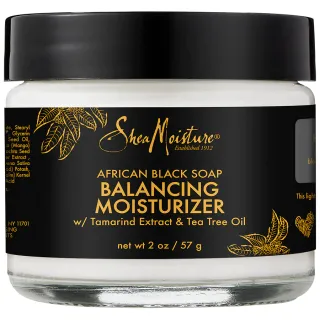
SheaMoisture Balancing Moisturizer
Works for
1 of 2 advertised claims delivered
Moisturizing21 ingredients credited for this claimGood support
“Balancing Moisturizer”
This product can help improve hydration of the skin with the two types of ingredients.
The first type is called “humectants”:
these ingredients help attract water.
When humectants are on the surface of the skin, they “pull in” the moisture from the outside environment, or from
within deeper layers of the skin. The following ingredients in this product do the job:
allantoin, glycerin.
This product also contains ingredients called “occlusives”. They help reduce the speed with which our skin loses moisture to the outside environment. These ingredients also help soften the upper layer of the skin, so it feels less tight and nicer to the touch. The following ingredients in this product do the job: butyrospermum parkii butter, caprylic/capric triglyceride.
Evens skin tone2 ingredients credited for this claimLimited support
“Use after facial cleanser and skin care toner made for treating uneven skin tone.”
This product contains ingredients (punica granatum extract) that could help reduce hyperpigmentation (for example, post-acne marks or age spots) in theory, but there is not enough evidence that they actually work.
Anti-oxidationNot advertised by the brand · 10 ingredients credited for this claimModerate support
This product contains antioxidants (punica granatum extract) that might be able to help neutralize free radicals in skin to lessen the damage it gets from the UV light (sun). There is not enough evidence to confirm their effectiveness in skin though.
Can it cause trouble?
Irritancy2 strong irritants: Melaleuca alternifolia leaf oil, ParfumMedium risk
Comedogenic4 ingredients rated 2 or more on the 0–5 pore-clogging scale4 flagged
User reviews
Be the first — your take helps the next person decide.
Ingredients
Filter by role to see what each ingredient is doing.
Aloe barbadensis leaf juice~23–34%
- Irritation risk
- Medium
Traditionally used to treat sunburns, dermatitis and inflammation, but evidence for its effectiveness is lacking. The extract can contain humectants that help attract water into the skin
More about Aloe barbadensis leaf juiceWater~12–18%
Caprylic/capric triglyceride~5.4–8%
- Irritation risk
- Medium
A good mix of fatty acids that forms a protective layer on the skin. Improves the shelf life of products. Derived from coconut and glycerin
More about Caprylic/capric triglycerideGlyceryl stearate~3.3–5%
- Irritation risk
- Low
An emollient that softens the skin and forms a protective layer on its surface. Helps water and oil mix together
More about Glyceryl stearateStearyl alcohol~2.6–3.9%
- Irritation risk
- Low
An emollient that helps soften the skin
More about Stearyl alcoholCetyl alcohol~1.9–2.8%
- Irritation risk
- Low
A non-drying alcohol that works to soften the skin and stabilize product formulations helping oil and water mix together
More about Cetyl alcoholGlyceryl stearate citrate~1.4–2.2%
- Irritation risk
- Low
Helps oil and water mix together while softening the upper layer of the skin
More about Glyceryl stearate citrateCetearyl alcohol~1.3–1.9%
- Irritation risk
- Low
- Comedogenicity
- 2/5
A non-drying alcohol. Works as an emollient. Helps water and oil mix together and creates a nice product texture
More about Cetearyl alcoholButyrospermum parkii butter~1.3–2%
- Irritation risk
- Low
- Comedogenicity
- 3/5
A great moisturising ingredient that softens the skin and reduces water loss from its upper layer. It also can be helpful in protecting skin from free radicals
More about Butyrospermum parkii butterGlycerin~1–1.6%
- Irritation risk
- Low
One of the best moisturizing ingredients. Naturally present in skin. It attracts water to the upper layer of the skin working as a humectant
More about GlycerinGlyceryl caprylate~0.85–1.3%
- Irritation risk
- Low
An emollient that can also help water and oil mix together, as well as prevent bacteria growth in products
More about Glyceryl caprylateSodium palm kernelate~1.1–1.6%
Sodium shea butterate~0.55–1.3%
- Irritation risk
- Medium
Helps water and oil mix together
More about Sodium shea butterateSodium cocoate~0.5–1.2%
Theobroma cacao seed butter~0.45–1.05%
- Irritation risk
- Low
- Comedogenicity
- 3/5
Helps soften the upper layer of the skin and can be helpful in restoring the skin barrier function. Might have some anti-oxidant effect
More about Theobroma cacao seed butterSimmondsia chinensis seed oil~0.45–1.1%
- Irritation risk
- Medium
Softens the upper layer of skin and helps restore the healthy skin barrier. Has shown to help calm down inflammation in skin. It is a stable oil, meaning that it retains its properties even when exposed to air.
More about Simmondsia chinensis seed oilVitis vinifera seed oil~0.45–1.05%
- Irritation risk
- Medium
A great emollient that can also have anti-oxidant properties
More about Vitis vinifera seed oilCocos nucifera oil~0.4–0.9%
- Irritation risk
- Low
- Comedogenicity
- 3/5
An emollient. Found to be as effective as a moisturizer for dry skin as mineral oil. Could be comedogenic
More about Cocos nucifera oilSolanum lycopersicum fruit/leaf/stem extract~0.35–0.85%
- Irritation risk
- Low
Persea gratissima oil~0.4–0.9%
- Irritation risk
- Medium
An emollient that helps soften the skin and could be helpful in repairing its barrier function
More about Persea gratissima oilTamarindus indica fruit extract~0.3–0.75%
- Irritation risk
- Low
Prunus armeniaca kernel oil~0.35–0.8%
- Irritation risk
- Medium
An emollient that helps soften the skin
More about Prunus armeniaca kernel oilTocopheryl acetate~0.35–0.85%
- Irritation risk
- Medium
A more stable but less bio-available form of vitamin E compared to Tocopherol. Might help moisturize and protect the skin from free radicals, but mostly used in low concentrations to stabilize other ingredients.
More about Tocopheryl acetateAvena sativa bran extract~0.35–0.75%
- Irritation risk
- Medium
Tocopherol~0.35–0.8%
- Irritation risk
- Low
Pure form of vitamin E. Can help moisturise and protect the skin from free radicals. Often used to help stabilise other ingredients or the formula itself
More about TocopherolAllantoin~0.15–0.6%
- Irritation risk
- Low
Helps calm down inflammation in skin and can help reduce itching. Helps to repair the skin barrier and keep skin hydrated
More about AllantoinBisabolol~0.15–0.6%
- Irritation risk
- Low
An active component of chamomile plant that historically has been used to calm down irritated skin. A recent study shows that bisabolol indeed can have some anti-inflammatory effect on skin, even though conclusive data is lacking. Bisabolol has a sweet floral scent and can be added to products for its aromatic properties
More about BisabololCamellia sinensis leaf extract~0.35–0.8%
- Irritation risk
- Low
Can contain potent anti-oxidant compounds (abbreviated ECG, GCG, EGC, and EGCG) that might help protect the skin from free radicals. Can help calm down inflammation and has some anti-bacterial properties. Unfortunately, these antioxidants are unstable and lose their effectiveness very quickly in products. The concentration of the antioxidant compounds in the extract also tends to be low to be effective in topical formulation
More about Camellia sinensis leaf extractSalix nigra bark extract~0.3–0.7%
- Irritation risk
- Medium
A plant extract that might contain salicylic acid
More about Salix nigra bark extractCharcoal powder~0.4–0.9%
Melaleuca alternifolia leaf oil~0.2–0.7%
- Irritation risk
- High
An essential oil that can be irritating. Has some anti-bacterial properties
More about Melaleuca alternifolia leaf oilOrmenis multicaulis oil~0.15–0.7%
- Irritation risk
- Low
Melia azadirachta seed oil~0.2–0.75%
- Irritation risk
- Low
Helps soften the upper layer of the skin and can support skin barrier function due to the high linoleic acid content
More about Melia azadirachta seed oilPunica granatum extract~0.1–0.5%
- Irritation risk
- Medium
A plant extract that can help neutralize free radicals in skin and even out the skin tone, but is typically used in products in a concentration that is too low to be effective
More about Punica granatum extractMangifera indica seed butter~0.1–0.45%
- Irritation risk
- Low
Helps to soften the upper layer of the skin and might have some anti-oxidant effect
More about Mangifera indica seed butterTriethyl citrate~0.1–0.4%
Caprylyl glycol~0.1–0.45%
- Irritation risk
- Medium
Helps preserve products and creates a nice product texture
More about Caprylyl glycolBenzoic acid~0.1–0.35%
Parfum~0.05–0.25%
- Irritation risk
- High
An aromatic blend of unspecified and possibly irritating ingredients
More about ParfumIngredient list view
Aloe barbadensis leaf juice, Water, Caprylic/capric triglyceride, Glyceryl stearate, Stearyl alcohol, Cetyl alcohol, Glyceryl stearate citrate, Cetearyl alcohol, Butyrospermum parkii butter, Glycerin, Glyceryl caprylate, Sodium palm kernelate, Sodium shea butterate, Sodium cocoate, Theobroma cacao seed butter, Unknown, Simmondsia chinensis seed oil, Vitis vinifera seed oil, Cocos nucifera oil, Solanum lycopersicum fruit/leaf/stem extract, Persea gratissima oil, Tamarindus indica fruit extract, Prunus armeniaca kernel oil, Tocopheryl acetate, Avena sativa bran extract, Tocopherol, Allantoin, Bisabolol, Camellia sinensis leaf extract, Salix nigra bark extract, Charcoal powder, Melaleuca alternifolia leaf oil, Ormenis multicaulis oil, Melia azadirachta seed oil, Punica granatum extract, Mangifera indica seed butter, Triethyl citrate, Caprylyl glycol, Benzoic acid, Parfum
Compare prices
Retailers ranked by price — lowest first.

Sources cited in this review
Every concentration estimate and effectiveness label is anchored to one of these 15 studies and safety reviews.
- 1
- 2
- 3Vitamin E in dermatologyncbi.nlm.nih.gov
- 4Vitamin E and Skin Healthlpi.oregonstate.edu
- 5
- 6

Affiliate links · As an Amazon Associate, WIMJ earns from qualifying purchases.