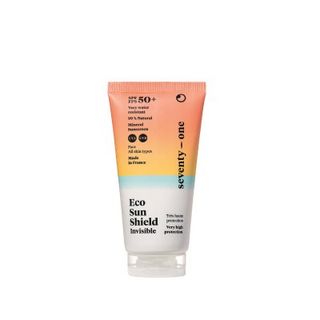
SeventyOne Percent Invisible Eco Sun Shield SPF 50+
Works for
0 of 1 advertised claim delivered
Sun protectionSPF 50 · 2 UV filters · Broad spectrumWeak protectionLow filter dose
This product can be considered "reef safe" because it does not contain the UV filters (oxybenzone and octinoxate) that can be harmful to coral reefs when present in the water in high concentrations.
Anti-oxidationNot advertised by the brand · Squalene, TocopherolModerate evidence
This product contains antioxidants (squalene) that might be able to help neutralize free radicals in skin to lessen the damage it gets from the UV light (sun). There is not enough evidence to confirm their effectiveness in skin though.
MoisturizingNot advertised by the brand · Squalene, Beta-sitosterol + 12 moreGood evidence
This product can help improve hydration of the skin with the two types of ingredients.
The first type is called “humectants”:
these ingredients help attract water.
When humectants are on the surface of the skin, they “pull in” the moisture from the outside environment, or from
within deeper layers of the skin. The following ingredients in this product do the job:
glycerin.
This product also contains ingredients called “occlusives”. They help reduce the speed with which our skin loses moisture to the outside environment. These ingredients also help soften the upper layer of the skin, so it feels less tight and nicer to the touch. The following ingredients in this product do the job: caprylic/capric triglyceride, helianthus annuus seed oil.
Can it cause trouble?
Irritancy4 strong irritants: Parfum, Linalool + 2 more — patch-test recommendedHigh risk
Comedogenic3 ingredients rated 2 or more on the 0–5 pore-clogging scale3 flagged
User reviews
Be the first — your take helps the next person decide.
Ingredients
Filter by role to see what each ingredient is doing.
Water~45–55%
Caprylic/capric triglyceride~7.5–9.1%
- Irritation risk
- Medium
A good mix of fatty acids that forms a protective layer on the skin. Improves the shelf life of products. Derived from coconut and glycerin
More about Caprylic/capric triglycerideHelianthus annuus seed oil~5.1–6.2%
- Irritation risk
- Low
A great emollient due to its high linoleic acid content. One of the most effective plant oils in helping skin hydration and repairing skin barrier function
More about Helianthus annuus seed oilPongamia glabra seed oil~3.5–4.3%
- Irritation risk
- Low
A plant oil that helps soften the upper layer of the skin
More about Pongamia glabra seed oilUndecane~2.6–3.2%
- Irritation risk
- Medium
Helps create a non-greasy finish on the skin
More about UndecaneTitanium dioxide~2.6–3.2%
- Irritation risk
- Low
Works as a UV filter when used in high concentrations. It is photostable and is effective mostly against the UVB light, with some protection in the UVA range. In small concentrations, used for its ability to improve the color of cosmetic products. Is usually well tolerated by the skin
More about Titanium dioxideZinc oxide~2.5–3%
- Irritation risk
- Low
A broad spectrum sunblock (protects from both UVA and UVB rays). Is suitable for most sensitive skins. In small concentrations, can be used as a colorant
More about Zinc oxideGlycerin~1.6–2%
- Irritation risk
- Low
One of the best moisturizing ingredients. Naturally present in skin. It attracts water to the upper layer of the skin working as a humectant
More about GlycerinZea mays starch~1.3–1.6%
- Irritation risk
- Medium
- Comedogenicity
- 3/5
Used to thicken the product's consistency
More about Zea mays starchTridecane~0.95–1.2%
Polyglyceryl-3 diisostearate~0.7–1.1%
- Irritation risk
- Medium
- Comedogenicity
- 3/5
Helps oil and water mix together
More about Polyglyceryl-3 diisostearateSimmondsia chinensis seed oil~0.65–0.95%
- Irritation risk
- Medium
Softens the upper layer of skin and helps restore the healthy skin barrier. Has shown to help calm down inflammation in skin. It is a stable oil, meaning that it retains its properties even when exposed to air.
More about Simmondsia chinensis seed oilTrimyristin~0.5–0.75%
- Irritation risk
- Low
C10-18 triglycerides~0.5–0.75%
- Irritation risk
- Low
Helps soften the skin and attract water to its upper layer. Helps create nice product texture
More about C10-18 triglyceridesParfum~0.4–0.65%
- Irritation risk
- High
An aromatic blend of unspecified and possibly irritating ingredients
More about ParfumPolyglyceryl-3 polyricinoleate~0.45–0.7%
- Irritation risk
- Medium
Helps oil and water mix together
More about Polyglyceryl-3 polyricinoleatePolyglyceryl-2 dipolyhydroxystearate~0.45–0.65%
- Irritation risk
- Low
Helps to soften the upper layer of the skin
More about Polyglyceryl-2 dipolyhydroxystearateStearic acid~0.55–0.8%
- Irritation risk
- Low
Helps oil and water mix together and works as an emollient
More about Stearic acidJojoba esters~0.4–0.6%
- Irritation risk
- Medium
An emollient made of jojoba oil. Helps soften the skin and support its barrier function
More about Jojoba estersMagnesium sulfate~0.3–0.55%
Palmitic acid~0.35–0.6%
- Irritation risk
- Low
An emollient that is naturally present in skin and helps soften it
More about Palmitic acidPolyhydroxystearic acid~0.3–0.55%
- Irritation risk
- Medium
Used to create a thicker product consistency and stabilize the formulation
More about Polyhydroxystearic acidSilica~0.4–0.6%
Sodium chloride~0.25–0.5%
- Irritation risk
- Low
Used to stabilize mixtures of oil and water, and create thicker, gel-like product textures
More about Sodium chlorideSodium benzoate~0.25–0.5%
Pongamol~0.25–0.5%
- Irritation risk
- Low
Citric acid~0.25–0.5%
- Irritation risk
- Medium
Can work as an exfoliant but is typically used to adjust the product pH
More about Citric acidSodium hydroxide~0.25–0.45%
Xanthan gum~0.25–0.45%
- Irritation risk
- Low
Used to create a thicker product consistency
More about Xanthan gumPotassium sorbate~0.2–0.4%
Tocopherol~0.2–0.4%
- Irritation risk
- Low
Pure form of vitamin E. Can help moisturise and protect the skin from free radicals. Often used to help stabilise other ingredients or the formula itself
More about TocopherolLinalool~0.15–0.3%
Coumarin~0.15–0.3%
Beta-sitosterol~0.2–0.35%
- Irritation risk
- Low
A phytosterol that can support skin's barrier function and help the skin stay hydrated
More about Beta-sitosterolSqualene~0.15–0.3%
- Irritation risk
- Low
- Comedogenicity
- 2/5
An oil that is naturally part of skin sebum that helps to soften its upper layer, reduce water loss and neutralize free radicals. It might be comedogenic. Avoid applying large concentrations (or pure oil) before sun exposure as oxidized squalene can clog pores and lead to skin irritation. Today squalene is mostly derived from vegetable oils or synthetized by yeast
More about SqualeneGeraniol~0.1–0.15%
Ingredient list view
Water, Caprylic/capric triglyceride, Helianthus annuus seed oil, Pongamia glabra seed oil, Undecane, Titanium dioxide, Zinc oxide, Glycerin, Zea mays starch, Tridecane, Polyglyceryl-3 diisostearate, Simmondsia chinensis seed oil, Trimyristin, C10-18 triglycerides, Parfum, Polyglyceryl-3 polyricinoleate, Polyglyceryl-2 dipolyhydroxystearate, Stearic acid, Jojoba esters, Magnesium sulfate, Palmitic acid, Polyhydroxystearic acid, Silica, Sodium chloride, Sodium benzoate, Pongamol, Citric acid, Sodium hydroxide, Xanthan gum, Potassium sorbate, Tocopherol, Linalool, Coumarin, Beta-sitosterol, Squalene, Geraniol
Compare prices
Retailers ranked by price — lowest first.
Product summary
"SeventyOne Percent - Invisible Eco Sun Shield SPF 50+" is using UV filters in a relatively low concentration. Because of this, it might not be able to provide reliable sun protection.
It also works as a moisturizer, so you do not have to use an additional hydrating product.
Sunscreen filters
It is a mineral sunscreen. It uses titanium dioxide and zinc oxide for sun protection. Both titanium dioxide and zinc oxide almost never irritate even the most sensitive skin and eyes, but can leave a white cast.
Irritation risk
We assess the overall irritancy of it to be high. For a detailed overview of all potential irritants: click here
You can see the detailed formula review with the breakdown of all actives in the product and the full ingredient list with estimated concentrations in the tables below.
Price
The product retails for 20.90£ in the United Kingdom.
For a detailed price comparison: click here.
Sources cited in this review
Every concentration estimate and effectiveness label is anchored to one of these 20 studies and safety reviews.
- 1
- 2
- 3Effect of topically applied lipids on surfactant-irritated skinonlinelibrary.wiley.com
- 4
- 5
- 6A review of inorganic UV filters zinc oxide and titanium dioxideonlinelibrary.wiley.com

Affiliate links · As an Amazon Associate, WIMJ earns from qualifying purchases.